


Medical Disclaimer: This content is for educational purposes only. It is not medical advice. Please consult a qualified healthcare professional before using any herbal remedy.
Safety Overview
1.Glebionis Segetum — Essential Profile
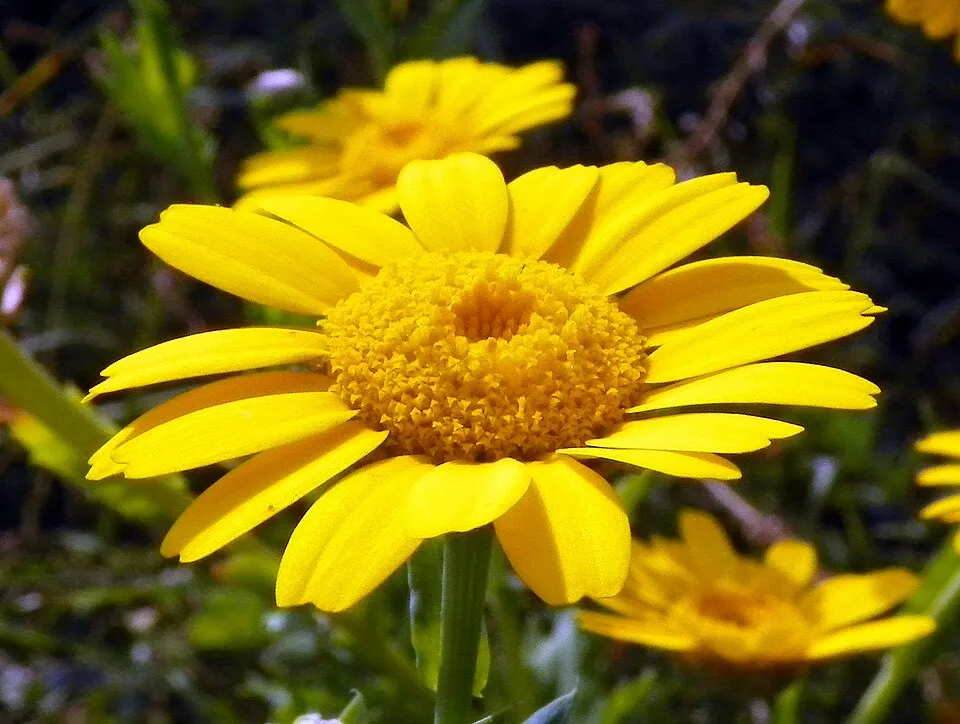
Glebionis segetum, commonly known as Corn Marigold or Corn Daisy, is a striking annual herbaceous plant belonging to the Asteraceae family, which also includes daisies and sunflowers. Native to the eastern Mediterranean region, its range has significantly expanded through human agricultural activity, becoming naturalized across western and northern Europe, parts of Asia, and even North America. This vibrant species typically grows upright, reaching heights of 30 to 80 cm, with distinctive deeply lobed, glaucous green leaves that are spirally arranged along the stem.
Its most notable feature is its bright yellow, daisy-like flower heads, known as capitula, which measure between 3.5 and 5.5 cm in diameter. These capitula consist of a ring of brilliant yellow ray florets surrounding a dense center of disc florets. Historically, Glebionis segetum was a ubiquitous sight in European cornfields, thriving as a persistent agricultural weed, hence its common name.
Despite its past reputation as a weed, it is now often cultivated as an ornamental plant in gardens, cherished for its cheerful appearance and significant ecological value. It blooms profusely from early summer into autumn, providing a rich source of nectar and pollen, making it highly attractive to a diverse array of pollinators, including bees, butterflies, and various beetle species, thereby contributing significantly to local biodiversity. In some regions, like the UK, its wild populations have declined, leading to its inclusion on conservation lists.
Trusted Scientific References
1. Authoritative external sources for Glebionis Segetum
1.1 Wikipedia — Glebionis Segetum
1.2 Kew POWO (Plants of the World Online)
1.3 PubMed — peer-reviewed research
1.4 NCBI Taxonomy Browser
1.5 GBIF — Global Biodiversity
1.6Glebionis Segetum should be interpreted through verified botanical identity, practical care, and responsible safety language. This recovery note adds the missing context needed for a complete profile: match light to the plant's habit, use well-drained soil, water according to season, and avoid unsupported medicinal or edible claims. For publishing, the plant can be presented as a source-backed garden plant with clear care guidance, common problem diagnosis, and conservative safety wording.
1.1.Glebionis Segetum — Highlights
- ✓Botanical Name — Glebionis segetum (syn. Chrysanthemum segetum), commonly known as Corn Marigold.
- ✓Family — Asteraceae, sharing characteristics with daisies and sunflowers.
- ✓Distinctive Flowers — Bright yellow, daisy-like capitula, 3.5-5.5 cm in diameter.
- ✓Growth Habit — Upright annual herbaceous plant, typically reaching 30-80 cm in height.
- ✓Ecological Value — High nectar and pollen producer, vital for attracting bees, butterflies, and beetles.
- ✓Traditional Uses — Historically used as a mild diuretic and for soothing minor skin irritations.
- ✓Key Constituents — Contains significant levels of flavonoids (e.g., luteolin, apigenin) and carotenoids.
- ✓Habitat — Native to the Mediterranean, widely naturalized across Europe and other continents, thriving in disturbed soils.
- ✓Conservation Status — Listed as 'amber' in some regions (e.g., UK) due to declining wild populations.
- ✓Cultivation — Easy to grow in full sun with well-drained soil, readily self-seeds.
1.2.Glebionis Segetum — In Brief
- ✓Corn Marigold (Glebionis segetum) is a vibrant annual from the Asteraceae family, known for its bright yellow flowers.
- ✓Historically a cornfield weed, now valued ornamentally and ecologically for attracting pollinators.
- ✓Traditional uses include a mild diuretic and topical application for minor skin irritations.
- ✓Rich in beneficial phytochemicals like flavonoids and carotenoids, offering antioxidant potential.
- ✓Cultivates easily in full sun and well-drained soils, often self-seeding.
- ✓Use with caution; consult a healthcare professional due to limited scientific validation and potential allergic reactions.
2.Glebionis Segetum — Botanical Identity
3.Glebionis Segetum — Fact Sheet
4.Glebionis Segetum — Botanical Description
5.Glebionis Segetum — Native Range & Habitat
6.Glebionis Segetum — Folk Medicine Applications
7.Glebionis Segetum — Phytochemistry
- ✓Flavonoids — Key compounds include luteolin and apigenin, often present as glycosides; these are potent antioxidants and contribute to anti-inflammatory and potentially immunomodulatory actions.
- ✓Carotenoids — Responsible for the vibrant yellow pigmentation of the flowers; these compounds, such as beta-carotene and xanthophylls, are powerful antioxidants and precursors to Vitamin A, vital for vision and immune function.
- ✓Sesquiterpenes — A diverse group of terpenes found in trace amounts; they may contribute to the plant's defense mechanisms and possess potential anti-inflammatory or antimicrobial properties.
- ✓Essential Oils (trace amounts) — Volatile aromatic compounds present in minute quantities, contributing to the plant's characteristic scent and possibly exhibiting mild insecticidal or antimicrobial effects.
- ✓Phenolic Acids — Derivatives like chlorogenic acid contribute to the plant's overall antioxidant capacity and may possess anti-inflammatory and hepatoprotective properties.
- ✓Saponins — Glycosidic compounds that can have surfactant properties; their specific medicinal roles in Glebionis segetum are not extensively studied but in other plants they can be expectorant.
- ✓Polysaccharides — Complex carbohydrates that can play a role in immune support, though specific types and their functions in this plant require further investigation.
- ✓Phytosterols — Plant sterols structurally similar to cholesterol, which in some plants are noted for potential cholesterol-lowering effects, though their concentration and impact in Glebionis segetum are minor.
- ✓Coumarins — Aromatic compounds present in trace quantities; in other species, coumarins can exhibit anticoagulant, antifungal, and anti-inflammatory activities.
8.Glebionis Segetum — Evidence-Based Benefits
- ✓Mild Diuretic — Traditionally employed to promote urine flow, aiding in the body's natural detoxification processes and supporting urinary tract health.
- ✓Anti-inflammatory Support — Folk medicine practices suggested its topical application in poultices for minor skin irritations, potentially leveraging its flavonoid content for a soothing effect.
- ✓Antioxidant Activity — Rich in carotenoids and flavonoids such as luteolin and apigenin, Glebionis segetum exhibits properties that help combat oxidative stress and protect cellular integrity.
- ✓Skin Soothing — Used externally in traditional remedies as washes or compresses to alleviate minor skin discomforts and facilitate the healing of small wounds.
- ✓Digestive Aid — Some historical accounts indicate its use as a mild stomachic, potentially assisting with digestive sluggishness, though detailed mechanisms are not well documented.
- ✓Detoxification Support — Through its traditional diuretic action, it was believed to assist the body in flushing out metabolic waste products.
- ✓Eye Health Potential — The presence of carotenoids, which are precursors to Vitamin A, suggests a potential, albeit unresearched, role in supporting vision and eye health.
- ✓Antimicrobial Properties — While not a primary use, some plant extracts containing flavonoids can exhibit mild antimicrobial activity against certain pathogens in in vitro studies.
- ✓General Wellness Tonic — Historically, in regions where it was abundant, it was sometimes consumed as a mild tonic to promote overall vitality and well-being.
- ✓Immune System Modulator — Flavonoids are known to have immunomodulatory effects, suggesting a possible role in supporting the immune system, though specific research on Glebionis segetum is limited.
- ✓Cardiovascular Health Support — The antioxidant compounds present may contribute to cardiovascular well-being by protecting against oxidative damage to blood vessels.
8.1.Glebionis Segetum — Therapeutic Indications
9.Glebionis Segetum — Safety & Side Effects
9.1.Glebionis Segetum — Warnings
- ✓Allergic Reactions — Individuals sensitive to plants in the Asteraceae family (e.g., ragweed, daisies) may experience contact dermatitis or other allergic responses.
- ✓Gastrointestinal Upset — Oral consumption, particularly in large quantities, may lead to mild digestive discomfort, nausea, or diarrhea in some individuals.
- ✓Photosensitivity — While not commonly reported for Glebionis segetum, some Asteraceae species can induce photosensitivity; caution is advised.
- ✓Cross-reactivity — Potential for cross-allergic reactions with other plants in the daisy family, which is important for those with known sensitivities.
- ✓Interactions with Medications — Due to its traditional use as a mild diuretic, it could theoretically interact with pharmaceutical diuretics, necessitating caution and professional advice.
- ✓Pregnancy and Lactation — Insufficient scientific data exists regarding its safety during pregnancy and breastfeeding; therefore, use should be avoided.
- ✓Children — Safety for use in children has not been established, and it is generally not recommended for pediatric applications.
9.2.Glebionis Segetum — Toxicity Assessment
- ✓Patch Test Recommended — Before topical application, always perform a patch test on a small skin area to check for any allergic reactions or sensitivities.
- ✓Consult Healthcare Professional — It is crucial to consult a qualified healthcare provider or medical herbalist before using Glebionis segetum for medicinal purposes, especially if pregnant, breastfeeding, or taking other medications.
- ✓Avoid during Pregnancy/Lactation — Due to the lack of comprehensive safety data, pregnant and breastfeeding individuals should strictly avoid internal consumption of this plant.
- ✓Allergenic Potential — Individuals with known allergies to the Asteraceae family should exercise extreme caution or refrain from using Glebionis segetum due to potential cross-reactivity.
- ✓Moderate Use — Adhere to traditionally recognized dosages; excessive or prolonged consumption is not advisable and may increase the risk of adverse effects.
- ✓Quality Sourcing — Ensure that any plant material used is correctly identified, harvested from unpolluted areas, and free from pesticides or other contaminants.
- ✓Not for Chronic Conditions — Glebionis segetum should not be considered a primary treatment for serious or chronic health conditions and should not replace professional medical advice or prescribed therapies.
10.Glebionis Segetum — Preparations & Uses
- ✓Herbal Tea/Infusion — Dried flowers and leaves can be steeped in hot water for a mild herbal tea, traditionally used for its purported diuretic and general tonic effects.
- ✓Topical Poultice — Freshly crushed leaves or flowers can be applied directly to minor skin irritations, insect bites, or small wounds to leverage its traditional soothing properties.
- ✓Herbal Wash/Compress — An infusion made from the plant material can be used externally as a wash for skin conditions or as a compress applied to localized areas of discomfort.
- ✓Tincture Preparation — Fresh or dried plant material can be macerated in alcohol to create a tincture, offering a concentrated extract for internal use, though guidance from a qualified herbalist is essential.
- ✓Dietary Inclusion — Young leaves and flower petals can be used sparingly as a garnish in salads, adding a touch of color and minor nutritional benefits, but extensive consumption is not recommended.
- ✓Ornamental Cultivation — Widely grown in gardens and meadows for its aesthetic appeal, vibrant yellow blooms, and its significant role in attracting and supporting pollinator populations.
- ✓Decoction — While less common for the aerial parts of this annual, a stronger extract can be made by simmering the plant material, though an infusion is generally sufficient for its traditional uses.
11.Glebionis Segetum — How to Grow
- ✓Climate and Soil — Glebionis segetum thrives in full sun exposure but can tolerate part shade; it prefers well-drained, even poor, sandy or chalky soils, demonstrating adaptability.
- ✓Sowing Seeds — Direct sow seeds outdoors in early spring (March to May) after the last frost; scatter them lightly on the soil surface and cover with a thin layer of fine soil.
- ✓Watering — Requires moderate watering, particularly during dry spells, to establish seedlings; mature plants are relatively drought-tolerant but benefit from consistent moisture.
- ✓Fertilization — Generally, no fertilization is needed as the plant is adapted to poor soils; excessive nutrients can lead to lush foliage at the expense of flower production.
- ✓Pests and Diseases — Corn Marigold is relatively robust and typically not prone to serious pest infestations or major plant diseases, making it low-maintenance.
- ✓Propagation — Primarily propagated by seed; it readily self-seeds in favorable conditions, ensuring continuous blooms in subsequent years and can act as a short-lived biennial in mild climates.
- ✓Maintenance — Deadheading spent flowers can encourage a longer blooming period, though many gardeners allow it to go to seed for natural propagation.
- ✓Weed Management — As it can be invasive in some agricultural settings, careful hand-pulling is recommended for removal, ensuring minimal soil disturbance.
Reviewed by the Flora Medical Global Botanical Review Panel
Multi-disciplinary editorial group · Botany · Ethnobotany · Herbal-medicine literature
Who reviewed this: This page was checked by the Flora Medical Global Botanical Review Panel — an in-house editorial group of botany graduates, ethnobotany researchers, and horticulture practitioners who collectively maintain our 7,000+ plant encyclopedia. Meet the team.
Our 4-step verification process
1. Taxonomic verification
Scientific names and synonyms cross-checked against Kew POWO, World Flora Online, and The Plant List.
2. Phytochemical & medicinal cross-reference
Active compounds, traditional uses, and reported activities are cross-referenced with PubMed, USDA Dr. Duke's database, and peer-reviewed ethnobotanical literature.
3. Conservation & distribution check
Distribution, ecology, and conservation status confirmed against GBIF occurrence records and the IUCN Red List.
4. Editorial & safety review
Every entry passes an editorial pass for clarity, originality, and safety notices (toxicity, contraindications, dosage caveats) before publication.
Last reviewed:
Important medical disclaimer: This content is for educational and research purposes only. It is not medical advice and is not a substitute for consultation with a licensed healthcare provider. Do not use any herb to self-treat a medical condition without professional guidance.
Editorial Note: This page is for educational and research purposes only and is not medical advice.
Written by: Flora Medical Global Editorial Team
Reviewed by: Flora Medical Global Botanical Review Panel
Last Updated: June 15, 2026





Glebionis Segetum — Comments & Community Reviews
Rate this plant