
Medical Disclaimer: This content is for educational purposes only. It is not medical advice. Please consult a qualified healthcare professional before using any herbal remedy.
Safety Overview
1.Hoya Krimson Queen — Botanical Snapshot
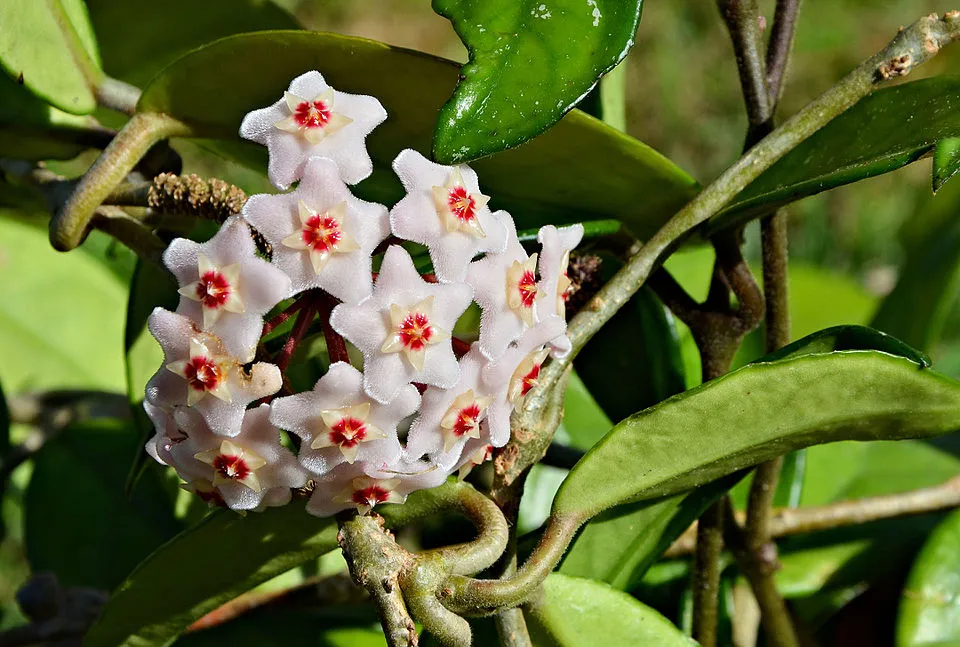
Hoya carnosa 'Krimson Queen' is a captivating cultivar of the genus Hoya, renowned for its striking ornamental appeal. This epiphytic, perennial vine, a member of the diverse Apocynaceae family, typically forms trailing or climbing stems reaching 2 to 4 feet in length, making it ideal for hanging baskets or trellises. Its most distinguishing feature lies in its thick, succulent-like leaves, which are broadly ovate to elliptical, measuring approximately 2-4 inches long.
These leaves exhibit a dramatic variegation pattern, featuring vibrant green centers bordered by irregular margins of creamy white, soft pink, or even deep magenta, especially on new growth or when exposed to adequate light. The sturdy, woody stems provide a robust framework for the lush foliage. Under optimal conditions, mature plants produce spherical clusters of delicate, star-shaped flowers, often referred to as 'porcelain flowers' or 'wax plants'.
These fragrant blooms, typically appearing in shades of white to pale pink with a contrasting red or dark pink corona, exude a sweet, nectar-like scent, particularly at night. Native to tropical and subtropical regions of East Asia, including Indonesia and Malaysia, the parent species, Hoya carnosa, thrives in the understory of forests, clinging to trees or rocks, where it receives dappled sunlight. 'Krimson Queen' inherits this adaptability, making it a favored choice for indoor cultivation globally, valued not only for its beauty but also for its purported ability to enhance indoor air quality.
Trusted Scientific References
1. Authoritative external sources for Hoya carnosa Krimson Queen
1.1 Wikipedia — Hoya carnosa Krimson Queen
1.2 Kew POWO (Plants of the World Online)
1.3 PubMed — peer-reviewed research
1.4 NCBI Taxonomy Browser
1.5 GBIF — Global Biodiversity
1.6Hoya Krimson Queen should be interpreted through verified botanical identity, practical care, and responsible safety language. This recovery note adds the missing context needed for a complete profile: match light to the plant's habit, use well-drained soil, water according to season, and avoid unsupported medicinal or edible claims. For publishing, the plant can be presented as a source-backed indoor plant with clear care guidance, common problem diagnosis, and conservative safety wording.
1.1.Hoya Krimson Queen — Distinguishing Points
- ✓Striking Variegated Foliage — Deep green leaves with prominent cream, white, or pink margins.
- ✓Waxy, Succulent — like Leaves — Thick, glossy leaves that store water, contributing to drought tolerance.
- ✓Fragrant 'Porcelain' Flowers — Clusters of star-shaped, often pink-white blooms with a sweet scent.
- ✓Epiphytic Growth Habit — Naturally climbs or trails, suitable for hanging baskets or trellises.
- ✓Low Maintenance Houseplant — Adaptable to various indoor conditions, making it beginner-friendly.
- ✓Air Purifying Benefits — Helps to filter indoor air pollutants for a healthier environment.
- ✓Member of Apocynaceae Family — Shares botanical characteristics with other milkweed relatives.
- ✓Native to Tropical Asia — Thrives in warm, humid conditions with dappled light.
- ✓Woody Stems — Develops sturdy, somewhat rough stems as it matures.
- ✓Distinctive Cultivar — A prized ornamental variety of the Hoya carnosa species.
1.2.Hoya Krimson Queen — Concise Overview
- ✓Ornamental Variegated Vine — Hoya carnosa 'Krimson Queen' is a stunning cultivar known for its green, cream, and pink variegated leaves.
- ✓Fragrant, Star-shaped Flowers — Produces clusters of waxy, sweet-scented flowers, typically pink and white with a red center.
- ✓Epiphytic & Easy Care — A low-maintenance, trailing houseplant thriving in indirect light and well-draining soil.
- ✓Air Purifying Qualities — Contributes to improved indoor air quality by filtering common airborne toxins.
- ✓Traditional Topical Uses — Sap from related Hoya species has anecdotal use for skin irritations and minor wounds.
- ✓Caution Against Ingestion — Contains compounds, common to the Apocynaceae family, that are considered toxic if consumed.
2.Hoya Krimson Queen — Botanical Identity
3.Hoya Krimson Queen — Fact Sheet
4.Hoya Krimson Queen — Physical Description
5.Hoya Krimson Queen — Native Range & Habitat
6.Hoya Krimson Queen — Heritage Uses
7.Hoya Krimson Queen — Phytochemistry
- ✓Triterpenoids — Known for their diverse biological activities, including anti-inflammatory, hepatoprotective, and antioxidant effects. Key examples in Hoya species include lupeol and β-amyrin derivatives.
- ✓Flavonoids — A broad class of polyphenolic compounds with significant antioxidant, anti-inflammatory, and cardioprotective properties. Quercetin and kaempferol derivatives are commonly found.
- ✓Steroids — Plant steroids such as β-sitosterol are present, contributing to anti-inflammatory and cholesterol-lowering potentials.
- ✓Saponins — Glycosides that can exhibit surfactant properties, with potential for antimicrobial and immunomodulatory activities, though some can be toxic.
- ✓Alkaloids — Nitrogen-containing compounds often with potent pharmacological effects. Specific alkaloids in Hoya species are less characterized but contribute to the plant's overall phytochemistry.
- ✓Cardiac Glycosides — Characteristic of the Apocynaceae family, these compounds can have strong effects on heart muscle, though their presence in Hoya carnosa is typically in low concentrations and primarily relevant for toxicity concerns if ingested.
- ✓Phenolic Acids — Compounds like caffeic acid and ferulic acid contribute to the plant's antioxidant capacity.
- ✓Volatile Organic Compounds (VOCs) — Responsible for the plant's fragrance, these compounds can also have mild antimicrobial or insect-repellent properties.
8.Hoya Krimson Queen — Scientific Evidence
- ✓Air Purification — Hoya carnosa, including the 'Krimson Queen' cultivar, is anecdotally recognized for its capacity to absorb volatile organic compounds (VOCs) and toxins from indoor air, contributing to a healthier living environment.
- ✓Anti-inflammatory Support — Based on traditional uses of related Hoya species, the plant's sap or extracts may possess compounds that help reduce inflammation when applied topically.
- ✓Wound Healing Properties — Historically, the sap from certain Hoya species has been used topically to aid in the healing of minor cuts, abrasions, and skin lesions, promoting tissue regeneration.
- ✓Skin Irritation Relief — Anecdotal evidence suggests that the milky sap of Hoya carnosa, when carefully applied, may soothe minor skin irritations, insect bites, and mild burns due to its emollient and potentially anti-pruritic effects.
- ✓Antioxidant Activity — Phytochemical studies on various Hoya species indicate the presence of flavonoids and other phenolic compounds, which exhibit antioxidant properties that protect cells from oxidative stress.
- ✓Analgesic Potential — Some compounds identified in Hoya species are being investigated for their potential to alleviate localized pain when applied externally, though specific research on 'Krimson Queen' is limited.
- ✓Antimicrobial Action — Extracts from certain Hoya plants have shown in vitro activity against various bacteria and fungi, suggesting potential for natural antiseptic applications.
- ✓Immunomodulatory Effects — Preliminary research on some Hoya species points towards compounds that might modulate immune responses, though direct application for 'Krimson Queen' is not established.
- ✓Traditional Pain Management — In some folk medicine systems, poultices made from Hoya leaves have been applied to sore muscles or joints to provide a soothing sensation.
- ✓Respiratory Comfort — While not directly medicinal, improved indoor air quality from plants like Hoya carnosa can indirectly support respiratory health by reducing airborne irritants.
8.1.Hoya Krimson Queen — Health Applications
9.Hoya Krimson Queen — Safety & Side Effects
9.1.Hoya Krimson Queen — Caution Notes
- ✓Skin Irritation — The milky sap may cause mild skin irritation or allergic reactions in sensitive individuals, characterized by redness or itching.
- ✓Allergic Reactions — Contact dermatitis or other allergic responses are possible, particularly with repeated exposure to the sap.
- ✓Gastrointestinal Upset — Ingestion of any part of Hoya carnosa is not recommended and may lead to mild gastrointestinal symptoms such as nausea, vomiting, or diarrhea.
- ✓Toxicity Concerns — As a member of the Apocynaceae family, Hoya species contain cardiac glycosides, which can be toxic if consumed in significant quantities, potentially affecting heart function.
- ✓Pet Toxicity — Keep out of reach of pets, as ingestion can cause adverse reactions, including digestive upset.
9.2.Hoya Krimson Queen — Toxicity Assessment
- ✓External Use Only — Medicinal applications, if considered, should be strictly external, and internal consumption is strongly advised against.
- ✓Patch Test Recommended — Before widespread topical application of sap or leaf preparations, perform a small patch test on an inconspicuous area of skin to check for sensitivity.
- ✓Not for Ingestion — All parts of Hoya carnosa 'Krimson Queen' should be considered toxic if ingested, especially in large amounts, due to potential cardiac glycosides.
- ✓Pregnant and Nursing Women — Due to lack of specific safety data, pregnant or nursing individuals should avoid any medicinal use of Hoya carnosa 'Krimson Queen'.
- ✓Children and Pets — Keep the plant out of reach of young children and pets to prevent accidental ingestion.
- ✓Consult a Professional — For any serious skin conditions or before using the plant for medicinal purposes, consult a qualified healthcare professional or medical herbalist.
10.Hoya Krimson Queen — Preparation Methods
- ✓Topical Application of Sap — For minor skin irritations or insect bites, a small amount of the milky sap from a freshly broken leaf or stem can be carefully dabbed onto the affected area. Always perform a patch test first.
- ✓Leaf Poultice — Crushed or macerated Hoya carnosa leaves can be applied as a poultice to minor wounds or inflamed areas, secured with a clean bandage, based on traditional practices.
- ✓Infused Oil (External) — Leaves could theoretically be infused into a carrier oil (e.g., olive, jojoba) for topical application, leveraging potential anti-inflammatory compounds, though this is not a common traditional method for Hoya 'Krimson Queen'.
- ✓Decoction for External Wash — A mild decoction made from the leaves of Hoya species has been used as a cleansing wash for skin conditions in some traditional contexts. This is for external use only.
- ✓Air Purification — Simply growing the Hoya carnosa 'Krimson Queen' as an indoor plant contributes to its air-purifying benefits, requiring no special preparation for this use.
- ✓Ornamental Display — Primarily used as a decorative houseplant, its aesthetic presence is its most common and safe 'usage method'.
11.Hoya Krimson Queen — Garden Cultivation
- ✓Light — Provide bright, indirect light; direct sun can scorch leaves, while too little light inhibits flowering and variegation.
- ✓Watering — Allow the top 1-2 inches of soil to dry out completely between waterings; overwatering is a common cause of root rot.
- ✓Soil — Use a well-draining, airy potting mix, such as an orchid mix or a blend with perlite and bark, to prevent waterlogging.
- ✓Humidity — Prefers high humidity (60-80%); misting, a pebble tray, or a humidifier can be beneficial, especially in dry indoor environments.
- ✓Temperature — Thrives in warm temperatures between 60-85°F (15-29°C); avoid sudden temperature drops or cold drafts.
- ✓Fertilization — Feed sparingly during the growing season (spring and summer) with a balanced liquid fertilizer diluted to half strength, once every 2-4 weeks.
- ✓Propagation — Easily propagated from stem cuttings, which can be rooted in water or directly in a moist, well-draining substrate.
- ✓Support — As an epiphytic vine, it benefits from a trellis, moss pole, or hanging planter to allow its stems to trail or climb naturally.
Reviewed by the Flora Medical Global Botanical Review Panel
Multi-disciplinary editorial group · Botany · Ethnobotany · Herbal-medicine literature
Who reviewed this: This page was checked by the Flora Medical Global Botanical Review Panel — an in-house editorial group of botany graduates, ethnobotany researchers, and horticulture practitioners who collectively maintain our 7,000+ plant encyclopedia. Meet the team.
Our 4-step verification process
1. Taxonomic verification
Scientific names and synonyms cross-checked against Kew POWO, World Flora Online, and The Plant List.
2. Phytochemical & medicinal cross-reference
Active compounds, traditional uses, and reported activities are cross-referenced with PubMed, USDA Dr. Duke's database, and peer-reviewed ethnobotanical literature.
3. Conservation & distribution check
Distribution, ecology, and conservation status confirmed against GBIF occurrence records and the IUCN Red List.
4. Editorial & safety review
Every entry passes an editorial pass for clarity, originality, and safety notices (toxicity, contraindications, dosage caveats) before publication.
Last reviewed:
Important medical disclaimer: This content is for educational and research purposes only. It is not medical advice and is not a substitute for consultation with a licensed healthcare provider. Do not use any herb to self-treat a medical condition without professional guidance.
Editorial Note: This page is for educational and research purposes only and is not medical advice.
Written by: Flora Medical Global Editorial Team
Reviewed by: Flora Medical Global Botanical Review Panel
Last Updated: June 15, 2026





Hoya Krimson Queen — Comments & Community Reviews
Rate this plant