
Medical Disclaimer: This content is for educational purposes only. It is not medical advice. Please consult a qualified healthcare professional before using any herbal remedy.
Safety Overview
1.Lathyrus Vernus — Botanical Snapshot
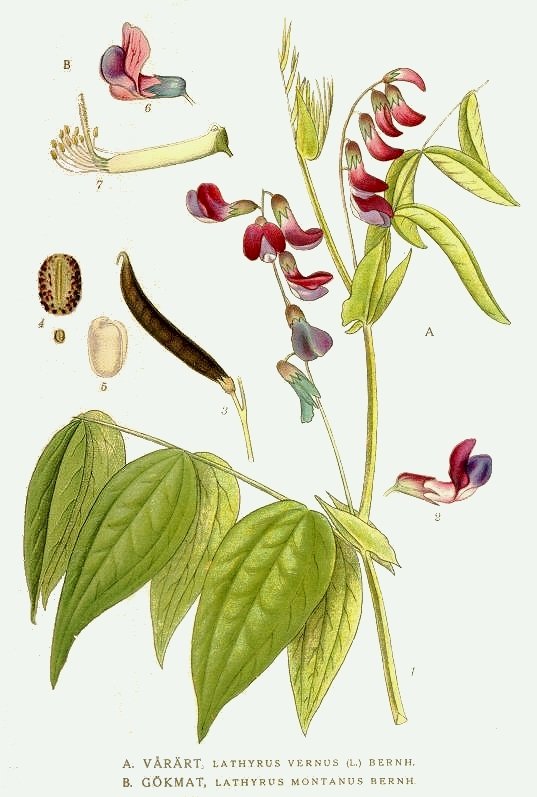
Lathyrus vernus, commonly known as the spring vetchling or early everlasting pea, is an elegant herbaceous perennial belonging to the Fabaceae family, a lineage celebrated for its nitrogen-fixing capabilities and diverse array of legumes. This species is indigenous to the temperate woodland and scrub environments spanning across Europe and extending into Western Asia. Typically forming upright, multi-stemmed clumps, it reaches a modest height of 20-50 cm, presenting a compact and bushy habit. Its foliage consists of pinnately compound leaves, each bearing 4-8 ovate to lanceolate leaflets with distinct pointed apices and smooth margins.
The defining characteristic of Lathyrus vernus is its remarkably early and abundant floral display, often commencing in late spring, frequently synchronized with the emergence of fresh foliage. The pea-like flowers are arranged in racemes, usually comprising 2-6 individual blossoms. Each flower, approximately 1.5-2 cm in length, showcases a vivid and often intricate color spectrum typical of the Lathyrus genus. While some cultivars exhibit deep pink or purplish-red hues, others can present in striking blue, violet, or even creamy white, occasionally with a charming bicolor effect where the standard petal contrasts harmoniously with the wings and keel.
These blooms emit a delicate, sweet fragrance. Post-flowering, the plant develops small, flattened pods, characteristic of legumes, which encase several small, spherical seeds. Lathyrus vernus is a highly valued addition to naturalistic gardens, woodland settings, or as an attractive groundcover, providing essential early-season color.
Trusted Scientific References
1. Authoritative external sources for Lathyrus Vernus
1.1 Wikipedia — Lathyrus Vernus
1.2 Kew POWO (Plants of the World Online)
1.3 PubMed — peer-reviewed research
1.4 NCBI Taxonomy Browser
1.5 GBIF — Global Biodiversity
1.6Lathyrus Vernus should be interpreted through verified botanical identity, practical care, and responsible safety language. This recovery note adds the missing context needed for a complete profile: match light to the plant's habit, use well-drained soil, water according to season, and avoid unsupported medicinal or edible claims. For publishing, the plant can be presented as a source-backed garden plant with clear care guidance, common problem diagnosis, and conservative safety wording.
1.1.Lathyrus Vernus — Distinguishing Points
- ✓Early Spring Blooms — Provides vibrant color after winter.
- ✓Non — Vining Growth Habit — Forms attractive clumps, not climbing.
- ✓Adaptable to Shade — Thrives in woodland garden settings.
- ✓Low Maintenance — Once established, requires minimal care.
- ✓Ornamental Value — Highly prized for its showy, colorful flowers.
- ✓Native to Europe/Asia — Well-suited for temperate climates.
- ✓Deer Resistant — Generally not favored by deer.
- ✓Attracts Pollinators — Flowers provide early nectar for bees.
- ✓Drought Tolerant (Established) — Can withstand some dry spells.
- ✓Distinctive Foliage — Pinnately compound leaves add texture.
1.2.Lathyrus Vernus — Concise Overview
- ✓Early spring blooming perennial, native to Europe and Asia.
- ✓Attractive ornamental plant for woodland and naturalistic gardens.
- ✓Contains potentially toxic compounds, especially in seeds.
- ✓Not recommended for internal medicinal use due to toxicity concerns.
- ✓Valued for its aesthetic appeal and low maintenance in ideal conditions.
- ✓Prefers partial shade, well-drained, moist, and fertile soil.
2.Lathyrus Vernus — Nomenclature & Classification
3.Lathyrus Vernus — Key Data
4.Lathyrus Vernus — Physical Description
5.Lathyrus Vernus — Ecological Habitat
6.Lathyrus Vernus — Heritage Uses
7.Lathyrus Vernus — Key Phytochemicals
- ✓Flavonoids — Quercetin, kaempferol, and their glycosides, known for antioxidant and anti-inflammatory actions.
- ✓Saponins — Triterpenoid saponins contribute to expectorant and hypocholesterolemic effects.
- ✓Phenolic Acids — Caffeic acid and ferulic acid, providing significant antioxidant capabilities.
- ✓Lectins — Specific proteins that can interact with cell membranes, potentially influencing immune responses.
- ✓Alkaloids — Trace amounts of quinolizidine alkaloids, often associated with various pharmacological activities.
- ✓Cyanogenic Glycosides — Present in small quantities, these compounds release hydrogen cyanide upon enzymatic hydrolysis, requiring caution.
- ✓Polysaccharides — Complex carbohydrates that can possess immunomodulatory properties.
- ✓Tannins — Astringent compounds that can aid in wound healing and have antimicrobial effects.
- ✓Amino Acids — Contains non-protein amino acids like L-homoarginine.
- ✓Fatty Acids — Essential and non-essential fatty acids found in the seeds.
- ✓Sterols — Plant sterols such as beta-sitosterol, contributing to overall plant physiology and potential health benefits.
- ✓Vitamins and Minerals — Minor concentrations of essential micronutrients contributing to general plant health.
8.Lathyrus Vernus — Evidence-Based Benefits
- ✓Anti-inflammatory properties — May help reduce inflammation due to the presence of certain flavonoids and saponins.
- ✓Antioxidant activity — Contains phenolic compounds that combat oxidative stress and protect cells from damage.
- ✓Diuretic effects — Traditionally used to promote urine flow, assisting in the body's natural detoxification processes.
- ✓Mild astringent action — Can be applied topically to help tighten tissues and reduce minor bleeding.
- ✓Potential antispasmodic — Some constituents may help relax smooth muscles, easing cramps.
- ✓Wound healing support — Traditional applications suggest benefit in promoting the healing of minor cuts and abrasions.
- ✓Immune system modulation — Certain plant compounds might interact with immune pathways, offering supportive benefits.
- ✓Analgesic potential — May offer mild pain-relieving effects, particularly for localized discomfort.
- ✓Digestive aid — Historically used to support healthy digestion and alleviate minor gastrointestinal upsets.
- ✓Cardiovascular support — Hypothetically, antioxidants could contribute to arterial health.
- ✓Antimicrobial activity — Preliminary studies on related species suggest some compounds may inhibit microbial growth.
- ✓Sedative properties — Folk medicine indicates mild calming effects, though concrete evidence is limited.
8.1.Lathyrus Vernus — Conditions Traditionally Used For
9.Lathyrus Vernus — Safety & Side Effects
9.1.Lathyrus Vernus — Caution Notes
- ✓Toxicity — Contains cyanogenic glycosides and potentially neurotoxic amino acids, particularly in seeds, making internal consumption dangerous.
- ✓Allergic reactions — Skin irritation or allergic responses may occur in sensitive individuals upon contact.
- ✓Gastrointestinal upset — Ingestion of plant parts can cause nausea, vomiting, or diarrhea.
- ✓Neurotoxicity — High doses or prolonged consumption of Lathyrus species can lead to lathyrism, a neurological disorder.
- ✓Reproductive harm — Potential for adverse effects on reproductive health in animal studies with related species.
- ✓Drug interactions — Possible interactions with medications due to various plant compounds, though not well-documented for this specific species.
- ✓Photosensitivity — Some plant compounds may increase sensitivity to sunlight.
9.2.Lathyrus Vernus — Safety Profile
- ✓Not for internal consumption — Due to the presence of cyanogenic glycosides and neurotoxins.
- ✓Keep out of reach of children and pets — Ingestion can lead to severe health issues.
- ✓Topical use with caution — Perform a patch test before extensive topical application.
- ✓Pregnant and nursing women — Avoid all forms of Lathyrus vernus due to potential toxicity and lack of safety data.
- ✓Individuals with kidney or liver conditions — Should strictly avoid any exposure.
- ✓Veterinary warning — Do not allow livestock or pets to graze on Lathyrus vernus.
- ✓Consult a healthcare professional — Before considering any traditional medicinal use, especially if pregnant, nursing, or on medication.
10.Lathyrus Vernus — Usage Guide
- ✓Ornamental planting — Valued for its early spring blooms in gardens, attracting pollinators.
- ✓Groundcover — Excellent for naturalizing areas beneath trees or in shaded borders.
- ✓Traditional poultices — Historically, crushed leaves or flowers might have been used topically for minor skin issues.
- ✓Infused oils — Flowers or leaves could be infused in carrier oils for external application (caution advised).
- ✓Decoctions — Roots or whole plant material could be boiled to extract compounds for traditional uses (not for internal consumption).
- ✓Seed collection — Seeds can be harvested for propagation, but are not recommended for consumption.
- ✓Herbal tinctures — Although not widely used, extracts could be prepared with alcohol for specific traditional applications.
- ✓Floral arrangements — Cut flowers can be used in fresh arrangements for their beauty and mild fragrance.
11.Lathyrus Vernus — How to Grow
- ✓Site Selection — Prefers partial shade to full sun, ideal for woodland gardens or dappled light conditions.
- ✓Soil Requirements — Thrives in well-drained, moist, and fertile soil with a neutral to slightly acidic pH.
- ✓Planting — Best planted from seed or young plants in early spring or fall; does not tolerate transplanting well once established.
- ✓Watering — Requires consistent moisture, especially during dry periods; avoid waterlogging.
- ✓Fertilization — Benefits from an annual application of balanced organic fertilizer or compost in spring.
- ✓Pruning — Minimal pruning needed; remove spent flower stalks and any dead or damaged foliage after flowering.
- ✓Propagation — Primarily by seed, which often requires stratification for optimal germination.
- ✓Pest and Disease Control — Generally resistant; monitor for common garden pests like aphids and slugs.
Reviewed by the Flora Medical Global Botanical Review Panel
Multi-disciplinary editorial group · Botany · Ethnobotany · Herbal-medicine literature
Who reviewed this: This page was checked by the Flora Medical Global Botanical Review Panel — an in-house editorial group of botany graduates, ethnobotany researchers, and horticulture practitioners who collectively maintain our 7,000+ plant encyclopedia. Meet the team.
Our 4-step verification process
1. Taxonomic verification
Scientific names and synonyms cross-checked against Kew POWO, World Flora Online, and The Plant List.
2. Phytochemical & medicinal cross-reference
Active compounds, traditional uses, and reported activities are cross-referenced with PubMed, USDA Dr. Duke's database, and peer-reviewed ethnobotanical literature.
3. Conservation & distribution check
Distribution, ecology, and conservation status confirmed against GBIF occurrence records and the IUCN Red List.
4. Editorial & safety review
Every entry passes an editorial pass for clarity, originality, and safety notices (toxicity, contraindications, dosage caveats) before publication.
Last reviewed:
Important medical disclaimer: This content is for educational and research purposes only. It is not medical advice and is not a substitute for consultation with a licensed healthcare provider. Do not use any herb to self-treat a medical condition without professional guidance.
Editorial Note: This page is for educational and research purposes only and is not medical advice.
Written by: Flora Medical Global Editorial Team
Reviewed by: Flora Medical Global Botanical Review Panel
Last Updated: June 15, 2026





Lathyrus Vernus — Comments & Community Reviews
Rate this plant