


Medical Disclaimer: This content is for educational purposes only. It is not medical advice. Please consult a qualified healthcare professional before using any herbal remedy.
Safety Overview
1.Limonium Perezii — Essential Profile
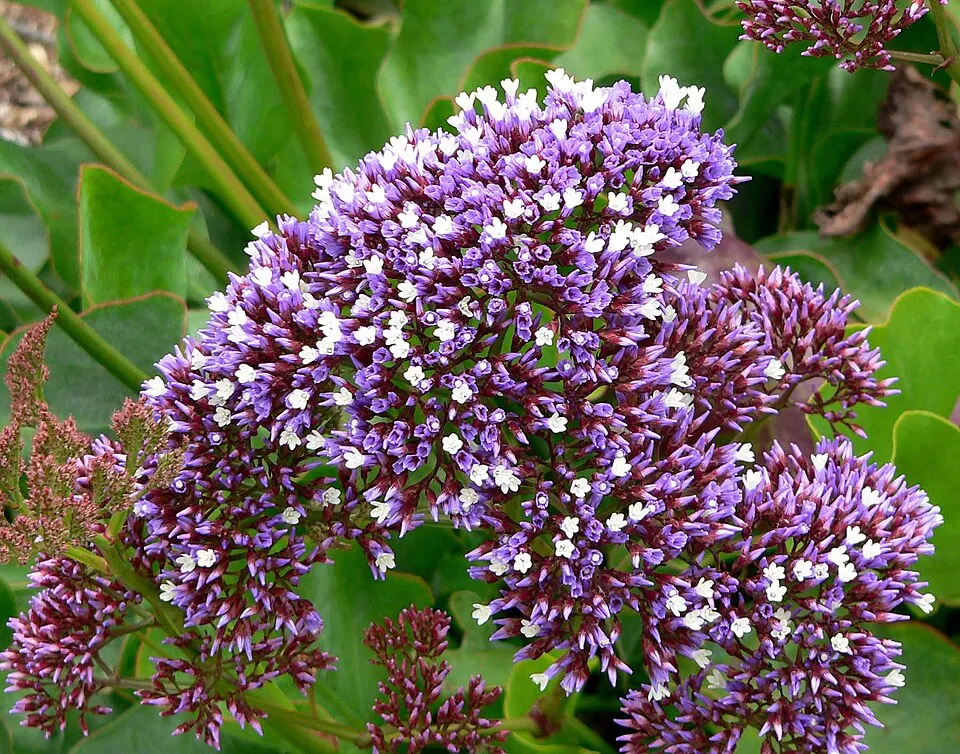
Limonium perezii, commonly known as Sea Lavender or Statice, is a captivating evergreen perennial belonging to the Plumbaginaceae family. Native to the sun-drenched Canary Islands, this robust plant is characterized by its striking inflorescences and resilient nature. It forms a prominent basal rosette of large, leathery, spatulate to ovate leaves, which are typically deep green and persistent, providing year-round visual interest.
From this foliage emerges tall, sturdy, branching stems, reaching heights of up to 3 feet (90 cm), crowned with dense, airy clusters of vibrant purple-blue flowers. Each tiny flower features an intense purple calyx contrasting beautifully with a white corolla, creating a cloud-like effect. These papery blooms are notably long-lasting, both on the plant and as cut flowers, making them highly valued ornamentally.
Limonium perezii thrives in coastal environments, exhibiting remarkable tolerance to salt spray, wind, and drought, making it an excellent choice for xeriscaping and Mediterranean-style gardens. Its natural distribution is primarily oceanic islands, where it adapts to rocky, well-draining soils.
Trusted Scientific References
1. Authoritative external sources for Limonium perezii
1.1 Wikipedia — Limonium perezii
1.2 Kew POWO (Plants of the World Online)
1.3 PubMed — peer-reviewed research
1.4 NCBI Taxonomy Browser
1.5 GBIF — Global Biodiversity
1.6Limonium Perezii should be interpreted through verified botanical identity, practical care, and responsible safety language. This recovery note adds the missing context needed for a complete profile: match light to the plant's habit, use well-drained soil, water according to season, and avoid unsupported medicinal or edible claims. For publishing, the plant can be presented as a source-backed garden plant with clear care guidance, common problem diagnosis, and conservative safety wording.
1.7Limonium Perezii (Limonium perezii) is maintained in this recovery file as a complete garden profile with practical care, safety, and identification context. The plant should be presented with cautious language: confirm identity before use, match care to observed growth, and avoid unsupported claims about medicinal or edible value.
1.1.Limonium Perezii — Highlights
- ✓Striking purple — blue flowers in dense clusters.
- ✓Evergreen basal rosette — Evergreen basal rosette of large, leathery leaves.
- ✓Native to the — Native to the Canary Islands, thriving in coastal conditions.
- ✓Excellent drought, salt, — Excellent drought, salt, and wind tolerance.
- ✓Highly valued as — Highly valued as a cut flower and for dried arrangements.
- ✓Contains beneficial phytochemicals — Contains beneficial phytochemicals like flavonoids and tannins.
- ✓Low maintenance and — Low maintenance and generally pest/disease resistant.
- ✓Attracts pollinators like — Attracts pollinators like butterflies and hummingbirds.
- ✓Grows 2 — 3 feet tall and wide, forming a rounded subshrub.
- ✓Adaptable to various well — drained soil types.
1.2.Limonium Perezii — Snapshot Summary
- ✓Limonium perezii is an ornamental evergreen perennial from the Canary Islands.
- ✓Prized for its vibrant, long-lasting purple-blue flowers, ideal for cuts and drying.
- ✓Tolerant of drought, salt, and wind, perfect for coastal and Mediterranean gardens.
- ✓Contains flavonoids, tannins, and phenolic acids with antioxidant and astringent potential.
- ✓While primarily ornamental, related species have traditional uses for wound healing and inflammation.
- ✓Generally low maintenance, requiring full sun and well-drained soil.
2.Limonium Perezii — Nomenclature & Classification
3.Limonium Perezii — Key Data
4.Limonium Perezii — Physical Description
5.Limonium Perezii — Origin & Spread
6.Limonium Perezii — Folk Medicine Applications
7.Limonium Perezii — Key Phytochemicals
- ✓Flavonoids — Quercetin, kaempferol, and their glycosides, known for antioxidant and anti-inflammatory activities.
- ✓Tannins — Predominantly condensed tannins, responsible for astringent properties, tissue contraction, and potential antimicrobial effects.
- ✓Phenolic Acids — Gallic acid, caffeic acid, and ferulic acid derivatives, contributing to antioxidant capacity and free radical scavenging.
- ✓Anthocyanins — Pigments like delphinidin and cyanidin derivatives, providing the purple coloration and acting as potent antioxidants.
- ✓Triterpenoids — Ursolic acid and oleanolic acid, which may possess anti-inflammatory and hepatoprotective properties.
- ✓Polysaccharides — Complex carbohydrates that can have immunomodulatory and demulcent effects.
- ✓Sterols — Beta-sitosterol, campesterol, and stigmasterol, important for membrane integrity and potential hormone modulation.
- ✓Saponins — Glycosides that can exhibit surfactant properties and potentially influence cholesterol metabolism.
- ✓Volatile Compounds — Minor amounts of monoterpenes and sesquiterpenes contributing to subtle aroma and potential antimicrobial activity.
- ✓Minerals — Accumulates various trace elements from saline environments, though specific medicinal implications are not well-defined.
8.Limonium Perezii — Evidence-Based Benefits
- ✓Astringent Properties — Traditional use of some Limonium species suggests topical application for minor wounds and skin irritations due to tannin content, promoting tissue contraction and reducing bleeding.
- ✓Antioxidant Activity — The presence of flavonoids and phenolic acids contributes to antioxidant effects, helping to neutralize free radicals and protect cellular integrity.
- ✓Anti-inflammatory Potential — Certain phenolic compounds may exhibit mild anti-inflammatory actions, potentially useful for soothing irritated tissues.
- ✓Wound Healing Support — Historically, extracts might have been used to aid in minor wound healing, primarily through astringency and potential antimicrobial effects.
- ✓Antimicrobial Effects — Preliminary research on related Limonium species indicates some extracts possess mild antimicrobial properties against certain bacteria and fungi.
- ✓Diuretic Action — Some Limonium species have been traditionally used as diuretics; however, specific evidence for L. perezii is limited.
- ✓Immunomodulatory Effects — Polysaccharides and other compounds in related species are being explored for potential immune system modulation.
- ✓Digestive Aid — In some traditional systems, astringent plants like certain Limonium species were used to alleviate mild digestive discomfort.
- ✓Skin Health — The astringent qualities could be beneficial for toning skin and reducing pore appearance when used topically.
- ✓Vascular Support — Flavonoids may help strengthen capillary walls and improve microcirculation, though direct studies on L. perezii are lacking.
8.1.Limonium Perezii — Health Applications
9.Limonium Perezii — Cautions & Contraindications
9.1.Limonium Perezii — Caution Notes
- ✓Allergic Reactions — Skin irritation or allergic contact dermatitis in sensitive individuals, especially with topical use.
- ✓Gastrointestinal Upset — High consumption of tannin-rich extracts may cause stomach upset, nausea, or constipation.
- ✓Drying Effect — Excessive internal use of astringent compounds might lead to dryness of mucous membranes.
- ✓Drug Interactions — Potential to interfere with iron absorption due to tannin content; avoid concurrent use with iron supplements.
- ✓Photosensitivity — Rare instances of increased skin sensitivity to sunlight have been reported with some Limonium species.
- ✓Kidney Irritation — Very high doses of some Limonium species extracts could theoretically irritate kidneys, though not specifically documented for L. perezii.
9.2.Limonium Perezii — Safety Overview
- ✓Pregnancy and Lactation — Avoid use due to insufficient safety data; consult a healthcare professional before use.
- ✓Children — Not recommended for internal use in children without expert medical guidance.
- ✓Pre-existing Conditions — Individuals with kidney issues or gastrointestinal sensitivities should exercise caution.
- ✓Dosage — Adhere strictly to recommended dosages if using medicinal preparations from related species; L. perezii lacks established safe dosages.
- ✓Topical Use — Perform a patch test before extensive topical application to check for skin sensitivity.
- ✓Long-term Use — Long-term internal use is generally not advised without professional supervision due to potential for cumulative effects.
- ✓Contamination — Ensure any plant material used is free from pesticides or environmental contaminants, especially if collected from the wild.
10.Limonium Perezii — Usage Guide
- ✓Ornamental Display — Primarily cultivated for its striking, long-lasting purple flowers in gardens, borders, and rockeries.
- ✓Cut Flowers — The durable, papery blooms are excellent for fresh cut flower arrangements, adding texture and vibrant color.
- ✓Dried Flowers — Flowers retain their color and form exceptionally well when dried, making them popular for everlasting bouquets and crafts.
- ✓Topical Compresses — Infusions from other Limonium species, rich in tannins, might be used as a compress for minor skin irritations or wounds (not specifically L. perezii).
- ✓Gargles/Mouthwash — Astringent extracts from related species could be used as a gargle for sore throats or mouth ulcers, though not directly for L. perezii.
- ✓Infusions — While not widely documented for L. perezii, some Limonium species leaves or roots are prepared as infusions for internal use in traditional medicine.
- ✓Tinctures — Alcoholic extracts of related Limonium species are sometimes prepared to concentrate active compounds for medicinal purposes.
- ✓Salves/Ointments — Astringent extracts could theoretically be incorporated into topical salves for wound care, but this is experimental for L. perezii.
11.Limonium Perezii — How to Grow
- ✓Site Selection — Plant Limonium perezii in full sun (at least 6 hours daily) for optimal flowering and robust growth, ideally in a location protected from harsh, continuous winds.
- ✓Soil Requirements — Thrives in well-draining soil, tolerating sandy, rocky, or even poor conditions; it is highly adaptable to saline soils and prefers neutral to alkaline pH.
- ✓Watering — Once established, Sea Lavender is remarkably drought-tolerant; water sparingly, allowing the soil to dry out completely between waterings to prevent root rot.
- ✓Propagation — Easily propagated from seeds, which can be sown in spring, or by division of mature clumps in early spring or fall, ensuring each division has adequate roots.
- ✓Fertilization — Generally requires minimal fertilization; a balanced, slow-release granular fertilizer can be applied annually in early spring if soil nutrients are severely depleted.
- ✓Pruning — Deadhead spent flower stalks regularly to encourage continuous blooming and maintain a tidy appearance; cut back hard in late winter or early spring to stimulate new growth.
- ✓Pests and Diseases — Generally resistant to most common garden pests and diseases, particularly when grown in well-drained conditions; watch for powdery mildew in high humidity or root rot in waterlogged soil.
- ✓Winter Hardiness — Hardy in USDA zones 9-11; in colder climates, it can be grown as an annual or overwintered indoors in a bright, cool location.
Reviewed by the Flora Medical Global Botanical Review Panel
Multi-disciplinary editorial group · Botany · Ethnobotany · Herbal-medicine literature
Who reviewed this: This page was checked by the Flora Medical Global Botanical Review Panel — an in-house editorial group of botany graduates, ethnobotany researchers, and horticulture practitioners who collectively maintain our 7,000+ plant encyclopedia. Meet the team.
Our 4-step verification process
1. Taxonomic verification
Scientific names and synonyms cross-checked against Kew POWO, World Flora Online, and The Plant List.
2. Phytochemical & medicinal cross-reference
Active compounds, traditional uses, and reported activities are cross-referenced with PubMed, USDA Dr. Duke's database, and peer-reviewed ethnobotanical literature.
3. Conservation & distribution check
Distribution, ecology, and conservation status confirmed against GBIF occurrence records and the IUCN Red List.
4. Editorial & safety review
Every entry passes an editorial pass for clarity, originality, and safety notices (toxicity, contraindications, dosage caveats) before publication.
Last reviewed:
Important medical disclaimer: This content is for educational and research purposes only. It is not medical advice and is not a substitute for consultation with a licensed healthcare provider. Do not use any herb to self-treat a medical condition without professional guidance.
Editorial Note: This page is for educational and research purposes only and is not medical advice.
Written by: Flora Medical Global Editorial Team
Reviewed by: Flora Medical Global Botanical Review Panel
Last Updated: June 15, 2026





Limonium Perezii — Comments & Community Reviews
Rate this plant