
Medical Disclaimer: This content is for educational purposes only. It is not medical advice. Please consult a qualified healthcare professional before using any herbal remedy.
Safety Overview
1.Madhumalati — Overview
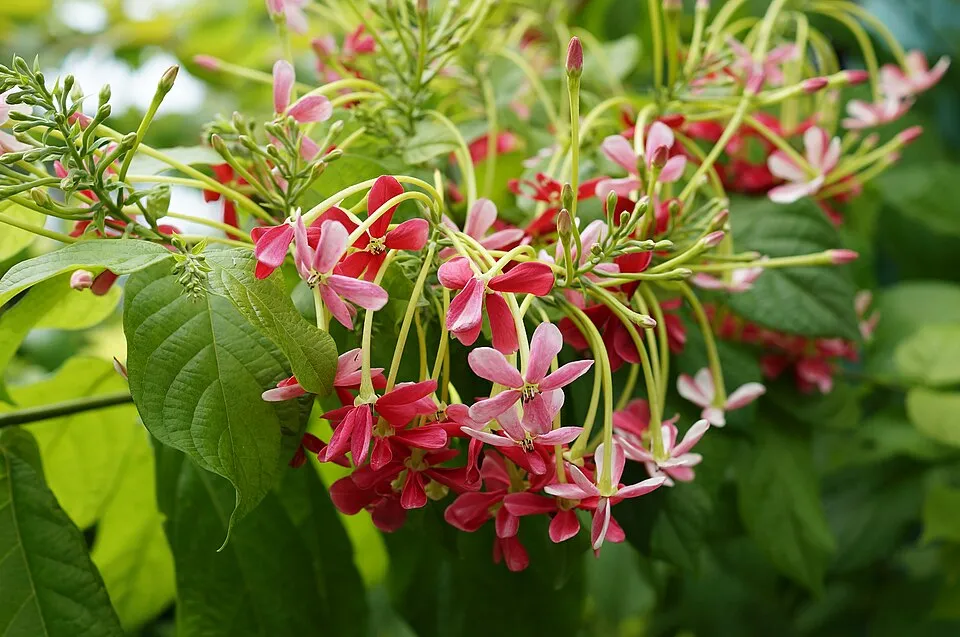
Madhumalati, botanically known as Quisqualis indica and commonly referred to as Rangoon Creeper or Chinese Honeysuckle, is a robust, fast-growing, woody vine belonging to the Combretaceae family. This ornamental climber is celebrated for its profuse clusters of fragrant, tubular flowers that exhibit a remarkable color transformation throughout their lifespan. The blossoms typically emerge white in the morning, gradually shifting to pink by midday, and finally maturing into a deep red or crimson hue by evening.
This captivating diurnal color change creates a dynamic visual display. Native to tropical regions of Asia, including India, Southeast Asia, and parts of Africa, Quisqualis indica thrives in warm, humid climates. It is a vigorous grower, capable of rapidly ascending trellises, arbors, pergolas, and even natural supports like trees and shrubs, covering them with its dense, ovate to elliptic green foliage.
The vine's strong, sweet fragrance, particularly pronounced during the evening hours, attracts nocturnal pollinators such as moths. Beyond its significant aesthetic appeal, Madhumalati holds cultural importance in various regions and has a long history of traditional medicinal use, contributing to its widespread recognition and cultivation.
Trusted Scientific References
1. Authoritative external sources for Quisqualis indica
1.1 Wikipedia — Quisqualis indica
1.2 Kew POWO (Plants of the World Online)
1.3 PubMed — peer-reviewed research
1.4 NCBI Taxonomy Browser
1.5 GBIF — Global Biodiversity
1.6Madhumalati should be interpreted through verified botanical identity, practical care, and responsible safety language. This recovery note adds the missing context needed for a complete profile: match light to the plant's habit, use well-drained soil, water according to season, and avoid unsupported medicinal or edible claims. For publishing, the plant can be presented as a source-backed garden plant with clear care guidance, common problem diagnosis, and conservative safety wording.
1.1.Madhumalati — Defining Traits
- ✓Ornamental Value — Highly prized for its beautiful, color-changing flowers.
- ✓Fragrant Blooms — Emits a strong, sweet scent, particularly in the evening.
- ✓Rapid Growth — A vigorous climber, quickly covering support structures.
- ✓Medicinal Properties — Traditional uses as an anthelmintic, antipyretic, and antidiarrheal.
- ✓Botanical Origin — Native to tropical Asia and parts of Africa.
- ✓Chemical Richness — Contains quisqualic acid, flavonoids, and triterpenoids.
- ✓Cultural Significance — Holds importance in various traditional practices.
- ✓Pollinator Attractor — Flowers attract moths and other nocturnal pollinators.
- ✓Adaptable Cultivation — Can be grown in ground or large containers in suitable climates.
- ✓Diurnal Color Change — Flowers transition from white to pink to red throughout the day.
1.2.Madhumalati — Quick Summary
- ✓Vigorous climbing vine with fragrant, color-changing flowers.
- ✓Traditional anthelmintic, antipyretic, and antidiarrheal.
- ✓Contains quisqualic acid, flavonoids, and triterpenoids.
- ✓Requires full sun, well-draining soil, and regular pruning for best blooms.
- ✓Caution advised due to potential toxicity, especially from seeds.
- ✓Not recommended for pregnant/lactating women or children without expert guidance.
2.Madhumalati — Taxonomic Classification
3.Madhumalati — Reference Facts
4.Madhumalati — Morphological Account
5.Madhumalati — Where It Grows
6.Madhumalati — Ethnobotanical Uses
Widely cultivated in Asia for its beauty and fragrance. Often used in traditional medicine systems like Ayurveda. Features in local folklore and garden designs. Its color-changing flowers are sometimes associated with different phases of life or emotions.
7.Madhumalati — Bioactive Constituents
- ✓Amino Acids — Notably quisqualic acid, a potent anthelmintic agent primarily found in the seeds, acting as a glutamate receptor agonist.
- ✓Triterpenoids — Including triterpene glycosides, which contribute to anti-inflammatory and cytotoxic activities.
- ✓Flavonoids — Such as quercetin and kaempferol derivatives, known for their antioxidant, anti-inflammatory, and antimicrobial properties.
- ✓Tannins — Astringent compounds providing antimicrobial and antidiarrheal effects, also contributing to skin healing.
- ✓Glycosides — Diverse group of compounds, including saponin glycosides, which may have various pharmacological effects.
- ✓Saponins — Contribute to the plant's anthelminthic and potential immune-modulating activities, often found in seeds.
- ✓Phenolic Compounds — Broad category of antioxidants, contributing to the plant's protective effects against oxidative stress.
- ✓Fatty Acids — Present in seeds, providing nutritional value and potentially contributing to emollient properties.
- ✓Steroids — Plant sterols which may possess anti-inflammatory and adaptogenic properties.
- ✓Volatile Oils — Responsible for the plant's characteristic fragrance and may have mild antiseptic qualities.
8.Madhumalati — Modern Studies
- ✓Anthelmintic — Traditionally used to expel intestinal parasites, particularly Ascaris and Enterobius vermicularis, due to compounds like quisqualic acid.
- ✓Antipyretic — Employed in traditional medicine to reduce fever, likely through modulation of inflammatory pathways.
- ✓Antidiarrheal — Used to alleviate diarrhea, possibly by reducing gut motility and microbial load in the intestines.
- ✓Dermatological Aid — Applied topically or taken internally for various skin ailments, suggesting anti-inflammatory and antiseptic properties.
- ✓Antitussive — Historically utilized to soothe coughs and respiratory discomfort, potentially acting as an expectorant or bronchodilator.
- ✓Nephroprotective — Some traditional systems suggest benefits for kidney-related conditions, though scientific evidence is limited.
- ✓Anti-inflammatory — Contains flavonoids and triterpenoids which may contribute to reducing inflammation in various tissues.
- ✓Antioxidant — Presence of phenolic compounds and flavonoids suggests potential to neutralize free radicals and protect against oxidative stress.
- ✓Antimicrobial — Extracts have shown activity against certain bacteria and fungi, supporting its use in infections.
- ✓Diuretic — May promote increased urine output, aiding in fluid balance and detoxification.
8.1.Madhumalati — Reported Uses
9.Madhumalati — Adverse Effects
9.1.Madhumalati — Caution Notes
- ✓Nausea and Vomiting — High doses, particularly of seeds, can induce gastrointestinal upset.
- ✓Abdominal Pain — May cause cramping or discomfort, especially when used for deworming.
- ✓Diarrhea — Paradoxically, excessive intake can lead to loose stools or worsening of existing diarrhea.
- ✓Dizziness — Some individuals may experience lightheadedness or vertigo.
- ✓Allergic Reactions — Skin rashes, itching, or respiratory issues can occur in sensitive individuals.
- ✓Liver Toxicity — Potential for hepatotoxic effects with prolonged or high-dose use, particularly from seeds.
- ✓Hypotension — May cause a drop in blood pressure in susceptible individuals.
9.2.Madhumalati — Safety Profile
- ✓Dosage Caution — Adhere strictly to recommended traditional dosages, especially for seeds, due to potential toxicity.
- ✓Professional Guidance — Always consult a qualified healthcare practitioner or medical herbalist before use.
- ✓Pregnancy and Lactation — Contraindicated in pregnant and breastfeeding women due to lack of safety data and potential abortifacient effects.
- ✓Children — Use with extreme caution in children; specific pediatric formulations and dosages are critical.
- ✓Pre-existing Conditions — Individuals with liver, kidney, or gastrointestinal disorders should avoid use.
- ✓Drug Interactions — May interact with medications, particularly those affecting the liver or gastrointestinal tract.
- ✓Allergy Test — Perform a patch test for topical applications to check for allergic reactions.
10.Madhumalati — How to Use
- ✓Seed Decoction — Seeds are typically crushed and boiled in water to prepare a decoction for anthelmintic purposes.
- ✓Leaf Poultice — Fresh leaves are crushed and applied as a poultice for skin ailments and localized inflammation.
- ✓Root Extract — Roots may be decocted or macerated to produce extracts for fevers and general debility.
- ✓Flower Infusion — Dried or fresh flowers can be steeped in hot water to make an infusion for mild respiratory complaints.
- ✓Powdered Seeds — Dried seeds are ground into a fine powder and mixed with honey or water for internal administration.
- ✓Herbal Syrups — Extracts of leaves or flowers are incorporated into traditional cough syrups.
- ✓Topical Pastes — Plant parts are ground with water to form a paste for external application on skin lesions.
- ✓Traditional Concoctions — Often combined with other herbs in polyherbal formulations to enhance efficacy for specific conditions.
11.Madhumalati — Growing Guide
- ✓Support Structure — Provide a sturdy trellis, arbor, or pergola for the climbing vine to ascend.
- ✓Soil Requirements — Plant in well-draining, fertile soil rich in organic matter.
- ✓Light Exposure — Thrives in full sun to partial shade; full sun promotes more abundant flowering.
- ✓Watering — Maintain consistent moisture, especially during dry periods; avoid waterlogging.
- ✓Fertilization — Feed regularly with a balanced fertilizer during the growing season to encourage robust growth and flowering.
- ✓Pruning — Prune heavily after flowering to control vigorous growth, maintain shape, and encourage new blooms.
- ✓Propagation — Can be propagated from semi-hardwood cuttings or by seed, though seed propagation can be challenging.
- ✓Container Growing — Can be grown in large containers in cooler climates, brought indoors during winter.
Reviewed by the Flora Medical Global Botanical Review Panel
Multi-disciplinary editorial group · Botany · Ethnobotany · Herbal-medicine literature
Who reviewed this: This page was checked by the Flora Medical Global Botanical Review Panel — an in-house editorial group of botany graduates, ethnobotany researchers, and horticulture practitioners who collectively maintain our 7,000+ plant encyclopedia. Meet the team.
Our 4-step verification process
1. Taxonomic verification
Scientific names and synonyms cross-checked against Kew POWO, World Flora Online, and The Plant List.
2. Phytochemical & medicinal cross-reference
Active compounds, traditional uses, and reported activities are cross-referenced with PubMed, USDA Dr. Duke's database, and peer-reviewed ethnobotanical literature.
3. Conservation & distribution check
Distribution, ecology, and conservation status confirmed against GBIF occurrence records and the IUCN Red List.
4. Editorial & safety review
Every entry passes an editorial pass for clarity, originality, and safety notices (toxicity, contraindications, dosage caveats) before publication.
Last reviewed:
Important medical disclaimer: This content is for educational and research purposes only. It is not medical advice and is not a substitute for consultation with a licensed healthcare provider. Do not use any herb to self-treat a medical condition without professional guidance.
Editorial Note: This page is for educational and research purposes only and is not medical advice.
Written by: Flora Medical Global Editorial Team
Reviewed by: Flora Medical Global Botanical Review Panel
Last Updated: June 15, 2026





Madhumalati — Comments & Community Reviews
Rate this plant