
Medical Disclaimer: This content is for educational purposes only. It is not medical advice. Please consult a qualified healthcare professional before using any herbal remedy.
Safety Overview
1.Molinia Caerulea — At a Glance
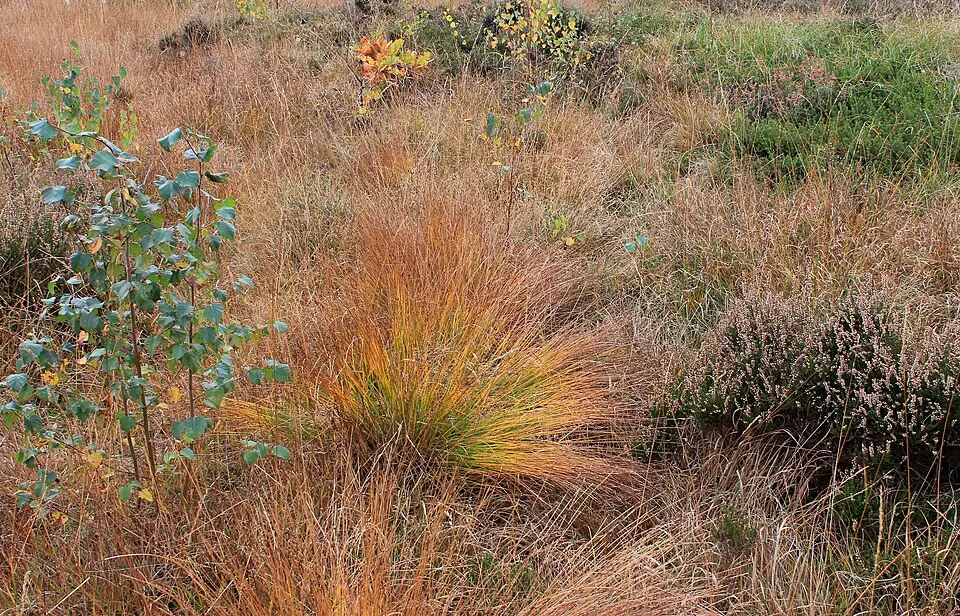
Molinia caerulea, commonly known as purple moor grass, is an elegant perennial grass indigenous to a wide range of habitats across Europe and parts of western Asia. As a member of the Poaceae family, it forms distinctive, dense tussocks, reaching heights of 60 to 120 cm, with some cultivars growing even taller. Its linear to narrowly lanceolate leaves emerge in spring with a vibrant green, gradually transitioning through a spectrum of autumnal hues including yellow, orange, and eventually striking purples and reddish-browns, which persist well into winter.
The plant's inflorescence is characterized by airy, delicate panicles, typically 15-40 cm long, borne on slender, erect stems that rise gracefully above the foliage. These panicles exhibit a shimmering, translucent quality, especially when backlit by sunlight, adding dynamic movement and texture to any setting. Molinia caerulea is remarkably adaptable, thriving in acidic, moist conditions characteristic of moors, bogs, and damp woodlands, but also tolerating drier, more open environments.
Its resilience and striking seasonal color shifts make it a highly valued ornamental grass in naturalistic garden designs, meadow plantings, and contemporary landscapes, where its architectural form provides year-round interest.
Trusted Scientific References
1. Authoritative external sources for Molinia caerulea
1.1 Wikipedia — Molinia caerulea
1.2 Kew POWO (Plants of the World Online)
1.3 PubMed — peer-reviewed research
1.4 NCBI Taxonomy Browser
1.5 GBIF — Global Biodiversity
1.6Molinia Caerulea should be interpreted through verified botanical identity, practical care, and responsible safety language. This recovery note adds the missing context needed for a complete profile: match light to the plant's habit, use well-drained soil, water according to season, and avoid unsupported medicinal or edible claims. For publishing, the plant can be presented as a source-backed garden plant with clear care guidance, common problem diagnosis, and conservative safety wording.
1.1.Molinia Caerulea — Notable Characteristics
- ✓Striking Seasonal Foliage Color — Green to yellow, orange, purple, and reddish-brown.
- ✓Dense Tussock Growth Habit — Forms attractive, upright clumps.
- ✓Airy, Delicate Panicles — Feathery flower plumes add texture and movement.
- ✓Adaptable to Various Soil Conditions — Tolerates both moist acidic and drier soils.
- ✓High Resilience — Withstands diverse environmental stressors.
- ✓Low Maintenance — Requires minimal care once established.
- ✓Non — Invasive — Generally well-behaved in garden and landscape settings.
- ✓Excellent for Naturalistic Plantings — Blends well with other native and ornamental plants.
- ✓Provides Winter Interest — Dried foliage and seed heads persist through cold months.
- ✓Habitat for Wildlife — Offers shelter and food for small creatures.
1.2.Molinia Caerulea — Quick Summary
- ✓Ornamental grass with striking seasonal color changes.
- ✓Native to Europe and Asia, thrives in moist, acidic conditions.
- ✓No recognized medicinal benefits for humans.
- ✓Important for ecosystem services and soil stabilization.
- ✓Low maintenance, suitable for various landscape designs.
- ✓Primarily composed of structural carbohydrates and pigments.
2.Molinia Caerulea — Nomenclature & Classification
3.Molinia Caerulea — Vital Statistics
4.Molinia Caerulea — Botanical Features
5.Molinia Caerulea — Native Range & Habitat
6.Molinia Caerulea — Folk Medicine Applications
While not deeply steeped in ancient lore, Molinia caerulea is significant in modern horticulture for its role in naturalistic garden design, popularized by designers like Piet Oudolf, where it contributes to a sustainable, low-maintenance aesthetic.
7.Molinia Caerulea — Chemical Profile
- ✓Structural Carbohydrates — Primarily composed of cellulose and hemicellulose, key components of plant cell walls, providing structural integrity.
- ✓Lignin — A complex polymer found in plant secondary cell walls, imparting rigidity and resistance to decay, typical of woody and grassy tissues.
- ✓Proteins and Amino Acids — Basic building blocks for plant growth and metabolism, present in typical grass foliage to support physiological functions.
- ✓Lipids — Essential for cell membrane structure and energy storage within the plant, found in standard grass tissues.
- ✓Minerals — Accumulates various micronutrients and macronutrients from the soil, critical for plant health and growth.
- ✓Chlorophylls — Pigments responsible for photosynthesis, giving the plant its green coloration during the growing season.
- ✓Carotenoids — Accessory pigments that contribute to the yellow and orange hues seen in autumn foliage, also involved in photosynthesis.
- ✓Anthocyanins — Pigments responsible for the purple and reddish-brown coloration, especially prominent during colder months and under stress conditions.
- ✓Flavonoids — General class of plant secondary metabolites, present in low, non-specific concentrations, contributing to plant defense and coloration.
- ✓Waxes — Cuticular waxes cover the leaf surface, providing protection against water loss and environmental stressors.
- ✓Silicates — Common in grasses, contributing to structural strength and defense against herbivores.
8.Molinia Caerulea — Evidence-Based Benefits
- ✓No Recognized Medicinal Benefits — Molinia caerulea has no recognized traditional or scientifically validated medicinal benefits for human health.
- ✓Forage Potential — While not directly medicinal for humans, its high cellulose content makes it a significant forage grass for livestock in certain ecosystems.
- ✓Ecosystem Services — It plays a crucial role in maintaining biodiversity in moorland and heathland ecosystems.
- ✓Soil Stabilization — Its dense root system contributes to soil stabilization, particularly in wetland and marginal agricultural areas.
- ✓Carbon Sequestration — As a perennial grass, it contributes to carbon sequestration, aiding in climate regulation.
- ✓Habitat Provision — The tussocks provide shelter and nesting sites for various small wildlife.
- ✓Biomass Production — Its robust growth offers potential for biomass production, though not for medicinal purposes.
- ✓Ecological Indicator — Its presence can indicate specific soil and environmental conditions, serving as an ecological marker.
- ✓Aesthetic Value — Its ornamental qualities provide psychological benefits through landscape beautification, though non-medicinal.
- ✓Grazing Management — In conservation efforts, its palatability (or lack thereof) influences grazing patterns of native ponies, indirectly supporting ecosystem health.
- ✓Climate Change Research — Molinia caerulea is used in studies researching plant responses to increased CO2 levels, offering insights into ecological shifts.
8.1.Molinia Caerulea — Indications & Uses
9.Molinia Caerulea — Safety & Side Effects
9.1.Molinia Caerulea — Side Effects & Warnings
- ✓Allergic Reactions — Potential for pollen allergies in sensitive individuals, typical of many grass species.
- ✓Skin Irritation — Direct contact with sharp leaf blades can cause minor skin irritation or cuts.
- ✓Invasive Tendency — In highly disturbed or non-native ecosystems, it could potentially outcompete other species, though generally well-behaved.
- ✓Digestive Issues (Animals) — While forage, excessive consumption by some livestock without other feed might lead to digestive discomfort due to high fiber.
- ✓Fire Hazard — Dried foliage in winter can become a fire hazard in arid regions if not managed.
- ✓Landscape Dominance — Can dominate planting areas if not properly spaced, reducing diversity in ornamental beds.
- ✓Resource Competition — In natural settings, dense stands can outcompete less vigorous native plants for resources.
9.2.Molinia Caerulea — Safety Overview
- ✓Non-Toxic to Humans — Molinia caerulea is not known to be toxic to humans through ingestion or contact.
- ✓Pet Safe — Generally considered safe for pets, though excessive consumption of any plant material can cause mild digestive upset.
- ✓Environmental Impact — Ecologically beneficial in its native range; non-invasive in most cultivated settings.
- ✓Handling Precautions — Wear gloves when handling large quantities to avoid minor cuts from sharp leaves.
- ✓Pollen Exposure — Individuals with grass pollen allergies should be mindful during its flowering season.
- ✓Fire Prevention — Clear dead foliage in fire-prone areas to reduce fuel load.
- ✓Grazing Management — Monitor animal grazing to ensure a balanced diet and prevent overconsumption.
10.Molinia Caerulea — Preparations & Uses
- ✓Ornamental Planting — Widely used in gardens, naturalistic landscapes, and meadows for its aesthetic appeal and seasonal color.
- ✓Erosion Control — Planted on slopes and banks due to its dense root system, which helps stabilize soil.
- ✓Wildlife Habitat — Provides shelter and foraging opportunities for small birds and insects.
- ✓Biomass Source — Explored for its potential as a renewable energy source due to its high biomass production.
- ✓Ecological Restoration — Utilized in wetland and moorland restoration projects to re-establish native vegetation.
- ✓Thatched Roofs — Historically, coarser grass species like Molinia were used for thatching, though less common now.
- ✓Animal Forage — Serves as a food source for grazing animals, particularly in its native moorland habitats.
- ✓Biofilter Systems — Its ability to thrive in wet conditions makes it suitable for some phytoremediation applications.
11.Molinia Caerulea — How to Grow
- ✓Site Selection — Thrives in full sun to partial shade, preferring moist, acidic soils but adaptable to various conditions.
- ✓Soil Preparation — Amend heavy clay soils with organic matter to improve drainage; for sandy soils, add compost to retain moisture.
- ✓Planting — Plant in spring or early autumn. Dig a hole twice the width of the root ball and the same depth.
- ✓Watering — Keep consistently moist, especially during establishment. Established plants tolerate short dry spells.
- ✓Fertilization — Generally low-maintenance; a light application of balanced granular fertilizer in spring is sufficient.
- ✓Pruning — Cut back old foliage in late winter or early spring before new growth appears to maintain a tidy appearance.
- ✓Propagation — Easily propagated by division in spring, or from seed sown in autumn or spring.
- ✓Pest and Disease — Highly resistant to most pests and diseases, making it a robust choice for various landscapes.
Reviewed by the Flora Medical Global Botanical Review Panel
Multi-disciplinary editorial group · Botany · Ethnobotany · Herbal-medicine literature
Who reviewed this: This page was checked by the Flora Medical Global Botanical Review Panel — an in-house editorial group of botany graduates, ethnobotany researchers, and horticulture practitioners who collectively maintain our 7,000+ plant encyclopedia. Meet the team.
Our 4-step verification process
1. Taxonomic verification
Scientific names and synonyms cross-checked against Kew POWO, World Flora Online, and The Plant List.
2. Phytochemical & medicinal cross-reference
Active compounds, traditional uses, and reported activities are cross-referenced with PubMed, USDA Dr. Duke's database, and peer-reviewed ethnobotanical literature.
3. Conservation & distribution check
Distribution, ecology, and conservation status confirmed against GBIF occurrence records and the IUCN Red List.
4. Editorial & safety review
Every entry passes an editorial pass for clarity, originality, and safety notices (toxicity, contraindications, dosage caveats) before publication.
Last reviewed:
Important medical disclaimer: This content is for educational and research purposes only. It is not medical advice and is not a substitute for consultation with a licensed healthcare provider. Do not use any herb to self-treat a medical condition without professional guidance.
Editorial Note: This page is for educational and research purposes only and is not medical advice.
Written by: Flora Medical Global Editorial Team
Reviewed by: Flora Medical Global Botanical Review Panel
Last Updated: June 15, 2026





Molinia Caerulea — Comments & Community Reviews
Rate this plant