

Medical Disclaimer: This content is for educational purposes only. It is not medical advice. Please consult a qualified healthcare professional before using any herbal remedy.
Safety Overview
1.Mountain Laurel — Plant Snapshot
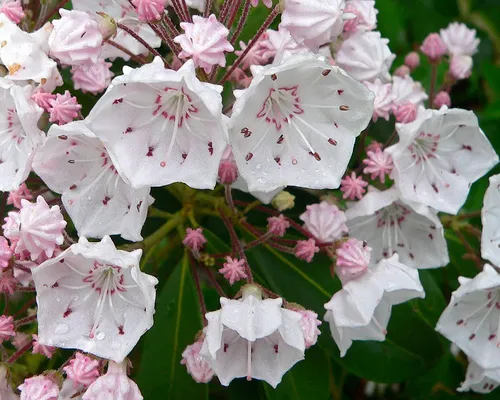
Mountain Laurel, scientifically known as Kalmia latifolia, is an iconic evergreen shrub belonging to the Ericaceae family, which also includes familiar genera like Rhododendron and Vaccinium. This striking plant typically grows between 4 to 15 feet tall, forming a dense, rounded growth habit that adds year-round structure to landscapes. Its leaves are distinctively alternate, lanceolate to elliptical in shape, measuring 2 to 5 inches in length, and possess a glossy, dark green upper surface contrasted by a paler undersurface, contributing to their interesting texture.
From late spring to early summer, Kalmia latifolia produces stunning clusters of cup-shaped flowers, ranging in color from delicate pink to pure white, often adorned with prominent red spots that attract various pollinators. The bark is characteristically thin, smooth, and grayish-brown, sometimes developing a subtly scaly texture with age. Mountain Laurel thrives in the acidic, well-drained soils of forests across the eastern United States, stretching from Maine down to Florida and westward into Illinois.
It prefers environments with partial shade to full sun and high humidity. While a cherished ornamental, it is crucial to note that the entire plant is toxic if ingested, primarily due to compounds like grayanotoxin.
Trusted Scientific References
1. Authoritative external sources for Kalmia latifolia
1.1 Wikipedia — Kalmia latifolia
1.2 Kew POWO (Plants of the World Online)
1.3 PubMed — peer-reviewed research
1.4 NCBI Taxonomy Browser
1.5 GBIF — Global Biodiversity
1.6Mountain Laurel should be interpreted through verified botanical identity, practical care, and responsible safety language. This recovery note adds the missing context needed for a complete profile: match light to the plant's habit, use well-drained soil, water according to season, and avoid unsupported medicinal or edible claims. For publishing, the plant can be presented as a source-backed medicinal plant with clear care guidance, common problem diagnosis, and conservative safety wording.
1.1.Mountain Laurel — Standout Qualities
- ✓Evergreen Shrub — Maintains its dark green foliage year-round, providing consistent garden interest.
- ✓Striking Flowers — Produces distinctive, cup-shaped flowers, often adorned with unique red spots.
- ✓Acid — Loving Plant — Thrives exclusively in highly acidic, well-drained soil conditions.
- ✓Native to Eastern North America — Indigenous to woodlands and forests of the eastern United States.
- ✓Toxic Plant — Contains grayanotoxins, making all parts dangerous if ingested by humans or animals.
- ✓Ericaceae Family Member — Botanically related to other acid-loving plants like rhododendrons and blueberries.
- ✓Ornamental Appeal — Widely cultivated in horticulture for its exceptional aesthetic beauty and unique blooms.
- ✓Pollinator Attractor — Its vibrant flowers effectively draw various pollinators to the garden ecosystem.
- ✓Deer Resistant — Generally avoided by deer and other herbivores due to its inherent toxicity.
1.2.Mountain Laurel — In Brief
- ✓Highly Toxic — Contains grayanotoxins, making all parts poisonous if ingested.
- ✓Ornamental Value — Prized for its stunning clusters of pink-to-white, cup-shaped flowers in gardens.
- ✓Eastern US Native — Thrives in acidic forest soils across its native range from Maine to Florida.
- ✓Traditional Topical Use Only — Historically used externally for some skin conditions, but with insufficient evidence and significant safety concerns; never for internal use.
- ✓No Internal Use — Absolutely unsafe for consumption; can cause severe illness, multi-organ failure, or death.
2.Mountain Laurel — Scientific Profile
3.Mountain Laurel — Botanical Stats
4.Mountain Laurel — Plant Morphology
5.Mountain Laurel — Habitat & Distribution
6.Mountain Laurel — Cultural & Traditional Roles
7.Mountain Laurel — Bioactive Constituents
- ✓Grayanotoxins — These potent diterpenoids, including Grayanotoxin I, II, and III, are primarily responsible for Mountain Laurel's severe toxicity, acting on sodium channels in cells and leading to profound cardiovascular and neurological symptoms upon ingestion.
- ✓Flavonoids — A diverse group of polyphenolic compounds such as quercetin and kaempferol, which are generally associated with antioxidant and anti-inflammatory properties in plants, though their specific therapeutic role from Kalmia latifolia is overshadowed by its toxicity.
- ✓Terpenoids — Various terpenes and other terpenoid compounds may be present, contributing to the plant's natural defense mechanisms or aromatic profile, but their medicinal application from this plant is not safely explored.
- ✓Phenolic Acids — Organic acid compounds like chlorogenic acid, typically known for antioxidant activity in many plant species, but their benefits from Mountain Laurel cannot be safely extracted for consumption.
- ✓Tannins — Astringent polyphenols known for their protein-binding properties, which might theoretically contribute to some historical topical applications, although internal consumption of the plant is unequivocally unsafe.
- ✓Alkaloids — While not the primary toxic agents, some nitrogen-containing organic compounds classified as alkaloids might be present in trace amounts, though grayanotoxins are the dominant toxic principles.
- ✓Saponins — Glycosides that can form a soapy lather in water, often associated with various biological activities, but their presence and specific role in Kalmia latifolia require further investigation and are not safely utilized.
- ✓Resins — Complex mixtures of organic compounds often found in plant saps, contributing to the plant's physical properties and potentially its defense mechanisms.
8.Mountain Laurel — What Research Suggests
- ✓Traditional Topical Use for Ringworm — Historically, preparations of Mountain Laurel leaves were sometimes applied topically to address ringworm of the scalp (tinea capitis), though modern scientific evidence is lacking to support its efficacy or safety for this purpose.
- ✓Traditional Topical Use for Psoriasis — Certain historical practices involved the external application of Kalmia latifolia extracts to alleviate symptoms associated with psoriasis, yet comprehensive clinical studies are needed to validate these claims and assess safety.
- ✓Traditional Topical Use for Herpes — Folk medicine traditions occasionally suggested the topical use of Mountain Laurel for managing herpes lesions, but there is currently insufficient scientific evidence to establish its effectiveness or safe application.
- ✓Traditional Topical Use for Syphilis — In some historical contexts, Mountain Laurel was reportedly used topically in attempts to treat syphilis, although contemporary research does not support these applications due to documented toxicity and lack of proven benefit.
- ✓Anti-inflammatory Action (Unsubstantiated) — While some traditional beliefs alluded to anti-inflammatory properties, any internal use is extremely dangerous due to the presence of grayanotoxins, and external use lacks sufficient safety data.
- ✓Antioxidant Properties (Theoretical) — The plant contains various phytochemicals that could theoretically exhibit antioxidant activity in isolation, but the plant's overall toxicity renders any internal application for this benefit highly hazardous.
- ✓Immune Support (Contraindicated) — Despite some traditional claims, there is no scientific basis or safe method for using Mountain Laurel to provide immune support, with oral ingestion posing severe health risks and being explicitly unsafe.
- ✓Digestive Health (Strictly Contraindicated) — Traditional mentions of digestive health benefits are entirely superseded by the plant's extreme toxicity; ingesting Mountain Laurel can cause severe gastrointestinal distress, vomiting, and diarrhea, and is explicitly unsafe.
8.1.Mountain Laurel — Health Applications
9.Mountain Laurel — Adverse Effects
9.1.Mountain Laurel — Warnings
- ✓Severe Gastrointestinal Distress — Ingestion leads to intense abdominal pain, profuse nausea, persistent vomiting, and severe diarrhea due to grayanotoxin poisoning.
- ✓Neurological Symptoms — Can cause pronounced dizziness, debilitating headache, sensation of numbness, profound muscle weakness, and potentially irreversible loss of vision.
- ✓Cardiovascular Complications — May lead to serious and life-threatening heart problems, including irregular heartbeat (arrhythmias), significant changes in blood pressure, and bradycardia.
- ✓Respiratory Issues — Known to cause significant lung problems, including difficulty breathing and respiratory distress, which can be severe.
- ✓Systemic Reactions — Common systemic responses following ingestion include cold sweats, shivering, and fever, indicating a profound toxicological response.
- ✓Death — In severe cases, particularly with larger doses or vulnerable individuals, ingestion of Mountain Laurel can be fatal due to multi-organ system failure.
- ✓Skin Irritation (Uncertain) — While information on the safety of topical application is insufficient, some individuals might experience skin irritation or allergic reactions from direct contact.
9.2.Mountain Laurel — Safety Overview
- ✓Extremely Toxic Internally — Mountain Laurel is unequivocally UNSAFE for oral consumption by humans and animals due to the presence of highly potent grayanotoxins throughout all plant parts.
- ✓Not for Pregnant or Breastfeeding Individuals — Oral ingestion is strictly contraindicated for pregnant and breastfeeding women due to severe and potentially fatal risks to both mother and child.
- ✓Skin Application Safety Unknown — There is insufficient reliable scientific information to determine if topical application is entirely safe; therefore, extreme caution is strongly advised for external use.
- ✓Keep Away from Children and Pets — All parts of the plant are poisonous; ensure it is planted in areas inaccessible to curious children and domestic animals to prevent accidental ingestion.
- ✓Consult Medical Professional Immediately — In the event of accidental ingestion, seek immediate emergency medical attention or contact a poison control center without delay.
- ✓No Established Safe Dosage — No safe or effective oral dosage for Mountain Laurel has been scientifically determined or recommended for any purpose due to its inherent toxicity.
- ✓Handling Precautions — Wear protective gloves when handling the plant, especially if you have sensitive skin, to minimize potential contact with plant sap and avoid irritation.
10.Mountain Laurel — Preparation & Dosage
- ✓Ornamental Planting — Primarily cultivated for its exceptional aesthetic appeal in gardens and landscapes, where its stunning flowers and evergreen foliage are highly valued, ensuring it is planted away from areas accessible to children and pets.
- ✓Landscaping Shrub — Utilized as a striking specimen plant, an attractive hedge, or integrated into woodland gardens, appreciated for its unique floral display and adaptability to acidic soils.
- ✓Botanical Study Specimen — Employed in educational and scientific research settings for studying plant morphology, taxonomy, and the intricate phytochemistry of its toxic compounds.
- ✓Historical Topical Poultices (Extreme Caution) — Traditionally, crushed or macerated leaves were sometimes applied externally as a poultice for certain skin conditions like ringworm; however, this practice is not medically recommended due to unknown safety and high toxicity.
- ✓Non-Ingestible Crafting — Dried flowers or leaves might occasionally be used in purely decorative, non-ingestible crafts, with strict precautions to prevent any contact with food or accidental ingestion.
- ✓Horticultural Display — Featured prominently in botanical gardens and arboretums to showcase native flora and its unique characteristics, often accompanied by explicit toxicity warnings.
11.Mountain Laurel — Growth Requirements
- ✓Soil Requirements — Thrives in highly acidic (pH 4.5-5.5), consistently moist, well-drained, and organic-rich soil, closely mimicking its native woodland habitat.
- ✓Light Exposure — Prefers partial shade, especially protection from intense afternoon sun, but can tolerate full sun in cooler, more humid environments.
- ✓Watering — Requires consistent moisture, particularly during dry spells, but it is critical to avoid waterlogging; high humidity is also beneficial.
- ✓Climate — Best suited for USDA hardiness zones 4-9, demonstrating good cold tolerance but can struggle in extreme heat or prolonged drought.
- ✓Propagation — Can be propagated from seeds, which typically require a period of cold stratification, or more commonly from semi-hardwood cuttings taken in mid to late summer.
- ✓Fertilization — Benefits from a slow-release, acid-forming fertilizer applied in early spring, specifically formulated for acid-loving plants like rhododendrons.
- ✓Pruning — Prune after flowering to maintain a desirable shape, remove any dead or diseased branches, and encourage denser, healthier growth.
Reviewed by the Flora Medical Global Botanical Review Panel
Multi-disciplinary editorial group · Botany · Ethnobotany · Herbal-medicine literature
Who reviewed this: This page was checked by the Flora Medical Global Botanical Review Panel — an in-house editorial group of botany graduates, ethnobotany researchers, and horticulture practitioners who collectively maintain our 7,000+ plant encyclopedia. Meet the team.
Our 4-step verification process
1. Taxonomic verification
Scientific names and synonyms cross-checked against Kew POWO, World Flora Online, and The Plant List.
2. Phytochemical & medicinal cross-reference
Active compounds, traditional uses, and reported activities are cross-referenced with PubMed, USDA Dr. Duke's database, and peer-reviewed ethnobotanical literature.
3. Conservation & distribution check
Distribution, ecology, and conservation status confirmed against GBIF occurrence records and the IUCN Red List.
4. Editorial & safety review
Every entry passes an editorial pass for clarity, originality, and safety notices (toxicity, contraindications, dosage caveats) before publication.
Last reviewed:
Important medical disclaimer: This content is for educational and research purposes only. It is not medical advice and is not a substitute for consultation with a licensed healthcare provider. Do not use any herb to self-treat a medical condition without professional guidance.
Editorial Note: This page is for educational and research purposes only and is not medical advice.
Written by: Flora Medical Global Editorial Team
Reviewed by: Flora Medical Global Botanical Review Panel
Last Updated: June 15, 2026





Mountain Laurel — Comments & Community Reviews
Rate this plant