

Medical Disclaimer: This content is for educational purposes only. It is not medical advice. Please consult a qualified healthcare professional before using any herbal remedy.
Safety Overview
1.Myriophyllum Aquaticum — At a Glance
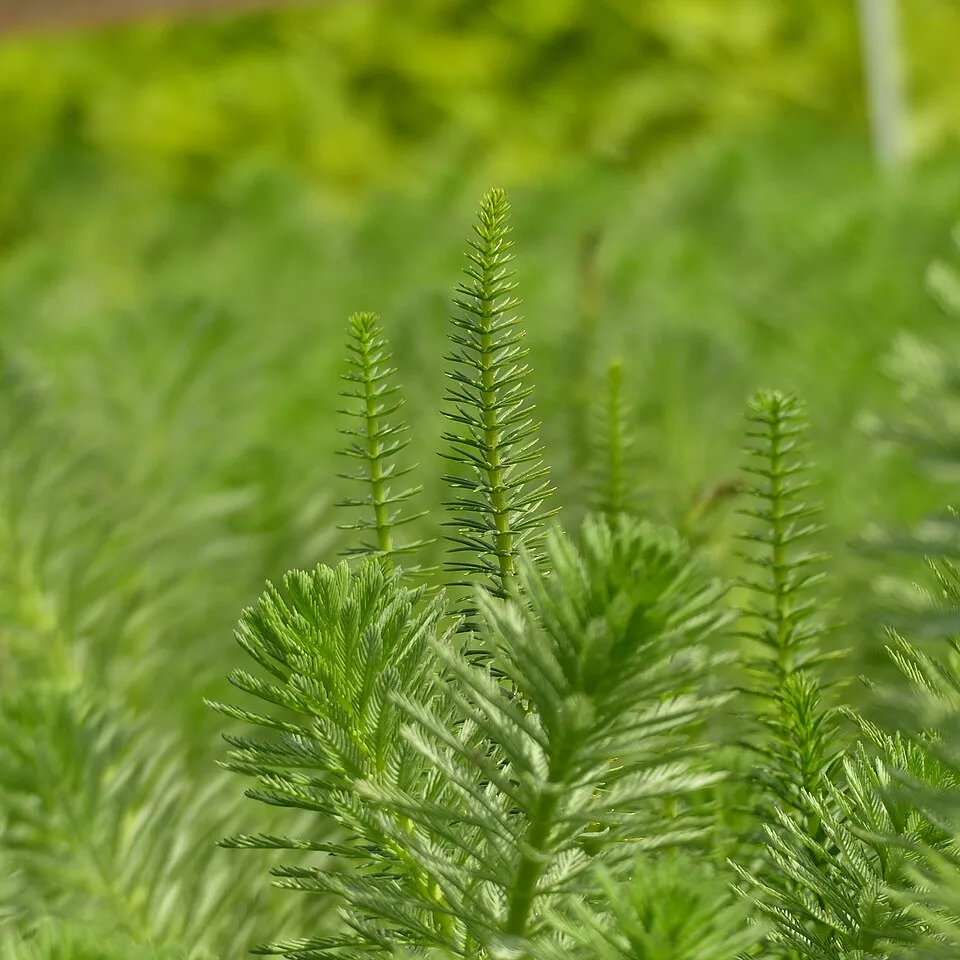
Myriophyllum aquaticum, commonly known as Parrot's Feather or Water Milfoil, is a remarkably vigorous perennial aquatic herb belonging to the Haloragaceae family. Native to the tranquil waters of the Amazon Basin in South America, particularly Brazil, this species has since naturalized and proliferated across numerous warm temperate and tropical regions globally, often becoming an invasive species due to its aggressive growth. Its distinctive morphology includes both submerged and emergent foliage. The submerged leaves are finely dissected and feathery, creating an intricate, fern-like appearance that contributes to underwater aesthetics.
Above the waterline, the emergent stems bear whorls of stiff, bright green leaves resembling miniature fir trees or stylized feathers, which can extend several inches to over a foot out of the water, forming dense, attractive mats. The plant anchors itself to the substrate via a robust rhizomatous root system, enabling it to form extensive colonies that can cover vast areas of pond bottoms or lake surfaces. While primarily valued for its ornamental appeal in aquariums and water gardens, Myriophyllum aquaticum also plays a significant ecological role. It provides vital habitat and shelter for various small aquatic organisms, aids in water oxygenation, and absorbs excess nutrients, thereby contributing to water clarity.
However, its rapid, unmanaged growth poses a substantial ecological challenge, as it can outcompete native aquatic vegetation, disrupt aquatic ecosystems, and obstruct waterways. Reproduction primarily occurs vegetatively through fragmentation, with small stem pieces readily developing new roots and establishing new plants, a key factor in its invasive success. Inconspicuous flowers may appear on emergent stems, but seed propagation is less common, especially outside its native range where most naturalized populations are female clones.
Trusted Scientific References
1. Authoritative external sources for Myriophyllum aquaticum
1.1 Wikipedia — Myriophyllum aquaticum
1.2 Kew POWO (Plants of the World Online)
1.3 PubMed — peer-reviewed research
1.4 NCBI Taxonomy Browser
1.5 GBIF — Global Biodiversity
1.1.Myriophyllum Aquaticum — Notable Characteristics
- ✓Feathery, finely dissected — Feathery, finely dissected submerged leaves.
- ✓Stiff, upright, emergent — Stiff, upright, emergent leaves resembling miniature fir trees.
- ✓Bright green foliage — Bright green foliage color.
- ✓Rhizomatous root system — Rhizomatous root system for anchoring and spread.
- ✓Forms dense, mat — like colonies on water surfaces.
- ✓Rapid and aggressive — Rapid and aggressive growth habit.
- ✓Adaptable to various — Adaptable to various freshwater conditions.
- ✓Primarily reproduces vegetatively — Primarily reproduces vegetatively via fragmentation.
- ✓Inconspicuous, small flowers. — Inconspicuous, small flowers.
- ✓Classified as an — Classified as an invasive species in many regions.
1.2.Myriophyllum Aquaticum — Concise Overview
- ✓Vigorous aquatic perennial native to the Amazon Basin, known for feathery foliage.
- ✓Widely cultivated ornamentally, but highly invasive in non-native environments.
- ✓Offers ecological benefits like oxygenation and nutrient absorption in water.
- ✓Young shoot tips are edible when cooked, but no known medicinal uses.
- ✓Reproduces primarily by fragmentation, making control challenging.
- ✓Requires careful management to prevent environmental harm and waterway obstruction.
2.Myriophyllum Aquaticum — Botanical Identity
3.Myriophyllum Aquaticum — Fact Sheet
4.Myriophyllum Aquaticum — Physical Description
5.Myriophyllum Aquaticum — Ecological Habitat
6.Myriophyllum Aquaticum — Heritage Uses
7.Myriophyllum Aquaticum — Chemical Profile
- ✓Undocumented Specific Phytochemistry — Comprehensive studies on the unique chemical constituents and specific bioactive compounds of Myriophyllum aquaticum are not widely published. Most available information pertains to its ecological role rather than its detailed phytochemical profile.
- ✓Flavonoids — As with many vascular plants, Myriophyllum aquaticum likely contains various flavonoids, which are known for their antioxidant, anti-inflammatory, and UV-protective properties, though specific compounds and their concentrations in this species are uncharacterized.
- ✓Phenolic Acids — Generic phenolic acids, commonly found in plant tissues, may be present in Parrot's Feather, contributing to general plant defense mechanisms and potential antioxidant activity, typical of plant secondary metabolism.
- ✓Terpenoids — Plants often produce terpenoids for defense against herbivores and pathogens, as well as for signaling. While not specifically identified, these compounds could hypothetically be present in low concentrations within Myriophyllum aquaticum.
- ✓Polysaccharides — Structural polysaccharides are fundamental components of plant cell walls, providing support and rigidity. Specific soluble polysaccharides might also contribute to the plant's physiological functions and ecological interactions.
- ✓Chlorophylls and Carotenoids — Essential for photosynthesis, these vibrant pigments are abundant in its green foliage, contributing to its color and light-harvesting capabilities, crucial for its aquatic survival.
- ✓Mineral Nutrients — As a vigorous aquatic plant, it actively absorbs and accumulates various macro- and micronutrients from its water environment, such as nitrogen, phosphorus, potassium, calcium, and magnesium, which are vital for its rapid growth and biomass production.
- ✓Lignins — These complex polymers provide structural support in plant cell walls, particularly in emergent stems, contributing to the plant's ability to grow upright out of the water.
8.Myriophyllum Aquaticum — Pharmacological Findings
- ✓No Established Direct Medicinal Use — Myriophyllum aquaticum is not widely documented in traditional or modern herbal medicine for direct human therapeutic benefits. Its primary roles are ecological and ornamental.
- ✓Ecological Water Purification — As a vigorous aquatic plant, Parrot's Feather efficiently absorbs excess nutrients like nitrates and phosphates from water bodies, contributing to improved water quality and clarity, which indirectly supports aquatic ecosystem health.
- ✓Habitat Provision for Aquatic Life — Its dense, feathery foliage provides crucial shelter, breeding grounds, and foraging areas for small fish, amphibians, and invertebrates, enhancing biodiversity and ecological stability in its aquatic habitat.
- ✓Oxygenation of Water — Through active photosynthesis, particularly with its submerged leaves, Myriophyllum aquaticum releases oxygen into the water, benefiting aquatic fauna and contributing to a healthier aquatic environment.
- ✓Potential for Bioactive Compound Research — While not currently recognized for medicinal use, many aquatic plants contain unique secondary metabolites. Myriophyllum aquaticum could be a subject for future phytochemical screening for novel compounds with potential pharmaceutical properties, though this is currently speculative and not established.
- ✓Ornamental Value — Widely cultivated for its striking visual appeal in water gardens, ponds, and aquaria, it offers aesthetic benefits and contributes to mental well-being through horticulture and the creation of serene environments.
- ✓Edible Young Shoots — In some regions, the young shoot tips of Parrot's Feather are gathered from the wild and consumed as a cooked vegetable, offering a minor dietary contribution and source of greens.
- ✓Bioremediation Potential — Its robust growth and efficient nutrient absorption capabilities suggest potential applications in phytoremediation efforts for contaminated aquatic environments, helping to mitigate pollution.
8.1.Myriophyllum Aquaticum — Indications & Uses
9.Myriophyllum Aquaticum — Safety & Side Effects
9.1.Myriophyllum Aquaticum — Reported Side Effects
- ✓Invasive Species Risk — Highly invasive outside its native range, rapidly outcompeting and displacing native aquatic vegetation.
- ✓Ecosystem Disruption — Forms dense mats that can reduce light penetration, alter water chemistry, and negatively impact native aquatic fauna.
- ✓Waterway Obstruction — Can clog irrigation channels, drainage ditches, and recreational waterways, impeding water flow and navigation.
- ✓Habitat Alteration — Dense growth can create anaerobic conditions at the water bottom, harming fish and other aquatic organisms.
- ✓Reproduction by Fragmentation — Even small plant fragments can root and grow, making eradication efforts challenging and promoting its spread.
- ✓Reduction of Biodiversity — Monocultures formed by Parrot's Feather significantly reduce the overall biodiversity of affected aquatic ecosystems.
- ✓Management Costs — Controlling its spread requires significant financial and labor resources for mechanical removal or herbicide application.
9.2.Myriophyllum Aquaticum — Toxicity Assessment
- ✓Non-Toxic for Consumption — Young shoots are considered edible when cooked and are not known to be toxic to humans.
- ✓Environmental Hazard — While not directly toxic to humans, its invasive nature poses a significant ecological threat, requiring careful management.
- ✓Skin Contact — Generally safe for skin contact, no known reports of dermal irritation or allergic reactions.
- ✓Pet Safety — No specific toxicity reported for common pets, but ingestion in large quantities is not recommended.
- ✓Water Quality — Can improve water quality by absorbing nutrients, but excessive growth can lead to oxygen depletion upon decomposition.
- ✓Handling Precautions — When managing its removal, especially in large quantities, wear gloves to prevent minor skin abrasions and to avoid spreading fragments.
- ✓Regulatory Status — Classified as a noxious weed in many regions, restricting its sale, transport, and cultivation to prevent ecological damage.
10.Myriophyllum Aquaticum — Preparation Methods
- ✓Ornamental Aquatic Plant — Widely used in water gardens, ponds, and aquariums for its attractive, feathery foliage and unique emergent growth habit.
- ✓Edible Preparation — Young shoot tips can be harvested, cooked, and consumed as a vegetable, typically blanched or stir-fried.
- ✓Water Feature Enhancement — Employed to add visual interest and texture to natural or artificial water features, creating a lush, green aesthetic.
- ✓Biofiltration in Ponds — Utilized in pond ecosystems to help absorb excess nutrients, contributing to water clarity and reducing algal blooms.
- ✓Habitat Creation — Planted to provide shelter and breeding grounds for small fish and invertebrates in managed aquatic environments.
- ✓Erosion Control — Can be used along the edges of small ponds or slow-moving streams to help stabilize banks and prevent erosion.
- ✓Aquarium Decoration — Placed in freshwater aquariums for its aesthetic appeal and ability to oxygenate the water for fish.
- ✓Educational Tool — Used in botanical gardens and educational settings to demonstrate aquatic plant biology and ecology.
11.Myriophyllum Aquaticum — How to Grow
- ✓Water Depth — Thrives in shallow to moderately deep freshwater, typically 15-60 cm (6-24 inches), but can grow in several meters of water.
- ✓Light Requirements — Prefers full sun to partial shade for optimal growth and vibrant foliage color.
- ✓Substrate — Best anchored in a rich, muddy substrate or fine gravel, though it can also float freely.
- ✓Temperature Tolerance — Adaptable to a wide range of temperatures, flourishing in tropical, subtropical, and warm temperate climates.
- ✓Propagation — Easily propagated from stem cuttings; even small fragments can root and establish new plants quickly.
- ✓Container Growing — Can be grown in submerged containers to manage its invasive spread in garden ponds.
- ✓Nutrient Levels — Tolerates and even thrives in nutrient-rich waters, efficiently absorbing excess nitrates and phosphates.
- ✓Maintenance — Requires regular pruning to control aggressive growth and prevent it from outcompeting other aquatic plants or clogging waterways.
Reviewed by the Flora Medical Global Botanical Review Panel
Multi-disciplinary editorial group · Botany · Ethnobotany · Herbal-medicine literature
Who reviewed this: This page was checked by the Flora Medical Global Botanical Review Panel — an in-house editorial group of botany graduates, ethnobotany researchers, and horticulture practitioners who collectively maintain our 7,000+ plant encyclopedia. Meet the team.
Our 4-step verification process
1. Taxonomic verification
Scientific names and synonyms cross-checked against Kew POWO, World Flora Online, and The Plant List.
2. Phytochemical & medicinal cross-reference
Active compounds, traditional uses, and reported activities are cross-referenced with PubMed, USDA Dr. Duke's database, and peer-reviewed ethnobotanical literature.
3. Conservation & distribution check
Distribution, ecology, and conservation status confirmed against GBIF occurrence records and the IUCN Red List.
4. Editorial & safety review
Every entry passes an editorial pass for clarity, originality, and safety notices (toxicity, contraindications, dosage caveats) before publication.
Last reviewed:
Important medical disclaimer: This content is for educational and research purposes only. It is not medical advice and is not a substitute for consultation with a licensed healthcare provider. Do not use any herb to self-treat a medical condition without professional guidance.
Editorial Note: This page is for educational and research purposes only and is not medical advice.
Written by: Flora Medical Global Editorial Team
Reviewed by: Flora Medical Global Botanical Review Panel
Last Updated: June 15, 2026





Myriophyllum Aquaticum — Comments & Community Reviews
Rate this plant