
Medical Disclaimer: This content is for educational purposes only. It is not medical advice. Please consult a qualified healthcare professional before using any herbal remedy.
Safety Overview
1.Nautilocalyx — Introduction & Highlights
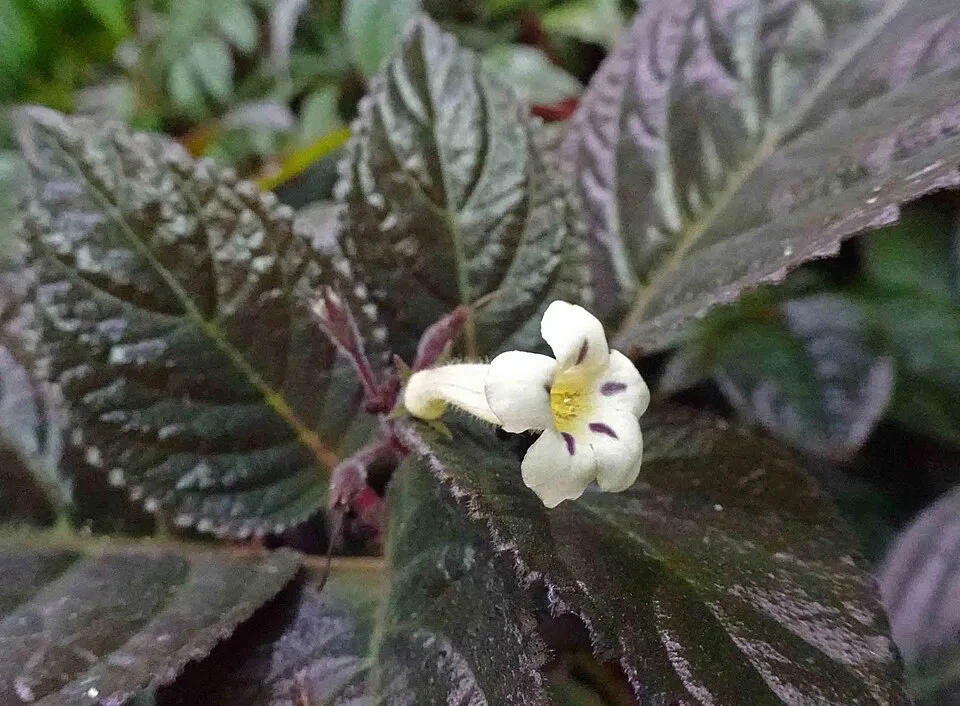
Nautilocalyx lynchii, affectionately known as the ‘Black Scallop’ or ‘Red-Back Gesneriad’, stands as a captivating member of the Gesneriaceae family, primarily celebrated for its dramatic foliage rather than its inconspicuous flowers. This species is indigenous to the humid, shaded understories of tropical rainforests in northern South America, with its native range extending across regions of Colombia, Venezuela, and Ecuador, where it typically thrives as a terrestrial or occasionally epiphytic plant.
Its classification in the late 19th and early 20th centuries highlighted its unique botanical characteristics, although detailed historical records regarding its traditional indigenous uses are notably limited compared to more widely recognized medicinal flora.
Botanically, Nautilocalyx lynchii is distinguished by its striking, elliptical to ovate leaves, which can measure between 10 to 20 cm in length. The adaxial, or upper, surface of these leaves exhibits a rich, velvety texture in shades of dark green to almost black, dramatically contrasted by a vibrant reddish-purple hue on the abaxial, or lower, surface. This spectacular coloration, combined with deeply impressed veins that create a puckered or scalloped appearance, renders it a highly prized ornamental plant.
Its moderate growth habit and specific requirements for consistently warm temperatures, high humidity, and moderate indirect light make it an exceptional choice for cultivation in terrariums, vivariums, or as a distinctive potted indoor specimen in temperate climates. While direct scientific research into Nautilocalyx lynchii’s medicinal applications is still nascent, the presence of various secondary metabolites, such as flavonoids and phenolic compounds, is highly probable, suggesting potential avenues for future phytochemical and pharmacological exploration within its family.
Trusted Scientific References
1. Authoritative external sources for Nautilocalyx lynchii
1.1 Wikipedia — Nautilocalyx lynchii
1.2 Kew POWO (Plants of the World Online)
1.3 PubMed — peer-reviewed research
1.4 NCBI Taxonomy Browser
1.5 GBIF — Global Biodiversity
1.1.Nautilocalyx — Standout Qualities
- ✓Striking Bicolor Foliage — Dark green to black above, reddish-purple below.
- ✓Velvety Leaf Texture — Distinctive soft, tactile feel on the upper leaf surface.
- ✓Scalloped Leaf Appearance — Deeply impressed veins create a unique puckered look.
- ✓Tropical Rainforest Native — Indigenous to the understory of South American humid forests.
- ✓Understory Growth Habit — Adapted to low-light conditions beneath a dense canopy.
- ✓Terrestrial or Epiphytic — Can grow in soil or on other plants in its natural habitat.
- ✓High Humidity Requirement — Essential for optimal growth and leaf health.
- ✓Moderate Indirect Light Preference — Avoids direct sunlight to prevent leaf damage.
- ✓Ideal for Terrariums/Vivariums — Thrives in enclosed, humid environments.
- ✓Member of Gesneriaceae Family — Related to African Violets and Gloxinias.
1.2.Nautilocalyx — Quick Summary
- ✓Distinctive Bicolor Foliage — Velvety dark green/black upper surface with a reddish-purple underside.
- ✓Tropical Rainforest Native — Originates from humid understories of northern South America.
- ✓Primarily Ornamental — Valued for its aesthetic appeal in terrariums and indoor environments.
- ✓Limited Medicinal Research — Specific uses for N. lynchii are largely unexplored.
- ✓Probable Phytochemicals — Contains anticipated flavonoids and phenolic compounds.
- ✓Requires High Humidity — Thrives in warm, moist conditions with indirect light.
2.Nautilocalyx — Systematic Position
3.Nautilocalyx — Reference Facts
4.Nautilocalyx — Plant Morphology
5.Nautilocalyx — Habitat & Distribution
6.Nautilocalyx — Cultural & Traditional Roles
7.Nautilocalyx — Active Compounds
- ✓Flavonoids — Likely present, including derivatives of quercetin and kaempferol, known for their potent antioxidant and anti-inflammatory actions.
- ✓Phenolic Acids — Compounds such as caffeic acid, ferulic acid, and chlorogenic acid are anticipated, contributing to the plant's antioxidant capacity and potentially antimicrobial effects.
- ✓Anthocyanins — Responsible for the striking reddish-purple coloration on the abaxial leaf surface, these pigments are powerful antioxidants.
- ✓Saponins — Possible presence; these glycosides can have emulsifying properties and are sometimes associated with anti-inflammatory or immunomodulatory activities.
- ✓Triterpenes — Common in many plant species, triterpenes may contribute anti-inflammatory and adaptogenic properties.
- ✓Tannins — Expected to be present in trace amounts, offering potential astringent and antimicrobial qualities.
- ✓Glycosides — Various types of glycosides, beyond saponins, may exist, which could contribute to diverse biological activities depending on their aglycone structures.
- ✓Carotenoids — Minor pigments that could be present, acting as antioxidants and contributing to overall plant health and defense mechanisms.
- ✓Volatile Organic Compounds — Trace amounts of terpenoids or other volatile compounds might be present, potentially influencing the plant's aroma or defense against pests.
8.Nautilocalyx — Research Insights
- ✓Potential Antioxidant Activity — Hypothetically, the presence of flavonoids and phenolic acids may confer free radical scavenging capabilities, protecting cells from oxidative damage.
- ✓Possible Anti-inflammatory Effects — Compounds like flavonoids often exhibit anti-inflammatory properties, which could potentially modulate inflammatory responses in the body.
- ✓Hypothetical Antimicrobial Properties — Many plants produce secondary metabolites that act against bacteria and fungi, suggesting N. lynchii might possess similar defense mechanisms.
- ✓Anticipated Dermatological Support — Should soothing compounds be present, topical applications could potentially aid in minor skin irritations or promote skin health, though unproven.
- ✓Immunomodulatory Potential — Certain plant compounds can influence immune system function, and future research might uncover such effects in N. lynchii or its extracts.
- ✓Cardioprotective Indications (Speculative) — Flavonoids are widely studied for their benefits to cardiovascular health, offering a speculative link for N. lynchii's phytochemical profile.
- ✓Neuroprotective Avenues (Exploratory) — Phenolic compounds frequently demonstrate neuroprotective effects, presenting a possible research direction for this plant.
- ✓Wound Healing Modalities (Undocumented) — General plant extracts are often used for wound care; if N. lynchii contains relevant compounds, this could be a future application.
- ✓Antiviral Activity (Unconfirmed) — Some plant constituents possess antiviral properties, leading to a theoretical basis for investigating N. lynchii in this area.
8.1.Nautilocalyx — Indications & Uses
9.Nautilocalyx — Precautions & Warnings
9.1.Nautilocalyx — Reported Side Effects
- ✓Skin Irritation — Direct contact with sap or leaves may cause mild skin irritation or dermatitis in sensitive individuals.
- ✓Allergic Reactions — As with many plants, susceptible persons may experience allergic responses, such as itching or rash, upon contact.
- ✓Gastrointestinal Upset — Accidental ingestion of any part of the plant is not recommended and could lead to mild digestive discomfort.
- ✓Unknown Systemic Toxicity — Due to limited research, the potential for systemic toxicity from ingestion remains largely unstudied.
- ✓Interaction with Medications — If bioactive compounds are present and ingested, hypothetical interactions with pharmaceutical drugs could occur.
- ✓Photosensitivity — While not documented, some plant compounds can induce skin sensitivity to light, a possibility that cannot be entirely ruled out.
- ✓Mucous Membrane Irritation — Handling or processing the plant without protection could potentially irritate eyes or other mucous membranes.
9.2.Nautilocalyx — Clinical Safety Notes
- ✓Strictly Ornamental Use — Nautilocalyx lynchii is primarily an ornamental plant and is not recommended for internal consumption.
- ✓Keep Away from Children and Pets — Ensure the plant is out of reach to prevent accidental ingestion, as its safety profile for consumption is unknown.
- ✓Handle with Care — Individuals with sensitive skin or known plant allergies should wear gloves when handling the plant to avoid potential irritation.
- ✓Consult a Professional — Always seek advice from a qualified healthcare provider or toxicologist before considering any internal or external application.
- ✓Limited Research — Specific safety data, toxicology, and drug interactions for N. lynchii are not established.
- ✓No Documented Medicinal Claims — Do not use this plant for self-medication as its therapeutic efficacy and safety are not clinically proven.
- ✓Avoid Ingestion — Given the lack of research, ingesting any part of Nautilocalyx lynchii is strongly advised against.
10.Nautilocalyx — Application Forms
- ✓Ornamental Cultivation — Primarily grown as an ornamental plant for its striking foliage in indoor settings, terrariums, and vivariums.
- ✓Botanical Study Specimen — Utilized in botanical gardens and research institutions for taxonomic, ecological, and horticultural studies.
- ✓Phytochemical Exploration — Raw plant material can be subjected to laboratory extraction for screening and isolation of secondary metabolites.
- ✓Educational Display — Serves as an excellent educational plant to showcase unique tropical foliage and plant adaptations.
- ✓Bioactive Compound Isolation — Extracts can be further fractionated to isolate specific compounds for detailed chemical and pharmacological analysis.
- ✓Environmental Enrichment — Used in enclosed environments like vivariums to provide aesthetic appeal and microhabitat complexity for certain fauna.
- ✓Future Herbal Preparations (Hypothetical) — If research supports, extracts might be developed into topical applications or other forms.
11.Nautilocalyx — Growing Guide
- ✓Light — Provide moderate to bright indirect light; direct sunlight can scorch the distinctive foliage.
- ✓Humidity — Requires high humidity, ideally between 70-80%, making it suitable for terrariums or humid indoor environments.
- ✓Temperature — Thrives in warm conditions, with an optimal range of 18-27°C (65-80°F).
- ✓Watering — Keep the soil consistently moist but never waterlogged; allow the top inch to dry slightly between waterings.
- ✓Soil — Use a well-draining, aerated potting mix rich in organic matter, such as a peat-based mix with perlite.
- ✓Fertilization — Fertilize sparingly during the growing season (spring and summer) with a diluted balanced liquid fertilizer.
- ✓Propagation — Easily propagated from stem cuttings, which root readily in high humidity conditions.
- ✓Acclimation — Plants grown in high humidity may need gradual acclimation to average home humidity if not placed in a terrarium.
Reviewed by the Flora Medical Global Botanical Review Panel
Multi-disciplinary editorial group · Botany · Ethnobotany · Herbal-medicine literature
Who reviewed this: This page was checked by the Flora Medical Global Botanical Review Panel — an in-house editorial group of botany graduates, ethnobotany researchers, and horticulture practitioners who collectively maintain our 7,000+ plant encyclopedia. Meet the team.
Our 4-step verification process
1. Taxonomic verification
Scientific names and synonyms cross-checked against Kew POWO, World Flora Online, and The Plant List.
2. Phytochemical & medicinal cross-reference
Active compounds, traditional uses, and reported activities are cross-referenced with PubMed, USDA Dr. Duke's database, and peer-reviewed ethnobotanical literature.
3. Conservation & distribution check
Distribution, ecology, and conservation status confirmed against GBIF occurrence records and the IUCN Red List.
4. Editorial & safety review
Every entry passes an editorial pass for clarity, originality, and safety notices (toxicity, contraindications, dosage caveats) before publication.
Last reviewed:
Important medical disclaimer: This content is for educational and research purposes only. It is not medical advice and is not a substitute for consultation with a licensed healthcare provider. Do not use any herb to self-treat a medical condition without professional guidance.
Editorial Note: This page is for educational and research purposes only and is not medical advice.
Written by: Flora Medical Global Editorial Team
Reviewed by: Flora Medical Global Botanical Review Panel
Last Updated: June 15, 2026





Nautilocalyx — Comments & Community Reviews
Rate this plant