
Medical Disclaimer: This content is for educational purposes only. It is not medical advice. Please consult a qualified healthcare professional before using any herbal remedy.
Safety Overview
1.Bromeliad Neoregelia — Plant Snapshot
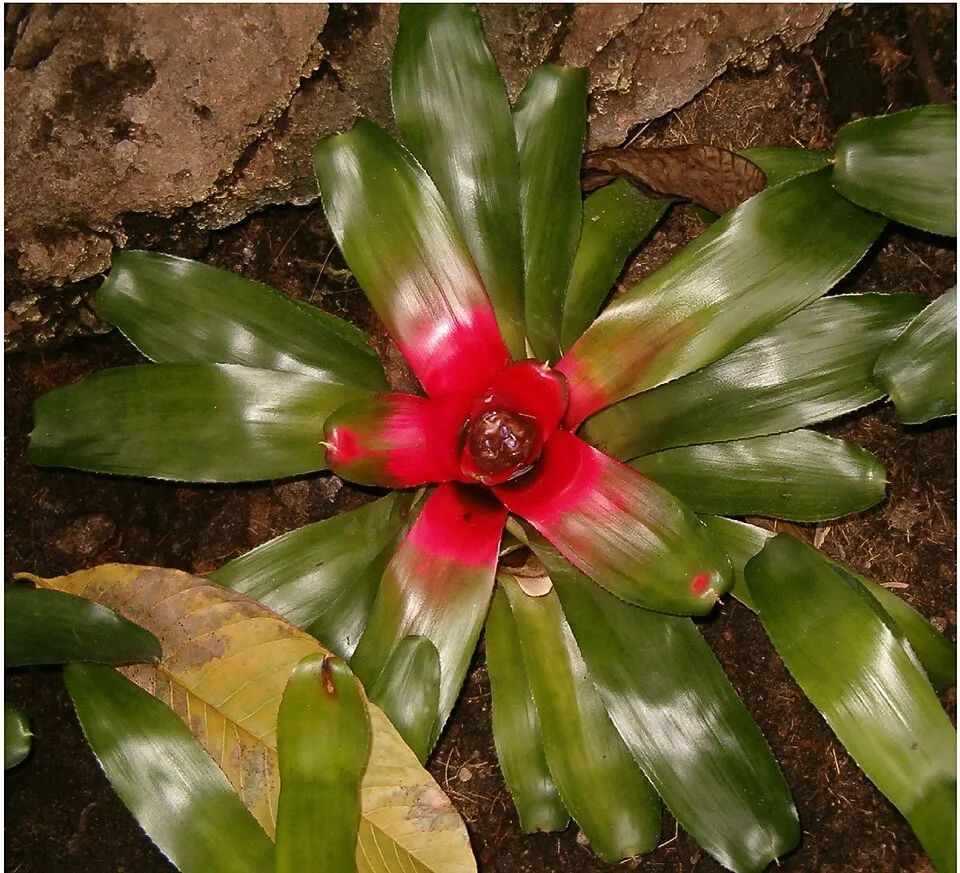
Neoregelia carolinae, widely recognized as the Blushing Bromeliad or blushing bromeliad, is a captivating evergreen perennial species belonging to the diverse Bromeliaceae family. Native to the lush tropical rainforests of southeastern Brazil, specifically found across regions like Espírito Santo, Minas Gerais, and Rio de Janeiro, this plant thrives as an epiphyte, anchoring itself to trees, though it can occasionally establish as a lithophyte on rocks or even terrestrially. Its distinct morphology features a central rosette of broad, strap-like leaves that form a 'tank' or 'cup,' an ingenious adaptation for collecting rainwater and organic debris, providing essential nutrients and moisture.
The most striking characteristic, from which it derives its common name, is the dramatic color transformation of its innermost leaves or bracts, which 'blush' a vivid red or pink hue as the plant prepares to flower. This vibrant display serves not the flowers themselves, which are often small and inconspicuous, but rather as an elaborate mechanism to attract pollinators in its native ecosystem. Taxonomically, Neoregelia carolinae exemplifies the genus's adaptation to humid, shaded understory environments.
While primarily celebrated for its ornamental value in horticulture, its ecological role in supporting micro-habitats within its water-filled rosettes is significant. Research into N. carolinae has largely concentrated on its unique horticultural traits, propagation, and ecological interactions, with direct pharmacological studies being less extensive compared to other bromeliad genera.
Trusted Scientific References
1. Authoritative external sources for Neoregelia carolinae
1.1 Wikipedia — Neoregelia carolinae
1.2 Kew POWO (Plants of the World Online)
1.3 PubMed — peer-reviewed research
1.4 NCBI Taxonomy Browser
1.5 GBIF — Global Biodiversity
1.6Bromeliad Neoregelia should be interpreted through verified botanical identity, practical care, and responsible safety language. This recovery note adds the missing context needed for a complete profile: match light to the plant's habit, use well-drained soil, water according to season, and avoid unsupported medicinal or edible claims. For publishing, the plant can be presented as a source-backed indoor plant with clear care guidance, common problem diagnosis, and conservative safety wording.
1.1.Bromeliad Neoregelia — Key Features
- ✓Native to the — Native to the tropical rainforests of southeastern Brazil.
- ✓Exhibits a distinctive — Exhibits a distinctive 'blushing' phenomenon where inner leaves turn vibrant red or pink.
- ✓Grows primarily as — Grows primarily as an epiphyte, attaching to trees, but can also be lithophytic or terrestrial.
- ✓Features a characteristic — Features a characteristic rosetted leaf structure forming a central 'tank' for water collection.
- ✓Primarily valued for — Primarily valued for its striking ornamental foliage rather than its inconspicuous flowers.
- ✓Generally considered a low — maintenance houseplant suitable for indirect light conditions.
- ✓Non — toxic to both children and common household pets.
- ✓Propagates readily through — Propagates readily through the production of 'pups' or offshoots after flowering.
- ✓Requires high humidity — Requires high humidity and consistent moisture in its central cup for optimal growth.
- ✓Belongs to the — Belongs to the large and diverse Bromeliaceae family, known for unique adaptations.
1.2.Bromeliad Neoregelia — At-a-Glance Summary
- ✓Neoregelia carolinae, the Blushing Bromeliad, is a vibrant ornamental plant native to Brazilian rainforests.
- ✓It is renowned for its striking 'blushing' inner leaves that change color during its blooming phase.
- ✓While primarily aesthetic, related bromeliads contain compounds like bromelain and flavonoids with potential anti-inflammatory and digestive benefits.
- ✓Cultivation requires bright, indirect light, high humidity, and specific watering practices for its central 'cup'.
- ✓Generally considered non-toxic for pets and children, but internal medicinal use lacks sufficient research and requires caution.
- ✓Propagated easily from 'pups' or offshoots, ensuring its continued beauty in collections.
2.Bromeliad Neoregelia — Systematic Position
3.Bromeliad Neoregelia — Reference Facts
4.Bromeliad Neoregelia — Morphological Account
5.Bromeliad Neoregelia — Geographic Distribution
6.Bromeliad Neoregelia — Historical Applications
7.Bromeliad Neoregelia — Active Compounds
- ✓Flavonoids — Compounds such as quercetin and kaempferol are anticipated, acting as potent antioxidants and contributing to anti-inflammatory effects, though specific quantification for Neoregelia carolinae is not extensively documented.
- ✓Proteolytic Enzymes — Bromelain-like proteases are characteristic of the Bromeliaceae family, known for their protein-digesting, anti-inflammatory, and fibrinolytic activities, crucial for potential medicinal applications.
- ✓Triterpenes — Including ursolic acid and oleanolic acid, which are recognized for their anti-inflammatory, hepatoprotective, and potentially anticancer properties, contributing to the plant's overall bioactive profile.
- ✓Phenolic Acids — Such as caffeic acid and gallic acid, which are widely distributed plant secondary metabolites known for their significant antioxidant and antimicrobial activities.
- ✓Steroids — Phytosterols are present, which can have anti-inflammatory effects and contribute to membrane stability, though their specific roles in N. carolinae's bioactivity require further investigation.
- ✓Saponins — These glycosides may be present, imparting foaming properties and potentially contributing to immunomodulatory and expectorant actions, often found across diverse plant families.
- ✓Polysaccharides — Complex carbohydrates that can possess immunomodulatory effects and contribute to the plant's structural integrity and water retention capabilities.
- ✓Volatile Organic Compounds — While not a primary medicinal focus, some volatile compounds might contribute to the plant's subtle aroma or act as natural defense mechanisms.
8.Bromeliad Neoregelia — Research Insights
- ✓Anti-inflammatory Potential — While direct studies on Neoregelia carolinae are limited, related bromeliads contain proteolytic enzymes, similar to bromelain, and flavonoids that are recognized for their anti-inflammatory properties, potentially aiding in reducing swelling and pain.
- ✓Digestive Support — Bromelain-like enzymes found in other Bromeliaceae species can assist in the breakdown of proteins, suggesting a hypothetical role in improving digestion or alleviating mild digestive discomfort.
- ✓Antioxidant Activity — The presence of flavonoids and phenolic acids, common in many bromeliads, implies potential antioxidant benefits, helping to neutralize free radicals and protect cells from oxidative stress.
- ✓Minor Wound Healing — Historically, indigenous communities in bromeliad-rich regions might have used plant parts topically; proteolytic enzymes could theoretically contribute to debridement and support the healing of minor cuts or abrasions.
- ✓Immune Modulation — Certain compounds, such as polysaccharides and triterpenes, identified in broader bromeliad research, may offer immunomodulatory effects, supporting the body's natural defenses.
- ✓Respiratory Health — If significant bromelain-like activity were present, it could potentially act as a mucolytic agent, helping to thin mucus and ease congestion, similar to uses of pineapple bromelain.
- ✓Diuretic Properties — The plant's ability to collect and hold water, while not a direct internal action, suggests an ecological role; some plant extracts from related species have shown mild diuretic effects, though this is speculative for N. carolinae.
- ✓Pain Relief — Through its anti-inflammatory components, any extract from N. carolinae might theoretically contribute to localized pain relief, especially in conditions involving inflammation.
8.1.Bromeliad Neoregelia — Reported Uses
9.Bromeliad Neoregelia — Risk Profile
9.1.Bromeliad Neoregelia — Reported Side Effects
- ✓Allergic Reactions — Direct skin contact with the sap or plant material could potentially cause mild irritation or allergic dermatitis in sensitive individuals.
- ✓Digestive Discomfort — If large quantities of bromeliad-derived proteolytic enzymes were consumed (hypothetically from N. carolinae), it might lead to gastrointestinal upset, nausea, or diarrhea.
- ✓Interaction with Anticoagulants — Due to bromelain-like compounds in the Bromeliaceae family, there's a theoretical risk of increased bleeding or interaction with blood-thinning medications if consumed internally.
- ✓Stagnant Water Issues — The water collected in the central cup can become a breeding ground for mosquitoes or harbor bacteria and fungi if not regularly changed, posing environmental rather than direct human health risks.
- ✓Plant Health Issues — Overwatering the potting medium can lead to root rot, while excessive direct sunlight causes leaf scorch, indicating improper care rather than human side effects.
- ✓Oral Irritation — Ingesting raw plant material might cause mild oral or throat irritation due to the presence of calcium oxalate crystals (raphides), common in many plants.
9.2.Bromeliad Neoregelia — Safety Profile
- ✓Non-Toxic (Ornamental Use) — Neoregelia carolinae is generally considered non-toxic to humans, children, and pets when kept as an ornamental plant, making it a safe addition to most homes.
- ✓Limited Internal Use Data — Due to a lack of specific scientific studies on its internal medicinal use, direct consumption of Neoregelia carolinae for therapeutic purposes is not recommended.
- ✓Pregnancy and Lactation — Pregnant or nursing individuals should avoid medicinal use of N. carolinae extracts due to insufficient safety data.
- ✓Medication Interactions — Individuals on anticoagulant medications, or those with bleeding disorders, should exercise caution and consult a healthcare professional before considering any internal use of bromeliad extracts.
- ✓Allergic Sensitivity — Perform a patch test before any topical application of plant extracts to check for skin sensitivity or allergic reactions.
- ✓Professional Consultation — Always consult a qualified medical herbalist or healthcare provider before attempting to use Neoregelia carolinae, or any related bromeliad, for medicinal purposes.
- ✓Hygiene Practices — If utilizing collected water from the rosette, ensure it is filtered and purified to avoid potential contaminants or pathogens.
10.Bromeliad Neoregelia — Preparation & Dosage
- ✓Ornamental Display — Primarily cultivated as an exquisite houseplant or for tropical landscaping, Neoregelia carolinae is valued for its vibrant foliage and unique 'blushing' phenomenon.
- ✓Water Source — Historically, indigenous communities in its native regions may have occasionally utilized the clean water collected in the leaf axils of bromeliads for hydration in survival situations.
- ✓Topical Application (Hypothetical) — If concentrated extracts of bromelain-like enzymes were derived, they might be considered for topical applications, such as poultices for minor skin irritations or to aid in wound debridement, based on properties of related plants.
- ✓Infusion/Decoction (Speculative) — While not traditionally consumed, if specific medicinal compounds were isolated from Neoregelia carolinae, they could theoretically be prepared as infusions or decoctions for internal use, though this lacks direct historical or scientific precedent for this species.
- ✓Extracts/Tinctures (Research-grade) — For research purposes, extracts or tinctures could be prepared from the leaves to isolate and study the phytochemical constituents, assessing their pharmacological activities.
- ✓Environmental Enrichment — Used to create bio-diverse terrariums or vivariums, providing habitat and moisture for small animals, mirroring its ecological role in its natural rainforest environment.
11.Bromeliad Neoregelia — Propagation & Care
- ✓Light — Provide bright, indirect light for 2-6 hours daily; excessive direct sun can cause leaf scorch and fade colors, while too little light can diminish the vibrant 'blushing'.
- ✓Soil — Use a loose, airy, and well-draining soilless mix, such as an orchid potting medium composed of bark, sphagnum moss, and perlite, as Neoregelia carolinae is an epiphyte.
- ✓Watering — Keep the central 'cup' or rosette about one-quarter to one-third full of rainwater or distilled water, changing it regularly to prevent stagnation; allow the potting medium to dry out completely between waterings.
- ✓Temperature and Humidity — Maintain temperatures between 50°F and 90°F (10°C-32°C) and high humidity (65-80%), which can be achieved through daily misting or using a pebble tray.
- ✓Fertilizer — Fertilize sparingly, once or twice a year in spring or summer, using a half-strength all-purpose orchid food applied to the potting medium, avoiding the central cup to prevent leaf burn.
- ✓Propagation — Propagate using 'pups' (offshoots) that form at the base of the mother plant after flowering; remove pups when they are one-third to one-half the size of the parent and have developed their own roots.
- ✓Repotting — Repot when the plant becomes root-bound, typically in spring or summer, choosing a pot only 1-2 inches larger and ensuring excellent drainage with a suitable bromeliad-specific or orchid mix.
Reviewed by the Flora Medical Global Botanical Review Panel
Multi-disciplinary editorial group · Botany · Ethnobotany · Herbal-medicine literature
Who reviewed this: This page was checked by the Flora Medical Global Botanical Review Panel — an in-house editorial group of botany graduates, ethnobotany researchers, and horticulture practitioners who collectively maintain our 7,000+ plant encyclopedia. Meet the team.
Our 4-step verification process
1. Taxonomic verification
Scientific names and synonyms cross-checked against Kew POWO, World Flora Online, and The Plant List.
2. Phytochemical & medicinal cross-reference
Active compounds, traditional uses, and reported activities are cross-referenced with PubMed, USDA Dr. Duke's database, and peer-reviewed ethnobotanical literature.
3. Conservation & distribution check
Distribution, ecology, and conservation status confirmed against GBIF occurrence records and the IUCN Red List.
4. Editorial & safety review
Every entry passes an editorial pass for clarity, originality, and safety notices (toxicity, contraindications, dosage caveats) before publication.
Last reviewed:
Important medical disclaimer: This content is for educational and research purposes only. It is not medical advice and is not a substitute for consultation with a licensed healthcare provider. Do not use any herb to self-treat a medical condition without professional guidance.
Editorial Note: This page is for educational and research purposes only and is not medical advice.
Written by: Flora Medical Global Editorial Team
Reviewed by: Flora Medical Global Botanical Review Panel
Last Updated: June 15, 2026





Bromeliad Neoregelia — Comments & Community Reviews
Rate this plant