
Medical Disclaimer: This content is for educational purposes only. It is not medical advice. Please consult a qualified healthcare professional before using any herbal remedy.
Safety Overview
1.Nepenthes Rajah — Plant Snapshot
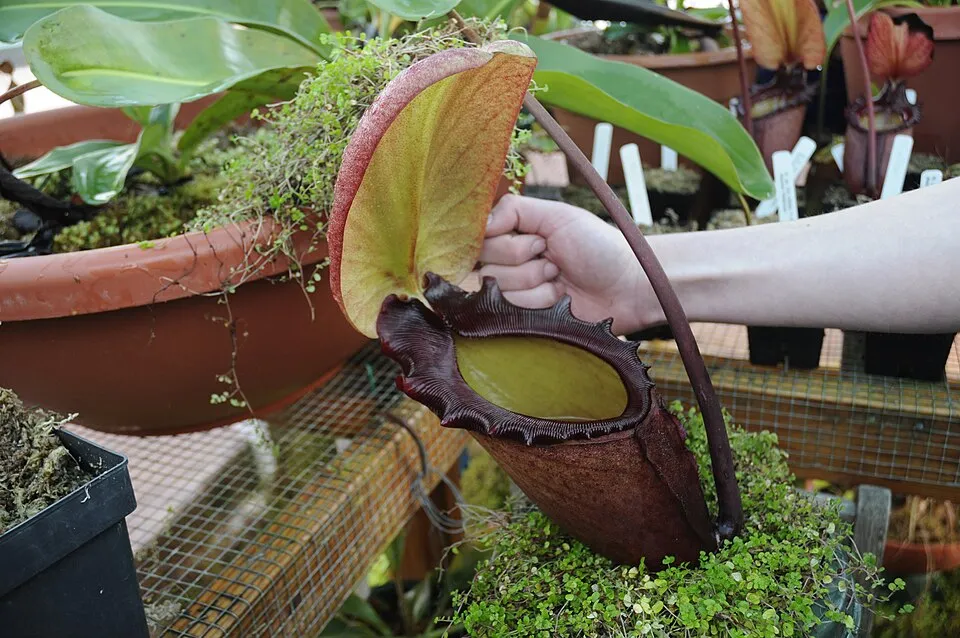
Nepenthes rajah, commonly known as the Rajah Pitcher Plant, is a truly magnificent and iconic carnivorous species endemic to the highlands of Borneo, specifically found on Mount Kinabalu and Mount Tambuyukon. This montane denizen thrives in mossy forests and open, disturbed areas at elevations ranging from 1,500 to 2,700 meters, where it experiences distinct warm days and cool nights. The plant is renowned for producing the largest pitchers within the Nepenthes genus, which can easily contain over a liter of digestive fluid. These striking pitchers, often exhibiting deep green to reddish-brown hues, can reach up to 30 cm in height and 16 cm in width, making them capable of trapping a broad spectrum of prey, including large insects and occasionally small vertebrates.
Its robust morphology includes an extensive root system, elongated and slender leaves up to 50 cm, and vines that can exceed 1.6 meters in length with a diameter of up to 1.3 meters in mature specimens. The upper parts of the leaves and pitcher peristomes often feature a waxy, slippery texture that aids in the insect-trapping mechanism. N. rajah produces small, yellowish, inconspicuous flowers arranged in a racemose inflorescence, with individual plants being either male or female (dioecious).
This species prefers well-drained, acidic soil rich in organic matter, mimicking its natural, nutrient-poor habitat. Its unique features and ecological adaptations make it a prime subject for botanical study and a highly prized, albeit challenging, specimen for dedicated horticulturists.
Trusted Scientific References
1. Authoritative external sources for Nepenthes rajah
1.1 Wikipedia — Nepenthes rajah
1.2 Kew POWO (Plants of the World Online)
1.3 PubMed — peer-reviewed research
1.4 NCBI Taxonomy Browser
1.5 GBIF — Global Biodiversity
1.6Nepenthes Rajah should be interpreted through verified botanical identity, practical care, and responsible safety language. This recovery note adds the missing context needed for a complete profile: match light to the plant's habit, use well-drained soil, water according to season, and avoid unsupported medicinal or edible claims. For publishing, the plant can be presented as a source-backed indoor plant with clear care guidance, common problem diagnosis, and conservative safety wording.
1.1.Nepenthes Rajah — Key Features
- ✓Gigantic Pitchers — Produces the largest pitchers in the Nepenthes genus, often exceeding 30 cm and holding over a liter of fluid.
- ✓Carnivorous Adaptation — Effectively traps and digests insects and small vertebrates using its unique pitcher structures.
- ✓Montane Highland Habitat — Exclusively found in high-altitude mossy forests of Borneo, demanding specific temperature and humidity.
- ✓Distinctive Morphology — Features elongated leaves, a waxy pitcher peristome, and vibrant green to reddish-brown coloration.
- ✓Dioecious Reproduction — Individual plants are either male or female, necessitating both for true species seed production.
- ✓Extensive Root System — Develops a broad and deep root network, requiring ample potting space for optimal growth.
- ✓High Humidity Requirement — Depends on consistently high relative humidity (75%+) for healthy pitcher development.
- ✓Slow Maturation Rate — Takes several years to reach appreciable size and maturity, even under ideal growing conditions.
- ✓Ecological Keystone Species — Plays a significant role in its native ecosystem by regulating insect populations.
- ✓Horticultural Challenge — Considered one of the most demanding Nepenthes species to cultivate, requiring expert care.
1.2.Nepenthes Rajah — At-a-Glance Summary
- ✓King of Pitcher Plants — Renowned for its enormous, fluid-filled pitchers capable of trapping large prey.
- ✓Endemic to Borneo — Native exclusively to the highlands of Mount Kinabalu and Mount Tambuyukon.
- ✓Critically Endangered Status — Listed under CITES Appendix I, emphasizing its extreme conservation priority.
- ✓Specialized Cultivation Needs — Requires precise environmental conditions including cool nights, high humidity, and specific substrates.
- ✓Primarily Ornamental/Ecological — Valued for its unique morphology and role in its ecosystem, not a primary medicinal plant.
- ✓Rich in Digestive Enzymes — Pitcher fluid contains potent proteolytic enzymes, a subject of scientific interest.
2.Nepenthes Rajah — Scientific Profile
3.Nepenthes Rajah — Botanical Stats
4.Nepenthes Rajah — Morphological Account
5.Nepenthes Rajah — Where It Grows
6.Nepenthes Rajah — Historical Applications
7.Nepenthes Rajah — Bioactive Constituents
- ✓Proteolytic Enzymes — Pitcher fluid of Nepenthes rajah is rich in aspartic proteases, such as nepenthesin I and II, crucial for the digestion of captured prey and a focus of biochemical research.
- ✓Organic Acids — Various organic acids, including formic acid, malic acid, and citric acid, contribute to the highly acidic environment (pH 2-4) within the pitchers, aiding in the breakdown of prey.
- ✓Flavonoids — Polyphenolic compounds like quercetin derivatives, known for their antioxidant and anti-inflammatory properties, are likely present in the leaves and pitchers, contributing to plant defense.
- ✓Phenolic Acids — Derivatives of benzoic and cinnamic acids, such as gallic acid and caffeic acid, are expected to be found, offering antioxidant and astringent qualities.
- ✓Terpenoids — A diverse group of organic compounds, including monoterpenes and sesquiterpenes, which can contribute to plant defense mechanisms and potential aromatic properties.
- ✓Anthocyanins — Pigments responsible for the vibrant reddish-brown coloration seen in some pitchers, these compounds are also recognized for their potent antioxidant activity.
- ✓Waxes and Cuticular Lipids — Present on the waxy surfaces of leaves and pitcher peristomes, these lipids play a critical role in moisture retention and the physical trapping of insects.
- ✓Lignans — Plant compounds with potential antioxidant and phytoestrogenic activities, which may be part of the complex phytochemical profile.
- ✓Alkaloids — While less prominent in carnivorous plants, some nitrogen-containing alkaloids may be present in trace amounts, often associated with defense mechanisms.
- ✓Saponins — Glycosides that can exhibit foam-forming properties and various biological activities, including potential antimicrobial effects.
8.Nepenthes Rajah — Research Insights
- ✓Digestive Enzyme Source — Pitcher fluid contains potent proteolytic enzymes, such as nepenthesin, which are highly efficient in breaking down proteins, making it a subject of biochemical research for potential industrial or therapeutic applications.
- ✓Antimicrobial Potential — Secondary metabolites found in Nepenthes rajah, like various phenolics and flavonoids, may exhibit antimicrobial properties against bacteria and fungi, warranting further scientific investigation.
- ✓Anti-inflammatory Properties — Certain phytochemicals present in the plant are known to possess anti-inflammatory effects, offering a potential area for future pharmacological studies, though not specific to N. rajah.
- ✓Antioxidant Activity — The presence of flavonoids and phenolic acids suggests that Nepenthes rajah may offer antioxidant benefits, crucial for neutralizing free radicals, a common characteristic of many plant species.
- ✓Metabolic Research Interest — Its unique adaptations to nutrient-poor, high-altitude environments make it a valuable subject for studying plant metabolism and stress physiology, providing insights into novel biochemical pathways.
- ✓Bioactive Compound Discovery — As a unique carnivorous plant thriving in extreme conditions, N. rajah is a potential source for discovering novel bioactive compounds with uncharacterized pharmacological activities.
- ✓Traditional Digestive Aid (Genus-specific) — While not specifically for N. rajah, other Nepenthes species have been traditionally utilized in indigenous medicine systems like TCM and Ayurveda for their purported digestive benefits.
- ✓Ecological Pest Control — In its natural habitat, the plant plays a significant role in controlling insect populations, offering an ecological benefit rather than direct human medicinal use.
- ✓Potential for Wound Healing Research — Extracts from some plants are explored for their regenerative and healing properties, a hypothetical area of interest for N. rajah based on its unique biochemical makeup.
- ✓Immunomodulatory Effects (Exploratory) — Plant-derived compounds are often screened for their ability to modulate immune responses, presenting another avenue for future research into N. rajah's constituents.
8.1.Nepenthes Rajah — Reported Uses
9.Nepenthes Rajah — Risk Profile
9.1.Nepenthes Rajah — Warnings
- ✓Allergic Reactions — Direct contact with plant sap or pollen may cause skin irritation, redness, or allergic reactions in sensitive individuals.
- ✓Digestive Upset — Ingesting unprepared plant material could lead to gastrointestinal discomfort, nausea, or vomiting due to unknown or unstudied compounds.
- ✓Potential Toxicity — While generally considered ornamental, the presence of various secondary metabolites means internal consumption carries an unknown risk of toxicity.
- ✓Drug Interactions (Hypothetical) — If consumed, unknown plant compounds could potentially interact with prescription medications, altering their efficacy or increasing side effects.
- ✓Misidentification Risk — Accidental ingestion of a misidentified plant, potentially a toxic lookalike, poses a significant health risk.
- ✓Conservation Impact — Unethical sourcing or harvesting from the wild can severely impact Nepenthes rajah's critically endangered populations.
9.2.Nepenthes Rajah — Toxicity Assessment
- ✓Avoid Internal Consumption — Nepenthes rajah is not recommended for internal consumption due to a lack of human safety data and its critically endangered status.
- ✓Handle with Care — While generally non-toxic to touch, individuals with sensitive skin should wear gloves to prevent potential mild irritation from plant fluids or surface compounds.
- ✓Keep Out of Reach — Ensure the plant is inaccessible to children and pets to prevent accidental ingestion, which could lead to unknown adverse effects.
- ✓Consult a Professional — Always seek advice from a qualified medical herbalist, botanist, or healthcare provider before considering any plant for medicinal use.
- ✓Conservation Awareness — Due to its CITES Appendix I listing, ensure any plant material is obtained from legitimate, cultivated sources to support conservation efforts.
- ✓Allergen Alert — Individuals with known plant allergies should exercise caution when in close proximity to Nepenthes rajah.
10.Nepenthes Rajah — How to Use
- ✓Traditional Decoction (Genus-Specific) — Historically, certain Nepenthes species have been prepared as boiled extracts for internal consumption, primarily for digestive ailments in traditional medicine.
- ✓Phytochemical Extraction (Research) — For scientific investigation, plant parts are subjected to various solvent extractions to isolate and identify specific bioactive compounds for pharmacological screening.
- ✓Enzyme Isolation (Research) — The proteolytic enzymes from pitcher fluid can be isolated and purified for biochemical studies or potential applications in industrial biotechnology or medicine.
- ✓Topical Application (Exploratory) — Extracts from the plant could theoretically be formulated for external application to address skin conditions, though this is not established for N. rajah and requires research.
- ✓Infusion (Genus-Specific) — Dried leaves or other parts of related Nepenthes species might be steeped in hot water to create an herbal tea, traditionally used for mild digestive support.
- ✓Direct Observation (Horticultural/Ecological) — Primarily, Nepenthes rajah is cultivated and observed for its unique botanical features, carnivorous mechanism, and ecological importance in botanical collections.
- ✓Bioassay Testing (Scientific) — Plant extracts are often tested in vitro or in vivo to evaluate their potential antimicrobial, antioxidant, or anti-inflammatory activities.
11.Nepenthes Rajah — Growing Guide
- ✓Temperature — Requires warm days (25-30°C) and crucially cool nights (10-15°C) to thrive, mimicking its montane habitat.
- ✓Humidity — Maintain consistently high relative humidity, ideally above 75%, as sustained low humidity significantly hinders pitcher formation.
- ✓Lighting — Needs very bright, diffused light for 13-14 hours daily; natural sunlight or high-efficiency LED grow lights are suitable, aiming for a bronzy leaf tint.
- ✓Growing Medium — Use a coarse, airy, and highly absorptive substrate like pre-soaked coconut husk or a 1:1 mix of sphagnum moss and perlite.
- ✓Potting — Requires wide, deep pots (e.g., 45 cm diameter or larger) to accommodate its extensive root system; repotting every couple of years is recommended.
- ✓Watering — Use purified water (e.g., reverse osmosis water) and ensure excellent drainage, never allowing the plant to sit in standing water to prevent root rot.
- ✓Feeding — Essential for robust growth; fertilize by pouring a dilute solution of MaxSea (or similar) into the pitchers (1/3 to 1/2 full) or by introducing live insects.
- ✓Space — Mature Nepenthes rajah plants are substantial, with vines exceeding 1.6 m, making them unsuitable for small terrariums and requiring a walk-in growing chamber or greenhouse.
Reviewed by the Flora Medical Global Botanical Review Panel
Multi-disciplinary editorial group · Botany · Ethnobotany · Herbal-medicine literature
Who reviewed this: This page was checked by the Flora Medical Global Botanical Review Panel — an in-house editorial group of botany graduates, ethnobotany researchers, and horticulture practitioners who collectively maintain our 7,000+ plant encyclopedia. Meet the team.
Our 4-step verification process
1. Taxonomic verification
Scientific names and synonyms cross-checked against Kew POWO, World Flora Online, and The Plant List.
2. Phytochemical & medicinal cross-reference
Active compounds, traditional uses, and reported activities are cross-referenced with PubMed, USDA Dr. Duke's database, and peer-reviewed ethnobotanical literature.
3. Conservation & distribution check
Distribution, ecology, and conservation status confirmed against GBIF occurrence records and the IUCN Red List.
4. Editorial & safety review
Every entry passes an editorial pass for clarity, originality, and safety notices (toxicity, contraindications, dosage caveats) before publication.
Last reviewed:
Important medical disclaimer: This content is for educational and research purposes only. It is not medical advice and is not a substitute for consultation with a licensed healthcare provider. Do not use any herb to self-treat a medical condition without professional guidance.
Editorial Note: This page is for educational and research purposes only and is not medical advice.
Written by: Flora Medical Global Editorial Team
Reviewed by: Flora Medical Global Botanical Review Panel
Last Updated: June 15, 2026





Nepenthes Rajah — Comments & Community Reviews
Rate this plant