
Medical Disclaimer: This content is for educational purposes only. It is not medical advice. Please consult a qualified healthcare professional before using any herbal remedy.
Safety Overview
1.Orostachys Iwarenge — Plant Snapshot
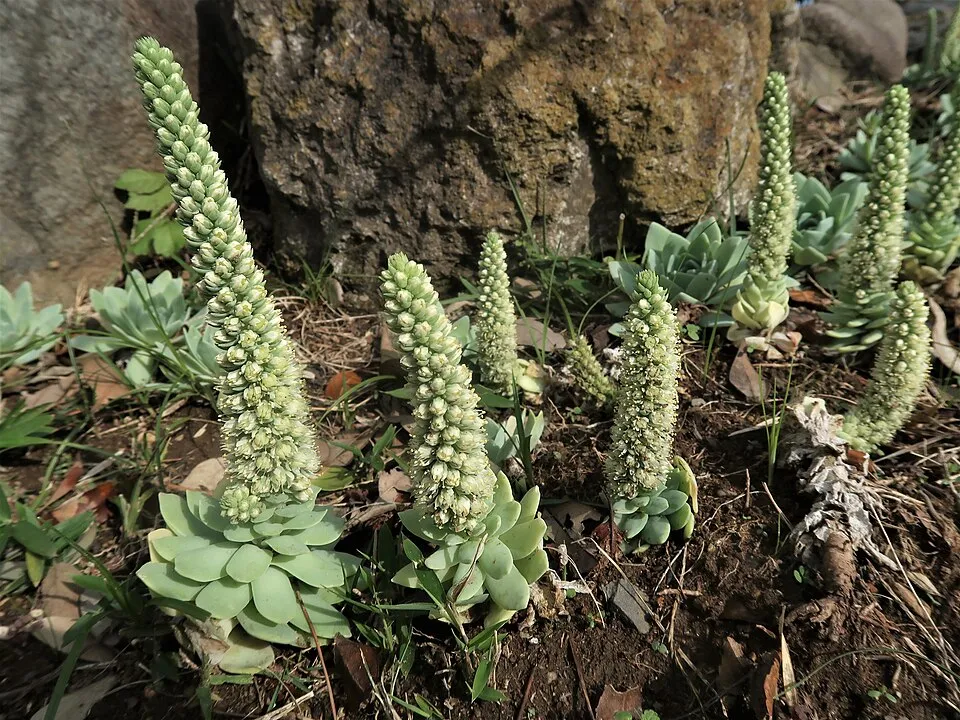
Orostachys Iwarenge, commonly known as Chinese Dunce Cap, is an intriguing succulent perennial belonging to the Crassulaceae family. Native to the rocky terrains and mountainous regions of East Asia, particularly Japan, Korea, and China, this plant is celebrated for its distinctive growth habit and striking architectural form. Its evocative common name, 'dunce cap,' accurately describes the unique conical rosettes that characterize its appearance, often stacking in layers, especially as the plant matures towards its flowering phase.
The foliage comprises fleshy, typically bluish-green leaves, which can sometimes develop attractive red tips, forming tight, intricate rosettes that can spread as ground cover. Individual rosettes mature to approximately 8 inches (20 cm) in height and 3 inches (7.6 cm) in width. In late summer to early autumn, mature rosettes undergo a monocarpic flowering event, sending forth tall, erect flower stalks adorned with numerous small, star-shaped flowers that range in color from white to pale yellow.
While the parent rosette dies after this spectacular bloom, it ensures its legacy by producing abundant offsets, or 'chicks,' around its base, guaranteeing continuous propagation. This resilience, combined with exceptional drought tolerance and visual appeal, makes Orostachys Iwarenge a highly valued choice for rock gardens, container plantings, and xeriscaping, thriving even in challenging, arid conditions. It actively grows in spring and fall, often appearing dormant or 'dead' during colder winter months before re-emerging.
Trusted Scientific References
1. Authoritative external sources for Orostachys Iwarenge
1.1 Wikipedia — Orostachys Iwarenge
1.2 Kew POWO (Plants of the World Online)
1.3 PubMed — peer-reviewed research
1.4 NCBI Taxonomy Browser
1.5 GBIF — Global Biodiversity
1.6Orostachys Iwarenge should be interpreted through verified botanical identity, practical care, and responsible safety language. This recovery note adds the missing context needed for a complete profile: match light to the plant's habit, use well-drained soil, water according to season, and avoid unsupported medicinal or edible claims. For publishing, the plant can be presented as a source-backed garden plant with clear care guidance, common problem diagnosis, and conservative safety wording.
1.1.Orostachys Iwarenge — Key Features
- ✓Crassulaceae family succulent — Crassulaceae family succulent native to East Asia.
- ✓Distinctive conical rosettes — Distinctive conical rosettes that stack and spread.
- ✓Monocarpic flowering with — Monocarpic flowering with prolific offset production.
- ✓Exceptional drought tolerance — Exceptional drought tolerance and low maintenance.
- ✓Traditional uses in — Traditional uses in Chinese and Korean folk medicine.
- ✓Rich in antioxidant and anti — inflammatory compounds.
- ✓Suitable for rock — Suitable for rock gardens, containers, and xeriscaping.
- ✓Flowers in late — Flowers in late summer to early autumn with white/pale yellow blooms.
- ✓Adapts to full sun conditions and well — draining soil.
- ✓Generally non — toxic, making it safe for ornamental gardening.
1.2.Orostachys Iwarenge — Snapshot Summary
- ✓Orostachys Iwarenge, or Chinese Dunce Cap, is a unique East Asian succulent.
- ✓Renowned for its distinctive conical rosettes and monocarpic flowering.
- ✓Traditionally valued for anti-inflammatory, antioxidant, and potential anti-cancer properties.
- ✓Rich in beneficial flavonoids and phenolic compounds.
- ✓Highly drought-tolerant and easy to propagate via offsets.
- ✓Generally considered non-toxic for external applications.
2.Orostachys Iwarenge — Scientific Profile
3.Orostachys Iwarenge — Botanical Stats
4.Orostachys Iwarenge — Morphological Account
5.Orostachys Iwarenge — Habitat & Distribution
6.Orostachys Iwarenge — Historical Applications
7.Orostachys Iwarenge — Secondary Metabolites
- ✓Flavonoids — Key compounds include quercetin, kaempferol, and their glycosides, known for their potent antioxidant, anti-inflammatory, and potentially anti-cancer activities.
- ✓Phenolic Acids — Such as gallic acid, caffeic acid, and chlorogenic acid, which contribute significantly to the plant's overall antioxidant capacity and protective effects against oxidative stress.
- ✓Triterpenoids — Compounds like ursolic acid and oleanolic acid, often found in succulents, are associated with anti-inflammatory, hepatoprotective, and anti-tumor properties.
- ✓Polysaccharides — Complex carbohydrates that can possess immunomodulatory and anti-tumor activities, contributing to the plant's overall health benefits.
- ✓Sterols — Including beta-sitosterol, which are plant-derived compounds with potential anti-inflammatory and cholesterol-lowering effects.
- ✓Alkaloids — While typically in smaller quantities in Crassulaceae, specific alkaloids might be present, contributing to various physiological effects.
- ✓Saponins — Glycosides that can have adaptogenic, immune-stimulating, and anti-inflammatory properties, though specific types and concentrations in Orostachys Iwarenge require further research.
- ✓Vitamins and Minerals — The succulent leaves contain various essential vitamins (e.g., Vitamin C) and minerals, contributing to its nutritional profile and supporting overall cellular function.
8.Orostachys Iwarenge — What Research Suggests
- ✓Anti-inflammatory Action — Extracts of Orostachys Iwarenge have demonstrated significant anti-inflammatory properties, potentially by modulating inflammatory pathways and reducing the production of pro-inflammatory mediators, offering relief from various inflammatory conditions.
- ✓Potent Antioxidant Activity — Rich in phenolic compounds and flavonoids, Chinese Dunce Cap exhibits strong antioxidant capabilities, effectively neutralizing free radicals and mitigating oxidative stress, thereby protecting cellular integrity and preventing cellular damage.
- ✓Potential Anti-cancer Effects — Preliminary in vitro and pre-clinical studies suggest that compounds within Orostachys Iwarenge may possess anti-proliferative effects against certain cancer cell lines, warranting further investigation into its chemopreventive or therapeutic potential.
- ✓Traditional Wound Healing — Historically, topical applications of the plant's leaves or extracts have been used in East Asian folk medicine to promote the healing of minor cuts, abrasions, and skin irritations, likely due to its anti-inflammatory and antimicrobial properties.
- ✓Skin Soothing and Repair — The plant has been traditionally applied to alleviate symptoms of minor burns, insect bites, and various dermatological discomforts, providing a cooling and soothing effect that aids in skin recovery.
- ✓Immune System Support — While not extensively studied, the presence of various bioactive compounds may contribute to general immune modulation, supporting the body's natural defense mechanisms.
- ✓Hepatoprotective Potential — Some traditional applications and studies on related species suggest a potential role in protecting liver cells from damage, possibly linked to its antioxidant capacity.
- ✓Antimicrobial Properties — Certain constituents may exhibit mild antimicrobial activity, contributing to its traditional use in preventing infection in minor skin injuries and promoting a healthy microbial balance.
8.1.Orostachys Iwarenge — Reported Uses
9.Orostachys Iwarenge — Precautions & Warnings
9.1.Orostachys Iwarenge — Reported Side Effects
- ✓Allergic Reactions — Individuals with sensitivities may experience skin irritation, redness, or itching upon topical application.
- ✓Gastrointestinal Upset — While generally non-toxic, excessive internal consumption (if attempted) could potentially lead to mild digestive discomfort, such as nausea or diarrhea.
- ✓Photosensitivity — Although rare for this plant, some herbal remedies can increase skin sensitivity to sunlight in susceptible individuals.
- ✓Drug Interactions — Theoretical possibility of interaction with medications, particularly those affecting inflammation or blood clotting, due to its bioactive compounds.
- ✓Unknown Long-Term Effects — Due to limited robust clinical trials, the long-term effects of internal Orostachys Iwarenge consumption are not well established.
- ✓Overdose Potential — Specific overdose symptoms for Orostachys Iwarenge are not documented due to its non-widespread internal use, but caution is always advised.
9.2.Orostachys Iwarenge — Safety Profile
- ✓General Toxicity — Orostachys Iwarenge is generally considered non-toxic for topical use and incidental ingestion, as per available data.
- ✓Pregnancy and Lactation — Avoid use during pregnancy and breastfeeding due to insufficient safety data to rule out potential risks to the fetus or infant.
- ✓Children — Use with caution in children; consultation with a healthcare professional is recommended for any internal application.
- ✓Pre-existing Conditions — Individuals with chronic health conditions, especially liver or kidney issues, should consult a doctor before using internally.
- ✓Topical Application — Always perform a patch test on a small area of skin before extensive topical use to check for allergic reactions.
- ✓Drug Interactions — Consult a healthcare provider if taking prescription medications, especially anti-inflammatory drugs, immunosuppressants, or blood thinners.
- ✓Internal Use Caution — Internal use is not widely practiced in modern herbalism and should only be considered under the strict guidance of a qualified medical herbalist.
10.Orostachys Iwarenge — How to Use
- ✓Topical Poultice — Fresh, crushed leaves can be applied directly as a poultice to minor skin irritations, burns, or swellings to leverage its anti-inflammatory and soothing properties.
- ✓Herbal Infusion (Traditional) — Dried leaves may be steeped in hot water to create an infusion, traditionally used for internal benefits, though modern internal use should be approached with caution and expert guidance.
- ✓Tincture Preparation — A concentrated alcoholic extract of the plant material can be made, allowing for easier dosage and preservation of its bioactive compounds for research or external application.
- ✓Ointments and Creams — Extracts of Orostachys Iwarenge can be incorporated into topical ointments or creams for targeted application on skin conditions, enhancing their soothing and healing effects.
- ✓Compresses — A cloth soaked in a strong herbal infusion or decoction can be applied as a cold or warm compress to inflamed areas or minor injuries.
- ✓Decoction (Traditional) — For harder plant parts or for stronger extraction, a decoction can be prepared by simmering the plant material in water for an extended period, traditionally for internal use in specific folk medicine systems.
- ✓Juice Extraction — Fresh leaves can be pressed to extract their juice, which can then be used topically or, in traditional contexts, consumed in very small, diluted amounts.
11.Orostachys Iwarenge — Growth Requirements
- ✓Sunlight — Requires full sun exposure, ideally 6 hours or more daily, to maintain its compact form and vibrant coloration; insufficient light can lead to etiolation.
- ✓Watering — Employ the 'soak and dry' method, allowing the soil to dry out completely between waterings to prevent root rot, typical for succulents.
- ✓Soil Requirements — Thrives in well-draining soil, such as a succulent or cactus mix, to ensure excess water does not accumulate around the roots.
- ✓Temperature and Hardiness — Not entirely cold hardy; suitable for USDA Zone 6a (minimum -10° F / -23.3° C). In colder zones, it should be grown in containers and brought indoors or protected during winter.
- ✓Humidity — Prefers low humidity environments; high humidity can increase the risk of fungal diseases and rot.
- ✓Propagation — Easily propagated from offsets, which are small plantlets produced on long stems, or from seeds collected after the plant blooms.
- ✓Dormancy — Expect the plant to go dormant in winter, appearing to die back, but it will typically regrow vigorously in spring.
- ✓Container vs. Ground — Excellent for rock gardens as ground cover, but also performs well in containers where its trailing offsets can create an attractive display.
Reviewed by the Flora Medical Global Botanical Review Panel
Multi-disciplinary editorial group · Botany · Ethnobotany · Herbal-medicine literature
Who reviewed this: This page was checked by the Flora Medical Global Botanical Review Panel — an in-house editorial group of botany graduates, ethnobotany researchers, and horticulture practitioners who collectively maintain our 7,000+ plant encyclopedia. Meet the team.
Our 4-step verification process
1. Taxonomic verification
Scientific names and synonyms cross-checked against Kew POWO, World Flora Online, and The Plant List.
2. Phytochemical & medicinal cross-reference
Active compounds, traditional uses, and reported activities are cross-referenced with PubMed, USDA Dr. Duke's database, and peer-reviewed ethnobotanical literature.
3. Conservation & distribution check
Distribution, ecology, and conservation status confirmed against GBIF occurrence records and the IUCN Red List.
4. Editorial & safety review
Every entry passes an editorial pass for clarity, originality, and safety notices (toxicity, contraindications, dosage caveats) before publication.
Last reviewed:
Important medical disclaimer: This content is for educational and research purposes only. It is not medical advice and is not a substitute for consultation with a licensed healthcare provider. Do not use any herb to self-treat a medical condition without professional guidance.
Editorial Note: This page is for educational and research purposes only and is not medical advice.
Written by: Flora Medical Global Editorial Team
Reviewed by: Flora Medical Global Botanical Review Panel
Last Updated: June 15, 2026





Orostachys Iwarenge — Comments & Community Reviews
Rate this plant