

Medical Disclaimer: This content is for educational purposes only. It is not medical advice. Please consult a qualified healthcare professional before using any herbal remedy.
Safety Overview
1.Pachypodium Lamerei — Essential Profile
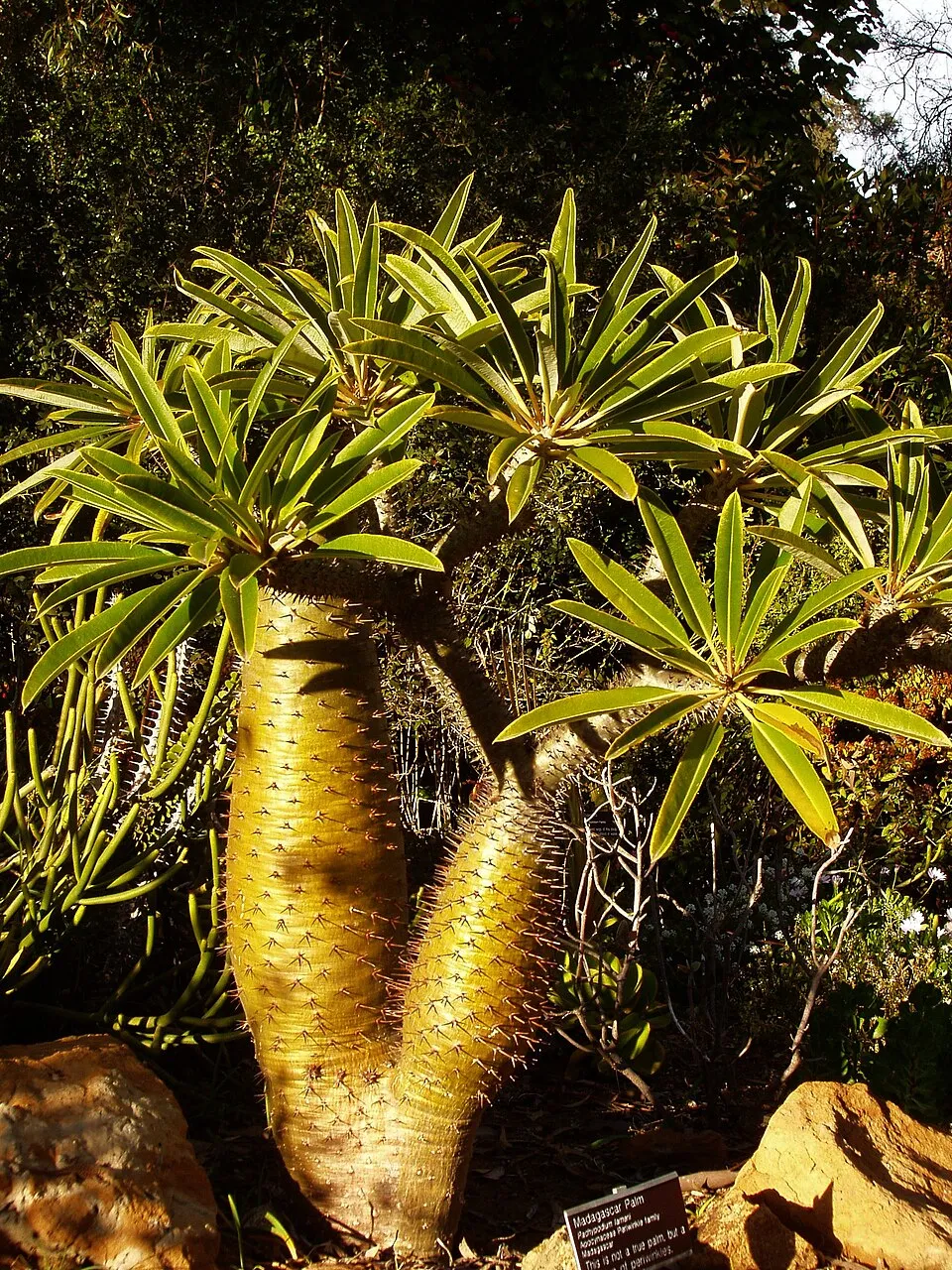
Pachypodium lamerei, commonly known as the Madagascar palm, is a distinctive succulent native to the arid regions of southern Madagascar, despite its misleading common name suggesting a true palm affiliation. This striking plant is botanically classified within the Apocynaceae family, renowned for its diverse species. It typically presents as a stout, upright shrub or small tree, reaching heights of 3 to 6 feet indoors and potentially over 20 feet in its natural habitat.
Its most prominent feature is a thick, greyish-green trunk, often covered in sharp, conical spines, which serves as a water reservoir, enabling its impressive drought resistance. The trunk is usually unbranched in younger plants but may branch after flowering or injury. Crowning the robust stem is a rosette of elongated, glossy, dark green leaves, typically measuring 2 to 10 inches in length, giving it a palm-like silhouette.
In optimal outdoor conditions, mature plants produce clusters of large, fragrant, trumpet-shaped flowers, usually white with a yellow center, blooming from spring into summer. These ornamental attributes, coupled with its unique morphology and adaptation to harsh environments, make Pachypodium lamerei a popular choice in xeriscaping and as an exotic houseplant.
Trusted Scientific References
1. Authoritative external sources for Pachypodium lamerei
1.1 Wikipedia — Pachypodium lamerei
1.2 Kew POWO (Plants of the World Online)
1.3 PubMed — peer-reviewed research
1.4 NCBI Taxonomy Browser
1.5 GBIF — Global Biodiversity
1.6Pachypodium Lamerei should be interpreted through verified botanical identity, practical care, and responsible safety language. This recovery note adds the missing context needed for a complete profile: match light to the plant's habit, use well-drained soil, water according to season, and avoid unsupported medicinal or edible claims. For publishing, the plant can be presented as a source-backed indoor plant with clear care guidance, common problem diagnosis, and conservative safety wording.
1.1.Pachypodium Lamerei — Notable Characteristics
- ✓Stout, Spiny Trunk — Distinctive greyish-green, often scaly trunk armed with sharp thorns.
- ✓Glossy Green Leaves — Elongated, oblong leaves (2-10 inches) clustered at the top, creating a palm-like appearance.
- ✓Trumpet — shaped Flowers — Produces large, fragrant white or pale yellow flowers in clusters, typically in spring/early summer.
- ✓Succulent Nature — Possesses remarkable drought resistance due to water storage in its trunk.
- ✓Ornamental Value — Highly prized as an indoor or outdoor decorative plant for its exotic look and unique form.
- ✓Toxicity — Contains cardiac glycosides and other compounds, rendering all parts harmful if ingested.
- ✓Madagascar Native — Indigenous to the dry regions of Madagascar, adapted to arid, sunny environments.
- ✓Apocynaceae Family — Part of the dogbane family, sharing characteristics with other toxic and some medicinally active species.
- ✓Slow to Bloom Indoors — Rarely flowers when grown as a houseplant, typically requiring maturity and ideal outdoor conditions.
- ✓Adaptable to Light — Prefers bright, indirect light but can tolerate lower light levels, increasing its versatility as an indoor plant.
1.2.Pachypodium Lamerei — At-a-Glance Summary
- ✓Ornamental Succulent — Known as Madagascar palm, a striking, spiny succulent, not a true palm.
- ✓Native to Madagascar — Thrives in dry, sunny conditions, stores water in its thick trunk.
- ✓Toxic Plant — All parts are toxic if ingested, especially for humans and pets.
- ✓Low Maintenance — Drought-tolerant and relatively easy to care for in appropriate climates or indoors.
- ✓No Proven Medicinal Use — Primarily ornamental; direct medicinal applications are not established.
- ✓Apocynaceae Family — Belongs to a family known for diverse compounds, including potent cardiac glycosides.
2.Pachypodium Lamerei — Scientific Identity
3.Pachypodium Lamerei — Vital Statistics
4.Pachypodium Lamerei — Physical Description
5.Pachypodium Lamerei — Ecological Habitat
6.Pachypodium Lamerei — Heritage Uses
7.Pachypodium Lamerei — Chemical Profile
- ✓The phytochemistry of Pachypodium lamerei, like many members of the Apocynaceae family, is characterized by the presence of potent secondary metabolites, primarily cardiac glycosides, which contribute to its toxicity.
- ✓Cardiac Glycosides — Potent compounds such as digitoxin-like substances (cardenolides) are present, known for their strong effects on heart muscle function, contributing significantly to the plant's toxicity upon ingestion.
- ✓Alkaloids — Nitrogen-containing organic compounds, which can have diverse pharmacological activities; specific alkaloid profiles for P. lamerei are less extensively studied compared to its cardiac glycosides.
- ✓Flavonoids — Polyphenolic compounds commonly found in plants, typically acting as antioxidants, UV protectants, and contributing to pigmentations.
- ✓Triterpenes — A diverse group of natural products, some of which exhibit anti-inflammatory, cytotoxic, or antimicrobial properties in various Apocynaceae species.
- ✓Steroids — Plant sterols are common membrane components, and some steroidal compounds within the Apocynaceae can possess hormonal or cardiotonic activities.
- ✓Saponins — Glycosides that produce a soapy lather in water; some saponins can have hemolytic properties and are found in various plant families, including Apocynaceae.
- ✓Cyanogenic Glycosides — Certain Apocynaceae species contain these compounds which release hydrogen cyanide upon enzymatic hydrolysis, contributing to their defensive mechanisms.
- ✓Phenolic Acids — Simple phenolic compounds with antioxidant and antimicrobial potential, widely distributed across the plant kingdom.
8.Pachypodium Lamerei — Pharmacological Findings
- ✓It is crucial to note that Pachypodium lamerei is primarily cultivated for its ornamental value and is not documented in traditional or modern herbal medicine for therapeutic purposes. Its sap contains toxic compounds, making it unsuitable for internal use.
- ✓Ornamental Value — Widely cultivated for its striking, exotic appearance, adding significant aesthetic appeal to indoor and outdoor botanical collections and landscapes.
- ✓Drought Tolerance — Its succulent nature allows it to thrive in arid conditions with minimal water, making it an excellent choice for xeriscaping and water-wise gardening.
- ✓Botanical Study Interest — Serves as a valuable subject for scientific research into succulent adaptations, plant morphology, and the diverse phytochemistry of the Apocynaceae family.
- ✓Habitat Support (in native range) — In its natural Madagascan habitat, it contributes to local biodiversity, providing structure and potentially resources for native fauna, though specific interactions are limited.
- ✓Low Maintenance — Its robust nature and resilience to drought and neglect make it an easy-care plant once established, reducing the need for intensive gardening efforts.
- ✓Aesthetic Well-being — The presence of unique and visually appealing plants like the Madagascar palm can contribute to a sense of calm and an improved living environment.
- ✓Educational Value — Offers a compelling example of convergent evolution, demonstrating how unrelated plant species can develop similar forms (like palms) in response to environmental pressures.
- ✓Air Purification (general plant property) — Like many green plants, it contributes to general air quality by absorbing carbon dioxide and releasing oxygen, though specific purification studies for this species are limited.
8.1.Pachypodium Lamerei — Therapeutic Indications
9.Pachypodium Lamerei — Safety Considerations
9.1.Pachypodium Lamerei — Side Effects & Warnings
- ✓Pachypodium lamerei contains toxic compounds, and ingestion or contact with its sap can lead to adverse effects.
- ✓Gastrointestinal Distress — Ingestion of any part of the plant can cause nausea, vomiting, abdominal pain, and diarrhea in humans and pets.
- ✓Cardiac Effects — Due to the presence of cardiac glycosides, severe ingestion may potentially affect heart rhythm and function, though specific human cases are less documented.
- ✓Skin Irritation — The milky white sap, if it contacts skin, can cause localized irritation, dermatitis, redness, and itching in sensitive individuals.
- ✓Eye Irritation — Direct contact of the sap with the eyes can result in significant irritation, burning sensations, redness, pain, and potentially temporary vision disturbances.
- ✓Oral and Throat Irritation — Chewing or ingesting plant material can cause a burning sensation and irritation of the mucous membranes in the mouth and throat.
- ✓Dizziness and Weakness — In cases of more significant exposure or ingestion, systemic effects such as dizziness, lethargy, or general weakness might occur.
9.2.Pachypodium Lamerei — Toxicity Assessment
- ✓Pachypodium lamerei is considered a toxic plant and requires careful handling and placement.
- ✓Toxic to Humans & Pets — All parts of Pachypodium lamerei are toxic if ingested, posing a significant risk to children and domestic animals.
- ✓Handle with Caution — Always wear protective gloves and eyewear when handling the plant, especially during pruning or repotting, to avoid contact with sap and sharp spines.
- ✓Keep Out of Reach — Place the plant in locations that are inaccessible to curious children and pets to prevent accidental ingestion or contact.
- ✓Avoid Ingestion — Emphasize that the plant is strictly ornamental and should never be consumed for any purpose, medicinal or otherwise.
- ✓Seek Medical Attention — In case of accidental ingestion or significant contact with sap, immediately seek professional medical or veterinary advice.
- ✓Wash Hands Thoroughly — After any interaction with the plant, always wash hands thoroughly with soap and water to remove any residual sap or irritants.
10.Pachypodium Lamerei — Usage Guide
- ✓Pachypodium lamerei is utilized solely for its ornamental value and should never be prepared or consumed for medicinal purposes due to its toxicity.
- ✓Indoor Display — Position potted Madagascar palm in a well-lit area, such as a south or west-facing window, ensuring adequate air circulation for optimal health.
- ✓Outdoor Landscaping — In suitable warm climates (USDA zones 9-11), plant in sunny, well-drained garden beds, allowing ample space for its mature size and root development.
- ✓Container Growing — Cultivate in heavy clay pots with large drainage holes to facilitate moisture wicking and prevent root rot, using a specialized cactus potting mix.
- ✓Protective Handling — Always wear sturdy gardening gloves and long sleeves when handling the plant, especially during pruning or repotting, to avoid contact with sharp spines and irritating sap.
- ✓Pest Management — Regularly inspect for common pests like aphids and whiteflies; treat infestations promptly with insecticidal soaps or by physically removing affected plant parts.
- ✓Disease Prevention — Ensure proper watering practices and good air circulation to prevent fungal diseases such as leaf spot or powdery mildew; treat with appropriate fungicides if detected.
- ✓Overwintering Indoors — In regions below USDA zone 9, move potted plants indoors to a protected, warm environment before temperatures consistently drop below 40°F (4°C) to prevent cold damage.
11.Pachypodium Lamerei — Cultivation & Care
- ✓Light Requirements — Thrives in full sunlight outdoors or in bright, south- or west-facing indirect light indoors to promote robust growth and potential flowering.
- ✓Soil Preference — Requires extremely well-draining soil, ideally a specialized succulent or cactus mix, with a pH ranging from mildly acidic to mildly alkaline (6.1-7.8).
- ✓Watering Schedule — Employ the 'soak and dry' method; water thoroughly when the top few inches of soil are completely dry, significantly reducing frequency during winter dormancy.
- ✓Temperature & Humidity — Hardy in USDA zones 9-11, sensitive to cold below 40°F (4°C); prefers medium relative humidity of 40-50% and warm conditions.
- ✓Fertilization — Feed with a diluted all-purpose or low-nitrogen liquid fertilizer once or twice during the active growing seasons of spring and early summer; cease feeding in fall and winter.
- ✓Propagation — Easily propagated from stem cuttings or offsets, allowing the cut end to callus for about a week before planting in a well-draining mix; seed propagation is slower and less reliable.
- ✓Pruning & Repotting — Pruning is generally not required but can be done to manage height or encourage branching; repot every 2-3 years as the plant becomes thick and top-heavy, always wearing protective gloves.
Reviewed by the Flora Medical Global Botanical Review Panel
Multi-disciplinary editorial group · Botany · Ethnobotany · Herbal-medicine literature
Who reviewed this: This page was checked by the Flora Medical Global Botanical Review Panel — an in-house editorial group of botany graduates, ethnobotany researchers, and horticulture practitioners who collectively maintain our 7,000+ plant encyclopedia. Meet the team.
Our 4-step verification process
1. Taxonomic verification
Scientific names and synonyms cross-checked against Kew POWO, World Flora Online, and The Plant List.
2. Phytochemical & medicinal cross-reference
Active compounds, traditional uses, and reported activities are cross-referenced with PubMed, USDA Dr. Duke's database, and peer-reviewed ethnobotanical literature.
3. Conservation & distribution check
Distribution, ecology, and conservation status confirmed against GBIF occurrence records and the IUCN Red List.
4. Editorial & safety review
Every entry passes an editorial pass for clarity, originality, and safety notices (toxicity, contraindications, dosage caveats) before publication.
Last reviewed:
Important medical disclaimer: This content is for educational and research purposes only. It is not medical advice and is not a substitute for consultation with a licensed healthcare provider. Do not use any herb to self-treat a medical condition without professional guidance.
Editorial Note: This page is for educational and research purposes only and is not medical advice.
Written by: Flora Medical Global Editorial Team
Reviewed by: Flora Medical Global Botanical Review Panel
Last Updated: June 15, 2026





Pachypodium Lamerei — Comments & Community Reviews
Rate this plant