
Medical Disclaimer: This content is for educational purposes only. It is not medical advice. Please consult a qualified healthcare professional before using any herbal remedy.
Safety Overview
1.Paris — Plant Snapshot
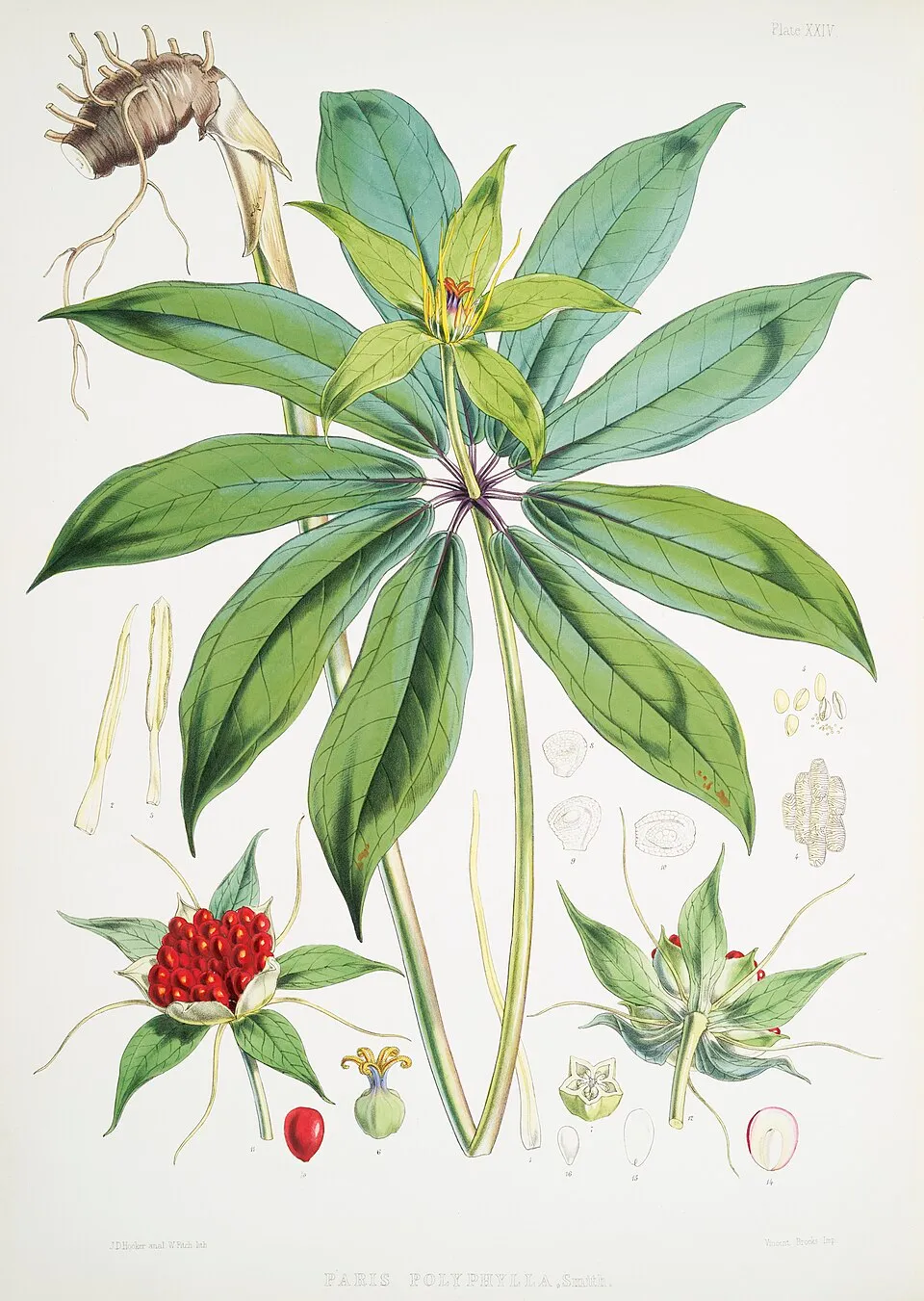
Paris polyphylla, widely recognized as 'Paris' or 'One-leafed Solomon's Seal', is a captivating herbaceous perennial belonging to the Melanthiaceae family. This distinctive plant is indigenous to the diverse landscapes of the Himalayas, the Indian subcontinent, and East Asia, thriving particularly in the moist, shaded environments of woodlands, bamboo forests, thickets, and along stream sides at altitudes up to 3300 meters. Its morphology is truly unique, characterized by an erect stem that emerges from a rhizomatous root system, topped by a single, prominent whorl of typically 5 to 11 large, obovate to elliptic leaves.
The specific epithet 'polyphylla', meaning 'many-leaved', aptly describes this striking leafy arrangement. From the center of this whorl, a solitary, star-like flower unfurls, featuring green, sometimes yellowish, sepals and petals. As summer transitions to autumn, these intriguing flowers give way to a cluster of dark purple to scarlet berries, a key diagnostic feature.
The plant's slow-spreading rhizomes allow it to form elegant clumps, making it a prized specimen for specialist woodland gardens. Beyond its aesthetic appeal, Paris polyphylla holds significant cultural and medicinal importance across its native range, known by names such as Ch'i Yeh I Chih Hua in China and Satuwa in Nepal, reflecting its esteemed status in traditional healing systems.
Trusted Scientific References
1. Authoritative external sources for Paris polyphylla
1.1 Wikipedia — Paris polyphylla
1.2 Kew POWO (Plants of the World Online)
1.3 PubMed — peer-reviewed research
1.4 NCBI Taxonomy Browser
1.5 GBIF — Global Biodiversity
1.6Paris should be interpreted through verified botanical identity, practical care, and responsible safety language. This recovery note adds the missing context needed for a complete profile: match light to the plant's habit, use well-drained soil, water according to season, and avoid unsupported medicinal or edible claims. For publishing, the plant can be presented as a source-backed garden plant with clear care guidance, common problem diagnosis, and conservative safety wording.
1.1.Paris — Standout Qualities
- ✓Striking Whorl of 5 — 11 Leaves — Unique botanical architecture.
- ✓Solitary Star — like Flower — Greenish-yellow petals and sepals.
- ✓Distinctive Dark Purple to Scarlet Berries — Prominent diagnostic feature.
- ✓Rhizomatous Perennial Growth — Slow-spreading and clump-forming.
- ✓Native to Himalayas & East Asia — Thrives in shaded, moist woodlands.
- ✓Rich in Steroidal Saponins — Primarily polyphyllins and diosgenin.
- ✓Traditional Chinese Medicine Staple — Valued for detoxifying and anti-inflammatory properties.
- ✓Potent Anti — inflammatory & Analgesic Actions — Research-supported benefits.
- ✓Considered Highly Toxic Internally — Requires expert supervision for all medicinal applications.
- ✓IUCN Vulnerable Conservation Status — Facing threats from overharvesting and deforestation.
1.2.Paris — Snapshot Summary
- ✓Potent traditional medicine with significant anti-inflammatory and anticancer potential.
- ✓Contains highly toxic steroidal saponins, especially polyphyllins.
- ✓Strict professional supervision is mandatory for any internal use.
- ✓Used traditionally for pain, inflammation, infections, and certain cancers.
- ✓Classified as a vulnerable species due to overharvesting.
- ✓Features unique morphology with a whorl of leaves and striking red berries.
2.Paris — Systematic Position
3.Paris — Reference Facts
4.Paris — Morphological Account
5.Paris — Where It Grows
6.Paris — Historical Applications
7.Paris — Secondary Metabolites
- ✓Steroidal Saponins — These are the primary active compounds, including polyphyllin I, II, D, and diosgenin; they are responsible for significant anti-inflammatory, anticancer, and cytotoxic activities.
- ✓Flavonoids — Compounds like quercetin and kaempferol are present, contributing antioxidant and anti-inflammatory properties, protecting cells from oxidative damage.
- ✓Glycosides — Various glycosidic compounds are found, which can have diverse pharmacological effects, often influencing cardiac function or acting as precursors to other active molecules.
- ✓Alkaloids — While less prominent, certain minor alkaloids may be present, potentially contributing to the plant's overall medicinal profile with various biological activities.
- ✓Polysaccharides — These complex carbohydrates are known for their immunomodulatory effects, potentially stimulating or balancing the immune system.
- ✓Phytosterols — Beta-sitosterol and campesterol are examples, recognized for their anti-inflammatory and cholesterol-lowering properties.
- ✓Phenolic Acids — Compounds such as gallic acid and caffeic acid provide additional antioxidant capacity, scavenging free radicals and reducing cellular stress.
- ✓Fatty Acids — Essential for cell membrane integrity and signaling, some fatty acids also possess anti-inflammatory or antimicrobial properties.
- ✓Terpenoids — A diverse group of compounds, some of which may contribute to the plant's defense mechanisms and pharmacological activities.
8.Paris — What Research Suggests
- ✓Anti-inflammatory — Paris polyphylla contains potent saponins that help reduce swelling and discomfort associated with various inflammatory conditions, acting on cellular pathways to mitigate inflammation.
- ✓Analgesic — Traditionally employed for its pain-relieving properties, particularly in cases of traumatic injuries and musculoskeletal pain, by modulating pain signals.
- ✓Anticancer Potential — Research indicates that steroidal saponins, especially polyphyllins, exhibit cytotoxic effects against various cancer cell lines, suggesting a role in inhibiting tumor growth and inducing apoptosis.
- ✓Detoxifying — In traditional medicine, it is highly valued for its ability to 'detoxify' the body, believed to neutralize harmful substances and clear heat and toxins from the system.
- ✓Anthelmintic — Historically used to expel parasitic worms from the gastrointestinal tract, demonstrating efficacy against a range of internal parasites.
- ✓Antimicrobial — The plant's extracts have shown activity against certain bacteria and fungi, making it useful in treating skin infections and other microbial ailments.
- ✓Hemostatic — Applied topically in traditional practices to stop bleeding from wounds and traumatic injuries, promoting coagulation and wound closure.
- ✓Anticonvulsant — Traditionally prescribed for managing convulsions and epileptic seizures, suggesting a calming effect on the nervous system.
- ✓Wound Healing — External application of its rhizome paste is believed to accelerate the healing of snakebites, traumatic wounds, and skin lesions due to its anti-inflammatory and antimicrobial actions.
- ✓Immunomodulatory — Some studies suggest that certain compounds in Paris polyphylla may modulate immune responses, potentially enhancing or suppressing immune functions as needed.
8.1.Paris — Health Applications
9.Paris — Precautions & Warnings
9.1.Paris — Caution Notes
- ✓Gastrointestinal Distress — Common adverse effects include severe nausea, vomiting, abdominal pain, and diarrhea, even at relatively low doses.
- ✓Cardiac Toxicity — High doses can lead to cardiotoxic effects, including arrhythmias, bradycardia, and other heart rhythm disturbances.
- ✓Neurological Symptoms — May induce dizziness, headache, and in severe cases, convulsions or central nervous system depression.
- ✓Allergic Reactions — Some individuals may experience skin rashes, itching, or other hypersensitivity reactions upon contact or ingestion.
- ✓Liver & Kidney Damage — Prolonged or excessive use can potentially cause damage to the liver and kidneys, impairing their function.
- ✓Oral & Mucosal Irritation — Ingestion can cause a burning sensation and irritation of the mouth, throat, and esophagus.
- ✓Respiratory Depression — In very high toxic doses, respiratory difficulties, including slowed or labored breathing, may occur.
9.2.Paris — Safety Overview
- ✓High Toxicity — Paris polyphylla is highly toxic due to its saponin content, particularly polyphyllins, and must be handled with extreme caution.
- ✓Professional Supervision Required — Internal use is strictly contraindicated without the direct supervision and prescription of a qualified medical herbalist or practitioner.
- ✓Contraindications — Absolutely avoided in pregnancy, lactation, young children, and individuals with pre-existing heart conditions, liver disease, or kidney impairment.
- ✓Drug Interactions — May interact dangerously with cardiac medications (e.g., digoxin), anticoagulants, and other drugs due to its potent compounds.
- ✓Avoid Raw Ingestion — The raw plant and its berries are highly poisonous and should never be ingested under any circumstances.
- ✓External Use Caution — While less risky, external application should be limited, avoid broken skin, and always test a small area first for sensitivity.
- ✓Dosage Critical — Even slight deviations from expert-prescribed doses can lead to severe adverse reactions or poisoning.
10.Paris — Preparation & Dosage
- ✓Traditional Decoctions — The rhizome is typically boiled in water to create a potent decoction for internal administration, always under strict supervision due to its toxicity.
- ✓Topical Pastes & Poultices — Crushed or powdered rhizome is mixed with a liquid to form a paste, then applied directly to the skin for snakebites, traumatic injuries, or skin infections.
- ✓Tinctures — Alcohol-based extracts of the rhizome are prepared, used internally in very small, controlled doses or externally for specific conditions.
- ✓Powdered Formulations — Dried and pulverized rhizome is incorporated into traditional herbal blends or taken encapsulated, strictly managed by practitioners.
- ✓Herbal Compresses — Infusions or decoctions can be used as compresses for external application to reduce swelling and inflammation.
- ✓Standardized Extracts — Modern applications may involve highly purified, standardized extracts of polyphyllins for controlled research or pharmaceutical development.
- ✓Expert-Guided Dosage — Due to its high toxicity, any internal use of Paris polyphylla must be precisely dosed and supervised by a qualified and experienced medical herbalist or practitioner.
- ✓External Use Precautions — Even for external applications, a patch test is advisable, and it should not be applied to large areas or broken skin without professional guidance.
11.Paris — Growth Requirements
- ✓Soil Preference — Requires moist, well-draining, humus-rich soil, ideally mimicking its natural woodland habitat with plenty of organic matter.
- ✓Light Conditions — Thrives in full to partial shade, preferring dappled light under a canopy of deciduous trees; direct, intense sunlight should be avoided.
- ✓Watering — Needs consistent moisture, especially during dry periods, but ensure good drainage to prevent waterlogging which can lead to rhizome rot.
- ✓Propagation — Best propagated by rhizome division in early spring or late autumn; seed propagation is challenging due to low viability and prolonged dormancy.
- ✓Temperature & Hardiness — Fully hardy in temperate climates, it prefers cool, damp conditions and tolerates winter dormancy well.
- ✓Nutrient Requirements — Benefits from annual top-dressing with compost or well-rotted leaf mold to provide essential nutrients and maintain soil fertility.
- ✓Spacing — Allow adequate space for its slow-spreading rhizomes, typically planting individual specimens about 30 cm (1 foot) apart to form clumps.
- ✓Conservation Minded Cultivation — If harvesting, ensure only a portion of the rhizome with a bud is removed, leaving the rest to regenerate, crucial for the species' sustainability.
Reviewed by the Flora Medical Global Botanical Review Panel
Multi-disciplinary editorial group · Botany · Ethnobotany · Herbal-medicine literature
Who reviewed this: This page was checked by the Flora Medical Global Botanical Review Panel — an in-house editorial group of botany graduates, ethnobotany researchers, and horticulture practitioners who collectively maintain our 7,000+ plant encyclopedia. Meet the team.
Our 4-step verification process
1. Taxonomic verification
Scientific names and synonyms cross-checked against Kew POWO, World Flora Online, and The Plant List.
2. Phytochemical & medicinal cross-reference
Active compounds, traditional uses, and reported activities are cross-referenced with PubMed, USDA Dr. Duke's database, and peer-reviewed ethnobotanical literature.
3. Conservation & distribution check
Distribution, ecology, and conservation status confirmed against GBIF occurrence records and the IUCN Red List.
4. Editorial & safety review
Every entry passes an editorial pass for clarity, originality, and safety notices (toxicity, contraindications, dosage caveats) before publication.
Last reviewed:
Important medical disclaimer: This content is for educational and research purposes only. It is not medical advice and is not a substitute for consultation with a licensed healthcare provider. Do not use any herb to self-treat a medical condition without professional guidance.
Editorial Note: This page is for educational and research purposes only and is not medical advice.
Written by: Flora Medical Global Editorial Team
Reviewed by: Flora Medical Global Botanical Review Panel
Last Updated: June 15, 2026





Paris — Comments & Community Reviews
Rate this plant