


Medical Disclaimer: This content is for educational purposes only. It is not medical advice. Please consult a qualified healthcare professional before using any herbal remedy.
Safety Overview
1.Parrotia Persica — Introduction & Highlights
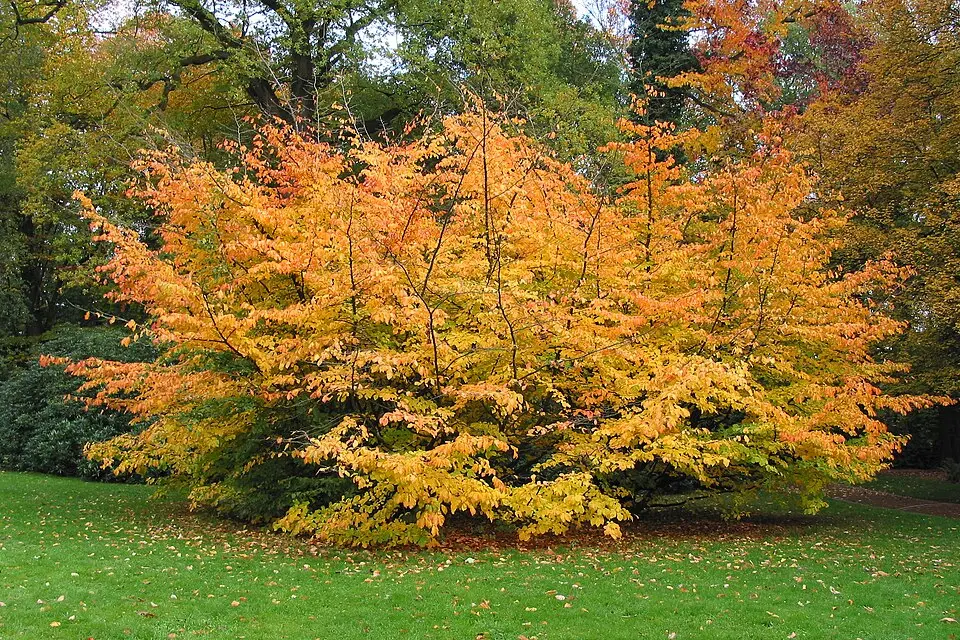
Parrotia persica, commonly known as Persian Ironwood, is a distinguished deciduous tree native to the ancient Hyrcanian forests of the Alborz mountains in northern Iran and Azerbaijan. Belonging to the Hamamelidaceae family, it shares close botanical kinship with the witch-hazels. This captivating species is highly prized for its exceptional multi-seasonal aesthetic appeal. In early spring, before the emergence of its foliage, delicate, apetalous red flowers with prominent stamens subtly adorn its bare branches.
These are later followed by small, two-valved woody fruit capsules containing glossy brown seeds. The true spectacle unfolds in autumn, as its lustrous green, ovate to elliptic leaves undergo a dramatic transformation, displaying a breathtaking mosaic of yellow, orange, red, and deep purple hues, often simultaneously on a single branch. This autumnal display can persist for several weeks, providing unparalleled visual interest. As Parrotia persica matures, its bark develops a striking exfoliating pattern, flaking in irregular patches to reveal a tapestry of cream, green, grey, and brown underlayers, which offers significant year-round appeal, particularly during the dormant winter months.
It typically adopts a multi-stemmed growth habit, forming an elegant vase-shaped or broad, rounded canopy. Its robust and wide-spreading nature makes it an ideal specimen tree for larger landscapes, parks, and botanical gardens. The Persian Ironwood exhibits remarkable resilience, demonstrating excellent resistance to most common pests and diseases, and thrives in a diverse range of soil conditions once established, cementing its status as a highly desirable and low-maintenance ornamental plant.
Trusted Scientific References
1. Authoritative external sources for Parrotia persica
1.1 Wikipedia — Parrotia persica
1.2 Kew POWO (Plants of the World Online)
1.3 PubMed — peer-reviewed research
1.4 NCBI Taxonomy Browser
1.5 GBIF — Global Biodiversity
1.6Parrotia Persica should be interpreted through verified botanical identity, practical care, and responsible safety language. This recovery note adds the missing context needed for a complete profile: match light to the plant's habit, use well-drained soil, water according to season, and avoid unsupported medicinal or edible claims. For publishing, the plant can be presented as a source-backed garden plant with clear care guidance, common problem diagnosis, and conservative safety wording.
1.1.Parrotia Persica — Key Features
- ✓Native to the — Native to the Alborz mountains of northern Iran and Azerbaijan.
- ✓Member of the — Member of the Hamamelidaceae family, closely related to witch-hazels.
- ✓Exhibits spectacular multi — seasonal ornamental interest.
- ✓Features delicate red, — Features delicate red, apetalous flowers in early spring.
- ✓Renowned for its — Renowned for its breathtaking autumn foliage in shades of yellow, orange, red, and purple.
- ✓Develops distinctive exfoliating — Develops distinctive exfoliating bark, revealing multiple color layers.
- ✓Grows as a multi — stemmed tree or large shrub with a wide-spreading canopy.
- ✓Demonstrates excellent resistance — Demonstrates excellent resistance to pests and diseases.
- ✓Highly adaptable to — Highly adaptable to various soil conditions once established.
- ✓Contains tannins and — Contains tannins and flavonoids, contributing to its botanical properties.
1.2.Parrotia Persica — At-a-Glance Summary
- ✓Persian Ironwood is a stunning deciduous ornamental tree, native to Iran.
- ✓Known for its vibrant multi-seasonal appeal, especially brilliant autumn foliage and exfoliating bark.
- ✓Belongs to the Hamamelidaceae family, related to witch-hazels.
- ✓Rich in phytochemicals like tannins and flavonoids, primarily for plant defense.
- ✓Not recognized or studied for established medicinal uses in humans.
- ✓Highly robust, pest-resistant, and adaptable for landscape cultivation.
2.Parrotia Persica — Systematic Position
3.Parrotia Persica — Botanical Stats
4.Parrotia Persica — Structural Profile
5.Parrotia Persica — Where It Grows
6.Parrotia Persica — Historical Applications
7.Parrotia Persica — Active Compounds
- ✓Tannins — Predominantly gallotannins and ellagitannins, found in the bark and leaves, responsible for astringent properties and contributing to bark color.
- ✓Flavonoids — Including quercetin, kaempferol, and their glycosides, present in leaves and bark, known for antioxidant and potential anti-inflammatory activities.
- ✓Phenolic Acids — Such as gallic acid and caffeic acid derivatives, contributing to antioxidant capacity and plant defense mechanisms.
- ✓Anthocyanins — Pigments responsible for the striking red and purple hues in autumn foliage, strong antioxidants that protect plant cells from oxidative stress.
- ✓Lignans — Phytoestrogenic compounds found in various plant parts, often with antioxidant and potential anticancer properties.
- ✓Triterpenoids — Compounds like betulinic acid, typically found in bark, which may exhibit anti-inflammatory and cytotoxic activities in some plant species.
- ✓Saponins — Glycosides that can have emulsifying properties and, in some plants, adaptogenic or immunomodulatory effects, though their role in Parrotia is not well-defined.
- ✓Volatile Organic Compounds — Present in trace amounts, contributing to the plant's subtle fragrance and possibly acting as signaling molecules or defense compounds.
- ✓Polysaccharides — Structural carbohydrates found throughout the plant, playing roles in cell structure and potentially in immune modulation.
8.Parrotia Persica — Research Insights
- ✓Astringent Potential — The bark and leaves of Parrotia persica contain tannins, which may exert astringent effects, hypothetically useful for tightening tissues or reducing minor surface bleeding.
- ✓Antioxidant Activity — Phytochemicals like flavonoids and anthocyanins, particularly abundant in the vibrant autumn leaves, suggest potential antioxidant properties that could help neutralize free radicals.
- ✓Anti-inflammatory Prospects — Certain compounds found in woody plants, including Parrotia persica, might possess mild anti-inflammatory properties, currently unexplored in specific research.
- ✓Mood Enhancement — As a highly ornamental tree, its stunning visual appeal, especially the vibrant autumn foliage and attractive bark, contributes to biophilic design, potentially reducing stress and improving psychological well-being.
- ✓Air Quality Improvement — Like all mature trees, Parrotia persica contributes to local air purification by absorbing carbon dioxide and releasing oxygen, enhancing the environment in planted areas.
- ✓Ecological Support — The tree provides habitat and food (seeds) for various wildlife, contributing to local biodiversity in urban and suburban landscapes.
- ✓Soil Stabilization — Its extensive root system helps prevent soil erosion, particularly on slopes or in disturbed areas, offering an indirect ecological benefit.
- ✓Hypothetical Skin Support — If extracts were prepared, the astringent properties of tannins might be theoretically explored for topical application in minor skin irritations, though no research exists.
- ✓Research Subject — The unique phytochemical profile, particularly concerning its vibrant autumn coloration, makes Parrotia persica a valuable subject for botanical and chemical research into natural pigments and plant defense mechanisms.
- ✓General Wellness — The presence of green spaces and beautiful trees like Persian Ironwood has been linked to improved overall human health and well-being through access to nature.
8.1.Parrotia Persica — Indications & Uses
9.Parrotia Persica — Precautions & Warnings
9.1.Parrotia Persica — Caution Notes
- ✓Gastrointestinal Upset — Hypothetically, ingestion of large quantities of plant material, particularly bark due to high tannin content, could lead to digestive discomfort.
- ✓Allergic Reactions — Sensitive individuals might experience mild skin irritation or allergic responses upon direct contact with sap or pollen, though this is uncommon.
- ✓Photosensitivity — While not documented for Parrotia persica, some plant compounds can induce photosensitivity, a potential but unconfirmed risk.
- ✓Drug Interactions — Due to the presence of various phytochemicals, theoretical interactions with medications could occur if ingested, but specific data is absent.
- ✓No Established Adverse Effects — There are no widely documented adverse effects or toxicity reports for Parrotia persica in humans, largely due to its lack of medicinal use.
- ✓Tannin Overload — Excessive, prolonged internal consumption of tannin-rich parts could theoretically impair nutrient absorption, a general concern with high tannin intake.
9.2.Parrotia Persica — Clinical Safety Notes
- ✓Non-Medicinal Plant — Parrotia persica is primarily an ornamental species and is not recommended for internal medicinal use or self-medication.
- ✓Lack of Human Studies — There is a significant absence of scientific studies validating the safety or efficacy of any part of Parrotia persica for human consumption.
- ✓Pregnancy and Lactation — Pregnant or nursing individuals should strictly avoid any internal use due to the complete lack of safety data.
- ✓Children — Keep all parts of the plant away from children, as ingestion could lead to unknown adverse effects.
- ✓Topical Use — If exploring topical applications (e.g., for astringent properties), perform a patch test first to check for skin sensitivity.
- ✓Consult a Professional — Always consult a qualified healthcare provider or medical herbalist before considering any use of Parrotia persica for health purposes.
- ✓Ornamental Safety — Generally considered safe for landscape use, posing no known significant toxic risks through casual contact.
10.Parrotia Persica — Application Forms
- ✓Ornamental Landscaping — Primarily valued as a specimen tree in gardens, parks, and large landscapes for its multi-seasonal interest.
- ✓Horticultural Research — Used in botanical gardens and arboreta for study of deciduous tree physiology, autumn coloration, and hardiness.
- ✓Wood Crafting — The dense, hard wood, which gives it the 'Ironwood' moniker, can be used in specialized woodworking projects.
- ✓Phytochemical Extraction (Research) — Bark and leaves are collected for laboratory research to isolate and characterize tannins, flavonoids, and other compounds.
- ✓Botanical Education — Employed as an educational specimen to teach about plant morphology, seasonal changes, and Hamamelidaceae family characteristics.
- ✓Environmental Restoration — Utilized in some ecological restoration projects for its hardiness and ability to establish in various conditions.
- ✓Foliage Display — Its vibrant autumn leaves are sometimes used in fresh or dried floral arrangements for their striking colors.
- ✓Non-Medicinal Use — It is critical to note that Parrotia persica is not traditionally or currently recommended for internal medicinal use due to lack of scientific validation.
11.Parrotia Persica — Growing Guide
- ✓Site Selection — Prefers full sun to partial shade for optimal growth and autumn color development.
- ✓Soil Requirements — Thrives in well-drained, fertile soil with a slightly acidic to neutral pH, though it is adaptable to various soil types.
- ✓Watering — Requires regular watering during establishment; once mature, it is moderately drought tolerant.
- ✓Propagation — Primarily propagated by seed, which benefits from stratification, or by semi-hardwood cuttings taken in summer.
- ✓Pruning — Generally low-maintenance; prune in late winter or early spring to remove dead or crossing branches, or to shape the multi-stemmed structure.
- ✓Hardiness — Exhibits excellent cold hardiness, typically thriving in USDA Zones 4-8.
- ✓Pest and Disease Resistance — Highly resistant to most common pests and diseases, requiring minimal chemical intervention.
- ✓Urban Tolerance — Demonstrates good tolerance to urban pollution and compacted soils once established, making it suitable for city landscapes.
Reviewed by the Flora Medical Global Botanical Review Panel
Multi-disciplinary editorial group · Botany · Ethnobotany · Herbal-medicine literature
Who reviewed this: This page was checked by the Flora Medical Global Botanical Review Panel — an in-house editorial group of botany graduates, ethnobotany researchers, and horticulture practitioners who collectively maintain our 7,000+ plant encyclopedia. Meet the team.
Our 4-step verification process
1. Taxonomic verification
Scientific names and synonyms cross-checked against Kew POWO, World Flora Online, and The Plant List.
2. Phytochemical & medicinal cross-reference
Active compounds, traditional uses, and reported activities are cross-referenced with PubMed, USDA Dr. Duke's database, and peer-reviewed ethnobotanical literature.
3. Conservation & distribution check
Distribution, ecology, and conservation status confirmed against GBIF occurrence records and the IUCN Red List.
4. Editorial & safety review
Every entry passes an editorial pass for clarity, originality, and safety notices (toxicity, contraindications, dosage caveats) before publication.
Last reviewed:
Important medical disclaimer: This content is for educational and research purposes only. It is not medical advice and is not a substitute for consultation with a licensed healthcare provider. Do not use any herb to self-treat a medical condition without professional guidance.
Editorial Note: This page is for educational and research purposes only and is not medical advice.
Written by: Flora Medical Global Editorial Team
Reviewed by: Flora Medical Global Botanical Review Panel
Last Updated: June 15, 2026





Parrotia Persica — Comments & Community Reviews
Rate this plant