
Medical Disclaimer: This content is for educational purposes only. It is not medical advice. Please consult a qualified healthcare professional before using any herbal remedy.
Safety Overview
1.Pau Pereira — Plant Snapshot
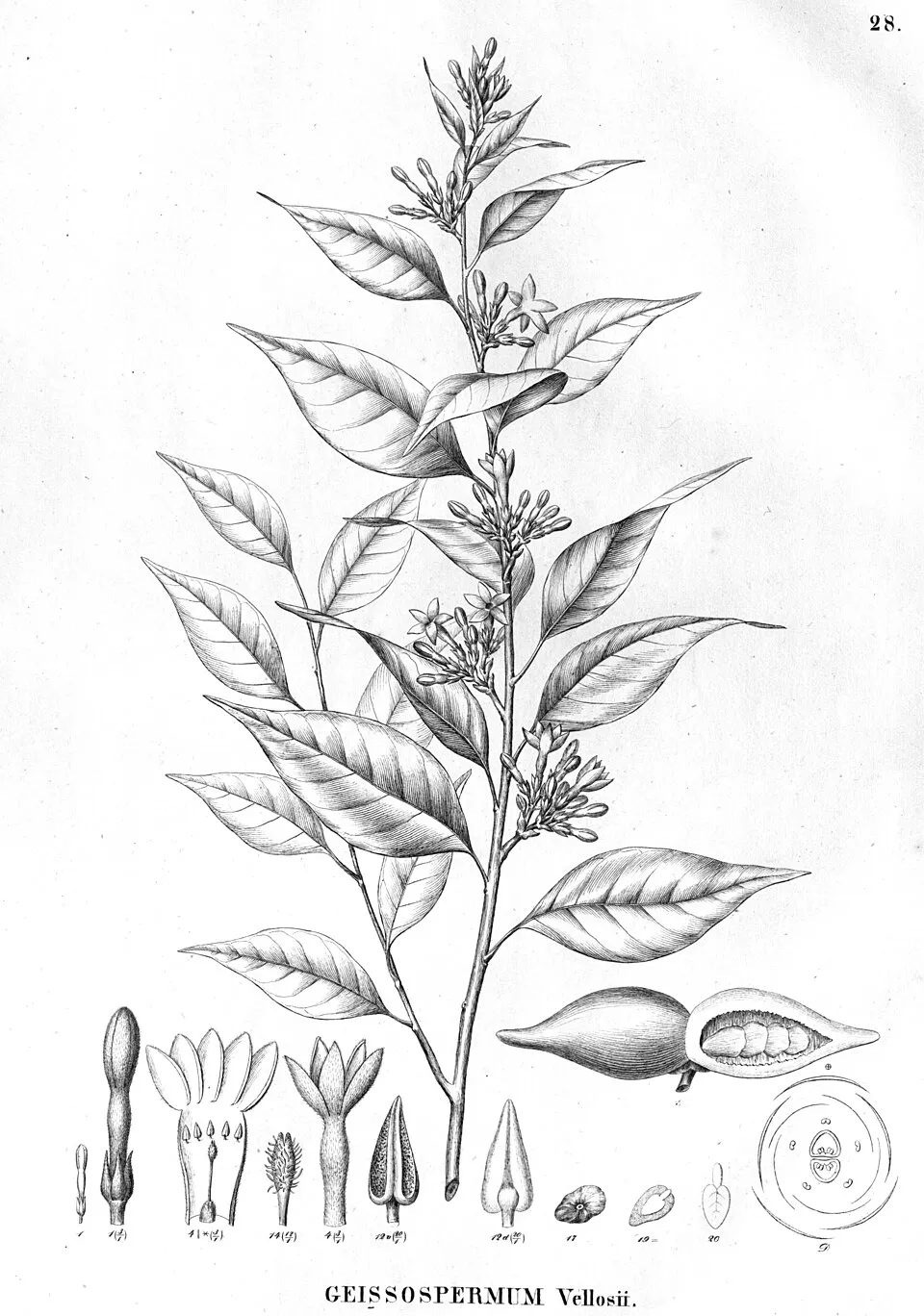
Pau Pereira, scientifically known as Geissospermum vellosii, is a significant medicinal tree indigenous to the lush rainforests of Brazil, particularly within the Amazon basin. It belongs to the Apocynaceae family, a diverse group renowned for its alkaloid-rich species. This medium-sized tree typically features a straight trunk, often with a grayish bark that is the primary part utilized in traditional medicine.
The leaves are generally simple, opposite, and elliptic, characteristic of many species within its family. While specific details on its inflorescence and fruit morphology are less commonly highlighted in general medicinal literature, its growth habit is that of a robust tropical forest tree, thriving in the warm, humid conditions prevalent in its native range.
The plant's distribution is concentrated in South America, reflecting its specific ecological requirements for well-drained, fertile soil and ample sunlight found in its natural habitat. The wood of Geissospermum vellosii is dense and durable, though it is the bark that holds the primary pharmacological interest. Traditional communities have long recognized and utilized this species, passing down knowledge of its therapeutic properties through generations.
Its taxonomic classification places it within a genus known for producing a spectrum of indole and beta-carboline alkaloids, which are central to its reputed medicinal actions. Understanding the botanical characteristics of Pau Pereira is crucial for its sustainable harvesting and proper identification, ensuring the integrity of its medicinal applications.
Trusted Scientific References
1. Authoritative external sources for Geissospermum vellosii
1.1 Wikipedia — Geissospermum vellosii
1.2 Kew POWO (Plants of the World Online)
1.3 PubMed — peer-reviewed research
1.4 NCBI Taxonomy Browser
1.5 GBIF — Global Biodiversity
1.6Pau Pereira should be interpreted through verified botanical identity, practical care, and responsible safety language. This recovery note adds the missing context needed for a complete profile: match light to the plant's habit, use well-drained soil, water according to season, and avoid unsupported medicinal or edible claims. For publishing, the plant can be presented as a source-backed medicinal plant with clear care guidance, common problem diagnosis, and conservative safety wording.
1.1.Pau Pereira — Standout Qualities
- ✓Amazonian Origin — Native to the Brazilian rainforests, deeply rooted in indigenous medicinal traditions.
- ✓Apocynaceae Family — Belongs to a botanical family known for its diverse and potent alkaloid content.
- ✓Alkaloid — Rich Bark — The primary medicinal part, containing a complex array of bioactive compounds.
- ✓Beta — Carboline Alkaloids — Key active constituents, including geissospermine and flavopereirine.
- ✓Emerging Research — Subject of scientific investigation for its potential in cellular health and inflammation.
- ✓Traditional Uses — Employed for centuries in folk medicine for various ailments, including digestive and immune support.
- ✓Antioxidant Properties — Contributes to cellular protection against oxidative damage.
- ✓Anti — inflammatory Potential — May help mitigate inflammatory responses in the body.
- ✓Immune Modulating Effects — Supports the body's natural defense mechanisms.
- ✓Cautionary Use — Emphasizes the need for professional guidance due to limited human safety data.
1.2.Pau Pereira — Quick Summary
- ✓Pau Pereira (Geissospermum vellosii) is an Amazonian tree bark, traditionally used in Brazil.
- ✓Rich in beta-carboline and indole alkaloids, such as geissospermine and flavopereirine.
- ✓Research explores its potential anti-cancer, anti-inflammatory, antioxidant, and antimalarial properties.
- ✓Traditionally used for digestive issues, fever, liver support, and immune modulation.
- ✓Limited human safety data; avoid during pregnancy and breastfeeding.
- ✓Consultation with a healthcare professional is strongly recommended before use.
2.Pau Pereira — Scientific Profile
3.Pau Pereira — Reference Facts
4.Pau Pereira — Morphological Account
5.Pau Pereira — Where It Grows
6.Pau Pereira — Historical Applications
7.Pau Pereira — Bioactive Constituents
- ✓Indole Alkaloids — Pau Pereira is notably rich in indole alkaloids, which are complex nitrogen-containing compounds derived from the amino acid tryptophan. These compounds are often responsible for significant pharmacological activities.
- ✓Beta-Carboline Alkaloids — A prominent subgroup of indole alkaloids found in Geissospermum vellosii, including geissospermine, flavopereirine, geissoschizoline, and apogeissoschizine. These are particularly studied for their potential anticancer and antimalarial properties.
- ✓Geissospermine — A key beta-carboline alkaloid, often considered a marker compound for Pau Pereira. It has been investigated for its cytotoxic effects on various cancer cell lines and its potential to modulate cellular processes.
- ✓Flavopereirine — Another significant beta-carboline alkaloid identified in the plant, contributing to its overall pharmacological profile. Research suggests its involvement in the plant's observed biological activities.
- ✓Geissoschizoline — An indole alkaloid that, along with its derivatives, contributes to the complex phytochemistry of Pau Pereira. Its specific contributions to the plant's therapeutic effects are an area of ongoing research.
- ✓Apogeissoschizine — A derivative alkaloid also present in the bark, further enriching the plant's alkaloid composition and potentially influencing its synergistic actions within the body.
- ✓Other Alkaloids — The bark may contain a variety of other structurally related or distinct alkaloids, each potentially contributing to the plant's broad spectrum of traditional and scientifically observed effects.
- ✓Saponins — While less prominent than alkaloids, saponins may be present, contributing to general tonic or immune-modulating effects, common in many medicinal plants.
- ✓Tannins — These phenolic compounds are often found in tree barks and can contribute astringent, antioxidant, and antimicrobial properties.
8.Pau Pereira — Modern Studies
- ✓Cellular Health Support — Preliminary in vitro studies suggest that Pau Pereira extracts, particularly its beta-carboline alkaloids, may inhibit the proliferation of certain cancer cells, including prostate, pancreatic, and ovarian cancer cell lines.
- ✓Anti-inflammatory Properties — The bioactive compounds found in Geissospermum vellosii are believed to exert anti-inflammatory effects, potentially mediating immune responses and reducing systemic inflammation.
- ✓Antioxidant Activity — Pau Pereira contains phytochemicals that act as antioxidants, helping to neutralize free radicals and mitigate oxidative stress, which contributes to cellular damage and aging.
- ✓Immune System Modulation — Traditional use and some research indicate that Pau Pereira may support and modulate the immune system, enhancing the body's natural defense mechanisms.
- ✓Digestive Health — Historically, Pau Pereira has been used in traditional Amazonian medicine to address various stomach problems and to alleviate constipation, suggesting a role in promoting gastrointestinal regularity.
- ✓Antimalarial Potential — Early research has explored the plant's potential to help eliminate the parasite responsible for malaria, a significant traditional application in endemic regions.
- ✓Benign Prostatic Hyperplasia (BPH) Management — Animal studies have shown that Pau Pereira extract may attenuate testosterone-induced benign prostatic hyperplasia by inhibiting 5-alpha-reductase, offering a potential natural approach to prostate health.
- ✓Liver Support — Traditional practices suggest its use for liver disease, implying hepatoprotective effects, though more specific research is needed to validate this claim.
- ✓Fever Reduction — Indigenous communities have traditionally employed Pau Pereira to help reduce fever, indicating its historical role as an antipyretic agent.
- ✓Antimicrobial Action — The plant's compounds may possess antimicrobial properties, contributing to its traditional use in managing various infections.
8.1.Pau Pereira — Health Applications
9.Pau Pereira — Adverse Effects
9.1.Pau Pereira — Caution Notes
- ✓Insufficient Data — There is limited reliable scientific information regarding the safety and potential side effects of Pau Pereira when taken orally, necessitating caution.
- ✓Gastrointestinal Upset — As with many herbal supplements, some individuals may experience mild digestive disturbances such as nausea, stomach discomfort, or diarrhea.
- ✓Allergic Reactions — Sensitive individuals may develop allergic reactions, manifesting as skin rashes, itching, or respiratory symptoms.
- ✓Potential for Toxicity at High Doses — Given the presence of potent alkaloids, there is a theoretical risk of toxicity if consumed in excessive amounts, although specific human toxicity data is scarce.
- ✓Unknown Interactions — Pau Pereira may interact with prescription medications or other supplements, particularly those affecting the liver or blood clotting, due to its complex chemical profile.
- ✓Pregnancy and Breastfeeding — Due to the lack of safety data, Pau Pereira is generally advised to be avoided during pregnancy and breastfeeding.
9.2.Pau Pereira — Safety Profile
- ✓Lack of Human Safety Data — The safety profile of Pau Pereira is not well-established in humans, with insufficient reliable information available on its oral consumption.
- ✓Pregnancy and Breastfeeding — Avoid use during pregnancy and breastfeeding due to the absence of conclusive safety studies and the presence of potent alkaloids.
- ✓Consult Healthcare Professional — Always consult a qualified healthcare provider before using Pau Pereira, especially if you have underlying health conditions, are taking medications, or are considering its use for serious ailments.
- ✓Dosage Uncertainty — There is no scientifically established appropriate dose for Pau Pereira, making it crucial to follow product label directions cautiously and seek expert guidance.
- ✓Potential Drug Interactions — Although specific interactions are not well-documented, the alkaloid content suggests a potential for interaction with various medications, including those metabolized by the liver or affecting the nervous system.
- ✓Long-Term Use — The safety of long-term use of Pau Pereira is unknown, and it is generally recommended for short-term, supervised use if considered.
- ✓Quality and Purity — Ensure that any Pau Pereira product is sourced from reputable suppliers to minimize the risk of adulteration or contamination.
10.Pau Pereira — Application Forms
- ✓Decoction — The dried bark is traditionally prepared as a decoction by simmering in water for an extended period, allowing water-soluble compounds to extract. This is a common method for hard plant materials.
- ✓Tincture — Pau Pereira bark can be macerated in alcohol or a glycerin-alcohol blend to create a concentrated liquid extract known as a tincture. This method extracts both water-soluble and alcohol-soluble compounds.
- ✓Capsules/Tablets — For modern convenience, powdered Pau Pereira bark or standardized extracts are often encapsulated or pressed into tablets, providing a precise dosage.
- ✓Topical Applications — In some traditional practices, poultices or washes made from the bark may be applied externally for skin conditions, though this is less common than internal use.
- ✓Infusion (less common) — While decoction is preferred for bark, a strong infusion can be made from finely ground bark, steep in hot water for a shorter period.
- ✓Extracts — Standardized extracts, often concentrated for specific alkaloids, are available and used in research or specialized formulations.
- ✓Traditional Beverages — Indigenous communities may incorporate the bark into traditional ceremonial or medicinal beverages, often combined with other botanicals.
11.Pau Pereira — Growing Guide
- ✓Climate — Thrives in tropical to subtropical climates with high humidity and consistent warmth, typical of its native Amazonian rainforest environment.
- ✓Soil Requirements — Prefers well-drained, fertile, humus-rich soil with a slightly acidic to neutral pH, mimicking rainforest floor conditions.
- ✓Sunlight — Requires adequate sunlight, ideally partial shade to full sun, especially in its mature stages, to support robust growth and secondary metabolite production.
- ✓Watering — Needs consistent moisture, particularly during dry spells, but susceptible to waterlogging; ensure good drainage.
- ✓Propagation — Primarily propagated by seeds, which require specific germination conditions, or vegetatively through cuttings, though this can be more challenging for mature trees.
- ✓Pest and Disease Management — Generally resilient, but young plants may be susceptible to common tropical pests; integrated pest management is recommended.
- ✓Harvesting — The bark is the primary medicinal part, typically harvested sustainably from mature trees to ensure regeneration and minimize environmental impact.
- ✓Maintenance — Requires minimal pruning once established, focusing on removing dead or diseased branches to maintain plant health.
Reviewed by the Flora Medical Global Botanical Review Panel
Multi-disciplinary editorial group · Botany · Ethnobotany · Herbal-medicine literature
Who reviewed this: This page was checked by the Flora Medical Global Botanical Review Panel — an in-house editorial group of botany graduates, ethnobotany researchers, and horticulture practitioners who collectively maintain our 7,000+ plant encyclopedia. Meet the team.
Our 4-step verification process
1. Taxonomic verification
Scientific names and synonyms cross-checked against Kew POWO, World Flora Online, and The Plant List.
2. Phytochemical & medicinal cross-reference
Active compounds, traditional uses, and reported activities are cross-referenced with PubMed, USDA Dr. Duke's database, and peer-reviewed ethnobotanical literature.
3. Conservation & distribution check
Distribution, ecology, and conservation status confirmed against GBIF occurrence records and the IUCN Red List.
4. Editorial & safety review
Every entry passes an editorial pass for clarity, originality, and safety notices (toxicity, contraindications, dosage caveats) before publication.
Last reviewed:
Important medical disclaimer: This content is for educational and research purposes only. It is not medical advice and is not a substitute for consultation with a licensed healthcare provider. Do not use any herb to self-treat a medical condition without professional guidance.
Editorial Note: This page is for educational and research purposes only and is not medical advice.
Written by: Flora Medical Global Editorial Team
Reviewed by: Flora Medical Global Botanical Review Panel
Last Updated: June 15, 2026





Pau Pereira — Comments & Community Reviews
Rate this plant