
Medical Disclaimer: This content is for educational purposes only. It is not medical advice. Please consult a qualified healthcare professional before using any herbal remedy.
Safety Overview
1.Petasites Japonicus — At a Glance
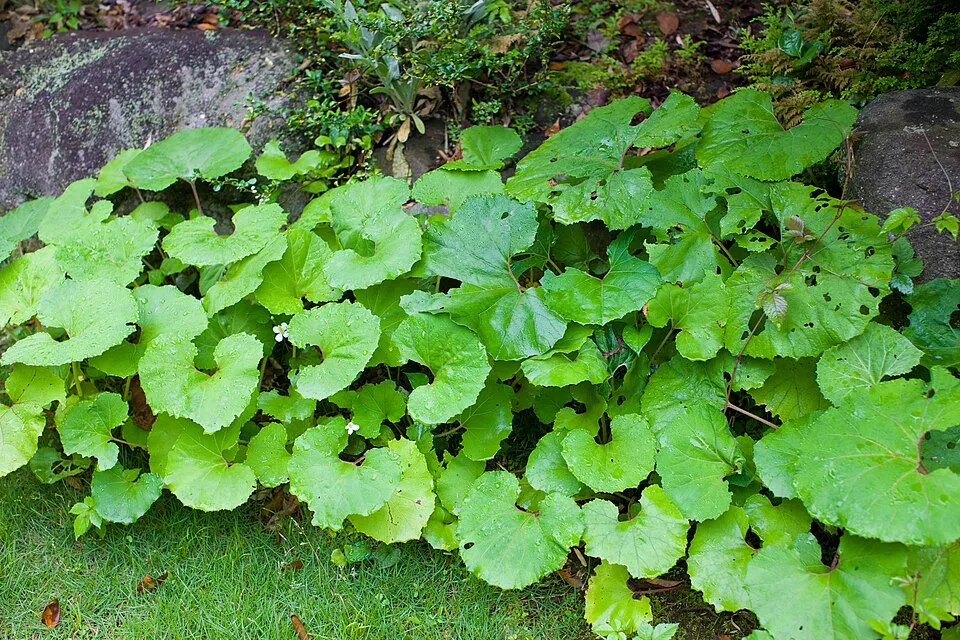
Petasites japonicus, commonly known as Fuki or Giant Butterbur, is a distinctive, robust rhizomatous perennial herb belonging to the Asteraceae family. It is indigenous to the temperate regions of East Asia, including Japan, Korea, and China, where it thrives in moist, shaded environments such as stream banks, woodland understories, and damp meadows. This plant is renowned for its strikingly large, orbicular to reniform (kidney-shaped) leaves, which can expand up to 1.2 meters (4 feet) in diameter, supported by thick, succulent petioles of comparable length.
A unique characteristic of Petasites japonicus is its precocious flowering habit; dense clusters of greenish-white or pale yellow flowers emerge on stout, scaly stems directly from the ground in late winter to early spring, often before the magnificent foliage fully unfurls. The plant's extensive network of thick, subterranean rhizomes facilitates its vigorous and often aggressive spread, allowing it to form dense, sprawling colonies over time. While highly valued for its architectural form and exotic presence in naturalized garden settings, particularly near water features, its assertive growth necessitates careful placement and management to prevent it from dominating less competitive flora.
Its unique life cycle and imposing size make it a botanical marvel, contributing significantly to its local ecosystems.
Trusted Scientific References
1. Authoritative external sources for Petasites Japonicus
1.1 Wikipedia — Petasites Japonicus
1.2 Kew POWO (Plants of the World Online)
1.3 PubMed — peer-reviewed research
1.4 NCBI Taxonomy Browser
1.5 GBIF — Global Biodiversity
1.6Petasites Japonicus should be interpreted through verified botanical identity, practical care, and responsible safety language. This recovery note adds the missing context needed for a complete profile: match light to the plant's habit, use well-drained soil, water according to season, and avoid unsupported medicinal or edible claims. For publishing, the plant can be presented as a source-backed garden plant with clear care guidance, common problem diagnosis, and conservative safety wording.
1.1.Petasites Japonicus — Distinguishing Points
- ✓Native to East — Native to East Asia, including Japan, Korea, and China, thriving in moist, shady habitats.
- ✓Distinctive large, kidney — shaped leaves (up to 1.2m diameter) and precocious greenish-white flowers.
- ✓Rhizomatous perennial with — Rhizomatous perennial with an aggressive spreading habit, forming dense colonies.
- ✓Primary active compounds — Primary active compounds are the sesquiterpenes petasin and isopetasin.
- ✓Possesses potent anti — inflammatory and antispasmodic properties.
- ✓Effective in managing — Effective in managing symptoms of migraines and allergic rhinitis.
- ✓Contains hepatotoxic pyrrolizidine — Contains hepatotoxic pyrrolizidine alkaloids (PAs) in its raw, unprocessed form.
- ✓Requires specialized processing to produce PA — free medicinal extracts for safe consumption.
- ✓Used in traditional — Used in traditional Asian medicine for respiratory ailments, pain relief, and as a seasonal vegetable.
- ✓Valued ornamental plant — Valued ornamental plant for naturalizing in moist garden areas, especially near water.
1.2.Petasites Japonicus — At-a-Glance Summary
- ✓Petasites japonicus, or Fuki, is a robust East Asian perennial known for its large leaves and early spring flowers.
- ✓Traditionally used for its anti-inflammatory and antispasmodic effects, particularly for migraines and allergic rhinitis.
- ✓Contains petasin and isopetasin, key compounds responsible for its therapeutic actions.
- ✓Raw plant contains toxic pyrrolizidine alkaloids (PAs) and should never be consumed.
- ✓Only PA-free commercial extracts are safe for medicinal use under professional guidance.
- ✓Offers natural relief for various inflammatory and spasmodic conditions when used responsibly.
2.Petasites Japonicus — Scientific Identity
3.Petasites Japonicus — Fact Sheet
4.Petasites Japonicus — Physical Description
5.Petasites Japonicus — Native Range & Habitat
6.Petasites Japonicus — Traditional Uses
7.Petasites Japonicus — Chemical Profile
- ✓Sesquiterpenes — Petasin, Isopetasin, and S-Petasin are the primary bioactive compounds responsible for the anti-inflammatory and antispasmodic effects through inhibition of leukotriene synthesis and calcium channel modulation.
- ✓Pyrrolizidine Alkaloids (PAs) — Senecionine, Senkirkine, and other hepatotoxic PAs are naturally present in the unprocessed plant; commercial preparations typically undergo extensive processing to remove these harmful compounds.
- ✓Flavonoids — Quercetin, Kaempferol, and their glycosides may contribute to antioxidant and additional anti-inflammatory activities, supporting overall cellular health and enhancing capillary strength.
- ✓Phenolic Acids — Caffeic acid and chlorogenic acid provide antioxidant benefits, helping to neutralize free radicals and protect against oxidative stress and cellular damage.
- ✓Triterpenoids — Compounds like lupeol and ursolic acid might offer further anti-inflammatory, cytoprotective, and potentially adaptogenic properties.
- ✓Volatile Oils — Trace amounts of essential oils contribute to the plant's characteristic aroma and may offer mild antimicrobial or soothing effects.
- ✓Polysaccharides — Complex carbohydrates that can support immune function and possess demulcent properties, contributing to mucosal protection.
- ✓Tannins — Astringent compounds that may offer mild anti-diarrheal or wound-healing properties, particularly relevant in traditional topical applications.
8.Petasites Japonicus — Evidence-Based Benefits
- ✓Migraine Management — Petasites japonicus extracts, particularly those rich in petasin and isopetasin, have demonstrated efficacy in reducing the frequency and intensity of migraine attacks by modulating cerebral blood flow and inhibiting inflammatory pathways.
- ✓Allergic Rhinitis Relief — The plant's compounds can alleviate symptoms of hay fever such as sneezing, nasal congestion, and itchy eyes through their anti-inflammatory and antihistaminic-like actions, offering a natural alternative for seasonal allergies.
- ✓Antispasmodic Action — Its active constituents contribute to smooth muscle relaxation, which is beneficial in treating spasmodic conditions affecting the respiratory and gastrointestinal tracts, thereby easing coughs and abdominal discomfort.
- ✓Anti-inflammatory Properties — Petasites japonicus contains sesquiterpenes that suppress inflammatory mediators like leukotrienes, making it a valuable agent for reducing systemic and localized inflammation.
- ✓Respiratory Support — By relaxing bronchial smooth muscles and reducing inflammation within the airways, it can aid in alleviating symptoms associated with asthma and other obstructive airway conditions.
- ✓Gastrointestinal Comfort — The antispasmodic effects extend to the digestive system, potentially easing cramps and discomfort linked to irritable bowel syndrome or other spasmodic GI issues.
- ✓Pain Relief — Beyond migraines, the anti-inflammatory and muscle-relaxing properties may contribute to general pain relief, particularly for muscle tension headaches or minor musculoskeletal aches.
- ✓Traditional Cold Remedy — Historically used in East Asian medicine to address symptoms of common colds, including coughs and congestion, leveraging its mucolytic and soothing properties.
8.1.Petasites Japonicus — Indications & Uses
9.Petasites Japonicus — Cautions & Contraindications
9.1.Petasites Japonicus — Reported Side Effects
- ✓Liver damage and veno-occlusive disease from unprocessed plant material containing pyrrolizidine alkaloids (PAs).
- ✓Mild gastrointestinal disturbances such as burping, indigestion, abdominal discomfort, or nausea, even with PA-free extracts.
- ✓Allergic reactions, including skin rashes, itching, or swelling, particularly in individuals sensitive to the Asteraceae family.
- ✓Headache or dizziness reported in some sensitive individuals, though less common with PA-free preparations.
- ✓Fatigue or drowsiness, though infrequent, can occur in some users.
- ✓Diarrhea or constipation in rare instances, indicating individual sensitivity to the extract.
9.2.Petasites Japonicus — Toxicity Assessment
- ✓Only use commercially available, certified pyrrolizidine alkaloid (PA)-free Petasites japonicus extracts for internal consumption.
- ✓Contraindicated in pregnancy and lactation due to potential risks to the fetus or infant, even with PA-free preparations.
- ✓Individuals with pre-existing liver disease should strictly avoid Petasites japonicus due to the hepatotoxic risk of PAs.
- ✓Not recommended for children without explicit medical supervision from a qualified practitioner to ensure safety and appropriate dosing.
- ✓Exercise caution if taking medications metabolized by the liver, as potential interactions are not fully established.
- ✓Discontinue use if any signs of liver dysfunction (e.g., dark urine, jaundice) or severe allergic reactions occur.
- ✓Consult a healthcare professional before use, especially if you have underlying health conditions, are on other medications, or are considering long-term use.
10.Petasites Japonicus — Preparation Methods
- ✓Standardized extracts are the most common and safest form, specifically processed to remove hepatotoxic pyrrolizidine alkaloids (PAs).
- ✓Capsules or tablets containing PA-free Petasites japonicus extract are used for systemic conditions like migraines and allergic rhinitis.
- ✓Tinctures made from PA-free root or leaf extracts can be consumed orally, typically diluted in water, following professional guidance.
- ✓In traditional East Asian culinary practices, young leaf stalks are boiled and repeatedly leached to remove bitterness and potentially reduce PAs, then consumed as a vegetable (fuki-no-to).
- ✓Topical applications of prepared creams or salves, though less common, are explored for localized pain or inflammation, ensuring no PAs are present.
- ✓Always consult a qualified healthcare professional for appropriate dosing and to ensure the product is certified PA-free before internal use.
- ✓Never consume raw or unprocessed Petasites japonicus plant material due to the inherent toxicity of pyrrolizidine alkaloids.
11.Petasites Japonicus — Garden Cultivation
- ✓Requires consistently moist to wet, well-drained soil rich in organic matter, mimicking its natural woodland habitat.
- ✓Thrives in partial to full shade; direct afternoon sun can scorch its exceptionally large leaves and inhibit growth.
- ✓Propagated primarily by division of its vigorous rhizomes in early spring or autumn, ensuring each section has a bud.
- ✓Can be grown from seed, but germination can be erratic and plants take longer to establish, making rhizome division more common.
- ✓Prefers cool, temperate climates and is hardy in USDA zones 4-8, tolerating cold winters.
- ✓Due to its aggressive spreading nature, consider planting in areas where it can naturalize or use root barriers to control its expansion.
- ✓Mulching with organic material helps retain soil moisture, suppress weeds, and provide nutrients, especially in drier climates.
Reviewed by the Flora Medical Global Botanical Review Panel
Multi-disciplinary editorial group · Botany · Ethnobotany · Herbal-medicine literature
Who reviewed this: This page was checked by the Flora Medical Global Botanical Review Panel — an in-house editorial group of botany graduates, ethnobotany researchers, and horticulture practitioners who collectively maintain our 7,000+ plant encyclopedia. Meet the team.
Our 4-step verification process
1. Taxonomic verification
Scientific names and synonyms cross-checked against Kew POWO, World Flora Online, and The Plant List.
2. Phytochemical & medicinal cross-reference
Active compounds, traditional uses, and reported activities are cross-referenced with PubMed, USDA Dr. Duke's database, and peer-reviewed ethnobotanical literature.
3. Conservation & distribution check
Distribution, ecology, and conservation status confirmed against GBIF occurrence records and the IUCN Red List.
4. Editorial & safety review
Every entry passes an editorial pass for clarity, originality, and safety notices (toxicity, contraindications, dosage caveats) before publication.
Last reviewed:
Important medical disclaimer: This content is for educational and research purposes only. It is not medical advice and is not a substitute for consultation with a licensed healthcare provider. Do not use any herb to self-treat a medical condition without professional guidance.
Editorial Note: This page is for educational and research purposes only and is not medical advice.
Written by: Flora Medical Global Editorial Team
Reviewed by: Flora Medical Global Botanical Review Panel
Last Updated: June 15, 2026





Petasites Japonicus — Comments & Community Reviews
Rate this plant