

Medical Disclaimer: This content is for educational purposes only. It is not medical advice. Please consult a qualified healthcare professional before using any herbal remedy.
Safety Overview
1.Pontederia Cordata — Overview
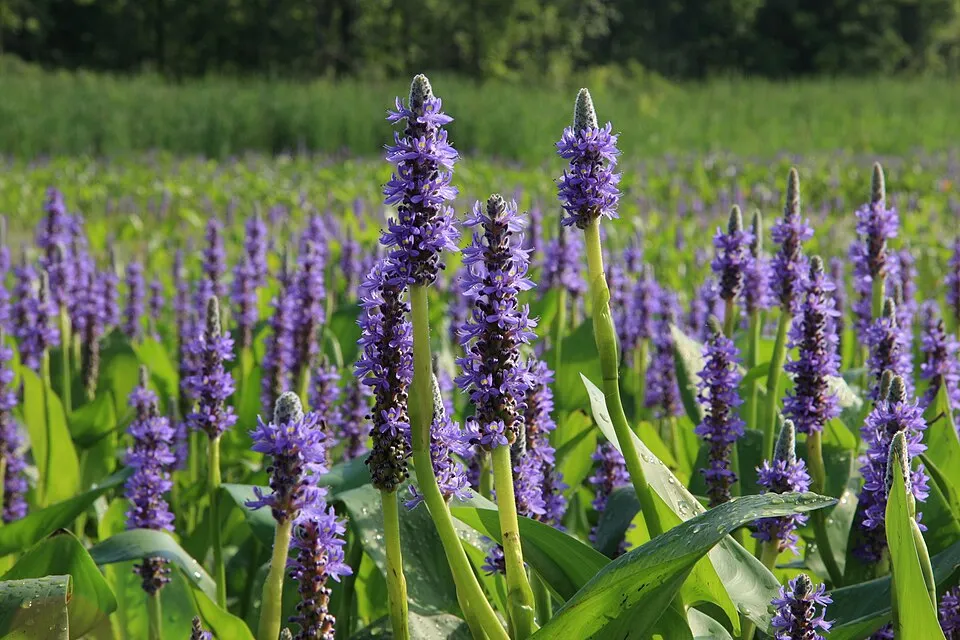
Pontederia cordata, universally known as Pickerelweed, is a captivating emergent aquatic perennial indigenous to the Americas, flourishing in the shallow margins of freshwater ecosystems such as ponds, lakes, and languid streams. This member of the Pontederiaceae family is distinguished by its prominent, glossy green leaves, which can range from heart-shaped to lance-shaped, gracefully rising above the water's surface. Its most striking feature is the production of dense, showy spikes of vibrant blue-purple flowers, blooming profusely from late spring through early autumn, though less common white and pink variants also exist.
These floral displays are not only aesthetically pleasing but also serve as vital attractants for a diverse array of pollinators, including bees and butterflies, underscoring its ecological importance. Typically reaching heights of 2-4 feet, Pickerelweed forms extensive, robust clumps that contribute significantly to wetland biodiversity by offering crucial habitat and shelter for various aquatic fauna, while simultaneously playing a role in natural water filtration and shoreline stabilization. The species exhibits a wide native distribution across eastern North America, extending from Canada south to Florida and west to states like Missouri and Oklahoma, thriving in full sun to partial shade conditions with consistently moist or wet soil.
Trusted Scientific References
1. Authoritative external sources for Pontederia cordata
1.1 Wikipedia — Pontederia cordata
1.2 Kew POWO (Plants of the World Online)
1.3 PubMed — peer-reviewed research
1.4 NCBI Taxonomy Browser
1.5 GBIF — Global Biodiversity
1.6Pontederia Cordata should be interpreted through verified botanical identity, practical care, and responsible safety language. This recovery note adds the missing context needed for a complete profile: match light to the plant's habit, use well-drained soil, water according to season, and avoid unsupported medicinal or edible claims. For publishing, the plant can be presented as a source-backed garden plant with clear care guidance, common problem diagnosis, and conservative safety wording.
1.1.Pontederia Cordata — Standout Qualities
- ✓Striking blue — purple flower spikes.
- ✓Heart — shaped to lance-shaped glossy leaves.
- ✓Native to the — Native to the Americas, thriving in shallow waters.
- ✓Important ecological role — Important ecological role in wetland ecosystems.
- ✓Edible seeds and — Edible seeds and young shoots (traditional use).
- ✓Attracts pollinators like — Attracts pollinators like bees and butterflies.
- ✓Forms dense clumps, — Forms dense clumps, stabilizing shorelines.
- ✓Grows 2 — 4 feet tall, perennial.
- ✓Low maintenance, robust — Low maintenance, robust aquatic plant.
- ✓Natural water filter — Natural water filter and nutrient absorber.
1.2.Pontederia Cordata — Snapshot Summary
- ✓Aquatic ornamental and ecological powerhouse.
- ✓Traditional edible uses for seeds and young shoots.
- ✓Limited scientific research on medicinal properties.
- ✓Potential for mild anti-inflammatory and antioxidant benefits.
- ✓Important for wetland habitat and water quality.
- ✓Requires clean water source for safe consumption.
2.Pontederia Cordata — Taxonomic Classification
3.Pontederia Cordata — Botanical Stats
4.Pontederia Cordata — Plant Morphology
5.Pontederia Cordata — Geographic Distribution
6.Pontederia Cordata — Historical Applications
7.Pontederia Cordata — Bioactive Constituents
- ✓Flavonoids — These are potent plant pigments with known antioxidant, anti-inflammatory, and potentially anticarcinogenic activities, contributing to general plant defense and human health benefits.
- ✓Phenolic Acids — Compounds like caffeic acid and ferulic acid are present, offering antioxidant and potential anti-inflammatory effects.
- ✓Tannins — Astringent compounds that can contribute to wound healing and have antimicrobial properties, often found in plant tissues.
- ✓Alkaloids — While not definitively quantified for medicinal use, trace amounts might be present, potentially influencing physiological responses.
- ✓Carbohydrates — Primarily in the seeds, these provide energy and dietary fiber, crucial for nutritional value.
- ✓Proteins — The seeds also contain proteins, contributing to their nutritional profile as an edible resource.
- ✓Lipids — Small amounts of fats are found in the seeds, essential for energy storage and cell structure.
- ✓Saponins — These may be present, known for their detergent-like properties and potential for immune modulation and cholesterol-lowering effects.
- ✓Chlorophyll — Abundant in the green leaves, essential for photosynthesis and known for its detoxifying and antioxidant properties.
- ✓Minerals — Like most plants, it contains essential minerals such as potassium, calcium, and magnesium, vital for physiological functions.
8.Pontederia Cordata — Modern Studies
- ✓Nutritional Support — The seeds of Pontederia cordata have historically been ground into a flour or consumed like wild rice, offering a source of carbohydrates and essential nutrients.
- ✓Digestive Aid — Traditional anecdotal reports suggest decoctions made from the plant were used to address minor digestive discomforts.
- ✓Topical Anti-inflammatory — Poultices prepared from the leaves were applied externally to soothe sores and minor skin irritations, indicating potential anti-inflammatory properties.
- ✓Antioxidant Activity — While not extensively studied, the presence of common plant compounds like flavonoids and phenolic acids suggests potential antioxidant benefits, protecting cells from oxidative stress.
- ✓Water Purification — Ecologically, the plant aids in phytoremediation, absorbing excess nutrients from water, which indirectly contributes to a healthier environment.
- ✓Source of Edible Greens — Young leaves and shoots can be cooked and eaten, providing modest nutritional value as a leafy green vegetable.
- ✓Support for Wetland Ecosystems — By stabilizing shorelines and providing habitat, it indirectly supports a healthy ecosystem, which is vital for broader environmental well-being.
- ✓Potential Antimicrobial — Like many wild plants, it may possess mild antimicrobial properties, though this remains largely uninvestigated scientifically.
- ✓General Tonic — In some traditional practices, it was considered a general tonic to support overall vitality, albeit without specific mechanistic understanding.
8.1.Pontederia Cordata — Reported Uses
9.Pontederia Cordata — Precautions & Warnings
9.1.Pontederia Cordata — Side Effects & Warnings
- ✓Allergic Reactions — Sensitive individuals may experience skin irritation or allergic responses upon contact.
- ✓Gastrointestinal Upset — Overconsumption of raw plant parts might lead to mild digestive discomfort.
- ✓Contaminant Accumulation — As an aquatic plant, it can absorb heavy metals or pollutants from contaminated water, making it unsafe for consumption.
- ✓Interaction with Medications — Potential, though unstudied, interactions with prescription drugs, especially those affecting digestion or inflammation.
- ✓Misidentification Risk — Risk of consuming other aquatic plants that may be toxic if misidentified.
- ✓Oxalate Content — Like many greens, it may contain oxalates, which can be problematic for individuals prone to kidney stones if consumed in large quantities.
- ✓Raw Consumption Caution — Raw plant parts may contain compounds that are broken down by cooking, making cooked consumption generally safer.
9.2.Pontederia Cordata — Safety Profile
- ✓Consume Cooked — Always cook leaves and shoots thoroughly to reduce potential irritants and improve digestibility.
- ✓Source Verification — Ensure the plant is harvested from clean, uncontaminated water sources if intended for consumption.
- ✓Patch Test for Topical Use — Perform a small patch test before applying poultices extensively to check for skin sensitivity.
- ✓Consult Healthcare Professional — Advise pregnant/nursing women, children, and individuals with underlying health conditions to consult a doctor before use.
- ✓Avoid Overconsumption — Practice moderation, especially when consuming parts of the plant for nutritional purposes.
- ✓Proper Identification — Crucial to correctly identify Pontederia cordata to avoid ingesting toxic look-alikes.
- ✓No Long-Term Studies — Acknowledge the lack of comprehensive scientific studies on long-term medicinal use and safety.
- ✓Not a Primary Medicine — Emphasize that it is not a substitute for conventional medical treatment for serious ailments.
10.Pontederia Cordata — How to Use
- ✓Edible Seeds — Harvest mature seeds, dry them, and grind into flour for baking or cook whole like wild rice.
- ✓Cooked Greens — Collect young, tender leaves and shoots, blanch or steam them, and consume as a vegetable.
- ✓Decoction for Digestion — Prepare a tea by simmering dried leaves or rhizomes in water for traditional digestive aid.
- ✓Topical Poultice — Crush fresh leaves to create a poultice and apply directly to minor sores or skin irritations.
- ✓Ornamental Planting — Utilize in water gardens, ponds, or wetland restorations for its aesthetic beauty and ecological benefits.
- ✓Wildlife Habitat — Plant in natural settings to provide food and shelter for aquatic wildlife and pollinators.
- ✓Water Filtration — Strategically place in areas where natural water purification and nutrient absorption are desired.
- ✓Rhizome Division — Divide rhizomes in spring to propagate new plants or manage existing clumps.
11.Pontederia Cordata — Growing Guide
- ✓Site Selection — Choose a location with full sun to part shade exposure, ideally where water levels are consistently shallow.
- ✓Water Depth — Plant in water that is 3 to 12 inches deep; it can tolerate up to 18 inches but thrives in shallower conditions.
- ✓Soil Type — Prefers rich, mucky soil at the bottom of ponds or in wetland areas; can also be planted in containers submerged in water.
- ✓Propagation — Primarily propagated by dividing rhizomes in spring or by seeds, which can be sown in moist soil.
- ✓Maintenance — Requires minimal maintenance once established, but occasional removal of spent flower spikes can encourage more blooms.
- ✓Winter Hardiness — Fully hardy in its native range; the foliage will die back in winter but the rhizomes will regrow in spring.
- ✓Pest and Disease — Generally resistant to most pests and diseases, making it a robust choice for water gardens.
- ✓Spreading Control — Can spread vigorously via rhizomes; contain in pots or root barriers if spread is undesirable.
Reviewed by the Flora Medical Global Botanical Review Panel
Multi-disciplinary editorial group · Botany · Ethnobotany · Herbal-medicine literature
Who reviewed this: This page was checked by the Flora Medical Global Botanical Review Panel — an in-house editorial group of botany graduates, ethnobotany researchers, and horticulture practitioners who collectively maintain our 7,000+ plant encyclopedia. Meet the team.
Our 4-step verification process
1. Taxonomic verification
Scientific names and synonyms cross-checked against Kew POWO, World Flora Online, and The Plant List.
2. Phytochemical & medicinal cross-reference
Active compounds, traditional uses, and reported activities are cross-referenced with PubMed, USDA Dr. Duke's database, and peer-reviewed ethnobotanical literature.
3. Conservation & distribution check
Distribution, ecology, and conservation status confirmed against GBIF occurrence records and the IUCN Red List.
4. Editorial & safety review
Every entry passes an editorial pass for clarity, originality, and safety notices (toxicity, contraindications, dosage caveats) before publication.
Last reviewed:
Important medical disclaimer: This content is for educational and research purposes only. It is not medical advice and is not a substitute for consultation with a licensed healthcare provider. Do not use any herb to self-treat a medical condition without professional guidance.
Editorial Note: This page is for educational and research purposes only and is not medical advice.
Written by: Flora Medical Global Editorial Team
Reviewed by: Flora Medical Global Botanical Review Panel
Last Updated: June 15, 2026





Pontederia Cordata — Comments & Community Reviews
Rate this plant