
Medical Disclaimer: This content is for educational purposes only. It is not medical advice. Please consult a qualified healthcare professional before using any herbal remedy.
Safety Overview
1.Pulmonaria Garden — Introduction & Highlights
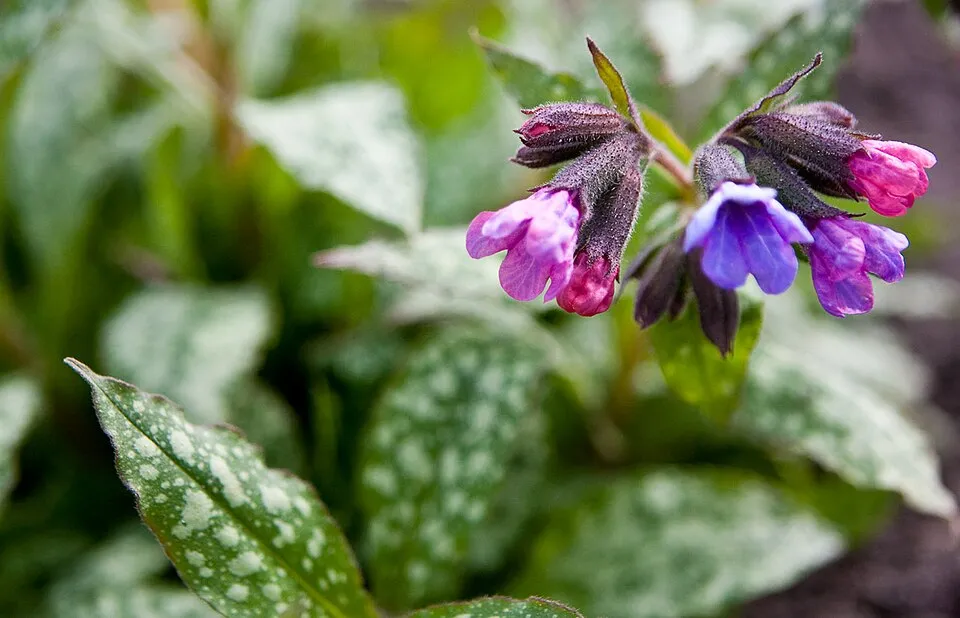
Pulmonaria saccharata, commonly known as Bethlehem lungwort or Bethlehem sage, is a captivating herbaceous perennial belonging to the Boraginaceae family. Native to the deciduous woodlands of Europe, this species is cherished for its distinctive ornamental foliage and vibrant early spring blossoms. It typically forms a robust basal rosette of ovate to oblong leaves, which are characteristically adorned with conspicuous silvery-white spots or blotches, creating a 'sugared' appearance that inspired its specific epithet, 'saccharata'. These hirsute (hairy) leaves can grow quite large, providing significant visual interest even outside of its flowering period.
In early to mid-spring, often before or concurrently with the full emergence of its leaves, erect stems emerge from the rosette, culminating in clusters of funnel-shaped flowers. A fascinating aspect of Pulmonaria saccharata's blooms is their striking color transformation; they typically open as pink or reddish hues and gradually mature to shades of blue or violet, resulting in a multi-toned floral display on a single plant. This color shift is attributed to changes in the pH levels within the flower petals as they age. Pulmonaria saccharata thrives in cool, moist, and well-drained soils rich in organic matter, preferring partial to full shade.
Its adaptability to shady conditions and compact growth habit make it an excellent choice for woodland gardens, shaded borders, or as an effective groundcover beneath trees and shrubs. Beyond its aesthetic appeal, its early blooms serve as a vital nectar source for emerging pollinators like bees and butterflies, underscoring its ecological importance.
Trusted Scientific References
1. Authoritative external sources for Pulmonaria saccharata
1.1 Wikipedia — Pulmonaria saccharata
1.2 Kew POWO (Plants of the World Online)
1.3 PubMed — peer-reviewed research
1.4 NCBI Taxonomy Browser
1.5 GBIF — Global Biodiversity
1.6Pulmonaria Garden should be interpreted through verified botanical identity, practical care, and responsible safety language. This recovery note adds the missing context needed for a complete profile: match light to the plant's habit, use well-drained soil, water according to season, and avoid unsupported medicinal or edible claims. For publishing, the plant can be presented as a source-backed garden plant with clear care guidance, common problem diagnosis, and conservative safety wording.
1.1.Pulmonaria Garden — Key Features
- ✓Distinctive silvery — spotted foliage, giving a 'sugared' appearance.
- ✓Flowers change color — Flowers change color from pink/red to blue/violet as they age.
- ✓Early spring bloomer, — Early spring bloomer, providing nectar for early pollinators.
- ✓Adaptable to partial — Adaptable to partial to full shade garden conditions.
- ✓Traditionally used in — Traditionally used in folk medicine for respiratory ailments.
- ✓Contains expectorant, demulcent, and anti — inflammatory compounds.
- ✓Perennial plant, forming — Perennial plant, forming attractive basal rosettes.
- ✓Low — maintenance once established in suitable conditions.
- ✓Excellent groundcover or — Excellent groundcover or accent plant for shaded areas.
- ✓Scientific name 'saccharata' — Scientific name 'saccharata' refers to its sugared leaf appearance.
1.2.Pulmonaria Garden — Concise Overview
- ✓Pulmonaria saccharata is a European perennial known for its spotted leaves and color-changing flowers.
- ✓Traditionally used for respiratory support due to its expectorant and demulcent properties.
- ✓Contains beneficial compounds like flavonoids, saponins, and mucilage.
- ✓Care must be taken due to the presence of pyrrolizidine alkaloids, especially with internal use.
- ✓Thrives in shaded, moist environments, making it popular for woodland gardens.
- ✓Offers antioxidant and anti-inflammatory benefits.
2.Pulmonaria Garden — Scientific Profile
3.Pulmonaria Garden — Botanical Stats
4.Pulmonaria Garden — Morphological Account
5.Pulmonaria Garden — Geographic Distribution
6.Pulmonaria Garden — Historical Applications
7.Pulmonaria Garden — Active Compounds
- ✓Polysaccharides — Including mucilage, which contributes to its demulcent and soothing properties for mucous membranes.
- ✓Saponins — These compounds possess expectorant qualities, helping to thin mucus in the respiratory passages.
- ✓Flavonoids — Such as quercetin and kaempferol derivatives, known for their antioxidant and anti-inflammatory activities.
- ✓Phenolic Acids — Including rosmarinic acid and caffeic acid, which provide significant antioxidant and anti-inflammatory benefits.
- ✓Tannins — Responsible for the plant's astringent properties, contributing to its traditional use for toning tissues and drying secretions.
- ✓Allantoin — A compound known for its skin-soothing and healing properties, often found in plants like comfrey and lungwort.
- ✓Silica — Present in the plant, supporting connective tissue health and potentially contributing to lung tissue integrity.
- ✓Pyrrolizidine Alkaloids (PAs) — Found in some Boraginaceae species, including Pulmonaria, though generally in low concentrations; these can be hepatotoxic.
- ✓Anthocyanins — Pigments responsible for the color change in the flowers, also possessing antioxidant properties.
- ✓Glycosides — Various glycosides contribute to the plant's overall pharmacological profile.
8.Pulmonaria Garden — What Research Suggests
- ✓Expectorant Action — Helps to loosen and expel mucus from the respiratory tract, easing congestion and promoting clearer breathing.
- ✓Anti-inflammatory Properties — Contains compounds that may reduce inflammation in the respiratory system, alleviating symptoms of bronchitis and coughs.
- ✓Antioxidant Support — Rich in polyphenols and flavonoids, it helps protect cells from oxidative damage caused by free radicals.
- ✓Astringent Effects — Possesses mild astringent qualities, which can tone and strengthen mucous membranes, particularly in the lungs and throat.
- ✓Demulcent Qualities — Provides a soothing, protective film over irritated mucous membranes, offering relief from dry coughs and sore throats.
- ✓Traditional Respiratory Aid — Historically used to support lung health, especially for conditions involving chronic coughs or lung weakness.
- ✓Wound Healing — External applications were traditionally believed to aid in the healing of minor cuts and skin irritations due to its astringent nature.
- ✓Immune System Modulation — Some components may help support overall immune function, indirectly contributing to recovery from respiratory infections.
- ✓Diuretic Properties — May exhibit mild diuretic effects, promoting increased urine production and assisting the body in eliminating waste.
- ✓Skin Soothing — Topically, extracts have been used to calm skin irritations and minor inflammation.
8.1.Pulmonaria Garden — Conditions Traditionally Used For
9.Pulmonaria Garden — Risk Profile
9.1.Pulmonaria Garden — Possible Adverse Reactions
- ✓Liver Toxicity — Contains pyrrolizidine alkaloids (PAs) which can be hepatotoxic, particularly with long-term or high-dose use.
- ✓Allergic Reactions — Potential for skin irritation or allergic responses in sensitive individuals.
- ✓Gastrointestinal Upset — Nausea, vomiting, or diarrhea may occur, especially with excessive intake.
- ✓Drug Interactions — May interact with medications, particularly liver-metabolized drugs due to PA content.
- ✓Pregnancy and Lactation — Not recommended due to lack of safety data and potential PA exposure.
- ✓Kidney Issues — High doses of PAs over time could potentially impact kidney function.
- ✓Photosensitivity — Rare cases of increased skin sensitivity to sunlight have been reported.
9.2.Pulmonaria Garden — Toxicity Assessment
- ✓Avoid Long-Term Use — Due to the presence of pyrrolizidine alkaloids, avoid prolonged or continuous internal use.
- ✓Consult a Healthcare Professional — Always seek advice before use, especially if pregnant, breastfeeding, or on medication.
- ✓Not for Internal Use by Children — Due to sensitivities and potential PA risks, avoid administering to children.
- ✓External Use Caution — Perform a patch test before extensive topical application to check for skin sensitivity.
- ✓Purchase from Reputable Sources — Ensure products are free from harmful contaminants and correctly identified.
- ✓Monitor for Adverse Reactions — Discontinue use if any unusual symptoms or allergic reactions occur.
- ✓Contraindications — Avoid if you have liver disease or are taking hepatotoxic medications.
10.Pulmonaria Garden — Application Forms
- ✓Herbal Tea/Infusion — Dried leaves and flowers steeped in hot water for respiratory ailments and as a general tonic.
- ✓Tincture — Alcohol-based extract of the aerial parts, used for concentrated therapeutic effects.
- ✓Poultice — Fresh crushed leaves applied topically to minor wounds or skin irritations for their soothing and astringent properties.
- ✓Syrup — Infusions simmered with honey or sugar, often used for coughs and sore throats.
- ✓Gargle/Mouthwash — A cooled infusion can be used to soothe inflamed throats and oral mucosa.
- ✓Inhalation — Steaming with a strong infusion can help clear respiratory passages.
- ✓Salve/Ointment — Infused oil incorporated into a salve for topical application on skin.
- ✓Decoction — Simmering roots or tougher plant parts for a longer extraction, though less common for Pulmonaria leaves.
11.Pulmonaria Garden — Growing Guide
- ✓Site Selection — Choose a location with partial to full shade, mimicking its natural woodland habitat.
- ✓Soil Preparation — Ensure well-drained, consistently moist soil rich in organic matter; amend with compost if necessary.
- ✓Watering — Provide regular watering, especially during dry periods, to keep the soil evenly moist but not waterlogged.
- ✓Propagation — Can be propagated by division in late summer or early spring, or by seed sown in early spring.
- ✓Fertilization — A light application of balanced, slow-release fertilizer in spring can promote vigorous growth.
- ✓Pest and Disease Management — Generally low-maintenance; watch for slugs and snails, and ensure good air circulation to prevent fungal issues.
- ✓Winter Care — In colder climates (USDA zones 3-5), a layer of mulch can provide winter protection.
- ✓Pruning — Remove spent flower stalks after blooming to encourage foliage growth and maintain a tidy appearance.
Reviewed by the Flora Medical Global Botanical Review Panel
Multi-disciplinary editorial group · Botany · Ethnobotany · Herbal-medicine literature
Who reviewed this: This page was checked by the Flora Medical Global Botanical Review Panel — an in-house editorial group of botany graduates, ethnobotany researchers, and horticulture practitioners who collectively maintain our 7,000+ plant encyclopedia. Meet the team.
Our 4-step verification process
1. Taxonomic verification
Scientific names and synonyms cross-checked against Kew POWO, World Flora Online, and The Plant List.
2. Phytochemical & medicinal cross-reference
Active compounds, traditional uses, and reported activities are cross-referenced with PubMed, USDA Dr. Duke's database, and peer-reviewed ethnobotanical literature.
3. Conservation & distribution check
Distribution, ecology, and conservation status confirmed against GBIF occurrence records and the IUCN Red List.
4. Editorial & safety review
Every entry passes an editorial pass for clarity, originality, and safety notices (toxicity, contraindications, dosage caveats) before publication.
Last reviewed:
Important medical disclaimer: This content is for educational and research purposes only. It is not medical advice and is not a substitute for consultation with a licensed healthcare provider. Do not use any herb to self-treat a medical condition without professional guidance.
Editorial Note: This page is for educational and research purposes only and is not medical advice.
Written by: Flora Medical Global Editorial Team
Reviewed by: Flora Medical Global Botanical Review Panel
Last Updated: June 15, 2026





Pulmonaria Garden — Comments & Community Reviews
Rate this plant