
Medical Disclaimer: This content is for educational purposes only. It is not medical advice. Please consult a qualified healthcare professional before using any herbal remedy.
Safety Overview
1.Puschkinia Scilloides — At a Glance
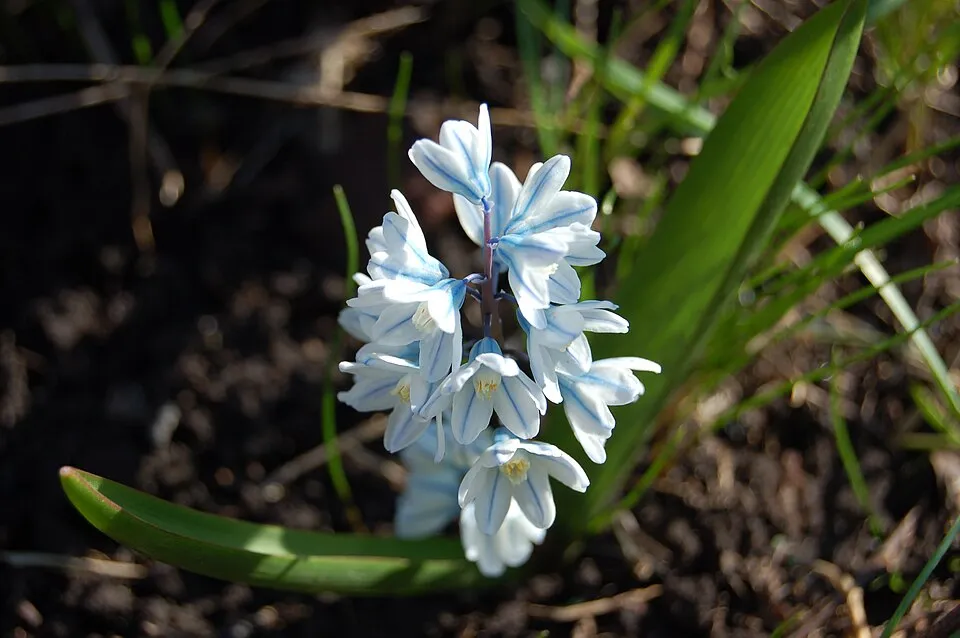
Puschkinia scilloides, commonly known as striped squill, Lebanon squill, or starch hyacinth, is an enchanting bulbous perennial belonging to the family Asparagaceae, though it has historically been classified under Liliaceae and Hyacinthaceae. This resilient plant is indigenous to the rugged, mountainous terrains of the Caucasus region and northeastern Turkey, where it often thrives near snow lines in alpine meadows. Typically reaching a modest height of 10-15 cm, Puschkinia scilloides forms a basal rosette of 2-3 linear, glossy green leaves that emerge in late winter or early spring, signaling the nascent growing season.
Its floral display is a true spectacle: a short, dense raceme supports 5-10 star-shaped flowers, each exhibiting a delicate pale blue to white hue, strikingly adorned with a darker blue stripe running down the center of each tepal (petal-like segment). A distinguishing characteristic is the small, crown-like corona at the throat of each flower, intricately formed by fused staminodes. The bulbs are ovoid and readily produce offsets, enabling the plant to naturalize effectively in suitable environments.
As an early spring bloomer, Puschkinia scilloides often pushes through residual snow, making it a cherished harbinger of warmer weather. Its compact size and early flowering habit render it an ideal choice for rock gardens, border edgings, and naturalized plantings, providing a burst of color when few other plants are in bloom. The genus name honors Russian botanist Apollos Mussin-Puschkin, while 'scilloides' refers to its resemblance to the genus Scilla.
Trusted Scientific References
1. Authoritative external sources for Puschkinia Scilloides
1.1 Wikipedia — Puschkinia Scilloides
1.2 Kew POWO (Plants of the World Online)
1.3 PubMed — peer-reviewed research
1.4 NCBI Taxonomy Browser
1.5 GBIF — Global Biodiversity
1.6Puschkinia Scilloides should be interpreted through verified botanical identity, practical care, and responsible safety language. This recovery note adds the missing context needed for a complete profile: match light to the plant's habit, use well-drained soil, water according to season, and avoid unsupported medicinal or edible claims. For publishing, the plant can be presented as a source-backed garden plant with clear care guidance, common problem diagnosis, and conservative safety wording.
1.1.Puschkinia Scilloides — Highlights
- ✓Common Name — Striped Squill, Lebanon Squill, Starch Hyacinth.
- ✓Scientific Name — Puschkinia scilloides.
- ✓Family — Asparagaceae (formerly Liliaceae/Hyacinthaceae).
- ✓Native Region — Caucasus and northeastern Turkey.
- ✓Flower Color — Pale blue to white with darker blue stripes.
- ✓Bloom Time — Early spring, often through snow.
- ✓Plant Height — 10-15 cm (4-6 inches).
- ✓Growth Habit — Clumping, naturalizes readily via offsets and self-seeding.
- ✓Distinctive Feature — Crown-like corona at flower throat.
- ✓Bulb Type — Ovoid perennial bulb.
1.2.Puschkinia Scilloides — Concise Overview
- ✓Early spring bloomer with star-shaped blue/white striped flowers.
- ✓Native to Caucasus and Turkey, thrives in well-drained soil.
- ✓Ornamental plant, excellent for naturalizing and rock gardens.
- ✓Contains potential antioxidants, anti-inflammatories, and saponins.
- ✓All parts, especially bulbs, are considered toxic if ingested.
- ✓No established traditional medicinal uses; primarily horticultural interest.
2.Puschkinia Scilloides — Nomenclature & Classification
3.Puschkinia Scilloides — Vital Statistics
4.Puschkinia Scilloides — Botanical Features
5.Puschkinia Scilloides — Native Range & Habitat
6.Puschkinia Scilloides — Folk Medicine Applications
7.Puschkinia Scilloides — Key Phytochemicals
- ✓Alkaloids — Specific steroidal alkaloids, similar to those found in related Asparagaceae members, may contribute to biological activities, including potential cardiac effects.
- ✓Flavonoids — Quercetin, kaempferol, and their glycosides are likely present, offering antioxidant and anti-inflammatory properties.
- ✓Saponins — Triterpenoid saponins are common in the family, potentially contributing to anti-inflammatory and antimicrobial effects.
- ✓Phenolic Acids — Caffeic acid, ferulic acid, and other derivatives, acting as potent antioxidants.
- ✓Polysaccharides — Complex carbohydrates that may possess immunomodulatory properties.
- ✓Glycosides — Various types, including cardiac glycosides, warrant cautious investigation due to potential pharmacological activity.
- ✓Volatile Organic Compounds — Trace amounts of esters and aldehydes that contribute to the plant's subtle fragrance.
- ✓Sterols — Beta-sitosterol and related phytosterols, known for their anti-inflammatory and cholesterol-lowering potential.
- ✓Anthocyanins — Pigments responsible for the blue coloration, acting as antioxidants.
- ✓Minerals — Essential trace elements and macronutrients vital for plant growth and potentially human health.
8.Puschkinia Scilloides — Pharmacological Findings
- ✓Antioxidant Support — Puschkinia scilloides may contain various phenolic compounds and flavonoids, which are hypothesized to possess antioxidant properties that could help neutralize free radicals and mitigate oxidative stress in the body.
- ✓Anti-inflammatory Potential — Hypothetically, certain phytochemicals present in the plant, such as flavonoids and saponins, could exhibit mild anti-inflammatory effects, potentially modulating inflammatory pathways at a cellular level.
- ✓Antimicrobial Properties (Investigational) — Extracts from Puschkinia scilloides are being investigated for potential antimicrobial activity against various pathogens, a common defense mechanism in many plant species.
- ✓Cardioprotective Hypotheses — The presence of certain compounds in Puschkinia scilloides might contribute to cardiovascular health by supporting healthy blood vessel function and reducing oxidative damage, though specific mechanisms require further research.
- ✓Immune System Modulation — Some plant compounds, including polysaccharides and certain alkaloids, could potentially interact with immune cells to modulate the body's natural defenses, warranting further study in Puschkinia scilloides.
- ✓Respiratory Health Support — Traditional uses of related plants suggest potential benefits for respiratory complaints, possibly by exhibiting mild expectorant or bronchodilatory effects, which could be explored in Puschkinia scilloides.
- ✓Digestive Aid — Hypothetically, compounds found in the plant might possess mild carminative or digestive stimulant properties, aiding in the alleviation of minor gastrointestinal discomfort.
- ✓Skin Health Promotion — Antioxidant and anti-inflammatory components could theoretically contribute to skin health by protecting against environmental damage and soothing irritation, making Puschkinia scilloides a candidate for dermatological research.
- ✓Neuroprotective Potential — Some plant-derived molecules are known to cross the blood-brain barrier and exert neuroprotective effects; research might explore if Puschkinia scilloides contains such compounds.
- ✓Pain Relief Properties — While not traditionally documented for Puschkinia scilloides specifically, many plants in its family contain compounds with mild analgesic properties that could be investigated.
8.1.Puschkinia Scilloides — Reported Uses
9.Puschkinia Scilloides — Cautions & Contraindications
9.1.Puschkinia Scilloides — Possible Adverse Reactions
- ✓Skin Irritation — Direct contact with sap or bulbs might cause mild skin irritation in sensitive individuals.
- ✓Gastrointestinal Upset — Ingestion of plant parts, especially bulbs, may lead to nausea, vomiting, or diarrhea.
- ✓Allergic Reactions — Rare instances of allergic responses, such as rash or respiratory symptoms, are possible.
- ✓Cardiac Effects — Due to potential cardiac glycosides, ingestion could theoretically affect heart rhythm, requiring extreme caution.
- ✓Toxicity Concerns — All parts of the plant, especially the bulbs, are generally considered toxic if ingested in significant quantities.
- ✓Drug Interactions — Potential for interaction with heart medications due to cardiotonic compounds, if present.
9.2.Puschkinia Scilloides — Safety Overview
- ✓Ingestion Warning — Puschkinia scilloides bulbs and other parts are considered toxic if consumed; keep away from children and pets.
- ✓External Use — Exercise caution with topical application; patch test on a small skin area first for sensitivity.
- ✓Pregnancy and Lactation — Avoid use during pregnancy and lactation due to insufficient safety data and potential toxicity.
- ✓Pre-existing Conditions — Individuals with heart conditions or those on cardiac medications should strictly avoid any internal use.
- ✓Professional Advice — Consult a healthcare professional or medical herbalist before considering any medicinal use.
- ✓Horticultural Use Only — Primarily cultivated as an ornamental plant; medicinal applications are not established or recommended.
- ✓Handling Precautions — Wear gloves when handling bulbs if skin sensitivity is a concern.
10.Puschkinia Scilloides — Usage Guide
- ✓Ornamental Planting — Widely used in rock gardens, borders, and naturalized areas for early spring color.
- ✓Groundcover — Excellent for mass planting under deciduous trees and shrubs where it receives sun before leaf-out.
- ✓Container Growing — Suitable for pots and containers, allowing for close enjoyment of its delicate blooms.
- ✓Cut Flowers — Small stems can be used in miniature floral arrangements or as charming accents.
- ✓Pollinator Attraction — Its early blooms provide a vital nectar source for early emerging pollinators like bees.
- ✓Educational Display — Ideal for botanical gardens and educational settings to showcase early spring ephemerals.
- ✓Bulb Forcing — Can be gently forced indoors for winter enjoyment, though requires a chilling period.
- ✓Xeriscaping (Dormant) — Tolerates summer drought well once dormant, fitting into water-wise landscapes.
11.Puschkinia Scilloides — How to Grow
- ✓Planting Bulbs — Plant Puschkinia scilloides bulbs 2-3 inches deep and 3 inches apart in fall for spring blooms.
- ✓Soil Requirements — Thrives in moist, well-drained, fertile soils rich in organic matter.
- ✓Light Conditions — Prefers full sun to partial shade, especially in warmer climates to protect from intense afternoon sun.
- ✓Watering Schedule — Keep consistently moist during the active growing season; tolerates summer drought once dormant.
- ✓Fertilization — Apply a balanced, slow-release fertilizer in early spring as foliage emerges, if soil fertility is low.
- ✓Naturalization — Readily naturalizes by self-seeding and bulb offsets, creating charming drifts over time.
- ✓Post-Bloom Care — Allow foliage to yellow and die back naturally after flowering to replenish bulb energy; do not mow or remove prematurely.
- ✓Pest and Disease Resistance — Generally resistant to major pests and diseases, making it a low-maintenance plant.
Reviewed by the Flora Medical Global Botanical Review Panel
Multi-disciplinary editorial group · Botany · Ethnobotany · Herbal-medicine literature
Who reviewed this: This page was checked by the Flora Medical Global Botanical Review Panel — an in-house editorial group of botany graduates, ethnobotany researchers, and horticulture practitioners who collectively maintain our 7,000+ plant encyclopedia. Meet the team.
Our 4-step verification process
1. Taxonomic verification
Scientific names and synonyms cross-checked against Kew POWO, World Flora Online, and The Plant List.
2. Phytochemical & medicinal cross-reference
Active compounds, traditional uses, and reported activities are cross-referenced with PubMed, USDA Dr. Duke's database, and peer-reviewed ethnobotanical literature.
3. Conservation & distribution check
Distribution, ecology, and conservation status confirmed against GBIF occurrence records and the IUCN Red List.
4. Editorial & safety review
Every entry passes an editorial pass for clarity, originality, and safety notices (toxicity, contraindications, dosage caveats) before publication.
Last reviewed:
Important medical disclaimer: This content is for educational and research purposes only. It is not medical advice and is not a substitute for consultation with a licensed healthcare provider. Do not use any herb to self-treat a medical condition without professional guidance.
Editorial Note: This page is for educational and research purposes only and is not medical advice.
Written by: Flora Medical Global Editorial Team
Reviewed by: Flora Medical Global Botanical Review Panel
Last Updated: June 15, 2026





Puschkinia Scilloides — Comments & Community Reviews
Rate this plant