


Medical Disclaimer: This content is for educational purposes only. It is not medical advice. Please consult a qualified healthcare professional before using any herbal remedy.
Safety Overview
1.Pushkarmool (Elecampane) — Essential Profile
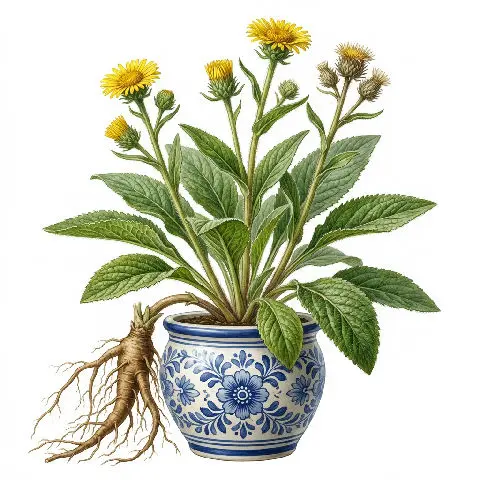
Pushkarmool, scientifically recognized as Inula racemosa, is a robust and striking perennial herb belonging to the Asteraceae family. It typically achieves an impressive height of 1 to 2 meters, standing tall with sturdy, often unbranched stems that possess a distinctly rough texture. The plant’s foliage is characterized by broad, lanceolate leaves, which can extend up to 30 cm in length and 15 cm in width. These leaves present a deep green coloration on their upper surface, exhibiting a slightly pubescent feel, while their undersides are densely tomentose, giving them a soft, woolly texture.
One of the most captivating features of Inula racemosa is its vibrant floral display, consisting of numerous bright yellow, daisy-like flower heads. These inflorescences typically bloom from late summer into early autumn, with each cluster potentially housing up to 20 individual flowers. The plant thrives predominantly across the Western Himalayan region, establishing itself in well-drained soils on rocky slopes and meadows at altitudes ranging from 1,000 to 3,000 meters above sea level. Its preference for cooler, high-altitude climates underscores its resilience.
Pushkarmool is also noted for its aromatic qualities, releasing an earthy yet sweet scent when its tissues are crushed. The primary source of its medicinal efficacy lies within its thick, yellowish-brown, rhizomatous roots, which are rich in a complex array of bioactive compounds.
Trusted Scientific References
1. Authoritative external sources for Inula racemosa
1.1 Wikipedia — Inula racemosa
1.2 Kew POWO (Plants of the World Online)
1.3 PubMed — peer-reviewed research
1.4 NCBI Taxonomy Browser
1.5 GBIF — Global Biodiversity
1.6Pushkarmool (Elecampane) should be interpreted through verified botanical identity, practical care, and responsible safety language. This recovery note adds the missing context needed for a complete profile: match light to the plant's habit, use well-drained soil, water according to season, and avoid unsupported medicinal or edible claims. For publishing, the plant can be presented as a source-backed medicinal plant with clear care guidance, common problem diagnosis, and conservative safety wording.
1.1.Pushkarmool (Elecampane) — Distinguishing Points
- ✓Robust Perennial Herb — Grows up to 2 meters with sturdy, rough stems.
- ✓Distinctive Foliage — Broad, lanceolate leaves with pubescent upper and tomentose lower surfaces.
- ✓Vibrant Yellow Flowers — Daisy-like inflorescences blooming in late summer to early autumn.
- ✓Aromatic Rhizomatous Roots — The primary medicinal part, emitting an earthy, sweet scent.
- ✓Traditional Ayurvedic Significance — Highly revered for its therapeutic applications, especially for respiratory and cardiac health.
- ✓Rich in Bioactive Compounds — Contains high levels of sesquiterpene lactones and inulin, driving its pharmacological actions.
- ✓High — Altitude Native — Thrives in the Western Himalayan region, adapted to cooler climates.
- ✓Cardioprotective Qualities — Known to support healthy blood pressure and cholesterol levels.
- ✓Expectorant and Bronchodilatory — Effective in clearing respiratory congestion and easing breathing.
- ✓Anti — Inflammatory Powerhouse — Offers natural relief from various inflammatory conditions.
1.2.Pushkarmool (Elecampane) — In Brief
- ✓Potent Ayurvedic herb for respiratory health.
- ✓Supports cardiovascular function and blood pressure.
- ✓Exhibits strong anti-inflammatory and antioxidant properties.
- ✓Rich in sesquiterpene lactones and inulin.
- ✓Traditionally used for asthma, cough, and heart conditions.
- ✓Native to the high altitudes of the Himalayan region.
2.Pushkarmool (Elecampane) — Nomenclature & Classification
3.Pushkarmool (Elecampane) — Vital Statistics
4.Pushkarmool (Elecampane) — Physical Description
5.Pushkarmool (Elecampane) — Ecological Habitat
6.Pushkarmool (Elecampane) — Heritage Uses
7.Pushkarmool (Elecampane) — Chemical Profile
- ✓Sesquiterpene Lactones — Key compounds include Alantolactone, Isoalantolactone, Inunolide, and Dihydroisoalantotolactone, known for their potent anti-inflammatory, expectorant, and antimicrobial properties.
- ✓Fructans (Polysaccharides) — Inulin is a major component, acting as a prebiotic fiber that supports gut health and modulates immune responses.
- ✓Essential Oils — Aromatic volatile compounds contribute to the plant's distinctive scent and possess antimicrobial and expectorant activities.
- ✓Phytosterols — Compounds like Beta-Sitosterol are present, which are associated with cholesterol-lowering and anti-inflammatory effects.
- ✓Flavonoids — These polyphenolic compounds provide antioxidant protection and contribute to the plant’s anti-inflammatory actions.
- ✓Alkaloids — While less prominent, specific alkaloids may contribute to its pharmacological profile, influencing various physiological pathways.
- ✓Triterpenoids — Other triterpenoid compounds are found, which can have diverse biological activities, including anti-inflammatory and hepatoprotective effects.
- ✓D-Mannitol — A sugar alcohol, which may contribute to diuretic effects and other metabolic processes within the plant.
8.Pushkarmool (Elecampane) — Scientific Evidence
- ✓Respiratory Support — Pushkarmool is highly valued in Ayurveda for its expectorant and bronchodilatory properties, effectively alleviating symptoms of asthma, chronic cough, and bronchitis by helping to clear congestion and ease breathing.
- ✓Cardiovascular Health Enhancement — Research suggests its ability to support heart function by reducing elevated cholesterol levels and moderating blood pressure, potentially mimicking beta-blocker effects.
- ✓Anti-inflammatory Action — Rich in sesquiterpene lactones, Inula racemosa exhibits potent anti-inflammatory properties, useful in managing various inflammatory conditions throughout the body.
- ✓Antioxidant Protection — Its diverse phytochemical profile contributes to significant antioxidant activity, helping to neutralize free radicals and protect cells from oxidative stress.
- ✓Digestive Aid — Traditionally employed to support digestive health, it can help alleviate indigestion, bloating, and loss of appetite by promoting healthy gut function.
- ✓Skin Health Promotion — Applied topically or consumed internally, it is used in traditional medicine to address certain skin ailments and promote healing due to its antimicrobial and anti-inflammatory effects.
- ✓Antipyretic Properties — Inula racemosa is known to help reduce fever and associated symptoms, making it a valuable remedy during febrile conditions.
- ✓Antihistamine Effect — It possesses natural antihistamine properties, which can be beneficial in reducing allergic reactions and respiratory hypersensitivity.
- ✓Antimicrobial Activity — Extracts of Pushkarmool have demonstrated antibacterial, antiviral, and antifungal actions, contributing to its use in combating various infections.
- ✓Diuretic Effect — It is understood to mildly stimulate kidney function, promoting increased urine output and aiding in detoxification.
8.1.Pushkarmool (Elecampane) — Reported Uses
9.Pushkarmool (Elecampane) — Safety & Side Effects
9.1.Pushkarmool (Elecampane) — Reported Side Effects
- ✓Hypotension — Over-dosage or sensitive individuals may experience a significant drop in blood pressure.
- ✓Allergic Reactions — Individuals with known allergies to the Asteraceae family (e.g., ragweed, daisies) may experience skin rashes or respiratory distress.
- ✓Gastrointestinal Upset — Some users might experience mild digestive discomfort, such as nausea or stomach upset.
- ✓Uterine Stimulation — Due to potential uterine stimulant properties, it may be contraindicated in pregnancy.
- ✓Drug Interactions — Can interact with blood pressure-lowering medications, sedatives, or anticoagulants, requiring medical supervision.
- ✓Hypoglycemia Risk — May potentially lower blood sugar levels, requiring caution for individuals with diabetes or on hypoglycemic medications.
- ✓Liver Sensitivity — In rare cases, high doses might impact liver function, especially in individuals with pre-existing liver conditions.
9.2.Pushkarmool (Elecampane) — Clinical Safety Notes
- ✓Medical Consultation — Always consult a healthcare professional before use, especially if you have pre-existing medical conditions or are on medication.
- ✓Pregnancy and Lactation — Avoid use during pregnancy and lactation due to potential uterine stimulant effects and lack of sufficient safety data.
- ✓Blood Pressure Monitoring — Individuals with hypertension or hypotension should use with extreme caution and monitor blood pressure closely.
- ✓Allergy Alert — Exercise caution if allergic to plants in the Asteraceae family, as cross-reactivity may occur.
- ✓Dosage Adherence — Strictly follow recommended dosages; excessive intake can lead to adverse effects, particularly hypotension.
- ✓Drug Interaction Awareness — Be aware of potential interactions with cardiovascular drugs, sedatives, and anti-diabetic medications.
- ✓Conservation Status — Note that Inula racemosa is a protected species in some regions, and sustainable sourcing is crucial.
10.Pushkarmool (Elecampane) — Preparations & Uses
- ✓Root Powder — Dried and finely ground root powder is commonly consumed, typically 1-3 grams per day, divided into doses, mixed with warm water or honey.
- ✓Decoction — Prepare a decoction by simmering 1-2 teaspoons of dried root in a cup of water for 10-15 minutes, then strain and drink.
- ✓Tincture — A concentrated liquid extract made by macerating the roots in alcohol, taken in small, measured drops.
- ✓Herbal Infusion — For milder preparations, steep dried root pieces in hot water for 10-15 minutes, similar to making tea.
- ✓External Application (Poultice) — Powdered root mixed with water or a carrier oil can be applied as a poultice to soothe skin ailments or reduce localized inflammation.
- ✓Ayurvedic Formulations — Pushkarmool is a key ingredient in many traditional Ayurvedic medicines, such as Shwasahara Kashaya for respiratory issues.
- ✓Essential Oil Extraction — The root can be distilled to extract essential oils, used in aromatherapy or diluted for topical application, though less common for internal use.
- ✓Dosage Guidance — Always adhere to recommended dosages and consult a qualified herbalist or physician, as individual needs and sensitivities vary.
11.Pushkarmool (Elecampane) — Garden Cultivation
- ✓Propagation — Primarily propagated by seeds sown in spring or by root division in early spring or autumn.
- ✓Soil Requirements — Prefers well-drained, fertile loamy or sandy-loamy soil with a slightly acidic to neutral pH (6.0-7.0).
- ✓Sun Exposure — Thrives in full sun to partial shade, requiring at least 6 hours of direct sunlight daily for optimal growth.
- ✓Watering — Requires consistent moisture, especially during dry periods, but avoids waterlogging to prevent root rot.
- ✓Climate — Best suited for cooler temperate climates, mirroring its native Himalayan habitat; tolerant of frost once established.
- ✓Spacing — Plant individual specimens about 60-90 cm apart to allow for adequate growth and air circulation.
- ✓Fertilization — Benefits from organic compost or a balanced slow-release fertilizer applied in spring to support robust growth.
- ✓Pest and Disease Management — Generally resilient, but monitor for aphids and powdery mildew; ensure good air circulation to prevent fungal issues.
Reviewed by the Flora Medical Global Botanical Review Panel
Multi-disciplinary editorial group · Botany · Ethnobotany · Herbal-medicine literature
Who reviewed this: This page was checked by the Flora Medical Global Botanical Review Panel — an in-house editorial group of botany graduates, ethnobotany researchers, and horticulture practitioners who collectively maintain our 7,000+ plant encyclopedia. Meet the team.
Our 4-step verification process
1. Taxonomic verification
Scientific names and synonyms cross-checked against Kew POWO, World Flora Online, and The Plant List.
2. Phytochemical & medicinal cross-reference
Active compounds, traditional uses, and reported activities are cross-referenced with PubMed, USDA Dr. Duke's database, and peer-reviewed ethnobotanical literature.
3. Conservation & distribution check
Distribution, ecology, and conservation status confirmed against GBIF occurrence records and the IUCN Red List.
4. Editorial & safety review
Every entry passes an editorial pass for clarity, originality, and safety notices (toxicity, contraindications, dosage caveats) before publication.
Last reviewed:
Important medical disclaimer: This content is for educational and research purposes only. It is not medical advice and is not a substitute for consultation with a licensed healthcare provider. Do not use any herb to self-treat a medical condition without professional guidance.
Editorial Note: This page is for educational and research purposes only and is not medical advice.
Written by: Flora Medical Global Editorial Team
Reviewed by: Flora Medical Global Botanical Review Panel
Last Updated: June 15, 2026





Pushkarmool (Elecampane) — Comments & Community Reviews
Rate this plant