

Medical Disclaimer: This content is for educational purposes only. It is not medical advice. Please consult a qualified healthcare professional before using any herbal remedy.
Safety Overview
1.Quassia — Plant Snapshot
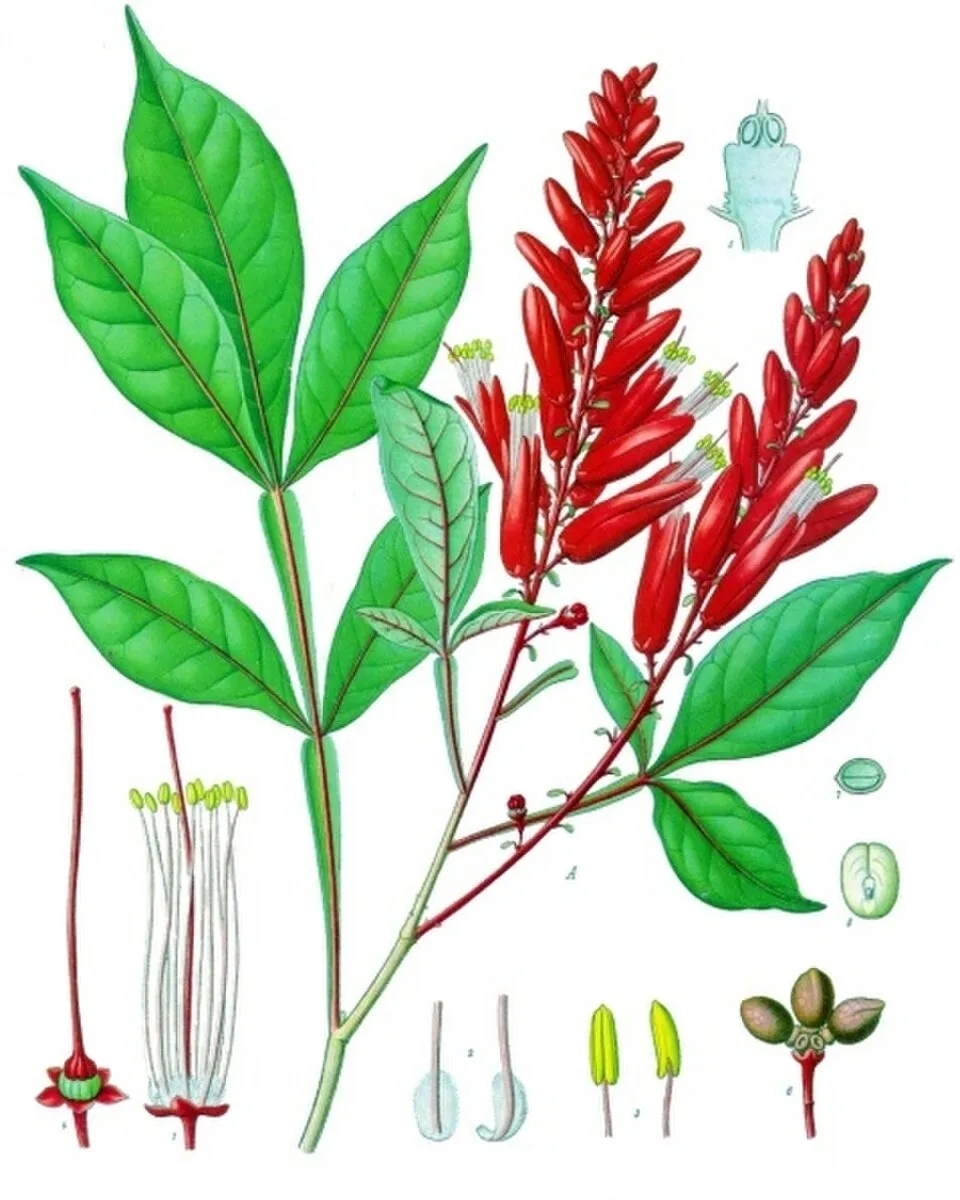
Quassia (Quassia amara), commonly known as Bitter Wood or Amargo, is a distinctive evergreen shrub or small tree belonging to the Simaroubaceae family. Native to the tropical rainforests of South America, particularly regions spanning from Suriname and French Guiana to parts of Brazil, Venezuela, Peru, and Colombia, it thrives in warm, humid climates with well-drained, fertile soil and adequate sunlight. The plant is characterized by its slender trunk, pinnate leaves, and striking bright red flowers that grow in terminal racemes, making it visually appealing despite its intensely bitter nature.
Its most medicinally significant parts are the bark and wood, which are renowned for their extreme bitterness attributed to a unique class of compounds called quassinoids. Taxonomically, Quassia amara is the type species for the genus Quassia, though some related species also share similar properties. Historically, its potent properties have led to its widespread adoption in various traditional medicine systems, and it has also found applications in pest control and as a bittering agent.
Its robust nature allows it to grow in diverse tropical forest understories, often reaching heights of 3 to 6 meters.
Trusted Scientific References
1. Authoritative external sources for Quassia amara
1.1 Wikipedia — Quassia amara
1.2 Kew POWO (Plants of the World Online)
1.3 PubMed — peer-reviewed research
1.4 NCBI Taxonomy Browser
1.5 GBIF — Global Biodiversity
1.6Quassia should be interpreted through verified botanical identity, practical care, and responsible safety language. This recovery note adds the missing context needed for a complete profile: match light to the plant's habit, use well-drained soil, water according to season, and avoid unsupported medicinal or edible claims. For publishing, the plant can be presented as a source-backed medicinal plant with clear care guidance, common problem diagnosis, and conservative safety wording.
1.7Quassia (Quassia amara) is maintained in this recovery file as a complete medicinal profile with practical care, safety, and identification context. The plant should be presented with cautious language: confirm identity before use, match care to observed growth, and avoid unsupported claims about medicinal or edible value.
1.1.Quassia — Key Features
- ✓Botanical Name — Quassia amara, commonly known as Bitter Wood.
- ✓Family — Simaroubaceae, known for bitter-tasting plants.
- ✓Primary Bioactives — Quassin and Neoquassin, powerful bitter triterpenoids.
- ✓Traditional Uses — Digestive tonic, antimalarial, anthelmintic, febrifuge.
- ✓Modern Applications — Research into antimalarial drugs, topical treatments for skin and lice.
- ✓Characteristic Taste — Extremely bitter, one of the most bitter natural substances.
- ✓Growth Habit — Small evergreen tree or shrub, typically 3-6 meters tall.
- ✓Native Region — Tropical South America, thriving in rainforest environments.
- ✓Key Medicinal Part — The wood and bark are primarily used for medicinal extracts.
- ✓SEO Focus — Quassia benefits, Quassia side effects, Quassia uses, natural antiparasitic.
1.2.Quassia — Snapshot Summary
- ✓Potent Bitter Principle — Contains quassinoids, which impart extreme bitterness and drive its medicinal properties.
- ✓Digestive & Antiparasitic — Primarily used to stimulate digestion, enhance appetite, and combat internal parasites like malaria and worms.
- ✓Topical Applications — Effective externally for treating head lice and potentially beneficial for certain skin conditions like rosacea.
- ✓South American Origin — Native to tropical South America, where it has a long history of traditional medicinal use.
- ✓Significant Safety Concerns — Oral use carries notable risks, including gastrointestinal upset, vision impairment, and interactions with medications.
- ✓Professional Guidance Essential — Due to its potency and side effects, Quassia should only be used under strict professional supervision.
2.Quassia — Taxonomic Classification
3.Quassia — Botanical Stats
4.Quassia — Morphological Account
5.Quassia — Where It Grows
6.Quassia — Historical Applications
7.Quassia — Secondary Metabolites
- ✓Quassinoids — These are the primary bitter principles, including Quassin and Neoquassin, responsible for the plant's antimalarial, insecticidal, and digestive stimulant actions.
- ✓Triterpenes — Beyond quassinoids, other triterpenoid compounds contribute to the plant's overall bitterness and diverse biological activities, including anti-inflammatory effects.
- ✓Alkaloids — Various nitrogen-containing compounds are present in minor quantities, with potential neuroactive and antiprotozoal properties.
- ✓Flavonoids — These polyphenolic compounds confer antioxidant and potentially anti-inflammatory benefits, protecting cells from oxidative stress.
- ✓Coumarins — A class of organic compounds found in Quassia, some of which may contribute to its anti-inflammatory and antimicrobial profile.
- ✓Saponins — These soap-like compounds may have hemolytic properties and contribute to the plant's bitter taste and potential for irritation at high doses.
- ✓Tannins — Present in the bark, tannins provide astringent properties, which can be beneficial for toning tissues or contributing to antimicrobial effects.
- ✓Volatile Oils — While not a major component, trace amounts of volatile oils may contribute to the plant's aroma and minor therapeutic actions.
8.Quassia — Modern Studies
- ✓Appetite Stimulant — Quassia's intense bitterness significantly stimulates gastric and bile secretions, enhancing appetite and preparing the digestive system for food.
- ✓Digestive Aid — It effectively addresses indigestion, dyspepsia, and mild constipation by promoting healthy digestive fluid flow and gut motility.
- ✓Antiparasitic Action — The quassinoids in Quassia exhibit potent activity against various internal parasites, including those causing malaria (Plasmodium falciparum) and intestinal worms.
- ✓Insecticidal Properties — Topically, Quassia tincture is traditionally used to kill head lice, while its extracts can also be effective against mosquito larvae.
- ✓Anti-inflammatory Support — Modern pharmacological research suggests that certain compounds in Quassia possess anti-inflammatory properties, potentially mitigating inflammatory responses.
- ✓Antioxidant Benefits — Phytochemicals present in Quassia contribute to its antioxidant capacity, helping to neutralize free radicals and protect cellular integrity.
- ✓Antimicrobial Activity — Studies indicate that Quassia extracts have antimicrobial effects against various bacteria and fungi, supporting its traditional use in infections.
- ✓Skin Condition Management — Applied topically, Quassia extracts may help reduce redness and inflammation associated with skin conditions like rosacea and seborrheic dermatitis.
- ✓Fever Reduction — Traditionally, Quassia has been employed as a febrifuge to help lower fever, likely due to its anti-inflammatory and general tonic effects.
- ✓Blood Sugar Modulation — Early research suggests Quassia may influence blood sugar levels, warranting careful monitoring for individuals with diabetes.
8.1.Quassia — Therapeutic Indications
9.Quassia — Risk Profile
9.1.Quassia — Possible Adverse Reactions
- ✓Gastrointestinal Irritation — Oral ingestion, especially in higher doses, can cause irritation of the mouth, throat, and digestive tract, leading to nausea and vomiting.
- ✓Cardiovascular Effects — Very large doses taken orally may lead to abnormal heart function, though severe emetic effects usually prevent such high intake.
- ✓Vision Changes — Prolonged and excessive oral use has been linked to vision impairment and, in severe cases, blindness.
- ✓Hypoglycemia — Quassia may lower blood sugar levels, posing a risk for individuals with diabetes, potentially leading to hypoglycemia.
- ✓Digestive Tract Exacerbation — Can irritate pre-existing digestive conditions such as stomach or intestinal ulcers, Crohn's disease, or infections.
- ✓Allergic Reactions — Sensitive individuals may experience allergic reactions, including skin irritation or other hypersensitivity responses, especially with topical application.
9.2.Quassia — Toxicity Assessment
- ✓Pregnancy and Breastfeeding — Quassia is considered highly unsafe during pregnancy and breastfeeding due to potential cellular damage and severe nausea; avoid use completely.
- ✓Diabetes Mellitus — Use with extreme caution; monitor blood sugar levels meticulously, as Quassia can significantly lower blood glucose, necessitating medication adjustments.
- ✓Digestive Disorders — Contraindicated in individuals with pre-existing digestive tract problems like ulcers, Crohn's disease, or infections due to its irritant properties.
- ✓Pre-surgical Use — Discontinue Quassia at least two weeks before any scheduled surgery due to its potential to interfere with blood sugar control.
- ✓Cardiac Conditions — Individuals with heart conditions should avoid Quassia due to the potential for abnormal heart function at very high doses.
- ✓Children — Not recommended for use in children due to the lack of sufficient safety data and the risk of severe side effects, particularly gastrointestinal upset.
- ✓Long-term Use — Avoid chronic or long-term oral administration due to the documented risk of vision changes and potential blindness.
10.Quassia — Preparation & Dosage
- ✓Decoction — The most common method; wood chips or bark are boiled in water to extract bitter compounds, used internally for digestion or antiparasitic action.
- ✓Tincture — An alcohol-based extract prepared from the bark or wood, suitable for internal use or topical application, such as for head lice.
- ✓Infusion — Less common for Quassia's bitter wood, but leaves can be steeped in hot water for a milder preparation, though less potent.
- ✓Topical Gel/Cream — Formulations containing Quassia extract are applied to the skin to address conditions like rosacea or seborrheic dermatitis.
- ✓Enema — Historically used rectally for intestinal worms, though this method requires extreme caution due to potential irritation and absorption risks.
- ✓Insecticide Spray — Aqueous extracts can be prepared and used as a natural insecticide for plants or as a repellent for mosquito larvae.
- ✓Flavoring Agent — In regulated amounts, Quassia extract has been historically used to impart a bitter flavor to certain foods, beverages, and laxatives.
11.Quassia — Growth Requirements
- ✓Climate — Thrives in tropical to subtropical climates, requiring consistently warm temperatures and high humidity.
- ✓Soil — Prefers well-drained, fertile soil with a slightly acidic to neutral pH range (5.5-7.0).
- ✓Sunlight — Best grown in full sun to partial shade, with adequate light promoting robust growth.
- ✓Watering — Requires regular and consistent moisture; avoid waterlogging, which can lead to root rot.
- ✓Propagation — Can be propagated from fresh seeds, which require scarification, or from semi-hardwood cuttings.
- ✓Pests and Diseases — Generally robust, but can be susceptible to common tropical plant pests if not properly managed.
- ✓Harvesting — The wood and bark are harvested from mature trees, typically after several years of growth, and then dried for medicinal use.
Reviewed by the Flora Medical Global Botanical Review Panel
Multi-disciplinary editorial group · Botany · Ethnobotany · Herbal-medicine literature
Who reviewed this: This page was checked by the Flora Medical Global Botanical Review Panel — an in-house editorial group of botany graduates, ethnobotany researchers, and horticulture practitioners who collectively maintain our 7,000+ plant encyclopedia. Meet the team.
Our 4-step verification process
1. Taxonomic verification
Scientific names and synonyms cross-checked against Kew POWO, World Flora Online, and The Plant List.
2. Phytochemical & medicinal cross-reference
Active compounds, traditional uses, and reported activities are cross-referenced with PubMed, USDA Dr. Duke's database, and peer-reviewed ethnobotanical literature.
3. Conservation & distribution check
Distribution, ecology, and conservation status confirmed against GBIF occurrence records and the IUCN Red List.
4. Editorial & safety review
Every entry passes an editorial pass for clarity, originality, and safety notices (toxicity, contraindications, dosage caveats) before publication.
Last reviewed:
Important medical disclaimer: This content is for educational and research purposes only. It is not medical advice and is not a substitute for consultation with a licensed healthcare provider. Do not use any herb to self-treat a medical condition without professional guidance.
Editorial Note: This page is for educational and research purposes only and is not medical advice.
Written by: Flora Medical Global Editorial Team
Reviewed by: Flora Medical Global Botanical Review Panel
Last Updated: June 15, 2026





Quassia — Comments & Community Reviews
Rate this plant