

Medical Disclaimer: This content is for educational purposes only. It is not medical advice. Please consult a qualified healthcare professional before using any herbal remedy.
Safety Overview
1.Quisqualis — Botanical Snapshot
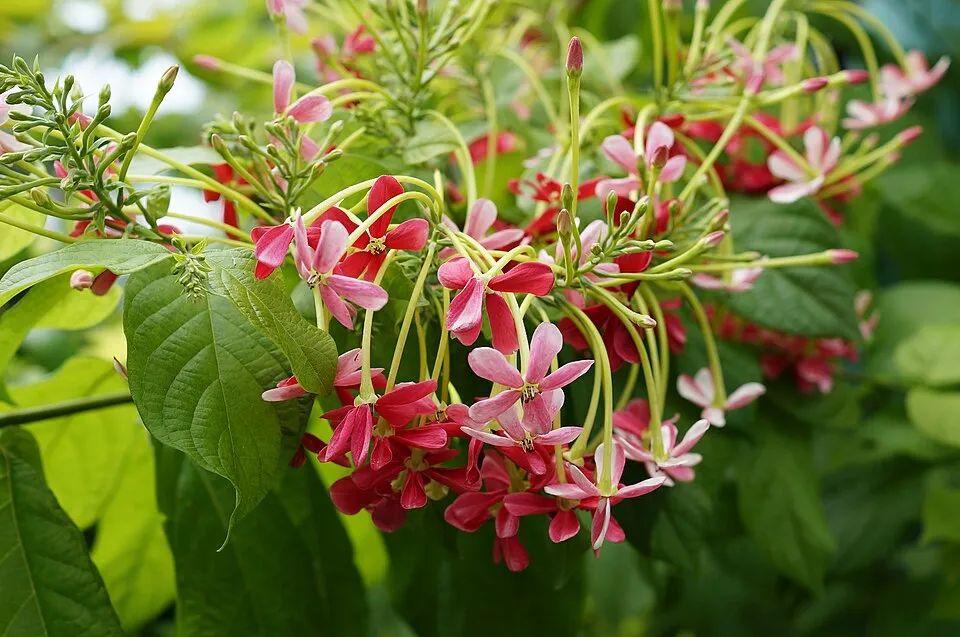
Quisqualis, scientifically known as Combretum indicum and commonly as Rangoon Creeper or Chinese Honeysuckle, is a robust, woody climbing vine belonging to the Combretaceae family. This vigorous plant can ascend to impressive heights, typically reaching 8 meters, with its much-branched stems extending up to 20 meters in tropical climates. Its foliage consists of elongated, glossy, elliptical leaves, measuring approximately 7 to 12 cm in length and 3 to 5 cm in width, arranged oppositely along the stems and possessing a distinct leathery texture. The plant's most striking feature is its fragrant, trumpet-shaped flowers, which bloom in dense clusters.
These captivating blossoms undergo a remarkable color transformation, starting as white before maturing through shades of pink and eventually deepening to a rich red. Each flower is characterized by five prominent lobes and elongated stamens, creating a visually appealing contrast. The bark of young Quisqualis plants is typically light gray and smooth, gradually becoming rougher and darker with age. Originally thought to be native to tropical Asia and potentially eastern Africa, Combretum indicum is now widely distributed across tropical, subtropical, and even warm temperate zones due to its ornamental and medicinal value.
It thrives in diverse habitats including scrublands, forest edges, cultivated gardens, low woods, thickets, hedges, and along roadsides, particularly in humid environments with good drainage and ample sunlight, at elevations below 1,500 meters. Its adaptability and rapid growth have led to its naturalization and, in some regions like Australia, its classification as an invasive species.
Trusted Scientific References
1. Authoritative external sources for Combretum indicum
1.1 Wikipedia — Combretum indicum
1.2 Kew POWO (Plants of the World Online)
1.3 PubMed — peer-reviewed research
1.4 NCBI Taxonomy Browser
1.5 GBIF — Global Biodiversity
1.6Quisqualis should be interpreted through verified botanical identity, practical care, and responsible safety language. This recovery note adds the missing context needed for a complete profile: match light to the plant's habit, use well-drained soil, water according to season, and avoid unsupported medicinal or edible claims. For publishing, the plant can be presented as a source-backed medicinal plant with clear care guidance, common problem diagnosis, and conservative safety wording.
1.1.Quisqualis — Distinguishing Points
- ✓Rapid Growth — A fast-growing, vigorous climbing shrub or vine.
- ✓Colorful Flowers — Fragrant flowers change color from white to pink to red.
- ✓Anthelmintic Properties — Widely used traditionally for expelling parasites.
- ✓Traditional Medicine Staple — Integral in Ayurveda and Traditional Chinese Medicine.
- ✓Adaptable Habitat — Thrives in diverse tropical and subtropical environments.
- ✓Ornamental Value — Popular for landscaping, clothing arches, and hedges.
- ✓Unique Chemistry — Contains potent compounds like quisqualic acid.
- ✓Invasive Potential — Can escape cultivation and naturalize, becoming invasive.
- ✓Versatile Plant Parts — Leaves, flowers, seeds, and bark all used medicinally.
- ✓Caution Required — Potentially toxic in large doses, emphasizing careful use.
1.2.Quisqualis — Snapshot Summary
- ✓Vigorous tropical vine with ornamental and medicinal value.
- ✓Traditional anthelmintic, anti-inflammatory, and digestive properties.
- ✓Contains triterpenoids, flavonoids, tannins, and potentially toxic quisqualic acid.
- ✓Requires careful cultivation in tropical to warm temperate zones.
- ✓Potent effects necessitate strict dosage and professional consultation.
- ✓Overdose can lead to severe gastrointestinal issues and even unconsciousness.
2.Quisqualis — Botanical Identity
3.Quisqualis — Fact Sheet
4.Quisqualis — Physical Description
5.Quisqualis — Native Range & Habitat
6.Quisqualis — Heritage Uses
7.Quisqualis — Phytochemistry
- ✓Triterpenoids — Key compounds like combretol, found in leaves and bark, are known for their anti-inflammatory and antioxidant activities.
- ✓Flavonoids — Including quercetin glycosides and other polyphenols, these compounds contribute significantly to the plant's antioxidant and anti-inflammatory effects.
- ✓Tannins — Present in bark and leaves, tannins provide astringent properties, contributing to antimicrobial and wound-healing actions.
- ✓Saponins — Found in seeds and roots, saponins can exhibit hemolytic and expectorant activities, though they require careful dosing.
- ✓Phenolic Acids — Such as gallic acid and caffeic acid derivatives, these contribute to the plant's overall antioxidant capacity.
- ✓Quisqualic Acid — A unique non-protein amino acid found primarily in the seeds, it is the primary anthelmintic principle but also a neurotoxin, requiring precise dosage.
- ✓Alkaloids — While less prominent, some alkaloidal compounds may be present, influencing various physiological responses.
- ✓Fatty Acids — Seeds contain various fatty acids, which can contribute to the overall nutritional and therapeutic profile.
- ✓Sterols — Plant sterols are present, which may offer additional anti-inflammatory and immune-modulating benefits.
8.Quisqualis — Evidence-Based Benefits
- ✓Anthelmintic Properties — Quisqualis seeds are traditionally renowned for their potent anthelmintic effects, effectively expelling intestinal parasites such as roundworms and tapeworms from the body.
- ✓Digestive Aid — The plant's leaves and flowers possess purgative qualities, traditionally used to alleviate constipation and promote healthy bowel movements.
- ✓Anti-inflammatory Action — Extracts from Combretum indicum have demonstrated anti-inflammatory properties, which may help reduce swelling and discomfort associated with various conditions.
- ✓Antioxidant Support — Rich in various phytochemicals, Quisqualis contributes to antioxidant defense, protecting cells from oxidative stress and free radical damage.
- ✓Respiratory Relief — In Traditional Chinese Medicine (TCM), Quisqualis is utilized to manage respiratory ailments such as asthma and bronchitis, potentially by reducing inflammation in the airways.
- ✓Wound Healing Promotion — Topical application of leaf poultices is a traditional method for treating skin irritations, minor cuts, and promoting faster wound healing.
- ✓Antimicrobial Activity — Some studies suggest that parts of the plant exhibit antimicrobial effects, helping to inhibit the growth of certain bacteria and fungi.
- ✓Pain Management — Traditional uses indicate potential analgesic properties, offering relief from mild to moderate pain.
- ✓Fever Reduction — Historically, preparations of Quisqualis have been employed to help reduce fever, possibly due to its anti-inflammatory and diaphoretic actions.
- ✓Skin Health — Beyond wound healing, the plant's extracts may contribute to overall skin health by alleviating various dermatological issues.
8.1.Quisqualis — Health Applications
9.Quisqualis — Safety & Side Effects
9.1.Quisqualis — Side Effects & Warnings
- ✓Nausea and Vomiting — Overdosing, especially with seeds, can lead to severe gastrointestinal upset.
- ✓Hiccough — High doses are known to induce persistent hiccoughing.
- ✓Unconsciousness — In extreme cases of overdose, particularly with the seeds, loss of consciousness can occur.
- ✓Allergic Reactions — Some individuals may experience allergic skin reactions or respiratory distress.
- ✓Abdominal Pain — Excessive consumption can cause cramping and discomfort in the abdominal region.
- ✓Diarrhea — Due to its purgative nature, high doses can lead to severe diarrhea and dehydration.
- ✓Drug Interactions — Potential interactions with other medications, particularly those affecting the gastrointestinal tract or central nervous system.
9.2.Quisqualis — Safety Overview
- ✓Dose Dependency — The therapeutic window is narrow; strict adherence to recommended dosages is crucial to avoid adverse effects.
- ✓Professional Guidance — Always consult a qualified healthcare practitioner or medical herbalist before using Quisqualis.
- ✓Pregnancy and Lactation — Contraindicated in pregnant and breastfeeding women due to potential toxicity and lack of safety data.
- ✓Children — Use in children should be strictly avoided or administered only under direct medical supervision due to high risk of overdose.
- ✓Pre-existing Conditions — Individuals with gastrointestinal disorders, neurological conditions, or liver/kidney impairment should avoid use.
- ✓Avoid Self-Medication — Due to its potent compounds and potential for toxicity, self-medication is strongly discouraged.
- ✓Storage — Keep all Quisqualis preparations out of reach of children and pets.
10.Quisqualis — Preparations & Uses
- ✓Seed Decoction — For anthelmintic purposes, a decoction of the dried seeds is traditionally prepared and consumed orally, often with a sweetener.
- ✓Leaf Poultice — Fresh leaves are crushed and applied topically as a poultice to soothe skin irritations, minor wounds, and insect bites.
- ✓Flower Infusion — An infusion made from the flowers can be taken to support respiratory health or as a mild purgative.
- ✓Bark Decoction — The bark can be decocted for its astringent and anti-inflammatory properties, used internally or externally.
- ✓Honey Mix — In Ayurveda, a mixture of powdered flowers and leaves with honey is traditionally used to treat constipation.
- ✓Tincture Preparation — A more concentrated alcoholic extract (tincture) can be made from various parts for controlled dosing.
- ✓Topical Oils/Salves — Infused oils or salves utilizing Quisqualis extracts can be prepared for targeted skin applications.
- ✓Powdered Form — Dried and powdered plant material can be encapsulated or mixed into foods for specific therapeutic uses, under expert guidance.
11.Quisqualis — How to Grow
- ✓Site Selection — Choose a location with full sun to partial shade for optimal growth and flowering.
- ✓Soil Requirements — Plant in well-drained soil; excessively fertile soil can lead to more foliage and fewer flowers.
- ✓Support Structure — Provide a sturdy trellis, arbor, or fence for this vigorous climbing vine to ascend.
- ✓Watering — Maintain consistent moisture, especially during dry periods, but avoid waterlogging.
- ✓Pruning — Prune regularly to manage its vigorous growth, promote bushiness, and encourage more blooms.
- ✓Propagation — Can be propagated from seeds, which may initially grow as shrubs before adopting a climbing habit, or from stem cuttings.
- ✓Climate — Thrives in tropical, subtropical, and warm temperate zones, intolerant of heavy frosts.
- ✓Fertilization — Fertilize sparingly; too much nitrogen can inhibit flowering.
Reviewed by the Flora Medical Global Botanical Review Panel
Multi-disciplinary editorial group · Botany · Ethnobotany · Herbal-medicine literature
Who reviewed this: This page was checked by the Flora Medical Global Botanical Review Panel — an in-house editorial group of botany graduates, ethnobotany researchers, and horticulture practitioners who collectively maintain our 7,000+ plant encyclopedia. Meet the team.
Our 4-step verification process
1. Taxonomic verification
Scientific names and synonyms cross-checked against Kew POWO, World Flora Online, and The Plant List.
2. Phytochemical & medicinal cross-reference
Active compounds, traditional uses, and reported activities are cross-referenced with PubMed, USDA Dr. Duke's database, and peer-reviewed ethnobotanical literature.
3. Conservation & distribution check
Distribution, ecology, and conservation status confirmed against GBIF occurrence records and the IUCN Red List.
4. Editorial & safety review
Every entry passes an editorial pass for clarity, originality, and safety notices (toxicity, contraindications, dosage caveats) before publication.
Last reviewed:
Important medical disclaimer: This content is for educational and research purposes only. It is not medical advice and is not a substitute for consultation with a licensed healthcare provider. Do not use any herb to self-treat a medical condition without professional guidance.
Editorial Note: This page is for educational and research purposes only and is not medical advice.
Written by: Flora Medical Global Editorial Team
Reviewed by: Flora Medical Global Botanical Review Panel
Last Updated: June 15, 2026





Quisqualis — Comments & Community Reviews
Rate this plant