
Medical Disclaimer: This content is for educational purposes only. It is not medical advice. Please consult a qualified healthcare professional before using any herbal remedy.
Safety Overview
1.Rodgersia Pinnata — Plant Snapshot
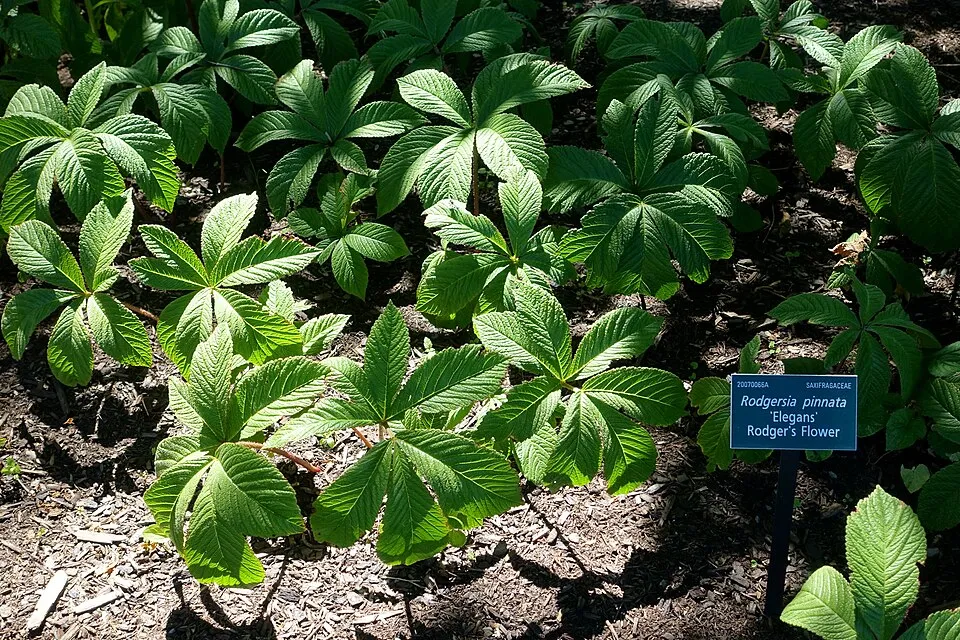
Rodgersia pinnata, commonly known as featherleaf rodgersia, is a magnificent herbaceous perennial belonging to the Saxifragaceae family. This species is indigenous to the high-altitude, moist mountainous regions of China, particularly thriving in the provinces of Sichuan and Yunnan. It is celebrated for its distinctive and robust morphology, exhibiting an architectural presence in temperate landscapes. The plant produces large, pinnately compound leaves that can impressively extend up to 60 cm in length and 40 cm in width. Each leaf comprises 5-9 ovate to elliptic leaflets, often characterized by serrated margins and a slightly wrinkled, textured surface.
These substantial leaves emerge from a vigorous, rhizomatous root system, allowing the plant to gradually spread and form impressive, dense clumps over time. During the early to mid-summer period, Rodgersia pinnata elevates spectacular, upright panicles of delicate, star-shaped flowers. These inflorescences, typically ranging in color from soft pink to pure white, can reach heights of up to 1 meter above the lush foliage, imparting a graceful vertical dimension. Though individually small, the flowers aggregate into dense clusters that are highly attractive to various pollinators. Featherleaf rodgersia flourishes in consistently moist, humus-rich soils and prefers partial to full shade, though it can withstand more direct sunlight if adequate and continuous moisture is supplied.
Its bold foliage and elegant flower spikes make it an outstanding specimen for woodland gardens, waterside plantings, or as a focal point in shaded borders where its considerable size and texture can be fully appreciated. It is considered a relatively low-maintenance plant, primarily requiring consistent hydration and protection from strong winds that can damage its expansive leaves. The genus Rodgersia is also recognized in traditional Chinese medicine for its diverse chemical constituents and pharmacological activities.
Trusted Scientific References
1. Authoritative external sources for Rodgersia pinnata
1.1 Wikipedia — Rodgersia pinnata
1.2 Kew POWO (Plants of the World Online)
1.3 PubMed — peer-reviewed research
1.4 NCBI Taxonomy Browser
1.5 GBIF — Global Biodiversity
1.1.Rodgersia Pinnata — Key Features
- ✓Large, pinnately compound — Large, pinnately compound leaves creating a dramatic architectural presence.
- ✓Impressive upright panicles — Impressive upright panicles of delicate pink or white star-shaped flowers.
- ✓Native to the — Native to the mountainous regions of Sichuan and Yunnan provinces, China.
- ✓Rhizomatous root system — Rhizomatous root system enabling gradual spread and clump formation.
- ✓Prefers moist, humus — rich soil and partial to full shade conditions.
- ✓Contains a rich — Contains a rich array of chemical constituents, including flavonoids and gallic acid derivatives.
- ✓Possesses notable anti — inflammatory, antioxidant, hepatoprotective, and antibacterial activities.
- ✓Attractive to pollinators, — Attractive to pollinators, enhancing garden biodiversity.
- ✓Relatively low — maintenance plant once established, requiring consistent moisture.
- ✓Valued for both — Valued for both its ornamental beauty and emerging medicinal potential.
1.2.Rodgersia Pinnata — In Brief
- ✓Rodgersia pinnata is a striking ornamental perennial native to mountainous China.
- ✓It is rich in diverse phytochemicals including flavonoids, terpenoids, and gallic acid derivatives.
- ✓Exhibits significant anti-inflammatory, antioxidant, hepatoprotective, and antibacterial properties.
- ✓Traditionally recognized in Chinese medicine for its therapeutic potential.
- ✓Thrives in moist, shaded environments, making it ideal for woodland gardens.
- ✓Requires careful usage and professional consultation due to limited human safety data.
2.Rodgersia Pinnata — Systematic Position
3.Rodgersia Pinnata — Reference Facts
4.Rodgersia Pinnata — Structural Profile
5.Rodgersia Pinnata — Geographic Distribution
6.Rodgersia Pinnata — Historical Applications
7.Rodgersia Pinnata — Secondary Metabolites
- ✓Flavonoids — A major class of compounds including flavonols, flavan-3-ols, flavones, and dihydrochalcones, known for their extensive antioxidant and anti-inflammatory properties.
- ✓Terpenoids — Comprising monoterpenes, diterpenes, and triterpenes, these compounds contribute to various pharmacological activities, including anti-inflammatory and potential antitumor effects.
- ✓Phenylpropanoids — This group includes simple phenylpropanoids, lignans, and coumarins, which often exhibit antioxidant, anti-inflammatory, and antimicrobial actions.
- ✓Gallic Acid Derivatives — Important medicinal components like gallic acid and bergenin are present, known for their strong antioxidant, astringent, and hepatoprotective properties.
- ✓Steroids — A class of compounds that may contribute to the plant's biological activities, although their specific roles in Rodgersia's medicinal profile are still being elucidated.
- ✓Volatile Oils — These aromatic compounds contribute to the plant's scent and may possess antimicrobial and insecticidal properties.
- ✓Tannins — Polyphenolic compounds responsible for the plant's astringent taste and properties, also acting as antioxidants and contributing to antimicrobial effects.
- ✓Glycosides — Various glycosides are found, which are compounds where a sugar is bound to another functional group, often enhancing solubility and bioavailability of active components.
- ✓Starch and Sugars — Basic carbohydrates that serve as energy storage and metabolic precursors within the plant, also present in extracts.
- ✓Organic Acids — A range of organic acids are present, contributing to the overall chemical complexity and potential therapeutic effects.
8.Rodgersia Pinnata — What Research Suggests
- ✓Anti-inflammatory Support — Rodgersia pinnata, along with other species in its genus, exhibits significant anti-inflammatory effects by modulating inflammatory pathways, potentially beneficial for conditions like rheumatoid arthritis.
- ✓Antioxidant Activity — Rich in phenolic compounds and flavonoids, Rodgersia pinnata effectively scavenges free radicals, protecting cellular structures from oxidative damage and promoting overall cellular health.
- ✓Hepatoprotective Effects — Specific flavonoids, such as kaempferol and quercetin derivatives, and bergenin found in the Rodgersia genus demonstrate a capacity to protect liver cells from damage, particularly against oxidative stress.
- ✓Antibacterial Properties — Extracts from Rodgersia species have shown broad-spectrum inhibitory effects against various pathogenic bacteria, including Staphylococcus aureus and Escherichia coli, suggesting potential as a natural antimicrobial.
- ✓Antiviral Activity — Research indicates that certain compounds within the Rodgersia genus possess antiviral capabilities, contributing to the body's defense against viral infections.
- ✓Antitumor Potential — Preliminary studies on the genus suggest the presence of constituents with potential antitumor activities, warranting further investigation into their mechanisms.
- ✓Antimalarial Efficacy — Some chemical constituents identified in Rodgersia have demonstrated antimalarial effects, highlighting a potential role in combating parasitic infections.
- ✓Astringent Properties — The presence of tannins contributes to the plant's astringent qualities, which can be useful in toning tissues and reducing excessive secretions.
- ✓Immunomodulatory Action — By influencing cytokine production, Rodgersia compounds may help regulate immune responses, contributing to balanced immune function.
- ✓Pain and Swelling Reduction — Traditional uses and preliminary clinical observations for related species point to an ability to alleviate joint pain and reduce swelling, particularly in inflammatory conditions.
8.1.Rodgersia Pinnata — Conditions Traditionally Used For
9.Rodgersia Pinnata — Precautions & Warnings
9.1.Rodgersia Pinnata — Caution Notes
- ✓Gastrointestinal Upset — High doses, particularly of extracts rich in tannins, may cause stomach upset, nausea, or constipation.
- ✓Allergic Reactions — Individuals sensitive to plants in the Saxifragaceae family may experience skin irritation or allergic contact dermatitis upon topical application.
- ✓Drug Interactions — Potential for interaction with anticoagulant medications due to uncharacterized compounds, or with other anti-inflammatory drugs.
- ✓Pregnancy and Lactation — Lack of sufficient safety data contraindicates use during pregnancy and breastfeeding.
- ✓Liver Enzyme Alterations — While hepatoprotective, very high doses or specific constituents might theoretically impact liver enzymes, though specific data for Rodgersia pinnata is limited.
- ✓Kidney Considerations — As with many potent herbal remedies, individuals with pre-existing kidney conditions should exercise caution and consult a healthcare professional.
- ✓Blood Pressure Changes — Some compounds in medicinal plants can influence blood pressure; monitoring is advised, especially for those with cardiovascular conditions.
9.2.Rodgersia Pinnata — Clinical Safety Notes
- ✓Professional Consultation — Always consult a qualified medical herbalist or healthcare practitioner before using Rodgersia pinnata for medicinal purposes, especially if pregnant, breastfeeding, or on medication.
- ✓Dosage Adherence — Strictly follow recommended dosages from a qualified practitioner; self-medication is not advised.
- ✓Patch Test — For topical applications, perform a small patch test on the skin to check for allergic reactions before widespread use.
- ✓Contraindications — Avoid use in individuals with known allergies to the Saxifragaceae family or those with severe gastrointestinal sensitivities.
- ✓Children and Elderly — Exercise caution when administering to children or elderly individuals due to potential increased sensitivity and lack of specific pediatric/geriatric dosing data.
- ✓Quality Sourcing — Ensure plant material is sourced from reputable suppliers to guarantee purity and prevent contamination.
- ✓Monitoring — Discontinue use and seek medical advice if any adverse reactions occur.
10.Rodgersia Pinnata — Preparation & Dosage
- ✓Decoction — Prepare a decoction from dried rhizomes or roots by simmering in water for 15-30 minutes, commonly used for internal anti-inflammatory or astringent effects.
- ✓Infusion — Create an infusion from dried leaves by steeping in hot water for 10-15 minutes, often consumed as a tea for its antioxidant properties.
- ✓Topical Poultice — Crush fresh leaves or rhizomes to form a poultice, applied externally to soothe inflamed skin or minor wounds, leveraging its astringent and anti-inflammatory actions.
- ✓Tincture — Extract active compounds by macerating plant material in alcohol, typically used for concentrated internal dosing under expert guidance.
- ✓Powdered Form — Dry and grind parts of the plant into a fine powder, which can be encapsulated for convenient oral administration or mixed into beverages.
- ✓Gargle/Mouthwash — Prepare a dilute decoction or infusion to be used as a gargle for sore throats or as a mouthwash for its astringent and antibacterial effects.
- ✓Herbal Compress — Soak a cloth in a strong decoction and apply as a warm compress to reduce swelling and pain in affected joints.
11.Rodgersia Pinnata — Growing Guide
- ✓Soil Preparation — Plant in deep, moist, humus-rich soil with a slightly acidic to neutral pH, ensuring good drainage while retaining moisture.
- ✓Light Requirements — Prefers partial to full shade; direct afternoon sun can scorch leaves, especially in warmer climates.
- ✓Watering — Requires consistent and ample moisture; do not allow the soil to dry out, particularly during hot periods.
- ✓Protection — Shield from strong winds, which can damage its large, delicate leaves and flower stalks.
- ✓Spacing — Allow ample space for its mature size and rhizomatous spread, typically 60-90 cm between plants.
- ✓Fertilization — Apply a balanced, slow-release organic fertilizer in spring, or enrich soil with compost annually.
- ✓Propagation — Propagate by division of rhizomes in early spring or autumn, or by seed in autumn.
- ✓Pest and Disease Management — Generally low-maintenance; watch for slugs and snails, especially on young foliage.
Reviewed by the Flora Medical Global Botanical Review Panel
Multi-disciplinary editorial group · Botany · Ethnobotany · Herbal-medicine literature
Who reviewed this: This page was checked by the Flora Medical Global Botanical Review Panel — an in-house editorial group of botany graduates, ethnobotany researchers, and horticulture practitioners who collectively maintain our 7,000+ plant encyclopedia. Meet the team.
Our 4-step verification process
1. Taxonomic verification
Scientific names and synonyms cross-checked against Kew POWO, World Flora Online, and The Plant List.
2. Phytochemical & medicinal cross-reference
Active compounds, traditional uses, and reported activities are cross-referenced with PubMed, USDA Dr. Duke's database, and peer-reviewed ethnobotanical literature.
3. Conservation & distribution check
Distribution, ecology, and conservation status confirmed against GBIF occurrence records and the IUCN Red List.
4. Editorial & safety review
Every entry passes an editorial pass for clarity, originality, and safety notices (toxicity, contraindications, dosage caveats) before publication.
Last reviewed:
Important medical disclaimer: This content is for educational and research purposes only. It is not medical advice and is not a substitute for consultation with a licensed healthcare provider. Do not use any herb to self-treat a medical condition without professional guidance.
Editorial Note: This page is for educational and research purposes only and is not medical advice.
Written by: Flora Medical Global Editorial Team
Reviewed by: Flora Medical Global Botanical Review Panel
Last Updated: June 15, 2026





Rodgersia Pinnata — Comments & Community Reviews
Rate this plant