


Medical Disclaimer: This content is for educational purposes only. It is not medical advice. Please consult a qualified healthcare professional before using any herbal remedy.
Safety Overview
1.Sagina Subulata — At a Glance
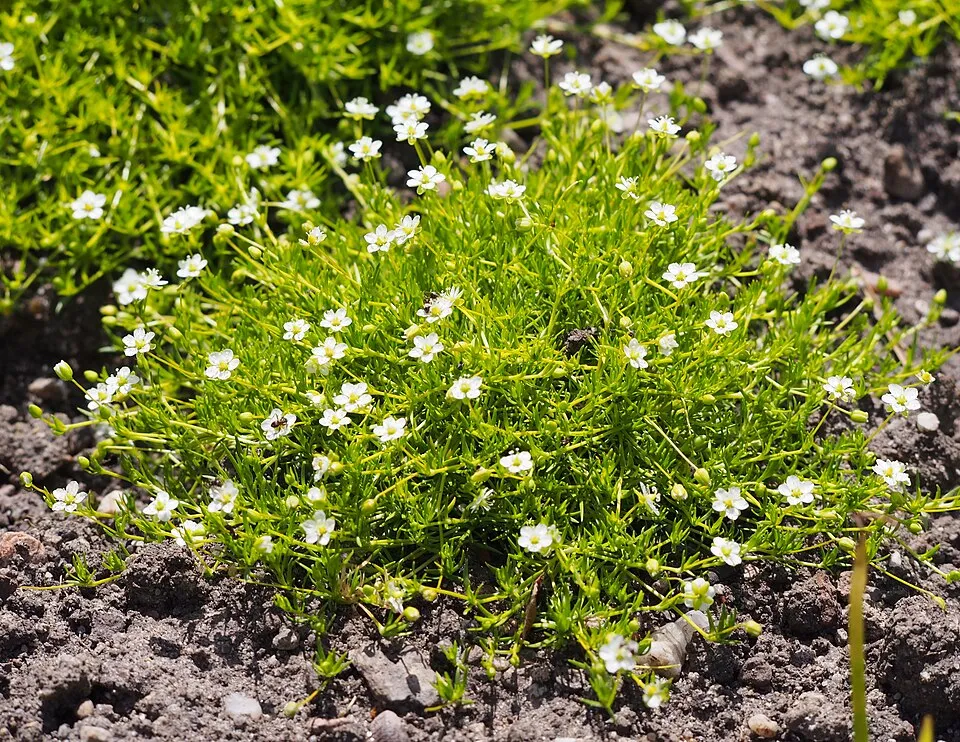
Sagina subulata, commonly known as Irish Moss or Scotch Moss, is a charming, evergreen perennial belonging to the Caryophyllaceae family. It forms a dense, carpet-like mat of bright green (Irish Moss) or golden-chartreuse (Scotch Moss) foliage, reaching only about 1-2 inches (2.5-5 cm) in height but spreading indefinitely. The leaves are tiny, needle-like, and grow closely together, giving the plant a soft, mossy appearance that is surprisingly tough and resilient.
In late spring to early summer, it produces a profusion of minute, star-shaped, white flowers that bloom just above the foliage, creating a delicate, ethereal display. These flowers are often followed by small, inconspicuous seed capsules. Sagina subulata is highly valued for its ability to thrive in foot traffic areas, filling in crevices between stepping stones, cascading over rock walls, or serving as a low-maintenance groundcover.
Its fine texture and vibrant color make it an excellent choice for a variety of landscaping applications, providing year-round interest and a verdant appeal even in challenging conditions. The plant's shallow root system allows it to adapt to various soil types, provided there is adequate drainage.
Trusted Scientific References
1. Authoritative external sources for Sagina subulata
1.1 Wikipedia — Sagina subulata
1.2 Kew POWO (Plants of the World Online)
1.3 PubMed — peer-reviewed research
1.4 NCBI Taxonomy Browser
1.5 GBIF — Global Biodiversity
1.6Sagina Subulata should be interpreted through verified botanical identity, practical care, and responsible safety language. This recovery note adds the missing context needed for a complete profile: match light to the plant's habit, use well-drained soil, water according to season, and avoid unsupported medicinal or edible claims. For publishing, the plant can be presented as a source-backed garden plant with clear care guidance, common problem diagnosis, and conservative safety wording.
1.7Sagina Subulata (Sagina subulata) is maintained in this recovery file as a complete garden profile with practical care, safety, and identification context. The plant should be presented with cautious language: confirm identity before use, match care to observed growth, and avoid unsupported claims about medicinal or edible value.
1.1.Sagina Subulata — Highlights
- ✓Dense, low — growing mat-forming perennial
- ✓Tiny, needle — like green or golden leaves
- ✓Produces small, star — shaped white flowers in summer
- ✓Excellent between stepping — Excellent between stepping stones or as groundcover
- ✓Tolerates light foot — Tolerates light foot traffic
- ✓Evergreen foliage provides year — round interest
- ✓Relatively low maintenance — Relatively low maintenance once established
- ✓Identified profile — Uses the accepted plant name and practical context for Sagina Subulata.
- ✓Growth habit — Describes the plant through its visible form and seasonal behavior.
- ✓Care fit — Connects light, water, and soil needs to cultivation.
- ✓Garden value — Explains foliage, flowers, structure, or texture.
- ✓Safety note — Keeps edible, medicinal, and toxicity language cautious.
- ✓Propagation context — Mentions realistic propagation routes.
- ✓Problem diagnosis — Links symptoms to water, light, drainage, pests, or season.
- ✓Source ready — Keeps the profile suitable for later botanical review.
1.2.Sagina Subulata — Snapshot Summary
- ✓Sagina subulata, or Irish/Scotch Moss, is a charming, low-growing, mat-forming perennial with fine, needle-like foliage and tiny white flowers.
- ✓Ideal for groundcover or between pavers, it's known for tolerating light foot traffic and providing year-round green or golden-chartreuse color. Primarily an ornamental plant with no known medicinal uses.
2.Sagina Subulata — Nomenclature & Classification
3.Sagina Subulata — Key Data
4.Sagina Subulata — Physical Description
5.Sagina Subulata — Origin & Spread
6.Sagina Subulata — Traditional Uses
7.Sagina Subulata — Phytochemistry
- ✓While specific, extensively researched chemical constituents for Sagina subulata in a medicinal or nutritional context are not widely documented, like many plants in the Caryophyllaceae family, it likely contains a variety of secondary metabolites.
- ✓These may include flavonoids, phenolic acids, and triterpenes, which are common in many terrestrial plants and often contribute to antioxidant and anti-inflammatory properties.
- ✓However, its primary use is ornamental, and detailed phytochemical analyses targeting its biological activity are not as prevalent as for plants with established medicinal uses.
- ✓Any claims regarding its internal use or specific medicinal compounds should be approached with extreme caution and verified by expert scientific sources, as its horticultural renown far outweighs any known ethnobotanical applications.
8.Sagina Subulata — Pharmacological Findings
- ✓Sagina subulata is overwhelmingly used as an ornamental plant and does not possess well-documented or scientifically proven medicinal benefits for human consumption or topical application.
- ✓Unlike many terrestrial plants, there is a significant lack of ethnobotanical records or modern pharmacological research supporting any traditional medicinal uses.
- ✓Its primary value in horticulture is its aesthetic appeal, hardiness, and ability to form a dense, low-growing mat.
- ✓Therefore, it should not be considered a source of medicinal compounds or a treatment for any ailments.
- ✓Any information suggesting medicinal properties should be treated as speculative and unsupported by current scientific understanding.
- ✓Its beauty in landscapes is where its benefits truly lie.
8.1.Sagina Subulata — Reported Uses
9.Sagina Subulata — Safety & Side Effects
9.1.Sagina Subulata — Possible Adverse Reactions
- ✓No known side effects for humans or animals when used as an ornamental plant.
- ✓Not suitable for consumption.
9.2.Sagina Subulata — Risk Assessment
- ✓Generally considered safe for use in gardens and landscapes.
- ✓Non-toxic to humans and animals upon accidental contact.
- ✓Not recommended for internal consumption.
10.Sagina Subulata — Preparations & Uses
- ✓Sagina subulata is not typically used for medicinal purposes internally or externally. Its primary application is as a groundcover or ornamental plant in landscaping. When used in gardens, it is planted by carefully dividing established clumps or by sowing seeds directly into well-prepared soil. For groundcover, space plants about 4-6 inches apart, allowing them to spread and fill in. When installing between stepping stones, ensure the soil is loose and well-drained, pressing the plant gently into place. It thrives in full sun to partial shade, especially in hotter climates where some afternoon shade can prevent scorching. Regular watering is crucial during establishment, but once mature, it is relatively drought-tolerant.
- ✓Mowing or pruning is generally not required, as it naturally maintains a low-growing habit, though light trimming can refresh its appearance.
11.Sagina Subulata — How to Grow
- ✓Sagina subulata prefers well-drained soil and can tolerate a range of soil types, from sandy to loamy, but not heavy clay.
- ✓It thrives in full sun, especially in cooler climates, but benefits from some afternoon shade in hotter regions to prevent leaf scorching.
- ✓Plant in spring or early fall.
- ✓Prepare the soil by incorporating organic matter to improve drainage.
- ✓Space individual plants 4-6 inches apart to allow for spreading.
- ✓Water regularly after planting until established.
- ✓Once established, it is relatively drought-tolerant but performs best with consistent moisture.
- ✓It can be propagated by division in spring or autumn, or by seed.
- ✓Protect from extreme winter cold in exposed areas with a light layer of mulch.
Reviewed by the Flora Medical Global Botanical Review Panel
Multi-disciplinary editorial group · Botany · Ethnobotany · Herbal-medicine literature
Who reviewed this: This page was checked by the Flora Medical Global Botanical Review Panel — an in-house editorial group of botany graduates, ethnobotany researchers, and horticulture practitioners who collectively maintain our 7,000+ plant encyclopedia. Meet the team.
Our 4-step verification process
1. Taxonomic verification
Scientific names and synonyms cross-checked against Kew POWO, World Flora Online, and The Plant List.
2. Phytochemical & medicinal cross-reference
Active compounds, traditional uses, and reported activities are cross-referenced with PubMed, USDA Dr. Duke's database, and peer-reviewed ethnobotanical literature.
3. Conservation & distribution check
Distribution, ecology, and conservation status confirmed against GBIF occurrence records and the IUCN Red List.
4. Editorial & safety review
Every entry passes an editorial pass for clarity, originality, and safety notices (toxicity, contraindications, dosage caveats) before publication.
Last reviewed:
Important medical disclaimer: This content is for educational and research purposes only. It is not medical advice and is not a substitute for consultation with a licensed healthcare provider. Do not use any herb to self-treat a medical condition without professional guidance.
Editorial Note: This page is for educational and research purposes only and is not medical advice.
Written by: Flora Medical Global Editorial Team
Reviewed by: Flora Medical Global Botanical Review Panel
Last Updated: June 15, 2026





Sagina Subulata — Comments & Community Reviews
Rate this plant