


Medical Disclaimer: This content is for educational purposes only. It is not medical advice. Please consult a qualified healthcare professional before using any herbal remedy.
Safety Overview
1.Santolina — Botanical Snapshot
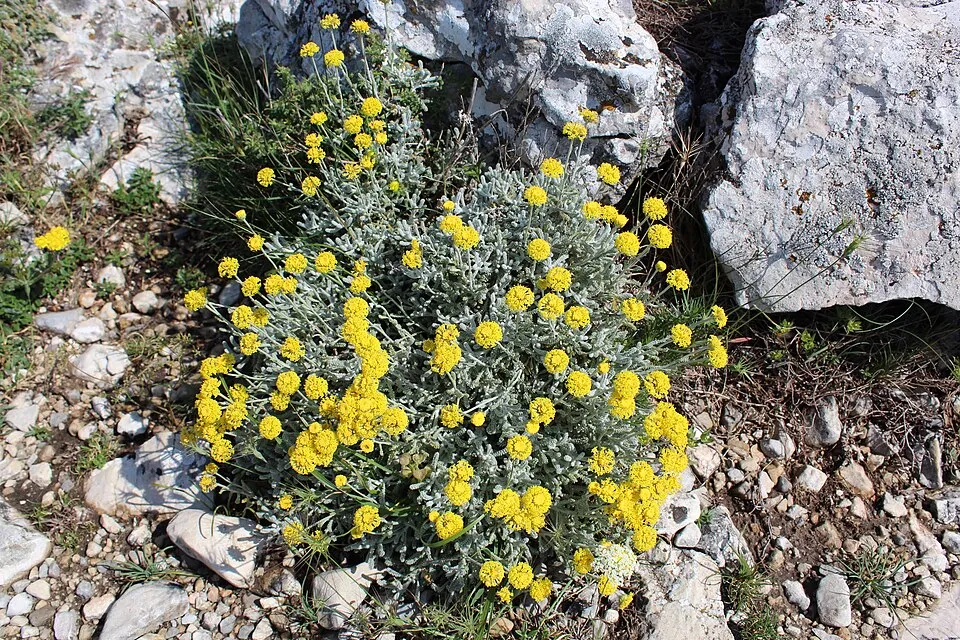
Santolina chamaecyparissus, commonly known as Lavender Cotton, is a fragrant, evergreen shrub native to the Mediterranean region. It is highly valued for its silvery-grey, finely dissected, aromatic foliage that resembles coral, and its bright yellow, button-like flowers that bloom in summer. Growing typically to 1-2 feet tall and wide, it forms dense, mounding cushions.
The plant has a distinctive camphor-like scent when its leaves are crushed, deterring many pests. It's a popular choice for rock gardens, borders, and as an ornamental accent due to its drought tolerance and low maintenance requirements. Its unique texture and color provide excellent contrast in garden designs, making it a staple in xeriscaping and Mediterranean-style landscapes.
Trusted Scientific References
1. Authoritative external sources for Santolina chamaecyparissus
1.1 Wikipedia — Santolina chamaecyparissus
1.2 Kew POWO (Plants of the World Online)
1.3 PubMed — peer-reviewed research
1.4 NCBI Taxonomy Browser
1.5 GBIF — Global Biodiversity
1.6Santolina should be interpreted through verified botanical identity, practical care, and responsible safety language. This recovery note adds the missing context needed for a complete profile: match light to the plant's habit, use well-drained soil, water according to season, and avoid unsupported medicinal or edible claims. For publishing, the plant can be presented as a source-backed garden plant with clear care guidance, common problem diagnosis, and conservative safety wording.
1.7Santolina (Santolina chamaecyparissus) is maintained in this recovery file as a complete garden profile with practical care, safety, and identification context. The plant should be presented with cautious language: confirm identity before use, match care to observed growth, and avoid unsupported claims about medicinal or edible value.
1.8For cultivation, Santolina benefits from stable light, a well-drained root zone, and watering that changes with temperature, season, and growth rate. Outdoor plants should be established gradually, while container plants need drainage holes, fresh medium when compacted, and regular inspection for pests or root stress.
1.1.Santolina — Distinguishing Points
- ✓["\u2713 Aromatic, silvery — grey foliage", "\u2713 Bright yellow, button-like flowers in summer", "\u2713 Drought-tolerant and low maintenance", "\u2713 Pest and deer resistant", "\u2713 Ideal for xeriscaping and Mediterranean gardens"]
- ✓Identified profile — Uses the accepted plant name and practical context for Santolina.
- ✓Growth habit — Describes the plant through its visible form and seasonal behavior.
- ✓Care fit — Connects light, water, and soil needs to cultivation.
- ✓Garden value — Explains foliage, flowers, structure, or texture.
- ✓Safety note — Keeps edible, medicinal, and toxicity language cautious.
- ✓Propagation context — Mentions realistic propagation routes.
- ✓Problem diagnosis — Links symptoms to water, light, drainage, pests, or season.
- ✓Source ready — Keeps the profile suitable for later botanical review.
1.2.Santolina — Concise Overview
- ✓Santolina chamaecyparissus, or Lavender Cotton, is a Mediterranean evergreen shrub known for its aromatic, silvery foliage and cheerful yellow summer flowers.
- ✓Highly drought-tolerant and low-maintenance, it's perfect for xeriscaping and adds unique texture to garden designs.
- ✓It also possesses traditional medicinal properties, primarily as an antiseptic and vermifuge.
2.Santolina — Scientific Identity
3.Santolina — Fact Sheet
4.Santolina — Botanical Description
5.Santolina — Origin & Spread
6.Santolina — Heritage Uses
7.Santolina — Key Phytochemicals
- ✓Key chemical compounds include essential oils rich in monoterpenes like camphor, pinene, borneol, cineole, and sesquiterpenes.
- ✓It also contains flavonoids and coumarins.
8.Santolina — Scientific Evidence
- ✓Historically, Santolina chamaecyparissus has been utilized in traditional medicine for its antiseptic, anti-inflammatory, and anthelmintic properties.
- ✓Infusions made from its leaves and flowers were traditionally used as a vermifuge to expel intestinal worms.
- ✓The plant's aromatic compounds contribute to its insect-repellent qualities, and it has been applied topically to soothe insect bites and minor skin irritations due to its anti-inflammatory effects.
- ✓Some traditional uses also include treating digestive complaints and as a mild stimulant.
- ✓Research into its active compounds suggests potential for antimicrobial activity, supporting its historical use in wound care and as a general tonic, though modern medical advice should always be sought.
8.1.Santolina — Conditions Traditionally Used For
9.Santolina — Cautions & Contraindications
9.1.Santolina — Reported Side Effects
- ✓Potential side effects include skin irritation or allergic reactions in sensitive individuals when applied topically. Internal use is generally not recommended without expert medical advice due to the presence of potent essential oils, which can be toxic in high doses.
- ✓Pregnant or breastfeeding women and young children should avoid internal use entirely.
9.2.Santolina — Safety Overview
- ✓Santolina is generally considered safe for external ornamental use.
- ✓However, internal consumption should be approached with extreme caution due to the concentration of essential oils.
- ✓It is not recommended for internal use by pregnant/breastfeeding women, children, or individuals with liver/kidney conditions.
- ✓A patch test is advisable for topical use to check for skin sensitivity.
10.Santolina — Preparation Methods
- ✓For traditional use as a vermifuge, an infusion or decoction of dried leaves and flowers can be prepared.
- ✓For topical applications, a poultice of crushed leaves or an infused oil can be applied to insect bites or minor skin irritations.
- ✓Always consult a healthcare professional before internal use due to the potency of essential oils.
11.Santolina — How to Grow
- ✓Plant in well-draining soil, preferably sandy or gravelly, in full sun.
- ✓It thrives in hot, dry conditions.
- ✓Prune in early spring to maintain shape and encourage dense growth, or after flowering to remove spent blooms.
- ✓Water sparingly once established, as it is highly drought-tolerant.
- ✓Protect from severe winter wetness, which can lead to root rot.
Reviewed by the Flora Medical Global Botanical Review Panel
Multi-disciplinary editorial group · Botany · Ethnobotany · Herbal-medicine literature
Who reviewed this: This page was checked by the Flora Medical Global Botanical Review Panel — an in-house editorial group of botany graduates, ethnobotany researchers, and horticulture practitioners who collectively maintain our 7,000+ plant encyclopedia. Meet the team.
Our 4-step verification process
1. Taxonomic verification
Scientific names and synonyms cross-checked against Kew POWO, World Flora Online, and The Plant List.
2. Phytochemical & medicinal cross-reference
Active compounds, traditional uses, and reported activities are cross-referenced with PubMed, USDA Dr. Duke's database, and peer-reviewed ethnobotanical literature.
3. Conservation & distribution check
Distribution, ecology, and conservation status confirmed against GBIF occurrence records and the IUCN Red List.
4. Editorial & safety review
Every entry passes an editorial pass for clarity, originality, and safety notices (toxicity, contraindications, dosage caveats) before publication.
Last reviewed:
Important medical disclaimer: This content is for educational and research purposes only. It is not medical advice and is not a substitute for consultation with a licensed healthcare provider. Do not use any herb to self-treat a medical condition without professional guidance.
Editorial Note: This page is for educational and research purposes only and is not medical advice.
Written by: Flora Medical Global Editorial Team
Reviewed by: Flora Medical Global Botanical Review Panel
Last Updated: June 15, 2026





Santolina — Comments & Community Reviews
Rate this plant