
Medical Disclaimer: This content is for educational purposes only. It is not medical advice. Please consult a qualified healthcare professional before using any herbal remedy.
Safety Overview
1.Senecio Haworthii — Plant Snapshot
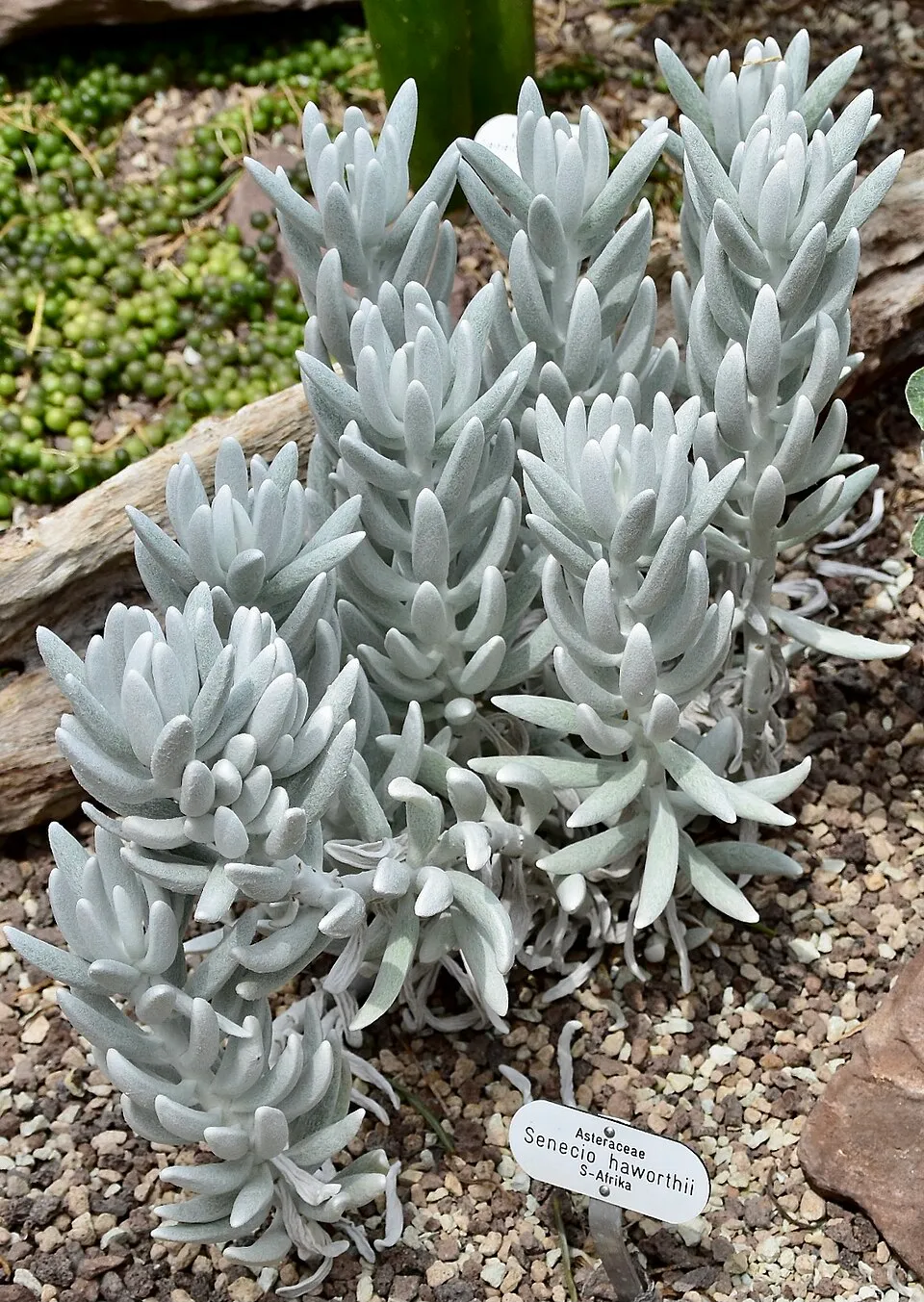
Senecio haworthii, widely recognized as the Cocoon Plant, is a distinctive succulent species endemic to the arid and semi-arid regions of South Africa. Belonging to the vast Asteraceae family, this perennial plant typically attains a modest height of 15 to 30 centimeters, forming dense, compact clumps. Its most striking morphological feature is its densely packed, cylindrical to oval-shaped leaves, which are entirely enveloped in a thick, white, woolly indumentum, giving them a cocoon-like or felted appearance.
These succulent leaves, measuring approximately 5 to 10 centimeters long and 1 to 2 centimeters wide, are highly adapted for moisture retention, crucial for survival in its native rocky or sandy habitats. The stems are generally erect, often becoming somewhat woody at the base over time, providing structural support. During late summer to early autumn, Senecio haworthii produces vibrant clusters of small, daisy-like flowers, typically bright yellow or orange, which emerge on slender stalks above the woolly foliage, offering a beautiful contrast.
This species thrives in well-draining soil and bright light, making it a popular and resilient ornamental plant for both indoor cultivation and xeriscaping in suitable climates worldwide.
Trusted Scientific References
1. Authoritative external sources for Senecio haworthii
1.1 Wikipedia — Senecio haworthii
1.2 Kew POWO (Plants of the World Online)
1.3 PubMed — peer-reviewed research
1.4 NCBI Taxonomy Browser
1.5 GBIF — Global Biodiversity
1.6Senecio Haworthii should be interpreted through verified botanical identity, practical care, and responsible safety language. This recovery note adds the missing context needed for a complete profile: match light to the plant's habit, use well-drained soil, water according to season, and avoid unsupported medicinal or edible claims. For publishing, the plant can be presented as a source-backed indoor plant with clear care guidance, common problem diagnosis, and conservative safety wording.
1.1.Senecio Haworthii — Defining Traits
- ✓Unique Woolly Foliage — Densely covered in white, felt-like hairs resembling cocoons.
- ✓Succulent Nature — Thick, fleshy leaves adapted for water storage in arid environments.
- ✓Low Maintenance — Requires minimal watering and care, ideal for beginner gardeners.
- ✓Drought Tolerant — Highly resistant to dry conditions once established.
- ✓Ornamental Value — Prized for its distinctive texture and form in decorative settings.
- ✓South African Native — Endemic to arid regions of South Africa.
- ✓Bright Yellow Flowers — Produces small, daisy-like yellow flowers in late summer.
- ✓Asteraceae Family Member — Belongs to the large daisy family.
- ✓Contains Pyrrolizidine Alkaloids — Possesses toxic compounds, making it unsafe for consumption.
- ✓Indoor Plant Suitability — Thrives in bright indoor conditions, making it a popular houseplant.
1.2.Senecio Haworthii — Quick Summary
- ✓Senecio haworthii, the Cocoon Plant, is a unique South African succulent.
- ✓Characterized by dense, white, woolly cylindrical leaves.
- ✓Contains highly toxic pyrrolizidine alkaloids (PAs).
- ✓Primarily valued as an ornamental houseplant; not for internal use.
- ✓Traditional topical use for skin irritation is unverified and risky.
- ✓Ingestion causes severe, irreversible liver damage.
2.Senecio Haworthii — Taxonomic Classification
3.Senecio Haworthii — Reference Facts
4.Senecio Haworthii — Morphological Account
5.Senecio Haworthii — Geographic Distribution
6.Senecio Haworthii — Historical Applications
7.Senecio Haworthii — Secondary Metabolites
- ✓Pyrrolizidine Alkaloids (PAs) — Senecio haworthii, like many species within the Senecio genus, contains hepatotoxic pyrrolizidine alkaloids such as senecionine and seneciphylline, which are responsible for liver damage upon ingestion.
- ✓Flavonoids — The plant likely contains various flavonoids, common in Asteraceae, which are known for potential antioxidant and anti-inflammatory activities, though specific compounds in S. haworthii are not well-documented.
- ✓Triterpenoids — Triterpenoids, including compounds like ursolic acid or oleanolic acid derivatives, may be present, potentially contributing to anti-inflammatory or protective properties, but require specific research for S. haworthii.
- ✓Phenolic Acids — Various phenolic acids, such as caffeic acid or chlorogenic acid, are anticipated to be present, offering potential antioxidant benefits, typical of many plant species.
- ✓Mucilage — As a succulent, Senecio haworthii likely contains mucilaginous polysaccharides in its leaves, which aid in water retention and could offer emollient properties in topical applications.
- ✓Fatty Acids — Lipids, including various fatty acids, are integral components of plant cell membranes and storage, potentially present in the plant's succulent tissues.
- ✓Volatile Organic Compounds — Trace amounts of volatile organic compounds may contribute to the plant's defense mechanisms or subtle aroma, though their specific composition in S. haworthii is largely unexplored.
- ✓Sterols — Plant sterols, such as beta-sitosterol, are commonly found in plant tissues and play roles in membrane structure and signaling, potentially present in Senecio haworthii.
8.Senecio Haworthii — What Research Suggests
- ✓Potential Topical Emollient — Traditionally, Senecio haworthii has been anecdotally used for soothing minor skin irritations when applied externally, though scientific validation is currently absent.
- ✓Folkloric Anti-inflammatory (Genus) — Some Senecio species, distinct from S. haworthii, were historically applied to reduce inflammation, a practice largely unsupported by modern safety data due to inherent toxicity.
- ✓Traditional Respiratory Support (Genus) — Historically, certain Senecio species were employed in folk medicine for conditions like bronchitis or asthma, but these uses are not associated with S. haworthii and carry significant health risks.
- ✓Homeopathic Gynaecological Aid (S. aureus) — In homeopathic practice, Senecio aureus is utilized for women's health concerns such as menstrual irregularities, though its efficacy is not scientifically proven, and the raw plant is toxic.
- ✓Potential Antioxidant Activity (Genus) — While not specifically studied in S. haworthii, some members of the diverse Senecio genus contain phenolic compounds that could offer antioxidant properties, though internal use is highly discouraged for the genus.
- ✓Traditional Wound Healing (Genus) — Certain Senecio species were historically used in poultices for minor wounds, a practice not recommended for S. haworthii due to its pyrrolizidine alkaloid content.
- ✓Folkloric Diuretic (Genus) — Some traditional practices attributed diuretic properties to various Senecio species, but such applications are dangerous and lack scientific backing for S. haworthii, posing severe health risks.
- ✓Potential Antispasmodic (Genus) — In traditional systems, other Senecio species were believed to help alleviate spasms, though this is not documented for S. haworthii and carries severe toxicity warnings due to pyrrolizidine alkaloids.
8.1.Senecio Haworthii — Reported Uses
9.Senecio Haworthii — Precautions & Warnings
9.1.Senecio Haworthii — Side Effects & Warnings
- ✓Liver Toxicity — Ingestion of Senecio haworthii, like other Senecio species, can cause severe and irreversible liver damage (veno-occlusive disease) due to pyrrolizidine alkaloids.
- ✓Gastrointestinal Distress — Symptoms such as nausea, vomiting, abdominal pain, and diarrhea may occur following accidental ingestion.
- ✓Allergic Contact Dermatitis — Topical application, though traditionally noted, may cause skin irritation, redness, itching, or allergic reactions in sensitive individuals.
- ✓Cumulative Toxicity — Pyrrolizidine alkaloids can accumulate in the liver over time, leading to chronic liver disease even from small, repeated doses.
- ✓Carcinogenic Potential — Some pyrrolizidine alkaloids are considered genotoxic and potentially carcinogenic, posing long-term health risks.
- ✓Fetal Harm — Ingestion by pregnant individuals can be severely harmful to the fetus, potentially causing birth defects or miscarriage.
9.2.Senecio Haworthii — Risk Assessment
- ✓Contains Pyrrolizidine Alkaloids — Senecio haworthii contains toxic pyrrolizidine alkaloids (PAs) that are highly hepatotoxic and can cause irreversible liver damage.
- ✓Strict Avoidance of Internal Consumption — Absolutely no part of this plant should be ingested by humans or animals due to severe toxicity risks.
- ✓Consult Healthcare Professional — Always consult a qualified medical herbalist or healthcare provider before considering any plant-based remedy, especially for Senecio species.
- ✓Not for Pregnant or Nursing Individuals — Due to the confirmed presence of PAs, pregnant or breastfeeding women must strictly avoid contact and ingestion.
- ✓Keep Away from Children and Pets — Ensure the plant is placed out of reach to prevent accidental ingestion, which can be fatal.
- ✓Caution with Topical Use — While some traditional topical use is noted, exercise extreme caution due to potential skin irritation and systemic absorption risks.
- ✓No Scientific Validation for Medicinal Use — There is no scientific evidence supporting the safe or effective medicinal use of Senecio haworthii; its primary value is ornamental.
10.Senecio Haworthii — Application Forms
- ✓Ornamental Display — Primarily cultivated as an ornamental houseplant or xeriscape garden specimen due to its unique aesthetic appeal and drought tolerance.
- ✓Topical Application (Traditional, Extreme Caution) — Historically, S. haworthii was anecdotally used topically for minor skin irritations; however, this use is unverified and carries risks due to potential skin sensitivity and the plant's overall toxicity.
- ✓Avoid Internal Use — Absolutely no part of Senecio haworthii should be ingested due to the presence of highly toxic pyrrolizidine alkaloids, which can cause severe, irreversible liver damage.
- ✓No Culinary Use — This plant is not safe for human or animal consumption in any form; ensure it is kept out of reach of children and pets.
- ✓Horticultural Study — May be used in botanical gardens or educational settings for study of succulent adaptations and plant morphology.
- ✓Home Decor Element — Valued for its unique texture and form, Senecio haworthii serves as an attractive, low-maintenance decorative plant in various interior design schemes.
11.Senecio Haworthii — Growth Requirements
- ✓Light — Provide bright, direct sunlight for at least 6 hours daily; partial shade is tolerated in very hot climates.
- ✓Soil — Use a well-draining succulent or cactus potting mix, ideally with added perlite or pumice to prevent root rot.
- ✓Watering — Water thoroughly only when the soil is completely dry, typically every 2-4 weeks, significantly reducing frequency in winter.
- ✓Temperature — Thrives in warm temperatures (18-24°C / 65-75°F) and can tolerate brief dips to 5°C (41°F), but protect from frost.
- ✓Humidity — Prefers low humidity, typical of its arid native environment, making it suitable for most indoor settings.
- ✓Propagation — Easily propagated from stem cuttings; allow cut ends to callus for several days before planting in dry, well-draining soil.
- ✓Fertilization — Feed sparingly with a diluted, balanced liquid fertilizer specifically formulated for succulents during the growing season (spring/summer), once every 2-3 months.
- ✓Pruning — Minimal pruning required, mainly to remove dead or leggy growth to maintain its compact, attractive form.
Reviewed by the Flora Medical Global Botanical Review Panel
Multi-disciplinary editorial group · Botany · Ethnobotany · Herbal-medicine literature
Who reviewed this: This page was checked by the Flora Medical Global Botanical Review Panel — an in-house editorial group of botany graduates, ethnobotany researchers, and horticulture practitioners who collectively maintain our 7,000+ plant encyclopedia. Meet the team.
Our 4-step verification process
1. Taxonomic verification
Scientific names and synonyms cross-checked against Kew POWO, World Flora Online, and The Plant List.
2. Phytochemical & medicinal cross-reference
Active compounds, traditional uses, and reported activities are cross-referenced with PubMed, USDA Dr. Duke's database, and peer-reviewed ethnobotanical literature.
3. Conservation & distribution check
Distribution, ecology, and conservation status confirmed against GBIF occurrence records and the IUCN Red List.
4. Editorial & safety review
Every entry passes an editorial pass for clarity, originality, and safety notices (toxicity, contraindications, dosage caveats) before publication.
Last reviewed:
Important medical disclaimer: This content is for educational and research purposes only. It is not medical advice and is not a substitute for consultation with a licensed healthcare provider. Do not use any herb to self-treat a medical condition without professional guidance.
Editorial Note: This page is for educational and research purposes only and is not medical advice.
Written by: Flora Medical Global Editorial Team
Reviewed by: Flora Medical Global Botanical Review Panel
Last Updated: June 15, 2026





Senecio Haworthii — Comments & Community Reviews
Rate this plant