
Medical Disclaimer: This content is for educational purposes only. It is not medical advice. Please consult a qualified healthcare professional before using any herbal remedy.
Safety Overview
1.Senna — Overview
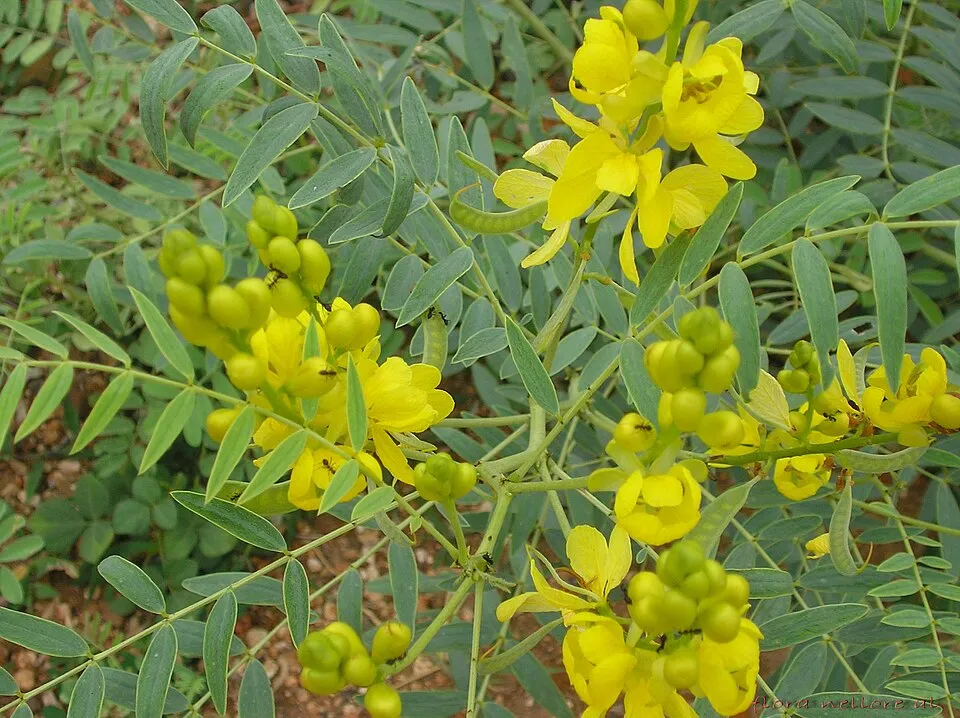
Senna alexandrina, commonly known as Senna, is a resilient perennial shrub belonging to the Leguminosae family, specifically Fabaceae, which also includes other notable leguminous plants. This species typically reaches a height of up to 1 meter, characterized by its sturdy, woody stem and light brown bark that often exhibits a peeling texture. The plant's foliage is distinctive, featuring compound, paripinnate leaves that measure between 15 to 30 centimeters in length.
Each leaf is composed of 4 to 8 pairs of oblong leaflets, each leaflet being approximately 2 to 7 centimeters long, with a smooth, bright green surface that deepens in color as it matures. During the warmer summer months, Senna alexandrina produces striking yellow flowers arranged in terminal or axillary racemes. Each flower typically presents five vibrant yellow petals, often with a subtle brownish coloration at their center, adding to its ornamental appeal.
Following successful pollination, the plant develops flattened, oblong pods, which are initially green and ripen to a dark brown, containing several seeds.
Native to tropical and subtropical regions, Senna alexandrina thrives in arid and semi-arid climates, particularly across parts of Africa, including Egypt and Sudan, and extending into Asia. It demonstrates a preference for well-drained, sandy soils and requires full sun exposure to flourish optimally. Its robust nature allows it to adapt to challenging environmental conditions, making it a prominent feature in its native landscapes.
Taxonomically, its classification within the genus Senna underscores its close relation to many other species, though S. alexandrina is uniquely distinguished by its potent medicinal properties, predominantly its well-documented efficacy as a natural laxative, primarily attributed to the sennoside compounds concentrated in its leaves and pods. This widespread distribution and adaptability have contributed significantly to its historical and contemporary use in traditional and modern herbal medicine systems globally.
Trusted Scientific References
1. Authoritative external sources for Senna alexandrina
1.1 Wikipedia — Senna alexandrina
1.2 Kew POWO (Plants of the World Online)
1.3 PubMed — peer-reviewed research
1.4 NCBI Taxonomy Browser
1.5 GBIF — Global Biodiversity
1.1.Senna — Defining Traits
- ✓Potent stimulant laxative — Potent stimulant laxative action.
- ✓Contains sennosides A — Contains sennosides A and B as primary active compounds.
- ✓FDA — approved for short-term constipation relief.
- ✓Used for bowel — Used for bowel cleansing prior to medical procedures.
- ✓Native to arid and semi — arid regions of Africa and Asia.
- ✓Member of the — Member of the Fabaceae (legume) family.
- ✓Distinctive yellow flowers — Distinctive yellow flowers and flattened pods.
- ✓Historically utilized in — Historically utilized in various traditional medicine systems.
- ✓Requires careful dosing — Requires careful dosing due to potential for side effects and dependence.
- ✓Important interactions with — Important interactions with certain medications.
1.2.Senna — Quick Summary
- ✓Senna alexandrina is a widely recognized stimulant laxative.
- ✓Its primary active compounds are sennosides, found in leaves and pods.
- ✓Effective for short-term constipation relief and bowel preparation.
- ✓Long-term use can lead to laxative dependence and severe side effects.
- ✓Available as tablets, teas, and liquid extracts.
- ✓Always consult a healthcare professional before use, especially if pregnant, breastfeeding, or on medication.
2.Senna — Systematic Position
3.Senna — Quick Facts
4.Senna — Structural Profile
5.Senna — Habitat & Distribution
6.Senna — Historical Applications
7.Senna — Active Compounds
- ✓Anthraquinone Glycosides — The primary active compounds are sennosides A and B, along with smaller amounts of sennosides C and D, which are prodrugs that are metabolized by gut bacteria into active rhein anthrones, responsible for the stimulant laxative effect.
- ✓Anthraquinones (free) — Emodin, aloe-emodin, and rhein are present in their free forms, contributing to the overall laxative and purgative actions, though in lower concentrations than their glycosidic counterparts.
- ✓Naphthalene Glycosides — These include compounds like tinnevellin glycosides, which may contribute to the plant's overall pharmacological profile, though their specific contributions are less studied than sennosides.
- ✓Flavonoids — Kaempferol and isorhamnetin derivatives are found in Senna, possessing antioxidant and anti-inflammatory properties, which may modulate the plant's effects and offer protective benefits.
- ✓Mucilage — Polysaccharides such as mucilage are present, which can act as a bulk-forming agent, contributing to stool softening and easing passage, complementing the stimulant action of sennosides.
- ✓Resins — Various resinous substances are found in Senna leaves and pods, which can contribute to the plant's complex chemical matrix and potentially influence its bioavailability and overall therapeutic effects.
- ✓Tartaric Acid — This organic acid is present in Senna, contributing to its taste profile and potentially playing a minor role in its overall physiological effects, though not directly related to its laxative action.
- ✓Salicylic Acid — Small amounts of salicylic acid and its derivatives can be found, which may possess mild anti-inflammatory or analgesic properties, though not a primary constituent for Senna's main uses.
- ✓Phytosterols — Compounds like beta-sitosterol are present, which are known for their potential to lower cholesterol and exhibit anti-inflammatory effects, adding to the plant's broader phytochemical spectrum.
- ✓Volatile Oils — Trace amounts of volatile oils contribute to the plant's aroma, although they are not considered primary active constituents for its medicinal applications.
8.Senna — Modern Studies
- ✓Constipation Relief — Senna is primarily recognized and FDA-approved for its stimulant laxative properties, effectively treating acute and chronic constipation by irritating the bowel lining and stimulating peristaltic contractions within 6-12 hours after ingestion.
- ✓Bowel Preparation — It is widely used in medical settings to effectively clear the colon before diagnostic procedures such as colonoscopies, ensuring optimal visibility for clinicians.
- ✓Hemorrhoid Management — By promoting softer stools and easier bowel movements, Senna can alleviate the strain and discomfort associated with hemorrhoids, preventing exacerbation of symptoms.
- ✓Irritable Bowel Syndrome (IBS) Support — While not a primary treatment, for individuals with constipation-predominant IBS, Senna can help regulate bowel movements and reduce symptoms when used short-term under medical supervision.
- ✓Post-Surgical Bowel Function — Senna can be administered to patients recovering from surgery to help restore normal bowel function and prevent post-operative constipation, which is a common complication.
- ✓Ayurvedic Medicine — In Ayurveda, Senna (often referred to as 'Swarnapatri') is used as a potent purgative to cleanse the body, particularly in conditions requiring removal of excess Pitta and Kapha doshas, promoting detoxification.
- ✓Traditional Chinese Medicine (TCM) — Though less common than in other systems, Senna may be used in TCM for heat-induced constipation, to clear heat and moisten the intestines, often combined with other herbs to balance its strong purgative effect.
- ✓Detoxification Aid — Due to its strong laxative action, Senna is sometimes included in short-term detoxification protocols to facilitate the elimination of waste products from the digestive tract, though caution is advised.
- ✓Weight Management Support — While not a direct weight-loss aid, by promoting regular bowel movements and reducing water retention, some individuals use Senna as part of a short-term regimen, though this use lacks strong scientific backing and can be risky.
- ✓Anti-parasitic Properties — Historically, Senna has been used in some traditional practices for its potential anthelmintic effects, assisting in the expulsion of intestinal parasites, though modern evidence is limited.
8.1.Senna — Therapeutic Indications
9.Senna — Adverse Effects
9.1.Senna — Warnings
- ✓Abdominal Cramps — Common side effect due to the stimulant action on intestinal muscles, often accompanied by discomfort or bloating.
- ✓Diarrhea — Excessive doses or prolonged use can lead to watery stools and dehydration, particularly concerning for vulnerable populations.
- ✓Nausea and Vomiting — Some individuals may experience gastrointestinal upset, including feelings of nausea or episodes of vomiting.
- ✓Electrolyte Imbalance — Chronic use can cause significant loss of potassium and other electrolytes, leading to muscle weakness, cardiac arrhythmias, and kidney issues.
- ✓Cathartic Colon — Long-term, high-dose use can result in a non-functioning colon, characterized by loss of muscle tone and nerve damage, making the bowel dependent on laxatives.
- ✓Discoloration of Urine — Senna metabolites can cause a harmless reddish-brown discoloration of urine, which is not a cause for concern.
- ✓Allergic Reactions — Rare instances of allergic reactions, such as skin rashes, itching, or hives, have been reported in sensitive individuals.
9.2.Senna — Clinical Safety Notes
- ✓Short-term Use Only — Senna is generally considered safe for short-term use, typically not exceeding one week, to prevent laxative dependence and adverse effects.
- ✓Pregnancy and Breastfeeding — Possibly safe for short-term use during pregnancy and breastfeeding at recommended doses; consult a healthcare provider due to potential risks with high doses or prolonged use.
- ✓Children — Likely safe for children over 2 years old for short periods at age-appropriate doses, but always under medical supervision.
- ✓Pre-existing Conditions — Contraindicated in individuals with abdominal pain of unknown origin, intestinal obstruction, inflammatory bowel disease (IBD), appendicitis, or hemorrhoids.
- ✓Drug Interactions — May interact moderately with digoxin, warfarin, diuretics, and estrogens; professional medical advice is crucial if taking these medications.
- ✓Hydration — Maintain adequate fluid intake to prevent dehydration, especially when experiencing diarrhea.
- ✓Dosage Adherence — Strictly follow recommended dosages and never exceed them, as higher doses increase the risk of severe side effects and toxicity, including liver damage.
10.Senna — Application Forms
- ✓Oral Tablets/Capsules — Senna is most commonly consumed as standardized oral tablets or capsules containing precise doses of sennosides, providing a convenient and controlled method for constipation relief.
- ✓Herbal Tea/Infusion — Dried Senna leaves or pods can be steeped in hot water for 5-10 minutes to create an herbal tea, a traditional method for its laxative effects, typically consumed before bedtime.
- ✓Liquid Extracts — Concentrated liquid extracts or tinctures of Senna are available, offering a flexible dosing option that can be mixed with water or juice.
- ✓Powdered Form — Dried Senna leaves can be ground into a fine powder, which can then be mixed into food, beverages, or encapsulated for internal consumption.
- ✓Ayurvedic Formulations — In Ayurvedic medicine, Senna powder or decoctions are often combined with other herbs like ginger or fennel to mitigate potential cramping and enhance its digestive benefits.
- ✓Rectal Suppositories — In some clinical contexts, Senna preparations can be found in suppository form for localized and rapid laxative action, particularly when oral administration is not feasible.
- ✓Dosage Guidance — Adhere strictly to recommended dosages, typically ranging from 8.6 mg to 34.4 mg of sennosides daily for adults, and avoid prolonged use to prevent dependence.
- ✓Timing of Use — For constipation relief, Senna is best taken in the evening, as its effects usually manifest within 6 to 12 hours, allowing for a morning bowel movement.
11.Senna — Growth Requirements
- ✓Climate and Soil — Senna alexandrina thrives in hot, arid to semi-arid tropical and subtropical climates, requiring well-drained, sandy or loamy soils with a pH between 6.0 and 7.5.
- ✓Sunlight Requirements — Full sun exposure is critical for optimal growth and sennoside production, with the plant needing at least 6-8 hours of direct sunlight daily.
- ✓Propagation — Senna is primarily propagated from seeds, which can be scarified before planting to improve germination rates, or occasionally from cuttings.
- ✓Planting and Spacing — Seeds are typically sown directly into prepared beds, with plants spaced about 30-45 cm apart to allow for adequate air circulation and growth.
- ✓Watering — While drought-tolerant once established, young plants require regular watering until robust, after which infrequent deep watering is sufficient, avoiding waterlogging.
- ✓Fertilization — Minimal fertilization is usually needed; however, incorporating organic matter or a balanced slow-release fertilizer at planting can support healthy development.
- ✓Pest and Disease Management — Senna is relatively resistant to pests, but occasional issues with aphids or fungal spots can be managed with organic pesticides or good cultural practices.
- ✓Harvesting — Leaves and pods are harvested when mature and green, typically before they turn yellow or brown, to ensure maximum sennoside content, then dried carefully in the shade.
Reviewed by the Flora Medical Global Botanical Review Panel
Multi-disciplinary editorial group · Botany · Ethnobotany · Herbal-medicine literature
Who reviewed this: This page was checked by the Flora Medical Global Botanical Review Panel — an in-house editorial group of botany graduates, ethnobotany researchers, and horticulture practitioners who collectively maintain our 7,000+ plant encyclopedia. Meet the team.
Our 4-step verification process
1. Taxonomic verification
Scientific names and synonyms cross-checked against Kew POWO, World Flora Online, and The Plant List.
2. Phytochemical & medicinal cross-reference
Active compounds, traditional uses, and reported activities are cross-referenced with PubMed, USDA Dr. Duke's database, and peer-reviewed ethnobotanical literature.
3. Conservation & distribution check
Distribution, ecology, and conservation status confirmed against GBIF occurrence records and the IUCN Red List.
4. Editorial & safety review
Every entry passes an editorial pass for clarity, originality, and safety notices (toxicity, contraindications, dosage caveats) before publication.
Last reviewed:
Important medical disclaimer: This content is for educational and research purposes only. It is not medical advice and is not a substitute for consultation with a licensed healthcare provider. Do not use any herb to self-treat a medical condition without professional guidance.
Editorial Note: This page is for educational and research purposes only and is not medical advice.
Written by: Flora Medical Global Editorial Team
Reviewed by: Flora Medical Global Botanical Review Panel
Last Updated: June 15, 2026





Senna — Comments & Community Reviews
Rate this plant