


Medical Disclaimer: This content is for educational purposes only. It is not medical advice. Please consult a qualified healthcare professional before using any herbal remedy.
Safety Overview
1.Shilajit (Mineral Pitch) — At a Glance
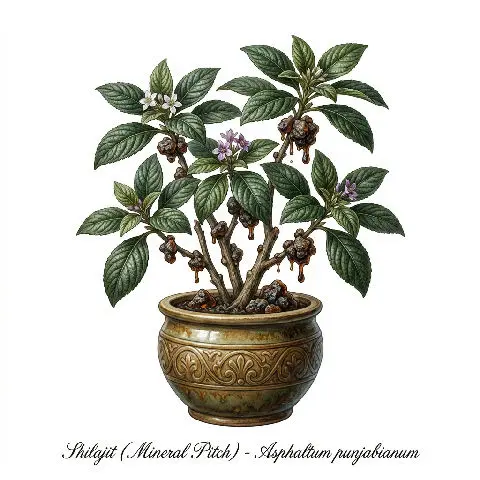
Shilajit (Asphaltum punjabianum), often referred to as mineral pitch, is a distinctive, sticky exudate that predominantly seeps from the rocky strata of high-altitude mountain ranges, most notably the Himalayas, but also found in other global mountainous regions. It presents as a black to dark brown, viscous, tar-like substance, deriving its texture and rich organic content from the slow decomposition of ancient plant matter and microbial biomass over centuries. This unique formation occurs within rock crevices, often between altitudes of 2,000 and 5,000 meters, where specific temperature and pressure conditions facilitate its maturation.
When dry, Shilajit can exhibit a more solid, sometimes crystalline appearance. Unlike typical botanical specimens, Shilajit does not possess leaves, flowers, or a traditional plant morphology; rather, it is a complex geologically formed substance. Its taxonomic classification falls under mineral pitch, characterized by a rich composition of fulvic acid, humic acid, and a broad spectrum of trace minerals.
This remarkable natural substance has been a cornerstone in ancient medicinal systems, particularly Ayurveda, where its rejuvenating and adaptogenic properties are highly esteemed for restoring vitality and systemic balance.
Trusted Scientific References
1. Authoritative external sources for Asphaltum punjabianum
1.1 Wikipedia — Asphaltum punjabianum
1.2 Kew POWO (Plants of the World Online)
1.3 PubMed — peer-reviewed research
1.4 NCBI Taxonomy Browser
1.5 GBIF — Global Biodiversity
1.6Shilajit (Mineral Pitch) should be interpreted through verified botanical identity, practical care, and responsible safety language. This recovery note adds the missing context needed for a complete profile: match light to the plant's habit, use well-drained soil, water according to season, and avoid unsupported medicinal or edible claims. For publishing, the plant can be presented as a source-backed medicinal plant with clear care guidance, common problem diagnosis, and conservative safety wording.
1.1.Shilajit (Mineral Pitch) — Notable Characteristics
- ✓Natural Mineral — Organic Exudate — Not a botanical plant, but a geologically formed substance.
- ✓Himalayan Origin — Primarily sourced from the Himalayan mountain ranges.
- ✓Rich in Fulvic Acid — A key active component responsible for many benefits.
- ✓Potent Adaptogen — Helps the body adapt to stress and promotes balance.
- ✓Ancient Ayurvedic Rasayana — Valued for its rejuvenating and vitality-enhancing properties.
- ✓Contains Over 80 Trace Minerals — Essential for numerous bodily functions.
- ✓Supports Cellular Energy — Enhances mitochondrial activity and ATP production.
- ✓Cognitive Enhancer — May improve memory and protect brain health.
- ✓Enhances Physical Performance — Boosts stamina and reduces fatigue.
- ✓Requires Rigorous Purification — Crucial for removing impurities and heavy metals.
1.2.Shilajit (Mineral Pitch) — Concise Overview
- ✓Shilajit is a unique mineral-organic exudate from high-altitude mountains, not a plant.
- ✓Revered in Ayurveda as a powerful adaptogen and rejuvenator.
- ✓Rich in fulvic acid, humic acid, and essential trace minerals.
- ✓Supports energy, cognitive function, fertility, and immune health.
- ✓Requires strict purification to remove heavy metals and contaminants.
- ✓Always consult a healthcare professional before use, especially with existing health conditions.
2.Shilajit (Mineral Pitch) — Nomenclature & Classification
3.Shilajit (Mineral Pitch) — Fact Sheet
4.Shilajit (Mineral Pitch) — Botanical Features
5.Shilajit (Mineral Pitch) — Origin & Spread
6.Shilajit (Mineral Pitch) — Traditional Uses
7.Shilajit (Mineral Pitch) — Key Phytochemicals
- ✓Fulvic Acid — A primary active component, it acts as a potent antioxidant, anti-inflammatory agent, and chelator, enhancing nutrient absorption and cellular energy.
- ✓Humic Acid — Works synergistically with fulvic acid, contributing to detoxification, anti-inflammatory actions, and overall gut health.
- ✓Dibenzo-alpha-pyrones (DBP) — These unique compounds are key to Shilajit's adaptogenic and mitochondrial-boosting effects, providing significant antioxidant protection.
- ✓Trace Minerals — A rich array including iron, copper, zinc, manganese, magnesium, potassium, calcium, and selenium, vital for numerous enzymatic reactions and bodily functions.
- ✓Triterpenes — Compounds known for their anti-inflammatory, hepatoprotective, and adaptogenic properties, contributing to Shilajit's broad therapeutic spectrum.
- ✓Phenolic Lipids — Provide additional antioxidant benefits, contributing to the overall free radical scavenging capacity of Shilajit.
- ✓Amino Acids — Present in small amounts, these are the building blocks of proteins, supporting various physiological processes.
- ✓Fatty Acids — Contribute to the overall organic matrix, with potential roles in cellular health and energy.
- ✓Small Peptides — Derived from decomposed microbial and plant matter, potentially contributing to its biological activities.
8.Shilajit (Mineral Pitch) — Evidence-Based Benefits
- ✓Potent Adaptogen — Shilajit helps the body adapt to various stressors, both physical and mental, promoting resilience and equilibrium.
- ✓Enhances Energy and Stamina — It supports mitochondrial function, improving cellular energy production and reducing fatigue, thereby boosting physical endurance.
- ✓Supports Cognitive Function — Preliminary research suggests it may protect brain cells, aid memory, and potentially slow cognitive decline by influencing amyloid plaque formation.
- ✓Promotes Male Fertility and Hormonal Balance — Studies indicate Shilajit can significantly increase testosterone levels and improve sperm count and motility in men.
- ✓Acts as a Powerful Antioxidant — Rich in fulvic acid and dibenzo-alpha-pyrones, it neutralizes free radicals, protecting cells from oxidative damage and premature aging.
- ✓Possesses Anti-inflammatory Properties — Shilajit helps modulate the body's inflammatory responses, potentially offering relief in various inflammatory conditions.
- ✓Boosts Immune System Function — It exhibits immunomodulatory effects, enhancing or suppressing immune responses as needed to maintain overall health and fight infections.
- ✓Aids in Bone Health and Healing — Early evidence suggests Shilajit may accelerate bone regeneration and slow bone loss, beneficial for conditions like osteoporosis.
- ✓Prevents Iron-Deficiency Anemia — Its rich iron content and ability to enhance iron absorption can help combat anemia and support healthy blood parameters.
- ✓Supports Detoxification — Humic and fulvic acids assist in binding and eliminating heavy metals and toxins from the body.
- ✓Regulates Blood Sugar Levels — Some studies point to its potential role in supporting healthy glucose metabolism, making it beneficial for managing conditions like diabetes.
- ✓Relieves Stress and Anxiety — Containing magnesium and other calming minerals, Shilajit can contribute to nervous system relaxation and reduce symptoms of stress.
8.1.Shilajit (Mineral Pitch) — Indications & Uses
9.Shilajit (Mineral Pitch) — Cautions & Contraindications
9.1.Shilajit (Mineral Pitch) — Side Effects & Warnings
- ✓Digestive Upset — May cause mild stomach discomfort, diarrhea, or nausea, especially when taken on an empty stomach or in excessive doses.
- ✓Allergic Reactions — Some individuals may experience skin rashes, itching, or other allergic symptoms.
- ✓Increased Uric Acid Levels — In susceptible individuals, Shilajit may elevate uric acid, potentially exacerbating gout.
- ✓Hypotension — Due to its potential to lower blood pressure, individuals with low blood pressure should use it cautiously.
- ✓Heavy Metal Contamination — Unpurified or low-quality Shilajit can contain dangerous levels of heavy metals (lead, mercury, arsenic) and other contaminants.
- ✓Iron Overload — Due to its iron content, individuals with hemochromatosis or other iron-overload conditions should avoid Shilajit.
- ✓Hormonal Imbalance — While beneficial for some, its impact on hormones warrants caution for individuals with pre-existing hormonal conditions.
9.2.Shilajit (Mineral Pitch) — Risk Assessment
- ✓Always Use Purified Shilajit — Ensure the product is third-party tested and certified free of heavy metals and other contaminants.
- ✓Consult a Healthcare Professional — Individuals with pre-existing medical conditions, especially heart conditions, diabetes, or those on medication, should seek medical advice before use.
- ✓Contraindicated in Certain Conditions — Avoid if pregnant, breastfeeding, or suffering from hemochromatosis, sickle cell anemia, thalassaemia, or porphyria.
- ✓Monitor Blood Pressure — Individuals with naturally low blood pressure or on blood pressure-lowering medication should use with caution due to its hypotensive potential.
- ✓Start with Low Doses — Begin with the smallest recommended dose and gradually increase to assess tolerance and avoid adverse reactions.
- ✓Discontinue if Adverse Effects Occur — If any allergic reactions or severe side effects develop, cease use immediately and consult a doctor.
- ✓Not for Children — Shilajit is generally not recommended for use in children due to lack of safety data.
10.Shilajit (Mineral Pitch) — Preparations & Uses
- ✓Resin Form — A small, pea-sized portion (approx. 200-500mg) of purified Shilajit resin can be dissolved in warm water, milk, or tea.
- ✓Powder Form — Purified Shilajit powder can be mixed into beverages or food, typically 200-500mg once or twice daily.
- ✓Capsule/Tablet Form — Standardized extracts are available in capsule or tablet form, offering convenient and precise dosing.
- ✓Sublingual Absorption — Some prefer to place a small amount of resin under the tongue for direct absorption, though its strong taste can be challenging.
- ✓Traditional Ayurvedic Practice — Often consumed with warm milk (Anupana) to enhance absorption and synergistic effects, especially for rejuvenation.
- ✓Dosage Adjustment — Start with a lower dose and gradually increase, observing individual response; always adhere to manufacturer guidelines or professional advice.
- ✓Consistency is Key — For optimal benefits, regular and consistent use over several weeks or months is typically recommended.
- ✓Purity Assurance — Always ensure the Shilajit is purified and tested for heavy metals and contaminants before consumption.
11.Shilajit (Mineral Pitch) — How to Grow
- ✓Natural Exudation — Shilajit is not cultivated but forms naturally as a sticky exudate from rock crevices, primarily in high-altitude mountain ranges.
- ✓Geological Formation — It develops over centuries from the decomposition of ancient plant and microbial matter, compressed and transformed by geological pressures and specific environmental conditions.
- ✓High-Altitude Habitat — Typically found in regions between 2,000 to 5,000 meters, where temperature fluctuations and rock types contribute to its unique composition.
- ✓Seasonal Harvesting — Traditional collection occurs during warmer months when the sun's heat causes the resinous substance to ooze out from the rocks.
- ✓Manual Extraction — Harvesters carefully scrape the raw Shilajit from the rock surfaces, often from challenging and remote locations.
- ✓Multi-Stage Purification — Raw Shilajit undergoes extensive purification involving filtration with spring water and sun-drying to remove impurities, heavy metals, and organic debris.
- ✓Quality Control — Purified Shilajit is then tested for purity, potency, and absence of contaminants to ensure safety and efficacy for consumption.
Reviewed by the Flora Medical Global Botanical Review Panel
Multi-disciplinary editorial group · Botany · Ethnobotany · Herbal-medicine literature
Who reviewed this: This page was checked by the Flora Medical Global Botanical Review Panel — an in-house editorial group of botany graduates, ethnobotany researchers, and horticulture practitioners who collectively maintain our 7,000+ plant encyclopedia. Meet the team.
Our 4-step verification process
1. Taxonomic verification
Scientific names and synonyms cross-checked against Kew POWO, World Flora Online, and The Plant List.
2. Phytochemical & medicinal cross-reference
Active compounds, traditional uses, and reported activities are cross-referenced with PubMed, USDA Dr. Duke's database, and peer-reviewed ethnobotanical literature.
3. Conservation & distribution check
Distribution, ecology, and conservation status confirmed against GBIF occurrence records and the IUCN Red List.
4. Editorial & safety review
Every entry passes an editorial pass for clarity, originality, and safety notices (toxicity, contraindications, dosage caveats) before publication.
Last reviewed:
Important medical disclaimer: This content is for educational and research purposes only. It is not medical advice and is not a substitute for consultation with a licensed healthcare provider. Do not use any herb to self-treat a medical condition without professional guidance.
Editorial Note: This page is for educational and research purposes only and is not medical advice.
Written by: Flora Medical Global Editorial Team
Reviewed by: Flora Medical Global Botanical Review Panel
Last Updated: June 15, 2026





Shilajit (Mineral Pitch) — Comments & Community Reviews
Rate this plant