


Medical Disclaimer: This content is for educational purposes only. It is not medical advice. Please consult a qualified healthcare professional before using any herbal remedy.
Safety Overview
1.Smoke Bush — Botanical Snapshot
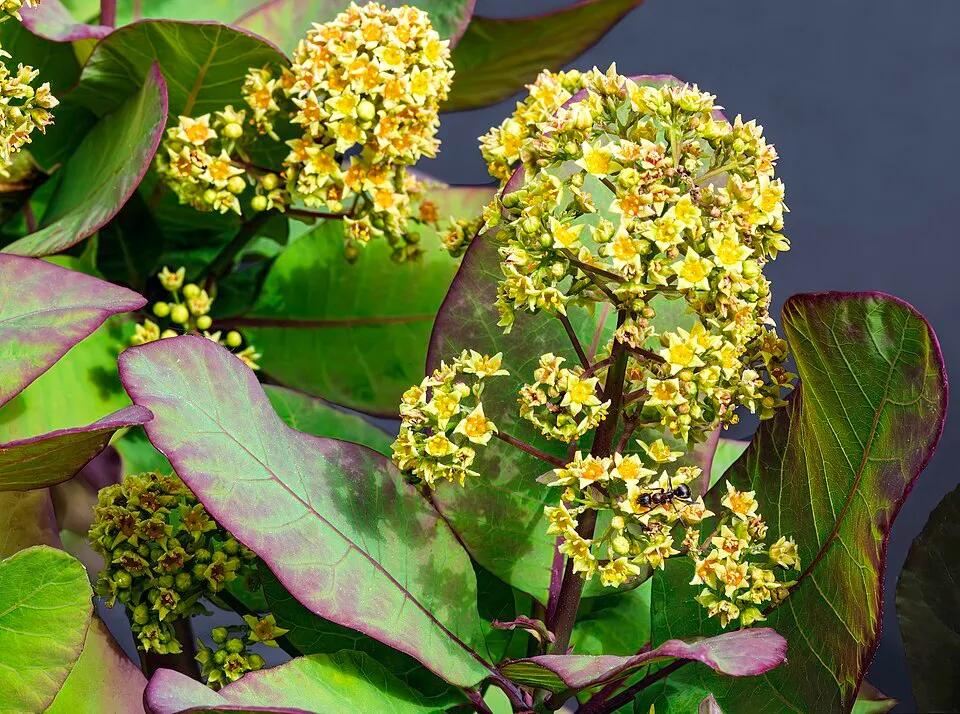
The Smoke Bush, scientifically known as Cotinus coggygria, is a captivating deciduous shrub or small tree belonging to the Anacardiaceae family, which also includes plants like cashews and pistachios. It is widely recognized for its distinctive, airy flower clusters that create a 'smoke-like' illusion, particularly prominent during the summer months. Native to a broad geographical range stretching from southern Europe across central Asia to northern China, Cotinus coggygria typically achieves a height and spread of 3 to 4.5 meters (10-15 feet).
Its oval to obovate leaves, measuring 3-8 cm long, emerge in shades of green or purple, depending on the cultivar, and undergo a stunning transformation in autumn, displaying vibrant hues of orange, fiery red, and deep purple. This spectacular fall foliage makes it a dramatic focal point in any landscape. The unique 'smoke' effect originates from the long, wispy, sterile flower stalks that develop after the tiny, inconspicuous flowers have bloomed, forming large, feathery panicles.
These panicles persist well into the season, enhancing its ornamental appeal. The plant’s adaptability to various soil types and its drought tolerance once established further contribute to its popularity as an ornamental species.
Trusted Scientific References
1. Authoritative external sources for Cotinus coggygria
1.1 Wikipedia — Cotinus coggygria
1.2 Kew POWO (Plants of the World Online)
1.3 PubMed — peer-reviewed research
1.4 NCBI Taxonomy Browser
1.5 GBIF — Global Biodiversity
1.6Smoke Bush should be interpreted through verified botanical identity, practical care, and responsible safety language. This recovery note adds the missing context needed for a complete profile: match light to the plant's habit, use well-drained soil, water according to season, and avoid unsupported medicinal or edible claims. For publishing, the plant can be presented as a source-backed garden plant with clear care guidance, common problem diagnosis, and conservative safety wording.
1.1.Smoke Bush — Notable Characteristics
- ✓Distinctive 'smoke' inflorescences — Distinctive 'smoke' inflorescences in summer.
- ✓Spectacular autumn foliage — Spectacular autumn foliage in shades of red, orange, and purple.
- ✓High concentration of — High concentration of medicinal tannins in leaves and bark.
- ✓Traditional uses as an astringent, antiseptic, and anti — inflammatory agent.
- ✓Robust and adaptable — Robust and adaptable plant, tolerant of drought and poor soils.
- ✓Contains potent antioxidant — Contains potent antioxidant compounds like flavonoids and phenolic acids.
- ✓Essential oils exhibit — Essential oils exhibit significant antimicrobial properties.
- ✓Subject of ongoing — Subject of ongoing pharmacological research into its diverse bioactivities.
- ✓Native to a — Native to a wide range across Eurasia.
- ✓Valued both for — Valued both for its ornamental beauty and its medicinal potential.
1.2.Smoke Bush — At-a-Glance Summary
- ✓Ornamental shrub known for 'smoke-like' flower clusters and vibrant fall foliage.
- ✓Rich in tannins, flavonoids, and essential oils, providing potent bioactivity.
- ✓Traditionally valued for its astringent, antiseptic, and anti-inflammatory properties.
- ✓Modern research highlights its antioxidant, antimicrobial, and potential anticancer effects.
- ✓Primarily used topically; internal use requires strict professional guidance due to high tannin content.
- ✓Adaptable to various growing conditions and drought-tolerant.
2.Smoke Bush — Nomenclature & Classification
3.Smoke Bush — Fact Sheet
4.Smoke Bush — Physical Description
5.Smoke Bush — Ecological Habitat
6.Smoke Bush — Folk Medicine Applications
7.Smoke Bush — Phytochemistry
- ✓Tannins — The most prominent active compounds, comprising hydrolyzable tannins such as gallotannins and ellagitannins, which are responsible for the plant's potent astringent, antiseptic, and antioxidant activities.
- ✓Flavonoids — Key compounds include quercetin, myricetin, and their glycosides, contributing significantly to the plant's anti-inflammatory, antioxidant, and potential anticancer effects.
- ✓Essential Oils — Containing a complex mixture of volatile compounds, notably monoterpenes like alpha-pinene and limonene, which impart antimicrobial (antibacterial, antifungal) and aromatic properties.
- ✓Gallic Acid — A phenolic acid widely recognized for its strong antioxidant, anti-inflammatory, and antimicrobial characteristics, often found in conjunction with tannins.
- ✓Ellagic Acid — Another important phenolic compound, known for its potent antioxidant, anti-inflammatory, and promising anticancer and antigenotoxic activities.
- ✓Phenolic Acids — Beyond gallic and ellagic acids, various other phenolic acids contribute to the overall antioxidant capacity and biological activity of the plant extracts.
- ✓Terpenoids — A diverse group of organic compounds including monoterpenes and sesquiterpenes, found in the essential oil, contributing to its aroma and potential therapeutic effects.
- ✓Resins — Present in smaller quantities, these complex mixtures of organic compounds can have protective and minor therapeutic roles.
8.Smoke Bush — Evidence-Based Benefits
- ✓Astringent Action — The high concentration of tannins in Cotinus coggygria makes it a potent astringent, effectively contracting tissues and reducing fluid secretion, beneficial for various skin and mucosal conditions.
- ✓Antiseptic Properties — Its rich tannin and flavonoid content contributes to significant antiseptic activity, helping to inhibit the growth of bacteria and fungi on wounds and inflamed areas.
- ✓Anti-inflammatory Effects — Flavonoids like quercetin and myricetin, along with gallic acid, provide notable anti-inflammatory benefits, which can soothe irritated skin and mucous membranes.
- ✓Antioxidant Support — The plant is abundant in polyphenolic compounds, including flavonoids and tannins, which act as powerful antioxidants, protecting cells from damage caused by free radicals.
- ✓Antibacterial Activity — Extracts and essential oils from Smoke Bush have demonstrated efficacy against a range of pathogenic bacteria, making it useful in combating various infections.
- ✓Antifungal Efficacy — Studies indicate that components of Cotinus coggygria possess antifungal properties, useful in managing certain fungal skin conditions.
- ✓Antiviral Potential — Preliminary research suggests that some extracts may exhibit antiviral activity, offering a promising avenue for future investigation into its medicinal applications.
- ✓Anticancer Research Interest — Compounds such as ellagic acid and certain flavonoids found in the plant are being investigated for their potential anticancer properties in laboratory settings.
- ✓Antigenotoxic Effects — Its antioxidant capabilities contribute to antigenotoxic potential, helping to protect genetic material from damage induced by environmental toxins.
- ✓Hepatoprotective Indications — Flavonoid-rich extracts have shown promise in protecting liver cells from damage, suggesting a potential role in liver health support.
8.1.Smoke Bush — Therapeutic Indications
9.Smoke Bush — Cautions & Contraindications
9.1.Smoke Bush — Reported Side Effects
- ✓Gastrointestinal Upset — High internal doses, particularly of tannin-rich preparations, can cause stomach upset, nausea, vomiting, or constipation.
- ✓Liver Toxicity — Prolonged or excessive internal use may lead to hepatotoxic effects, especially if liver function is already compromised.
- ✓Skin Irritation — Topical application may cause contact dermatitis or irritation in individuals with sensitive skin or allergies to Anacardiaceae family plants.
- ✓Allergic Reactions — Although rare, individuals may experience allergic reactions, including skin rashes, itching, or more severe systemic responses.
- ✓Tannin-Drug Interactions — Tannins can bind to certain medications, reducing their absorption, particularly iron supplements and some alkaloids.
- ✓Kidney Strain — Very high doses might potentially stress the kidneys, though this is less documented than liver concerns.
9.2.Smoke Bush — Clinical Safety Notes
- ✓Professional Consultation — Always consult a qualified healthcare professional or medical herbalist before using Smoke Bush internally, especially for chronic conditions.
- ✓Pregnancy and Lactation — Avoid use during pregnancy and breastfeeding due to insufficient safety data regarding its effects on fetal development or infant health.
- ✓Pediatric Use — Not recommended for infants or young children for internal use, as their systems are more sensitive to potent compounds.
- ✓Pre-existing Conditions — Individuals with liver disease, kidney impairment, or gastrointestinal disorders should exercise extreme caution or avoid use.
- ✓Drug Interactions — Be aware of potential interactions with medications, especially those for iron deficiency, as tannins can inhibit iron absorption.
- ✓Dosage Adherence — Strictly adhere to recommended dosages and duration of use to minimize the risk of adverse effects.
- ✓Patch Test for Topical Use — Perform a patch test on a small skin area before widespread topical application to check for sensitivity or allergic reactions.
10.Smoke Bush — Usage Guide
- ✓Decoctions for Topical Use — Prepare by simmering leaves and bark in water; traditionally used as a wash or compress for wounds, burns, skin conditions, and ulcers.
- ✓Gargles and Mouthwashes — Diluted decoctions are effective for rinsing the mouth to alleviate gum inflammation, sore throats, and mouth sores due to astringent properties.
- ✓Tinctures for Internal/External Use — Alcoholic extracts of leaves or bark can be prepared and used cautiously internally for digestive issues or diluted for topical applications.
- ✓Poultices — Freshly crushed leaves can be applied directly as a poultice to minor skin irritations or insect bites, providing localized relief.
- ✓Standardized Extracts — Modern preparations may involve standardized extracts, often concentrated for specific active compounds, used in controlled dosages.
- ✓Essential Oil (Diluted) — The essential oil, if available, must be heavily diluted with a carrier oil before topical application and never ingested.
- ✓Infusions (Less Common) — While possible, the potent tannin content makes decoctions more common for extracting medicinal compounds from the woody parts.
11.Smoke Bush — Cultivation & Care
- ✓Sun Exposure — Thrives best in full sun, which promotes robust growth, the most vibrant fall color, and abundant 'smoke' production.
- ✓Soil Requirements — Prefers well-drained soil but is highly adaptable to various soil types, including poor, rocky, or sandy soils, as long as they are not waterlogged.
- ✓Water Needs — Once established, Cotinus coggygria is remarkably drought-tolerant, requiring minimal supplemental irrigation.
- ✓Pruning Timing — Best pruned in late winter or early spring while the plant is dormant to shape it or remove dead/crossing branches.
- ✓Pruning for 'Smoke' — For maximum 'smoke' effect, prune lightly to encourage more flowering stems.
- ✓Propagation — Can be propagated from semi-hardwood cuttings taken in summer or by seed, though seed germination can be erratic.
- ✓Pest and Disease Resistance — Generally a low-maintenance plant with good resistance to most common pests and diseases.
- ✓Fertilization — Typically does not require heavy fertilization; an annual application of balanced slow-release fertilizer in spring is sufficient if growth is poor.
Reviewed by the Flora Medical Global Botanical Review Panel
Multi-disciplinary editorial group · Botany · Ethnobotany · Herbal-medicine literature
Who reviewed this: This page was checked by the Flora Medical Global Botanical Review Panel — an in-house editorial group of botany graduates, ethnobotany researchers, and horticulture practitioners who collectively maintain our 7,000+ plant encyclopedia. Meet the team.
Our 4-step verification process
1. Taxonomic verification
Scientific names and synonyms cross-checked against Kew POWO, World Flora Online, and The Plant List.
2. Phytochemical & medicinal cross-reference
Active compounds, traditional uses, and reported activities are cross-referenced with PubMed, USDA Dr. Duke's database, and peer-reviewed ethnobotanical literature.
3. Conservation & distribution check
Distribution, ecology, and conservation status confirmed against GBIF occurrence records and the IUCN Red List.
4. Editorial & safety review
Every entry passes an editorial pass for clarity, originality, and safety notices (toxicity, contraindications, dosage caveats) before publication.
Last reviewed:
Important medical disclaimer: This content is for educational and research purposes only. It is not medical advice and is not a substitute for consultation with a licensed healthcare provider. Do not use any herb to self-treat a medical condition without professional guidance.
Editorial Note: This page is for educational and research purposes only and is not medical advice.
Written by: Flora Medical Global Editorial Team
Reviewed by: Flora Medical Global Botanical Review Panel
Last Updated: June 15, 2026





Smoke Bush — Comments & Community Reviews
Rate this plant