
Medical Disclaimer: This content is for educational purposes only. It is not medical advice. Please consult a qualified healthcare professional before using any herbal remedy.
Safety Overview
1.Solanum Rantonnetii — At a Glance
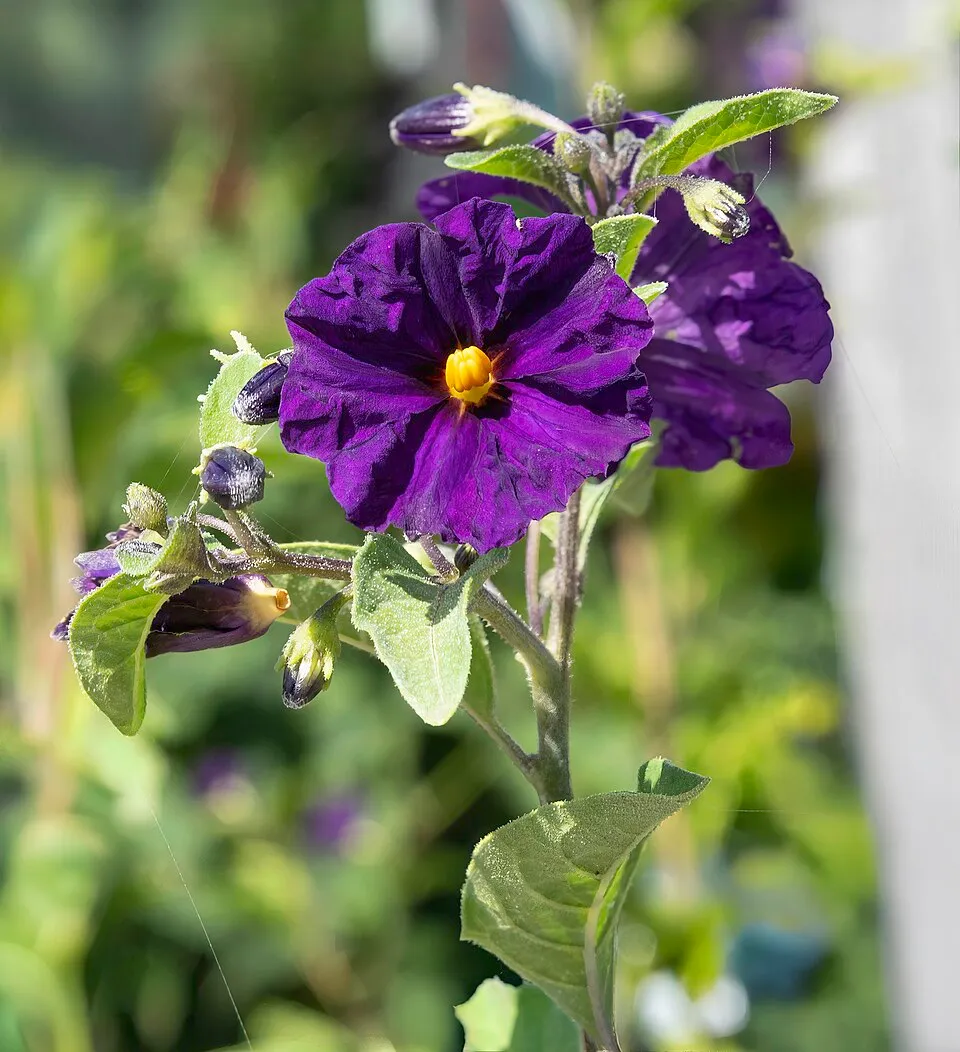
Lycianthes rantonnetii, commonly known as Blue Potato Bush or Paraguay Nightshade, is an enchanting, fast-growing evergreen shrub or small tree native to South America, particularly Paraguay and Brazil. Belonging to the vast Solanaceae family, it is primarily admired for its ornamental appeal, gracing gardens and landscapes with its prolific bloom. The plant typically reaches a height and spread of 6 to 10 feet, exhibiting a versatile growth habit that can be sprawling, upright, or even trained as a standard or espalier.
Its striking features include abundant, showy, violet-blue flowers, each adorned with a prominent yellow center, bearing a charming resemblance to miniature potato blossoms. These vibrant flowers appear profusely from spring through fall, and in warmer, frost-free climates, they can bloom almost continuously throughout the year, adding a splash of enduring color. The foliage consists of ovate to lanceolate, bright green leaves that are typically slightly hairy to the touch.
While historically recognized for its aesthetic value, recent scientific investigations are beginning to unveil a more complex biochemical profile for this species, revealing a notable presence of antioxidant compounds, essential vitamins, and various minerals, which prompts a re-evaluation of its potential beyond pure ornamentation.
Trusted Scientific References
1. Authoritative external sources for Lycianthes rantonnetii
1.1 Wikipedia — Lycianthes rantonnetii
1.2 Kew POWO (Plants of the World Online)
1.3 PubMed — peer-reviewed research
1.4 NCBI Taxonomy Browser
1.5 GBIF — Global Biodiversity
1.6Solanum Rantonnetii should be interpreted through verified botanical identity, practical care, and responsible safety language. This recovery note adds the missing context needed for a complete profile: match light to the plant's habit, use well-drained soil, water according to season, and avoid unsupported medicinal or edible claims. For publishing, the plant can be presented as a source-backed garden plant with clear care guidance, common problem diagnosis, and conservative safety wording.
1.1.Solanum Rantonnetii — Highlights
- ✓Botanical Name — Lycianthes rantonnetii
- ✓Common Names — Blue Potato Bush, Paraguay Nightshade
- ✓Family — Solanaceae (Nightshade family)
- ✓Ornamental Value — Highly prized for its showy, prolific blue-violet flowers.
- ✓Growth Habit — Fast-growing evergreen shrub or small tree, 6-10 feet tall/wide.
- ✓Flowering Season — Profuse blooming from spring to fall, often year-round in warm climates.
- ✓Toxic Nature — Contains potentially toxic solanaceous alkaloids; not for consumption.
- ✓Antioxidant Richness — Recent studies reveal high levels of vitamins A, E, C, phenols, and flavonoids.
- ✓Mineral Content — A source of essential minerals like copper, zinc, magnesium, and phosphorus.
- ✓Habitat — Native to South America, particularly Paraguay and Brazil.
1.2.Solanum Rantonnetii — Snapshot Summary
- ✓Blue Potato Bush (Lycianthes rantonnetii) is an ornamental shrub.
- ✓Features vibrant violet-blue flowers with yellow centers.
- ✓Contains solanaceous alkaloids, making it toxic for ingestion.
- ✓Recent research highlights high levels of antioxidant vitamins (A, E, C) and essential minerals.
- ✓Also rich in phenolic compounds and flavonoids, contributing to antioxidant activity.
- ✓Strictly an ornamental plant; not safe for human or animal consumption.
2.Solanum Rantonnetii — Scientific Identity
3.Solanum Rantonnetii — Vital Statistics
4.Solanum Rantonnetii — Botanical Description
5.Solanum Rantonnetii — Ecological Habitat
6.Solanum Rantonnetii — Heritage Uses
Lycianthes rantonnetii is primarily valued for its ornamental appeal in gardens worldwide. It does not have significant traditional cultural or historical uses documented beyond its aesthetic contribution to horticulture and landscaping.
7.Solanum Rantonnetii — Key Phytochemicals
- ✓Antioxidant Vitamins — Contains significant levels of retinol (Vitamin A), α-tocopherol (Vitamin E), and ascorbic acid (Vitamin C), crucial for cellular protection against oxidative stress and immune support.
- ✓Phenolic Compounds — Identified as possessing reasonable amounts of total phenols, which are secondary metabolites known for their potent antioxidant and anti-inflammatory effects.
- ✓Flavonoids — The plant contains measurable quantities of flavonoids, a diverse group of polyphenolic compounds contributing to its free radical scavenging capabilities and other potential health benefits.
- ✓Essential Trace Elements — Rich in elements such as Copper (Cu), Zinc (Zn), Manganese (Mn), Chromium (Cr), Molybdenum (Mo), Cobalt (Co), Vanadium (V), Lithium (Li), Titanium (Ti), and Strontium (Sr), vital for various biological functions.
- ✓Macro-minerals — Contains Magnesium (Mg) and Phosphorus (P), which are essential for bone health, energy metabolism, nerve function, and numerous enzymatic processes.
- ✓Heavy Metals/Toxic Elements — Analysis also detected trace amounts of potentially toxic elements like Cadmium (Cd), Arsenic (As), Lead (Pb), and Thallium (Tl), emphasizing the importance of safety precautions.
- ✓Solanaceous Alkaloids — As a member of the Solanaceae family, it is presumed to contain solanine-like glycoalkaloids, which are known for their potential toxicity and defense mechanisms in plants.
- ✓Organic Acids — While not specifically quantified in the provided research, many plants, especially those rich in Vitamin C, contain various organic acids that contribute to their flavor profile and antioxidant activity.
- ✓Chlorophylls and Carotenoids — As a green plant, it contains chlorophylls for photosynthesis and carotenoids, which are often precursors to Vitamin A and act as antioxidants.
8.Solanum Rantonnetii — Pharmacological Findings
- ✓Antioxidant Activity — Methanolic extracts of Lycianthes rantonnetii have demonstrated significant antioxidant and antiradical capabilities, effectively scavenging various free radicals like DPPH, ABTS, hydrogen peroxide, and hydroxyl radicals, suggesting a role in mitigating oxidative stress.
- ✓Vitamin C Content — The plant contains a substantial amount of ascorbic acid (Vitamin C), a potent antioxidant vital for immune function, collagen synthesis, and protecting cells from oxidative damage.
- ✓Vitamin E Content — Alpha-tocopherol (Vitamin E), another powerful lipid-soluble antioxidant, is present at high levels, contributing to cellular protection against oxidative stress and supporting skin health.
- ✓Vitamin A Precursors — Retinol, a form of Vitamin A, is found in Lycianthes rantonnetii, indicating potential benefits for vision, immune system integrity, and cellular growth and differentiation.
- ✓Essential Mineral Source — The plant is a source of several essential minerals, including copper, zinc, cobalt, and magnesium, which are crucial cofactors for numerous enzymatic reactions and physiological processes in the body.
- ✓Phosphorus Content — Lycianthes rantonnetii contains phosphorus, a vital mineral component of bones, teeth, and cellular energy (ATP), essential for overall metabolic function.
- ✓Phenolic Compound Presence — A reasonable amount of total phenolic compounds has been identified, which are known for their strong antioxidant, anti-inflammatory, and potentially chemoprotective properties.
- ✓Flavonoid Content — Significant levels of flavonoids are present, contributing to the plant's antioxidant capacity and offering potential benefits such as anti-inflammatory and cardiovascular support.
- ✓Anti-hemolytic Activity — Studies indicate that extracts of Lycianthes rantonnetii possess anti-hemolytic activity, suggesting a protective effect against red blood cell damage, likely due to its robust antioxidant profile.
- ✓Free Radical Scavenging — Beyond specific radicals, the overall extract exhibits high scavenging activity for various free radicals, indicating broad-spectrum antioxidant potential that could help combat cellular aging and disease.
8.1.Solanum Rantonnetii — Conditions Traditionally Used For
9.Solanum Rantonnetii — Cautions & Contraindications
9.1.Solanum Rantonnetii — Warnings
- ✓Toxicity — Contains solanaceous alkaloids, similar to those found in other nightshades, which can be toxic if ingested.
- ✓Gastrointestinal Upset — Ingestion of any part of the plant may cause symptoms such as nausea, vomiting, abdominal pain, and diarrhea.
- ✓Neurological Symptoms — Higher doses of toxic alkaloids could potentially lead to more severe neurological effects, including dizziness, confusion, or even paralysis.
- ✓Skin Irritation — Direct contact with sap or plant parts might cause mild skin irritation or allergic reactions in sensitive individuals.
- ✓Livestock Poisoning — There is a risk of poisoning for grazing animals if they consume significant quantities of the foliage or berries.
- ✓No Human Consumption — It is critical to reiterate that Lycianthes rantonnetii is not safe for human consumption in any form due to its inherent toxicity.
9.2.Solanum Rantonnetii — Risk Assessment
- ✓Not for Internal Use — Lycianthes rantonnetii is considered toxic and should never be ingested by humans or animals.
- ✓Keep Away from Children and Pets — Ensure the plant is placed out of reach of curious children and pets to prevent accidental ingestion.
- ✓Handle with Caution — Wear gloves when handling or pruning to avoid potential skin irritation from sap, especially for those with sensitivities.
- ✓Educate on Toxicity — Inform others, particularly those with small children or pets, about the plant's toxic nature if grown in shared spaces.
- ✓No Traditional Medicinal Use — There is no historical or traditional record of safe medicinal use for this species, reinforcing the need for caution.
- ✓Consult Poison Control — In case of accidental ingestion, seek immediate medical attention or contact a poison control center.
- ✓Ornamental Only — Reiterate its designation solely as an ornamental plant, despite emerging research on its biochemical constituents.
10.Solanum Rantonnetii — Preparation Methods
- ✓Ornamental Cultivation — Primarily grown as a highly decorative garden plant, prized for its vibrant, continuous blue-violet blooms in hedges, borders, or containers.
- ✓Landscape Feature — Utilized in landscape design as a specimen shrub, part of a mixed border, or trained as an espalier or standard for architectural interest.
- ✓Food Additive Potential (Research) — Based on its significant antioxidant, vitamin, and mineral content, research suggests it could potentially be explored as an additive in certain food products, though this is strictly a theoretical, research-level consideration.
- ✓Antioxidant Extract Source (Research) — The plant's rich profile of phenolic compounds, flavonoids, and vitamins makes it a subject for research into natural antioxidant extracts for industrial applications, not for direct human consumption.
- ✓Bioactive Compound Research — Extracts are used in laboratory settings to isolate and study specific bioactive compounds for their pharmacological properties, with no recommendation for human self-administration.
- ✓Horticultural Training — Due to its flexible branches, it can be artfully trained as a small tree (standard) or against a wall (espalier) to enhance its aesthetic appeal.
- ✓Green Manure/Compost (External) — Plant material, after careful handling, could potentially be composted to enrich soil, ensuring no direct human or animal consumption of the plant parts.
11.Solanum Rantonnetii — How to Grow
- ✓Sunlight — Prefers full sun to partial shade for optimal growth and flowering; at least 6 hours of direct sunlight is ideal.
- ✓Soil Requirements — Thrives in well-drained, fertile soil, tolerating a range of soil types but performing best in moist, organically rich substrates.
- ✓Watering — Requires regular watering, especially during dry periods and active growth, to keep the soil consistently moist but not waterlogged.
- ✓Pruning — Regular pruning is essential to maintain shape, encourage bushier growth, and promote a continuous abundance of flowers.
- ✓Fertilization — Benefits from fertilization during the growing season (spring and summer) with a balanced, slow-release granular fertilizer or liquid feed.
- ✓Winter Protection — In colder climates (below USDA Zone 9), Lycianthes rantonnetii should be overwintered indoors or treated as an annual, as it is sensitive to frost.
- ✓Propagation — Can be propagated by semi-hardwood cuttings taken in summer or by seeds, though germination can be variable.
- ✓Pest and Disease Management — Generally robust, but monitor for common garden pests like aphids or whiteflies, and ensure good air circulation to prevent fungal issues.
Reviewed by the Flora Medical Global Botanical Review Panel
Multi-disciplinary editorial group · Botany · Ethnobotany · Herbal-medicine literature
Who reviewed this: This page was checked by the Flora Medical Global Botanical Review Panel — an in-house editorial group of botany graduates, ethnobotany researchers, and horticulture practitioners who collectively maintain our 7,000+ plant encyclopedia. Meet the team.
Our 4-step verification process
1. Taxonomic verification
Scientific names and synonyms cross-checked against Kew POWO, World Flora Online, and The Plant List.
2. Phytochemical & medicinal cross-reference
Active compounds, traditional uses, and reported activities are cross-referenced with PubMed, USDA Dr. Duke's database, and peer-reviewed ethnobotanical literature.
3. Conservation & distribution check
Distribution, ecology, and conservation status confirmed against GBIF occurrence records and the IUCN Red List.
4. Editorial & safety review
Every entry passes an editorial pass for clarity, originality, and safety notices (toxicity, contraindications, dosage caveats) before publication.
Last reviewed:
Important medical disclaimer: This content is for educational and research purposes only. It is not medical advice and is not a substitute for consultation with a licensed healthcare provider. Do not use any herb to self-treat a medical condition without professional guidance.
Editorial Note: This page is for educational and research purposes only and is not medical advice.
Written by: Flora Medical Global Editorial Team
Reviewed by: Flora Medical Global Botanical Review Panel
Last Updated: June 15, 2026





Solanum Rantonnetii — Comments & Community Reviews
Rate this plant