

Medical Disclaimer: This content is for educational purposes only. It is not medical advice. Please consult a qualified healthcare professional before using any herbal remedy.
Safety Overview
1.Tacca Chantrieri — At a Glance
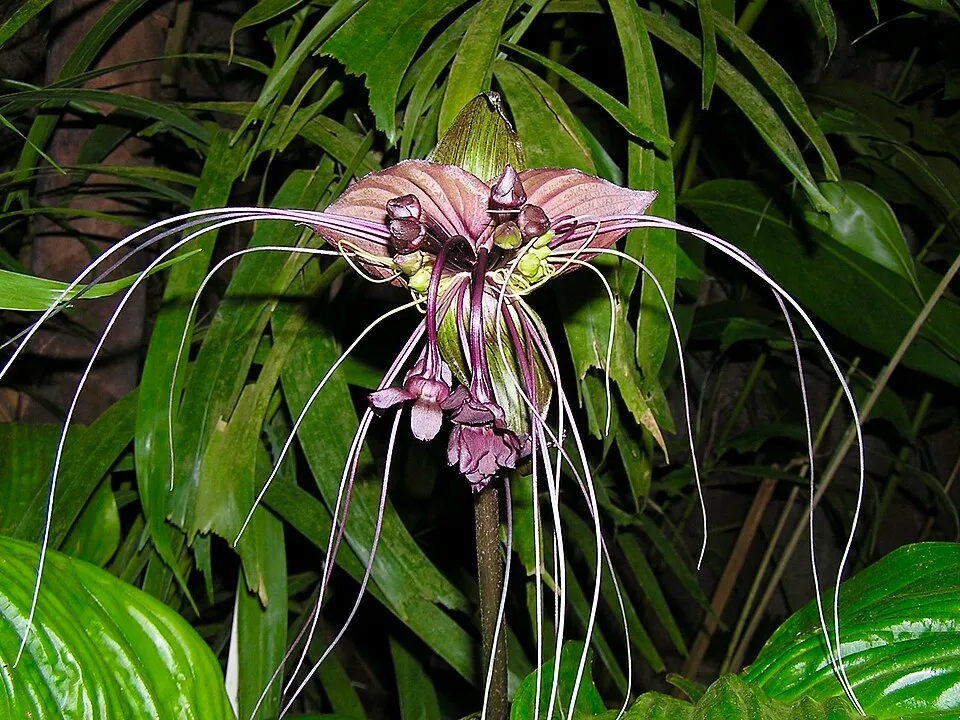
Tacca chantrieri, famously known as the Black Bat Flower or Devil's Flower, is an extraordinary perennial herb belonging to the Dioscoreaceae family, which also encompasses true yams. This captivating plant is indigenous to the humid tropical and subtropical rainforest understories of Southeast Asia, specifically found across Malaysia, Thailand, and southern China. Its distinctive morphology includes a striking inflorescence that mimics a bat in flight, characterized by dark purple to black bracts, long filamentous 'whiskers' (bracteoles), and a central cluster of smaller, darker flowers.
Unlike its edible relatives, Tacca chantrieri is primarily cultivated for its ornamental appeal, as its rhizomes are fibrous and possess a bitter taste. The plant thrives in environments offering deep shade, consistently moist yet well-drained soil, and high humidity, conditions typical of its native rainforest habitat. These specific ecological requirements have shaped its botanical characteristics, leading to its preference for filtered light and a stable, humid microclimate.
Historically, indigenous communities have been fascinated by its unique and somewhat eerie beauty, sometimes attributing mystical or superstitious properties to it. While not widely documented in classic medicinal texts, traditional practices in its native regions have utilized its rhizomes as a strong purgative or emetic, primarily to expel intestinal parasites. Modern scientific inquiry into Tacca chantrieri has intensified, revealing a rich phytochemical profile including steroidal saponins, flavonoids, and triterpenoids, which are now being investigated for potential pharmacological activities such as anti-inflammatory and cytotoxic effects.
Trusted Scientific References
1. Authoritative external sources for Tacca chantrieri
1.1 Wikipedia — Tacca chantrieri
1.2 Kew POWO (Plants of the World Online)
1.3 PubMed — peer-reviewed research
1.4 NCBI Taxonomy Browser
1.5 GBIF — Global Biodiversity
1.6Tacca Chantrieri should be interpreted through verified botanical identity, practical care, and responsible safety language. This recovery note adds the missing context needed for a complete profile: match light to the plant's habit, use well-drained soil, water according to season, and avoid unsupported medicinal or edible claims. For publishing, the plant can be presented as a source-backed indoor plant with clear care guidance, common problem diagnosis, and conservative safety wording.
1.1.Tacca Chantrieri — Notable Characteristics
- ✓Striking Appearance — Unique, dark, bat-like inflorescence with long 'whiskers'.
- ✓Tropical Origin — Native to humid rainforests of Southeast Asia.
- ✓Dioscoreaceae Family — Related to true yams, but primarily ornamental.
- ✓Medicinal Rhizomes — Traditionally used for purgative and anti-parasitic actions.
- ✓Rich Phytochemistry — Contains steroidal saponins, flavonoids, and triterpenoids.
- ✓Antioxidant Activity — Exhibits significant free radical scavenging properties.
- ✓Anticancer Potential — Demonstrated cytotoxic effects against various cancer cells.
- ✓Chemo — sensitizing Effects — May enhance effectiveness of chemotherapy drugs.
- ✓Shade — Loving Plant — Prefers deep shade and high humidity.
- ✓Ornamental Value — Highly prized as an exotic houseplant or garden specimen.
1.2.Tacca Chantrieri — Snapshot Summary
- ✓Black Bat Flower (Tacca chantrieri) is an ornamental plant from Southeast Asia.
- ✓Known for its unique, bat-like dark inflorescence.
- ✓Traditional uses include purgative and anti-parasitic properties from rhizomes.
- ✓Modern research highlights antioxidant, anti-inflammatory, and cytotoxic effects, particularly against cancer cells.
- ✓Contains steroidal saponins, flavonoids, and triterpenoids.
- ✓Requires careful handling due to potent effects and potential toxicity, not for self-medication.
2.Tacca Chantrieri — Scientific Identity
3.Tacca Chantrieri — Vital Statistics
4.Tacca Chantrieri — Physical Description
5.Tacca Chantrieri — Native Range & Habitat
6.Tacca Chantrieri — Heritage Uses
7.Tacca Chantrieri — Phytochemistry
- ✓Steroidal Saponins — These are a major class of compounds found in Tacca chantrieri, known for their potential cytotoxic, anti-inflammatory, and cholesterol-lowering activities.
- ✓Flavonoids — Present in significant amounts, flavonoids contribute to the plant's antioxidant capacity and may offer anti-inflammatory and cardioprotective benefits.
- ✓Triterpenoids — These compounds are widely distributed in plants and are recognized for their diverse pharmacological properties, including anti-cancer and anti-inflammatory effects.
- ✓Phenolic Compounds — Tacca chantrieri is rich in various phenolic acids, which are potent antioxidants and play a role in protecting cells from oxidative damage.
- ✓Polysaccharides — Complex carbohydrates that can have immunomodulatory effects, though specific studies on Tacca chantrieri are limited.
- ✓Alkaloids — While not as prominent as saponins, some alkaloidal compounds might be present, contributing to its biological activities.
- ✓Glycosides — These are compounds where a sugar molecule is bonded to a non-sugar component, often influencing a compound's bioavailability and activity.
- ✓Fatty Acids — Essential for cell structure and function, some fatty acids in the rhizome may contribute to its overall medicinal profile.
- ✓Tannins — Astringent compounds that can have antioxidant and antimicrobial properties, found in various plant parts.
- ✓Anthraquinones — These compounds are known for their laxative effects and might contribute to the purgative properties of the plant.
8.Tacca Chantrieri — Evidence-Based Benefits
- ✓Antioxidant Properties — Extracts from Tacca chantrieri exhibit significant antioxidant activity, attributed to high phenolic and flavonoid content, which helps neutralize harmful free radicals and reduce oxidative stress in the body.
- ✓Anti-inflammatory Effects — Specific compounds within the plant, particularly certain steroidal saponins, have demonstrated anti-inflammatory potential, which could be beneficial in managing inflammatory conditions.
- ✓Cytotoxic Activity Against Cancer Cells — Research indicates that Tacca chantrieri extracts, especially from its rhizomes, show cytotoxic effects against various cancer cell lines, including cholangiocarcinoma cells, by inducing apoptosis and inhibiting cell proliferation.
- ✓Enhanced Chemotherapy Sensitivity — Studies suggest that extracts of Tacca chantrieri can enhance the sensitivity of cancer cells to conventional chemotherapeutic agents like cisplatin, potentially improving treatment efficacy.
- ✓Anti-parasitic Action — Traditionally, the rhizomes were used as an emetic and purgative to expel intestinal parasites, indicating potential anthelmintic properties.
- ✓Purgative Effects — The plant's rootstock has been historically employed as a strong laxative or purgative, assisting in bowel evacuation.
- ✓Antimicrobial Potential — Preliminary investigations suggest that some phytochemicals in Tacca chantrieri may possess antimicrobial properties, contributing to its traditional use in various ailments.
- ✓Immunomodulatory Effects — Certain bioactive compounds might modulate the immune system, although more research is needed to fully understand this mechanism.
- ✓Pain Relief (Traditional) — Anecdotal evidence from traditional medicine suggests its use for alleviating certain types of pain, possibly due to its anti-inflammatory components.
- ✓Liver Protective Effects — Some compounds, particularly antioxidants, may contribute to liver health by reducing oxidative damage, although direct hepatoprotective studies are limited.
8.1.Tacca Chantrieri — Conditions Traditionally Used For
9.Tacca Chantrieri — Cautions & Contraindications
9.1.Tacca Chantrieri — Warnings
- ✓Severe Gastrointestinal Distress — High doses can cause intense nausea, vomiting, and diarrhea due to its purgative and emetic properties.
- ✓Dehydration and Electrolyte Imbalance — Excessive purgation can lead to significant fluid and electrolyte loss.
- ✓Abdominal Cramping — Strong stimulant laxative effects can result in severe stomach cramps.
- ✓Allergic Reactions — Sensitive individuals may experience skin irritation or other allergic responses upon contact or ingestion.
- ✓Potential Liver Toxicity — Long-term or high-dose use of certain plant compounds can theoretically impact liver function, requiring caution.
- ✓Drug Interactions — May interact with medications, especially those affecting gastrointestinal motility, blood clotting, or liver metabolism.
- ✓Uterine Contractions — Potential for inducing uterine contractions, making it unsafe during pregnancy.
9.2.Tacca Chantrieri — Risk Assessment
- ✓Not for Internal Use Without Expert Guidance — Due to potent purgative/emetic effects and potential toxicity, self-medication is strongly discouraged.
- ✓Pregnancy and Lactation Contraindicated — Risk of uterine contractions and unknown effects on infants.
- ✓Children and Elderly — Should not be administered to children or the elderly due to sensitivity and risk of severe side effects.
- ✓Gastrointestinal Conditions — Avoid in individuals with inflammatory bowel disease, appendicitis, or intestinal obstruction.
- ✓Dehydration Risk — Individuals prone to dehydration or with electrolyte imbalances should avoid use.
- ✓Consult Healthcare Professional — Always seek advice from a qualified medical herbalist or doctor before considering any use.
- ✓High Dosage Toxicity — Overconsumption can lead to severe adverse reactions, indicating a narrow therapeutic window.
10.Tacca Chantrieri — Usage Guide
- ✓Traditional Decoction — Rhizome pieces are boiled in water to create a strong decoction, traditionally used as a purgative or emetic.
- ✓Topical Poultice — Crushed rhizomes or leaves may be applied externally as a poultice for certain skin conditions or localized pain (traditional use, limited modern data).
- ✓Alcoholic Tincture — Rhizomes steeped in alcohol to extract compounds, used in small, diluted doses (experimental/traditional).
- ✓Powdered Extract — Dried rhizome is ground into a fine powder for encapsulation or mixing into beverages (modern experimental).
- ✓Herbal Infusion — Dried leaves or flowers can be steeped in hot water, though medicinal properties here are less studied compared to rhizomes.
- ✓Standardized Extracts — Modern formulations might involve standardized extracts of specific bioactive compounds for precise dosing in research settings.
- ✓Culinary (Caution) — While related to yams, the rhizomes are bitter and fibrous, not recommended for consumption due to potential toxicity and taste.
11.Tacca Chantrieri — Cultivation & Care
- ✓Soil Preference — Requires well-drained, humus-rich, slightly acidic to neutral soil (pH 6.0-7.0).
- ✓Light Conditions — Thrives in deep to partial shade; direct sunlight can scorch its leaves.
- ✓Watering — Needs consistent moisture; keep soil evenly damp but not waterlogged. High humidity is crucial.
- ✓Temperature — Prefers warm temperatures, ideally between 20-30°C (68-86°F); sensitive to cold.
- ✓Humidity — Requires high humidity (70-90%); misting or a humidity tray is beneficial.
- ✓Fertilization — Feed monthly during growing season with a balanced liquid fertilizer diluted to half strength.
- ✓Propagation — Primarily propagated by rhizome division or seeds, though seeds can be slow to germinate.
- ✓Pests and Diseases — Generally resistant, but watch for spider mites in dry conditions and root rot from overwatering.
Reviewed by the Flora Medical Global Botanical Review Panel
Multi-disciplinary editorial group · Botany · Ethnobotany · Herbal-medicine literature
Who reviewed this: This page was checked by the Flora Medical Global Botanical Review Panel — an in-house editorial group of botany graduates, ethnobotany researchers, and horticulture practitioners who collectively maintain our 7,000+ plant encyclopedia. Meet the team.
Our 4-step verification process
1. Taxonomic verification
Scientific names and synonyms cross-checked against Kew POWO, World Flora Online, and The Plant List.
2. Phytochemical & medicinal cross-reference
Active compounds, traditional uses, and reported activities are cross-referenced with PubMed, USDA Dr. Duke's database, and peer-reviewed ethnobotanical literature.
3. Conservation & distribution check
Distribution, ecology, and conservation status confirmed against GBIF occurrence records and the IUCN Red List.
4. Editorial & safety review
Every entry passes an editorial pass for clarity, originality, and safety notices (toxicity, contraindications, dosage caveats) before publication.
Last reviewed:
Important medical disclaimer: This content is for educational and research purposes only. It is not medical advice and is not a substitute for consultation with a licensed healthcare provider. Do not use any herb to self-treat a medical condition without professional guidance.
Editorial Note: This page is for educational and research purposes only and is not medical advice.
Written by: Flora Medical Global Editorial Team
Reviewed by: Flora Medical Global Botanical Review Panel
Last Updated: June 15, 2026





Tacca Chantrieri — Comments & Community Reviews
Rate this plant