

Medical Disclaimer: This content is for educational purposes only. It is not medical advice. Please consult a qualified healthcare professional before using any herbal remedy.
Safety Overview
1.Tillandsia Bulbosa — At a Glance
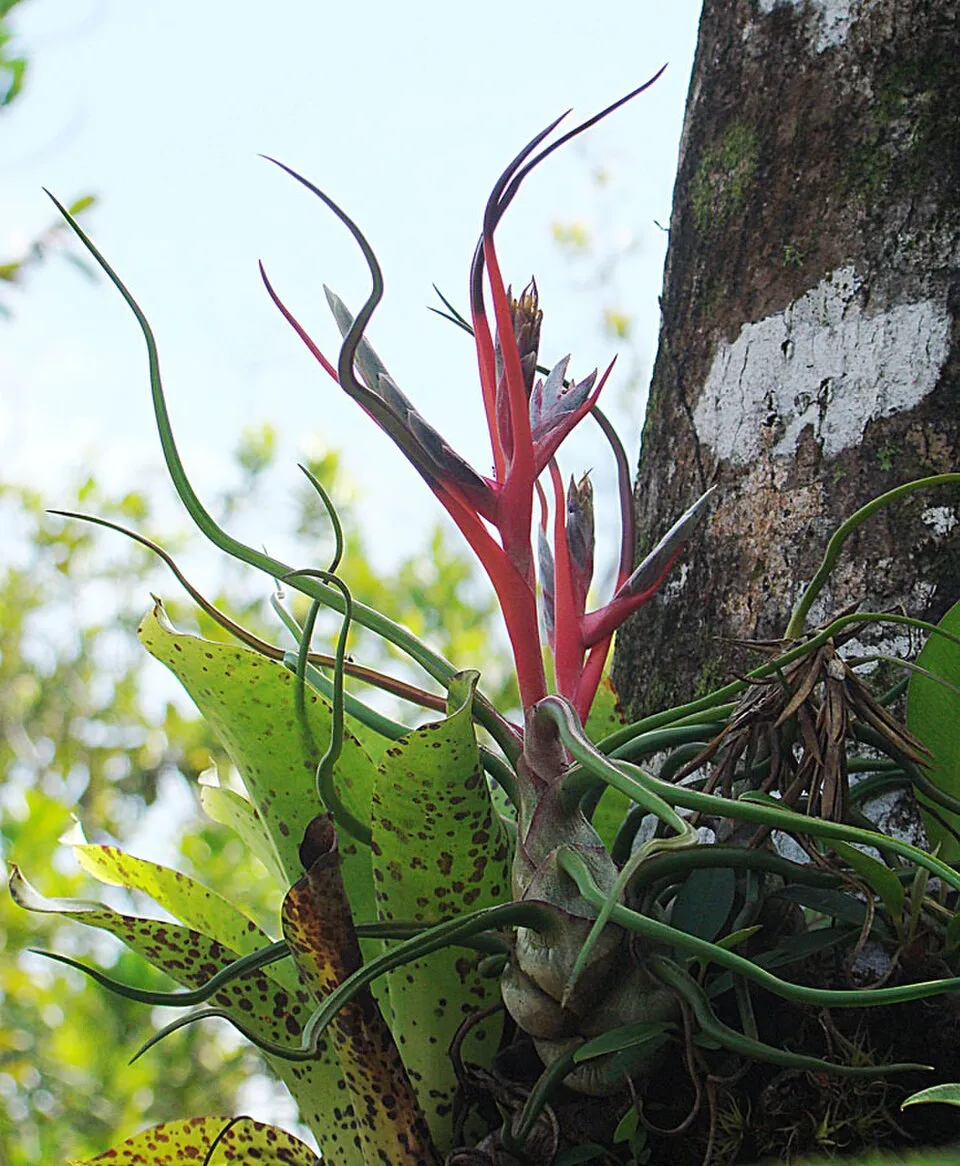
Tillandsia bulbosa, commonly known as the bulbous air plant, is a distinctive perennial epiphyte belonging to the Bromeliaceae family. Native to the humid tropical and subtropical regions spanning Mexico and Central America, it thrives in environments with abundant moisture and filtered light. This remarkable plant is characterized by its unique pseudobulbous base, which serves as a natural reservoir for water and nutrients, enabling its survival in arid periods.
From this bulbous structure emerge elongated, often contorted, and delicate leaves, typically arranged in a spiral fashion, reaching lengths of 20 to 30 centimeters. The leaves are densely covered with specialized trichomes—minute, silvery, hair-like scales—that are crucial for efficiently absorbing atmospheric moisture and dissolved nutrients directly from the air. As an epiphyte, Tillandsia bulbosa anchors itself to host trees or rocky outcrops without drawing sustenance from them, embodying a non-parasitic relationship.
During its reproductive phase, it produces a vibrant inflorescence with striking pink or purple flowers that arise from a thick, often colorful, stalk, attracting a variety of pollinators such as hummingbirds and insects. Its ability to flourish without soil, relying solely on atmospheric resources, makes it a fascinating botanical specimen and a popular choice for indoor cultivation in terrariums or mounted displays.
Trusted Scientific References
1. Authoritative external sources for Tillandsia bulbosa
1.1 Wikipedia — Tillandsia bulbosa
1.2 Kew POWO (Plants of the World Online)
1.3 PubMed — peer-reviewed research
1.4 NCBI Taxonomy Browser
1.5 GBIF — Global Biodiversity
1.6Tillandsia Bulbosa should be interpreted through verified botanical identity, practical care, and responsible safety language. This recovery note adds the missing context needed for a complete profile: match light to the plant's habit, use well-drained soil, water according to season, and avoid unsupported medicinal or edible claims. For publishing, the plant can be presented as a source-backed indoor plant with clear care guidance, common problem diagnosis, and conservative safety wording.
1.1.Tillandsia Bulbosa — Highlights
- ✓Epiphytic Growth Habit — Thrives without soil, attaching to hosts.
- ✓Bulbous Pseudobulb — Unique water and nutrient storage structure.
- ✓Trichome — Covered Leaves — Specialized scales for atmospheric absorption.
- ✓Vibrant Inflorescence — Produces striking pink/purple flowers.
- ✓Low Maintenance (for an epiphyte) — Adaptable to indoor conditions.
- ✓Air Purifying Qualities — Contributes to indoor air quality.
- ✓Non — Parasitic — Coexists with host plants without harm.
- ✓Drought Tolerant — Due to water storage in its bulbous base.
- ✓Ornamental Value — Highly prized for its aesthetic appeal.
- ✓Humidity Dependent — Requires consistent moisture in its environment.
1.2.Tillandsia Bulbosa — Snapshot Summary
- ✓Epiphytic bromeliad from Central America, no soil needed.
- ✓Bulbous base stores water; leaves absorb moisture via trichomes.
- ✓Primarily ornamental, contributes to air quality and mood.
- ✓Contains flavonoids and phenolic acids, potential for future research.
- ✓Requires bright, indirect light, good air circulation, and regular misting.
- ✓Generally safe, but avoid ingestion and check for skin sensitivity.
2.Tillandsia Bulbosa — Scientific Identity
3.Tillandsia Bulbosa — Fact Sheet
4.Tillandsia Bulbosa — Botanical Features
5.Tillandsia Bulbosa — Origin & Spread
6.Tillandsia Bulbosa — Traditional Uses
7.Tillandsia Bulbosa — Key Phytochemicals
- ✓Flavonoids — Quercetin, kaempferol, and their glycosides are common, acting as antioxidants and anti-inflammatory agents.
- ✓Phenolic Acids — Caffeic acid, ferulic acid, and chlorogenic acid contribute to antioxidant and antimicrobial activities.
- ✓Cycloartane Triterpenes — Unique to the Bromeliaceae family, these compounds may possess anti-inflammatory and cytotoxic properties.
- ✓Tannins — Astringent compounds that can exhibit antioxidant and antimicrobial effects, contributing to plant defense.
- ✓Saponins — Glycosides with detergent-like properties, potentially involved in immune modulation and anti-inflammatory responses.
- ✓Steroids — Plant sterols such as beta-sitosterol, which can have anti-inflammatory and cholesterol-lowering effects.
- ✓Carotenoids — Pigments like beta-carotene, acting as potent antioxidants and precursors to Vitamin A.
- ✓Polysaccharides — Complex carbohydrates that can possess immunomodulatory and prebiotic properties.
- ✓Volatile Organic Compounds (VOCs) — Terpenes and other aromatic compounds contributing to plant scent and possibly acting as defensive agents.
- ✓Minerals — Accumulates essential minerals from the air such as magnesium, calcium, and potassium, vital for plant and potentially human health.
8.Tillandsia Bulbosa — Scientific Evidence
- ✓Air Purification — As an epiphyte, Tillandsia bulbosa contributes to air quality by absorbing certain airborne particles and volatile organic compounds, acting as a natural biofilter.
- ✓Stress Reduction — The presence of living plants, including air plants, in indoor environments has been linked to reduced psychological stress and improved mood in human subjects.
- ✓Humidity Regulation — Through transpiration, Tillandsia bulbosa can subtly contribute to localized humidity levels, which may be beneficial in dry indoor climates.
- ✓Bioindicator Potential — Like other Tillandsia species, it may serve as a bioindicator for environmental pollutants, absorbing heavy metals and other atmospheric contaminants.
- ✓Antimicrobial Properties (Potential) — While not directly studied for T. bulbosa, other Tillandsia species contain compounds with reported antimicrobial activities, suggesting similar potential.
- ✓Anti-inflammatory Effects (Speculative) — Flavonoids and phenolic acids found in the genus Tillandsia often exhibit anti-inflammatory properties, providing a theoretical basis for further research.
- ✓Antioxidant Activity (Hypothetical) — The presence of various phenolic compounds in the Tillandsia genus implies potential antioxidant capacity, which could protect cells from oxidative stress.
- ✓Immunomodulatory Support (Undocumented) — Some plant compounds can modulate immune responses, and while not established for T. bulbosa, it's an area for future investigation based on genus-level phytochemistry.
- ✓Digestive Aid (Traditional use in other Tillandsia species) — Historically, certain Tillandsia species have been employed as purgatives or emetics, though not T. bulbosa specifically.
- ✓Anti-diabetic Potential (Exploratory) — Research on other Tillandsia species suggests hypoglycemic activities, warranting exploration for T. bulbosa's constituents.
- ✓Wound Healing (General plant benefit) — While not directly studied, some plant extracts with antioxidant and anti-inflammatory properties can support wound healing processes.
- ✓Cardiovascular Health (Theoretical) — The presence of hypolipidemic compounds in other Tillandsia species suggests a remote possibility for cardiovascular benefits.
8.1.Tillandsia Bulbosa — Indications & Uses
9.Tillandsia Bulbosa — Cautions & Contraindications
9.1.Tillandsia Bulbosa — Caution Notes
- ✓Skin Irritation — Direct contact with trichomes may cause mild skin irritation in sensitive individuals.
- ✓Allergic Reactions — Inhalation of pollen during blooming or contact with plant material could trigger mild allergic responses.
- ✓Toxicity (Oral) — Ingestion is not recommended; while generally considered non-toxic, specific effects are not well-studied.
- ✓Respiratory Issues — Excessive misting in poorly ventilated areas might encourage mold growth, leading to respiratory discomfort.
- ✓Over-fertilization Damage — Incorrect fertilizer strength can lead to nutrient burn on leaves.
- ✓Root Rot Equivalent — Prolonged wetness at the base can lead to 'base rot', mimicking root rot in soil-bound plants.
9.2.Tillandsia Bulbosa — Safety Profile
- ✓Non-toxic (Generally) — Tillandsia bulbosa is not known to be toxic to humans or pets through casual contact.
- ✓Avoid Ingestion — Not intended for internal consumption; no documented medicinal uses require ingestion.
- ✓Handle with Care — Trichomes may cause minor irritation; wear gloves if sensitive.
- ✓Allergen Awareness — Individuals with plant allergies should exercise caution during blooming periods.
- ✓Environmental Safety — Ensure proper ventilation to prevent moisture-related issues like mold.
- ✓Pet Safety — Generally safe for pets, but monitor for any adverse reactions if ingested.
- ✓Pest Management — Use organic pest control methods to avoid chemical exposure.
10.Tillandsia Bulbosa — Preparation Methods
- ✓Ornamental Display — Place on decorative mounts, in terrariums, or hang as botanical art to enhance indoor aesthetics.
- ✓Air Purifier — Position in living spaces to potentially absorb airborne pollutants and improve indoor air quality.
- ✓Bioindicator Specimen — Utilize in environmental studies to monitor atmospheric heavy metals or pollution levels.
- ✓Educational Tool — Employ in botanical lessons to demonstrate epiphytic growth and trichome function.
- ✓Mood Enhancer — Integrate into workspaces or homes to leverage the psychological benefits of biophilic design.
- ✓Craft Material — Incorporate dried specimens into floral arrangements or natural craft projects.
- ✓Habitat Enrichment — Provide as a natural element in pet enclosures for certain reptiles or amphibians that benefit from high humidity and natural decor.
11.Tillandsia Bulbosa — Garden Cultivation
- ✓Air Circulation — Requires excellent air movement; avoid enclosed spaces without ventilation.
- ✓Watering — Mist thoroughly 2-3 times per week, or soak for 20-30 minutes once a week.
- ✓Light — Thrives in bright, indirect light; direct sun can scorch leaves.
- ✓Mounting — Best grown mounted on wood, cork, or rock; do not plant in soil.
- ✓Humidity — Prefers high humidity (60-80%); supplement with misting if air is dry.
- ✓Fertilization — Use a bromeliad-specific fertilizer at 1/4 strength, once a month during growing season.
- ✓Temperature — Ideal temperatures range from 15°C to 30°C (60°F to 85°F).
- ✓Drainage — Ensure rapid drying after watering to prevent rot in the bulbous base.
Reviewed by the Flora Medical Global Botanical Review Panel
Multi-disciplinary editorial group · Botany · Ethnobotany · Herbal-medicine literature
Who reviewed this: This page was checked by the Flora Medical Global Botanical Review Panel — an in-house editorial group of botany graduates, ethnobotany researchers, and horticulture practitioners who collectively maintain our 7,000+ plant encyclopedia. Meet the team.
Our 4-step verification process
1. Taxonomic verification
Scientific names and synonyms cross-checked against Kew POWO, World Flora Online, and The Plant List.
2. Phytochemical & medicinal cross-reference
Active compounds, traditional uses, and reported activities are cross-referenced with PubMed, USDA Dr. Duke's database, and peer-reviewed ethnobotanical literature.
3. Conservation & distribution check
Distribution, ecology, and conservation status confirmed against GBIF occurrence records and the IUCN Red List.
4. Editorial & safety review
Every entry passes an editorial pass for clarity, originality, and safety notices (toxicity, contraindications, dosage caveats) before publication.
Last reviewed:
Important medical disclaimer: This content is for educational and research purposes only. It is not medical advice and is not a substitute for consultation with a licensed healthcare provider. Do not use any herb to self-treat a medical condition without professional guidance.
Editorial Note: This page is for educational and research purposes only and is not medical advice.
Written by: Flora Medical Global Editorial Team
Reviewed by: Flora Medical Global Botanical Review Panel
Last Updated: June 15, 2026





Tillandsia Bulbosa — Comments & Community Reviews
Rate this plant