

Medical Disclaimer: This content is for educational purposes only. It is not medical advice. Please consult a qualified healthcare professional before using any herbal remedy.
Safety Overview
1.Tricyrtis Hirta — Plant Snapshot
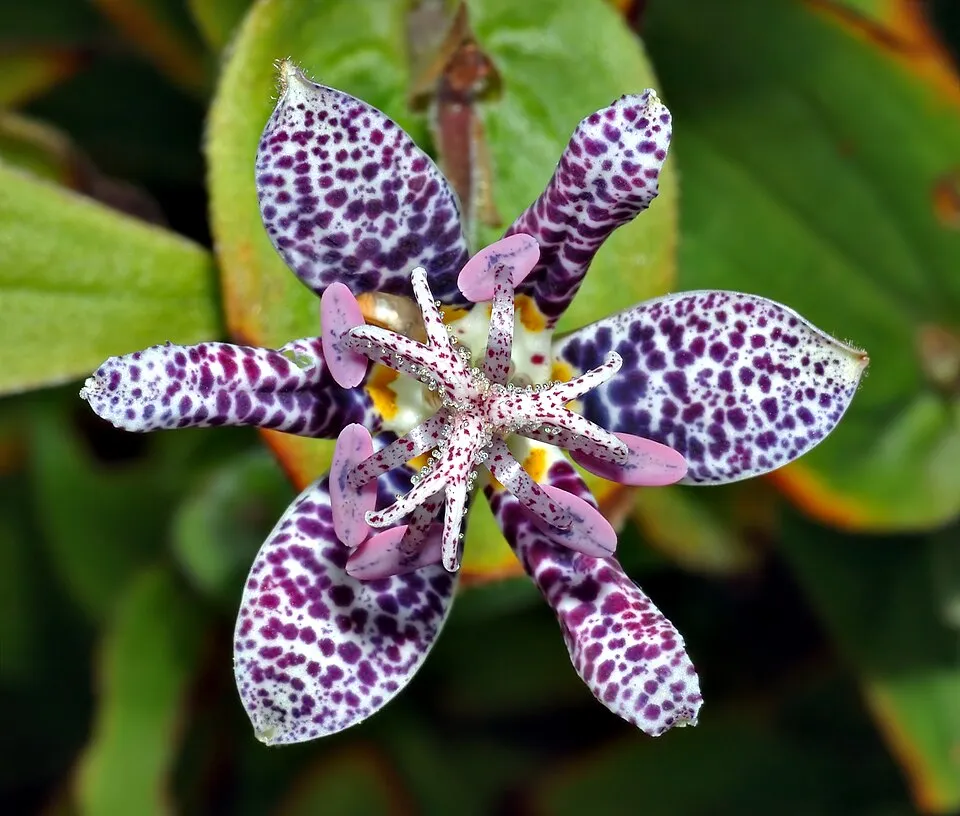
Tricyrtis hirta, commonly known as the Toad Lily or Hairy Toad Lily, is an enchanting herbaceous perennial belonging to the Liliaceae family, distinguished by its unique, orchid-like blossoms. This captivating species is indigenous to the shaded, moist woodlands of Japan, particularly thriving in its temperate forest understories. Morphologically, Tricyrtis hirta typically reaches a height of 0.3 to 1 meter (1 to 3 feet), presenting an elegant, arching growth habit.
Its lance-shaped leaves are arranged alternately along the stems, often clasping, and possess a distinct texture that can appear somewhat hairy, contributing to its 'hairy toad lily' moniker. The true spectacle of this plant lies in its star-shaped flowers, which emerge in late summer to early autumn, persisting until the first significant frost. These delicate blooms are typically white or pale lavender, intricately speckled with prominent purple or reddish-brown spots, a pattern reminiscent of a toad's skin, hence the common name.
Each flower can have six tepals, often with nectaries at their base. Tricyrtis hirta thrives in cool, consistently moist, well-draining soil rich in organic matter, and prefers conditions ranging from partial to full shade, making it an exquisite choice for woodland gardens, shaded borders, or naturalized areas where its unusual beauty can be appreciated. While primarily valued for its ornamental appeal, its botanical classification within the genus Tricyrtis, and the broader Liliaceae family, hints at a rich phytochemical profile that has historically attracted attention in traditional East Asian medicine.
Trusted Scientific References
1. Authoritative external sources for Tricyrtis hirta
1.1 Wikipedia — Tricyrtis hirta
1.2 Kew POWO (Plants of the World Online)
1.3 PubMed — peer-reviewed research
1.4 NCBI Taxonomy Browser
1.5 GBIF — Global Biodiversity
1.6Tricyrtis Hirta should be interpreted through verified botanical identity, practical care, and responsible safety language. This recovery note adds the missing context needed for a complete profile: match light to the plant's habit, use well-drained soil, water according to season, and avoid unsupported medicinal or edible claims. For publishing, the plant can be presented as a source-backed garden plant with clear care guidance, common problem diagnosis, and conservative safety wording.
1.1.Tricyrtis Hirta — Defining Traits
- ✓Unique Orchid — Like Flowers — Distinctive white to lavender blooms with purple spots, resembling a toad's skin.
- ✓Late Season Bloom — Offers vibrant flowering from late summer into autumn, extending garden interest.
- ✓Shade — Loving Perennial — Thrives in cool, shady woodland garden conditions.
- ✓Native to Japan — Indigenous to the temperate forests of Japan, reflecting its natural habitat.
- ✓Medicinal Folk History — Traditional use in East Asian folk medicine for topical applications.
- ✓Rich Phytochemical Profile — Contains saponins, flavonoids, and phenolic compounds with potential bioactivities.
- ✓Deer and Rabbit Resistant — Generally not preferred by browsing animals due
- ✓To its taste — to its taste or texture.
- ✓Moderate Growth Rate — Establishes well and forms clumps over time.
- ✓Low Maintenance — Once established, requires minimal care beyond consistent moisture.
- ✓Attractive Foliage — Lance-shaped leaves provide textural interest even when not in bloom.
1.2.Tricyrtis Hirta — In Brief
- ✓Ornamental Japanese perennial with unique, speckled, orchid-like flowers.
- ✓Traditionally used topically for skin ailments, insect bites, and inflammation.
- ✓Contains steroidal saponins, flavonoids, and phenolic compounds.
- ✓Modern scientific research on medicinal uses is very limited.
- ✓Requires partial to full shade, moist, well-draining soil.
- ✓Internal use is not recommended without expert medical supervision due to safety concerns.
2.Tricyrtis Hirta — Taxonomic Classification
3.Tricyrtis Hirta — Quick Facts
4.Tricyrtis Hirta — Plant Morphology
5.Tricyrtis Hirta — Where It Grows
6.Tricyrtis Hirta — Cultural & Traditional Roles
7.Tricyrtis Hirta — Bioactive Constituents
- ✓Steroidal Saponins — These triterpenoid glycosides, such as tricyrtisides, are known for their hemolytic, anti-inflammatory, and potential anticancer activities, acting as membrane-active compounds.
- ✓Flavonoids — Compounds like quercetin and kaempferol derivatives are strong antioxidants and anti-inflammatory agents, protecting cells from oxidative damage.
- ✓Phenolic Acids — Gallic acid and caffeic acid are examples of phenolics present, contributing significantly to the plant's antioxidant and free-radical scavenging capabilities.
- ✓Alkaloids — While less prominent, some species in Liliaceae contain alkaloids, which can exert diverse pharmacological effects, including analgesic and antispasmodic actions.
- ✓Glycosides — Various other glycosides, beyond saponins, may be present, influencing cardiac activity or possessing laxative properties in some plant species.
- ✓Polysaccharides — Complex carbohydrates contribute to immune modulation and have demulcent properties, potentially soothing irritated tissues.
- ✓Volatile Oils — Trace amounts of essential oils may contribute to the plant's defense mechanisms and exert mild antimicrobial or aromatic effects.
- ✓Tannins — Astringent compounds that can precipitate proteins, contributing to wound healing, anti-inflammatory, and antimicrobial actions.
- ✓Phytosterols — Plant sterols such as beta-sitosterol are known for cholesterol-lowering and anti-inflammatory effects.
- ✓Anthocyanins — Pigments responsible for the purple coloration in the flowers, also possessing notable antioxidant properties.
8.Tricyrtis Hirta — Research Insights
- ✓Anti-inflammatory Support — Traditionally, the plant was applied topically to soothe inflammation, a property potentially linked to its flavonoid and saponin content, which may modulate inflammatory pathways.
- ✓Wound Healing Aid — Folk medicine suggests topical application for minor cuts and abrasions, possibly due to astringent properties and compounds that support tissue regeneration.
- ✓Dermatological Comfort — Extracts have been historically used for skin ailments and irritations, offering a perceived soothing effect on insect bites and minor rashes.
- ✓Antimicrobial Potential — Certain phytochemicals, such as steroidal saponins, can exhibit mild antimicrobial activity, which might contribute to its traditional use on skin lesions.
- ✓Gastrointestinal Relief — In some traditional practices, internal use was suggested for mild gastrointestinal complaints, though this lacks scientific validation and should be approached with extreme caution.
- ✓Antioxidant Activity — The presence of phenolic compounds and flavonoids indicates potential antioxidant capacity, which could help protect cells from oxidative stress.
- ✓Diuretic Properties — Some traditional Liliaceae species are known for mild diuretic effects, suggesting a potential, though unproven, role for Tricyrtis hirta in fluid balance.
- ✓General Tonic — Historically, certain preparations were considered a general tonic, believed to support overall vitality, though specific mechanisms are not understood.
- ✓Pain Management — Topically, it was sometimes used for localized pain relief, possibly due to its anti-inflammatory and soothing properties.
- ✓Insect Repellent — The plant's unique compounds might have properties that traditionally deterred insects when applied to the skin, though this is anecdotal.
- ✓Respiratory Support — In very limited traditional contexts, some Liliaceae plants were used for respiratory issues, suggesting a highly speculative potential for Tricyrtis hirta.
8.1.Tricyrtis Hirta — Indications & Uses
9.Tricyrtis Hirta — Adverse Effects
9.1.Tricyrtis Hirta — Caution Notes
- ✓Gastrointestinal Upset — Internal consumption, particularly of larger doses, may lead to nausea, vomiting, or diarrhea, likely due to saponin content.
- ✓Skin Irritation — Topical application may cause contact dermatitis or allergic reactions in sensitive individuals, manifesting as redness or itching.
- ✓Hemolytic Activity — Saponins present in the plant can cause red blood cell lysis, making internal use potentially dangerous, especially in high concentrations.
- ✓Liver Toxicity — Lack of comprehensive safety data means potential for liver damage with prolonged or excessive internal use cannot be ruled out.
- ✓Kidney Stress — Similar to liver concerns, unresearched internal use could potentially burden kidney function.
- ✓Allergic Reactions — Individuals with sensitivities to plants in the Liliaceae family may experience allergic responses.
- ✓Pregnancy & Lactation Risks — Due to unknown effects on fetal development or infant health, use is contraindicated during pregnancy and breastfeeding.
9.2.Tricyrtis Hirta — Risk Assessment
- ✓Professional Guidance Essential — Always consult a qualified medical herbalist or healthcare professional before any internal use of Tricyrtis hirta.
- ✓External Use Caution — Perform a patch test on a small skin area before widespread topical application to check for allergic reactions.
- ✓Avoid During Pregnancy & Lactation — Due to insufficient safety data, pregnant and breastfeeding individuals should strictly avoid all forms of Tricyrtis hirta.
- ✓Children & Infants — Not recommended for use in children or infants due to lack of safety studies and potential toxicity.
- ✓Pre-existing Conditions — Individuals with liver, kidney, or gastrointestinal disorders should avoid internal use.
- ✓Drug Interactions — Potential interactions with medications (e.g., blood thinners, diuretics) are unknown; consult a doctor if on prescription drugs.
- ✓Dosage Unknown — Safe and effective internal dosages are not established, making self-medication highly risky.
- ✓Toxic Potential — The presence of steroidal saponins suggests a degree of inherent toxicity, especially when ingested.
10.Tricyrtis Hirta — How to Use
- ✓Topical Poultice — Fresh crushed leaves or roots traditionally applied directly to insect bites, minor skin irritations, or small wounds for a soothing effect.
- ✓Decoction for External Wash — Dried plant material boiled in water to create a liquid used as a wash for skin ailments or as a compress.
- ✓Infusion (Limited Internal Use) — Dried leaves or flowers steeped in hot water, traditionally consumed as a 'tonic' or for mild gastrointestinal issues, though this practice is not scientifically validated and requires caution.
- ✓Tincture Preparation — Plant material steeped in alcohol to extract compounds, used sparingly and under expert guidance, primarily for traditional internal applications.
- ✓Herbal Compress — Cloth soaked in a strong decoction and applied to affected areas of the skin for a longer duration.
- ✓Salve or Ointment — Infusing plant extracts into a base oil (like olive or coconut oil) and then solidifying with beeswax for topical skin application.
- ✓Root Powder — Dried and ground roots historically used as a dusting powder for certain skin conditions or incorporated into poultices.
- ✓Herbal Bath — Adding a strong decoction to bathwater for full-body skin soothing, particularly for widespread minor irritations.
11.Tricyrtis Hirta — Propagation & Care
- ✓Site Selection — Choose a location with partial to full shade, especially protected from hot afternoon sun.
- ✓Soil Preparation — Ensure well-draining, fertile soil enriched with ample organic matter; a slightly acidic to neutral pH (6.0-7.0) is ideal.
- ✓Watering Regime — Maintain consistently moist soil, especially during dry periods, but avoid waterlogging to prevent root rot.
- ✓Temperature & Hardiness — Hardy in USDA Zones 6-10; protect from harsh winter winds and extreme cold in marginal zones.
- ✓Fertilization Schedule — Apply a balanced, slow-release granular fertilizer or liquid feed monthly during the active growing season (spring to late summer).
- ✓Propagation Techniques — Primarily propagated by seed or division in early spring or autumn; stem cuttings are also viable.
- ✓Pest & Disease Management — Generally robust, but monitor for slugs and snails; ensure good air circulation to prevent fungal issues like powdery mildew.
- ✓Mulching — Apply a 2-4 inch layer of organic mulch (e.g., shredded bark, compost) to conserve moisture, regulate soil temperature, and suppress weeds.
Reviewed by the Flora Medical Global Botanical Review Panel
Multi-disciplinary editorial group · Botany · Ethnobotany · Herbal-medicine literature
Who reviewed this: This page was checked by the Flora Medical Global Botanical Review Panel — an in-house editorial group of botany graduates, ethnobotany researchers, and horticulture practitioners who collectively maintain our 7,000+ plant encyclopedia. Meet the team.
Our 4-step verification process
1. Taxonomic verification
Scientific names and synonyms cross-checked against Kew POWO, World Flora Online, and The Plant List.
2. Phytochemical & medicinal cross-reference
Active compounds, traditional uses, and reported activities are cross-referenced with PubMed, USDA Dr. Duke's database, and peer-reviewed ethnobotanical literature.
3. Conservation & distribution check
Distribution, ecology, and conservation status confirmed against GBIF occurrence records and the IUCN Red List.
4. Editorial & safety review
Every entry passes an editorial pass for clarity, originality, and safety notices (toxicity, contraindications, dosage caveats) before publication.
Last reviewed:
Important medical disclaimer: This content is for educational and research purposes only. It is not medical advice and is not a substitute for consultation with a licensed healthcare provider. Do not use any herb to self-treat a medical condition without professional guidance.
Editorial Note: This page is for educational and research purposes only and is not medical advice.
Written by: Flora Medical Global Editorial Team
Reviewed by: Flora Medical Global Botanical Review Panel
Last Updated: June 15, 2026





Tricyrtis Hirta — Comments & Community Reviews
Rate this plant