

Medical Disclaimer: This content is for educational purposes only. It is not medical advice. Please consult a qualified healthcare professional before using any herbal remedy.
Safety Overview
1.Trollius Europaeus — Overview
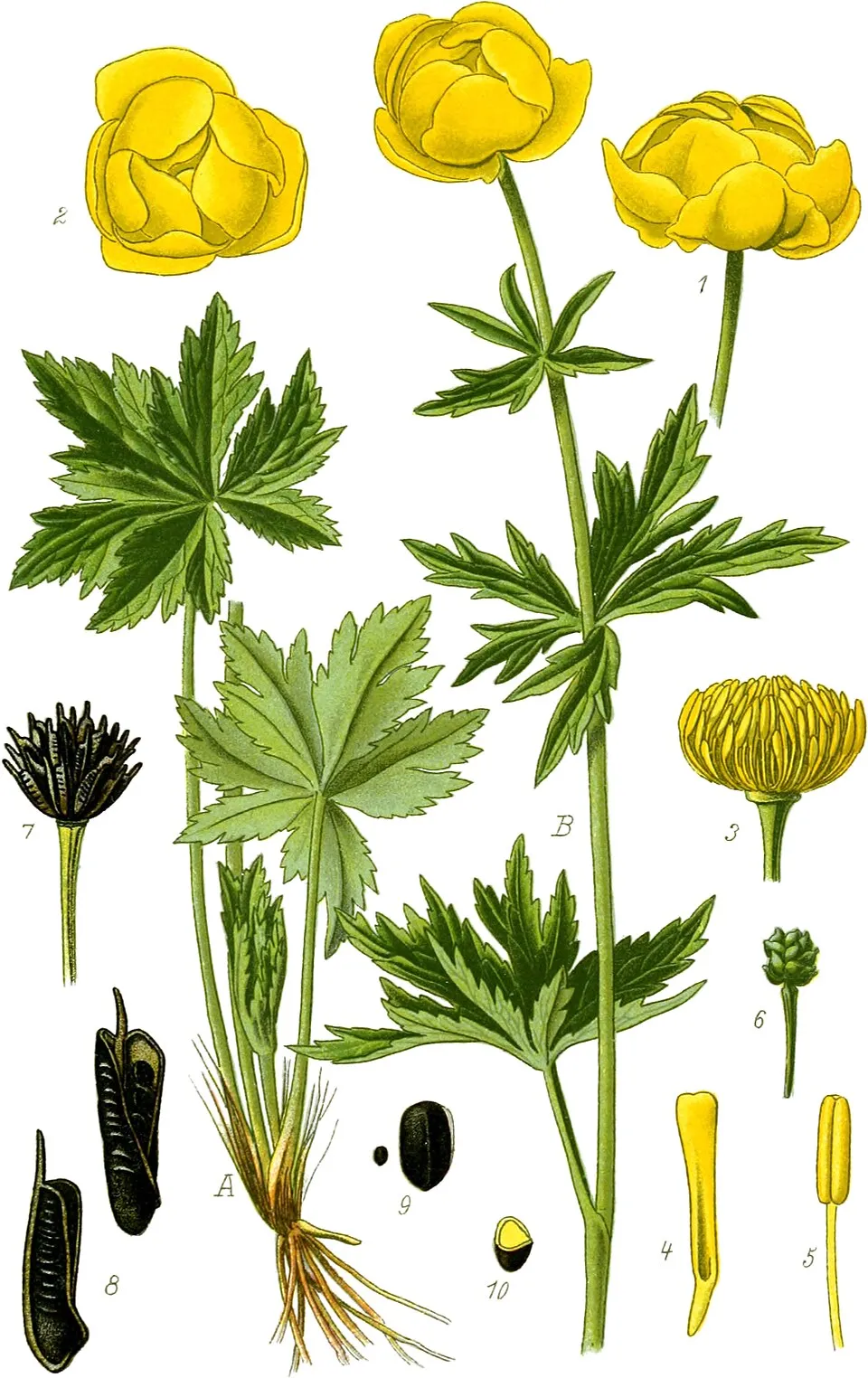
Trollius europaeus, widely recognized as the globe flower, is an enchanting herbaceous perennial native to a broad expanse of temperate Europe and parts of Western Asia. This member of the buttercup family, Ranunculaceae, typically achieves a stature of 30 to 70 centimeters, forming an erect and robust growth habit. Its most striking feature is the perfectly spherical, vibrant yellow to orange-yellow flowers, which emerge in profusion from late spring through early summer, typically between May and June.
These distinctive blossoms are formed by numerous incurved, petal-like sepals and true petals, creating a tightly closed, globe-like structure that gives the plant its evocative common name. The foliage is deeply lobed and dissected, often displaying a glossy sheen, forming an attractive basal rosette and alternating along the stems, providing a verdant backdrop to the bright flowers. Trollius europaeus thrives in moist, well-drained soils, typically found in damp meadows, open woodlands, bogs, and along stream banks.
It prefers slightly acidic to neutral soil pH and, while tolerant of full sun, often flourishes in partial shade where consistent soil moisture is more readily maintained. Its fibrous root system allows it to form dense clumps over time, contributing to its ornamental value and ecological role within riparian and wetland ecosystems. It is a protected species in some regions, including Russia and Bulgaria, highlighting its ecological significance.
Trusted Scientific References
1. Authoritative external sources for Trollius europaeus
1.1 Wikipedia — Trollius europaeus
1.2 Kew POWO (Plants of the World Online)
1.3 PubMed — peer-reviewed research
1.4 NCBI Taxonomy Browser
1.5 GBIF — Global Biodiversity
1.6Trollius Europaeus should be interpreted through verified botanical identity, practical care, and responsible safety language. This recovery note adds the missing context needed for a complete profile: match light to the plant's habit, use well-drained soil, water according to season, and avoid unsupported medicinal or edible claims. For publishing, the plant can be presented as a source-backed garden plant with clear care guidance, common problem diagnosis, and conservative safety wording.
1.1.Trollius Europaeus — Standout Qualities
- ✓Striking spherical yellow to orange — yellow flowers.
- ✓Herbaceous perennial, typically 30 — 70 cm tall.
- ✓Native to temperate — Native to temperate Europe and Western Asia.
- ✓Belongs to the — Belongs to the Ranunculaceae (buttercup) family.
- ✓Prefers moist, well — drained soil in partial shade.
- ✓Blooms from late spring through early summer (May — June).
- ✓Leaves are deeply — Leaves are deeply lobed and dissected, often glossy.
- ✓Contains potentially toxic — Contains potentially toxic compounds like protoanemonin.
- ✓Forms dense clumps — Forms dense clumps through its fibrous root system.
- ✓Protected species in — Protected species in certain countries like Russia and Bulgaria.
1.2.Trollius Europaeus — Quick Summary
- ✓Globe flower is a beautiful perennial with spherical yellow blossoms.
- ✓Traditionally used for anti-inflammatory and diuretic effects, primarily external.
- ✓Contains flavonoids, saponins, and the toxic protoanemonin.
- ✓Primarily for ornamental use; medicinal use requires extreme caution.
- ✓Thrives in moist, partial shade; protected in some regions.
- ✓Always consult experts before any medicinal application due to toxicity.
2.Trollius Europaeus — Scientific Profile
3.Trollius Europaeus — Botanical Stats
4.Trollius Europaeus — Plant Morphology
5.Trollius Europaeus — Geographic Distribution
6.Trollius Europaeus — Cultural & Traditional Roles
7.Trollius Europaeus — Active Compounds
- ✓Flavonoids — Key compounds include quercetin, kaempferol, and their glycosides, known for potent antioxidant, anti-inflammatory, and free-radical scavenging activities.
- ✓Saponins — Various triterpenoid saponins are present, which may contribute to diuretic and expectorant actions, though their exact structure and physiological effects in Trollius europaeus require further elucidation.
- ✓Protoanemonin — A characteristic irritant lactone found in many Ranunculaceae species, it is responsible for the plant's acrid taste and potential toxicity when fresh, converting to the less toxic anemonin upon drying.
- ✓Carotenoids — Pigments like xanthophylls and carotenes contribute to the vibrant yellow color of the flowers and possess antioxidant properties.
- ✓Phenolic Acids — Compounds such as caffeic acid and ferulic acid derivatives may be present, offering additional antioxidant and anti-inflammatory benefits.
- ✓Alkaloids — While less prominent than in some other Ranunculaceae, certain alkaloidal compounds might be present in trace amounts, requiring careful study.
- ✓Triterpenes — Beyond saponins, other triterpenoid structures may exist, contributing to various biological activities.
- ✓Volatile Oils — Although not a primary constituent, trace amounts of volatile compounds may contribute to the plant's aroma and minor biological effects.
8.Trollius Europaeus — What Research Suggests
- ✓Anti-inflammatory Support — Flavonoids and saponins found in Globe Flower are traditionally associated with modulating inflammatory pathways, potentially offering relief for minor skin irritations when applied topically.
- ✓Mild Diuretic Action — Traditional uses suggest a gentle diuretic effect, attributed to specific saponins, which may assist in managing mild fluid retention, though this should only be pursued under expert guidance.
- ✓Antioxidant Properties — The presence of potent flavonoids, such as quercetin and kaempferol, along with carotenoids, contributes to the plant's antioxidant capacity, helping to neutralize free radicals and support cellular health.
- ✓Wound Healing — Historical applications include using extracts for minor cuts and abrasions, believed to accelerate the healing process due to its anti-inflammatory and antiseptic qualities.
- ✓Astringent Effects — Tannins, if present, could impart mild astringent properties, useful in traditional remedies for toning tissues or reducing minor bleeding from superficial wounds.
- ✓Antiseptic Qualities — Certain plant compounds may possess mild antiseptic actions, supporting traditional use in cleaning and protecting minor wounds from infection.
- ✓Skin Soothing — Topically, infusions or poultices have been used to soothe irritated skin, likely due to a combination of anti-inflammatory and hydrating effects.
- ✓Traditional Pain Relief — In some folk traditions, the plant was used externally for localized aches and pains, though scientific validation for this specific application is limited.
- ✓Respiratory Support — Very limited traditional accounts suggest internal use for mild respiratory complaints, but this is highly cautious given the plant's potential toxicity.
8.1.Trollius Europaeus — Reported Uses
9.Trollius Europaeus — Risk Profile
9.1.Trollius Europaeus — Caution Notes
- ✓Skin Irritation — Direct contact with fresh plant material can cause blistering, redness, and dermatitis due to protoanemonin.
- ✓Gastrointestinal Distress — Ingestion of fresh or improperly prepared plant parts can lead to severe stomach pain, nausea, vomiting, and diarrhea.
- ✓Oral Irritation — Chewing fresh plant material can cause burning sensations and inflammation of the mouth and throat.
- ✓Systemic Toxicity — Large doses of fresh plant material can lead to more severe systemic effects, including dizziness, convulsions, and paralysis.
- ✓Allergic Reactions — Sensitive individuals may experience allergic contact dermatitis or other hypersensitivity reactions.
- ✓Hepatic and Renal Stress — Prolonged or high-dose internal use, even of dried material, could potentially stress liver and kidney function.
- ✓Cardiac Effects — In extreme cases of poisoning, cardiac rhythm disturbances have been reported with Ranunculaceae species.
9.2.Trollius Europaeus — Risk Assessment
- ✓Not for Internal Use — Due to the presence of protoanemonin, Trollius europaeus is generally considered toxic and should not be consumed internally without expert medical herbalist supervision.
- ✓External Use Only with Caution — Topical application should primarily use dried plant material, as fresh plants can cause skin irritation and blistering.
- ✓Pregnancy and Lactation — Contraindicated during pregnancy and breastfeeding due to potential toxicity and lack of safety data.
- ✓Children — Avoid use in children due to their increased sensitivity to toxic compounds.
- ✓Avoid on Broken Skin — Do not apply fresh plant material or strong preparations to open wounds or severely broken skin.
- ✓Professional Guidance — Any medicinal use, especially internal, must be under the strict guidance of a qualified medical herbalist.
- ✓Allergy Alert — Individuals with known allergies to the Ranunculaceae family should avoid contact.
10.Trollius Europaeus — Preparation & Dosage
- ✓Topical Infusion — Prepare a cooled infusion of dried leaves or flowers for external washes or compresses to soothe minor skin irritations.
- ✓Poultice Application — Fresh, crushed leaves (with caution due to protoanemonin) or dried, rehydrated material can be applied as a poultice to minor bruises or inflamed areas.
- ✓Tincture (External) — A diluted tincture made from dried plant parts can be used topically as an astringent or antiseptic on superficial wounds.
- ✓Herbal Bath Additive — Dried globe flower material can be added to bathwater to provide a soothing, aromatic experience for irritated skin.
- ✓Decoction for Soaks — A decoction of the root (always with extreme caution and professional guidance) can be used externally for foot soaks or localized applications.
- ✓Ointment or Salve — Infused oil from dried flowers can be incorporated into a salve for topical application on dry or chapped skin.
- ✓Traditional Internal Use — Historically, extremely diluted preparations were used internally, but this is highly discouraged due to toxicity and must only be considered under the strict supervision of a qualified medical herbalist.
11.Trollius Europaeus — Propagation & Care
- ✓Soil Preparation — Ensure fertile, well-draining soil enriched with ample organic matter to retain moisture.
- ✓Watering Regimen — Maintain consistently moist soil throughout the growing season, avoiding waterlogging, especially important in dry spells.
- ✓Light Exposure — Plant in partial shade, especially in warmer climates, or full sun in cooler, moist conditions for optimal flowering.
- ✓Temperature Requirements — Thrives in temperate zones (USDA 9-12), tolerating minimum temperatures down to -3°C (27°F), with optimal growth between 10-28°C.
- ✓Fertilization Schedule — Apply a balanced liquid fertilizer monthly during the active growing season to support robust growth and abundant blooms.
- ✓Propagation Techniques — Primarily propagated by seed or division; seeds require consistent moisture and moderate temperatures for germination, while division is best in spring or autumn.
- ✓Mulching Practice — Apply a layer of organic mulch around the base to help retain soil moisture, regulate soil temperature, and suppress weed growth.
Reviewed by the Flora Medical Global Botanical Review Panel
Multi-disciplinary editorial group · Botany · Ethnobotany · Herbal-medicine literature
Who reviewed this: This page was checked by the Flora Medical Global Botanical Review Panel — an in-house editorial group of botany graduates, ethnobotany researchers, and horticulture practitioners who collectively maintain our 7,000+ plant encyclopedia. Meet the team.
Our 4-step verification process
1. Taxonomic verification
Scientific names and synonyms cross-checked against Kew POWO, World Flora Online, and The Plant List.
2. Phytochemical & medicinal cross-reference
Active compounds, traditional uses, and reported activities are cross-referenced with PubMed, USDA Dr. Duke's database, and peer-reviewed ethnobotanical literature.
3. Conservation & distribution check
Distribution, ecology, and conservation status confirmed against GBIF occurrence records and the IUCN Red List.
4. Editorial & safety review
Every entry passes an editorial pass for clarity, originality, and safety notices (toxicity, contraindications, dosage caveats) before publication.
Last reviewed:
Important medical disclaimer: This content is for educational and research purposes only. It is not medical advice and is not a substitute for consultation with a licensed healthcare provider. Do not use any herb to self-treat a medical condition without professional guidance.
Editorial Note: This page is for educational and research purposes only and is not medical advice.
Written by: Flora Medical Global Editorial Team
Reviewed by: Flora Medical Global Botanical Review Panel
Last Updated: June 15, 2026





Trollius Europaeus — Comments & Community Reviews
Rate this plant