

Medical Disclaimer: This content is for educational purposes only. It is not medical advice. Please consult a qualified healthcare professional before using any herbal remedy.
Safety Overview
1.Vateria — Overview
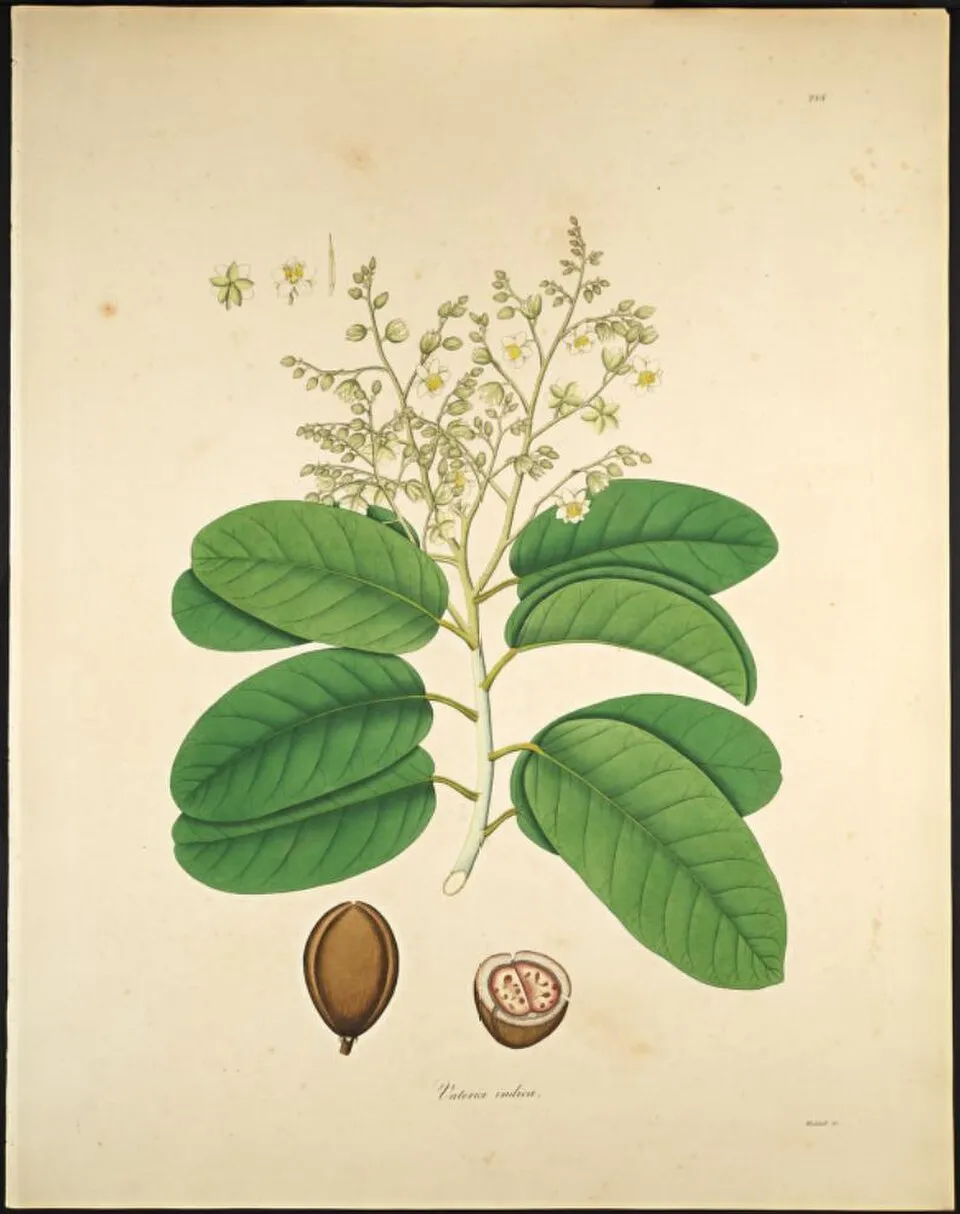
Vateria indica, widely known as the Indian Dammar or White Dammar Tree, is a majestic evergreen tree belonging to the Dipterocarpaceae family. It commands attention as one of the largest trees in its native range, capable of reaching impressive heights of up to 50 meters. The tree's foliage consists of simple, alternate, elliptical leaves, typically measuring 10-20 cm in length and 5-10 cm in width.
These leaves present a vibrant dark green hue that gracefully transitions to a yellowish shade in the autumn months. Its creamy white to pale yellow flowers are arranged in delicate axillary or terminal panicles, each bloom featuring five petals approximately 5 cm long. The distinctive fruit is a woody, dehiscent capsule encasing seeds resembling butterflies, usually 2-3 cm long.
Vateria indica’s bark is characteristically rough, deeply fissured, and greyish-brown, notably exuding a fragrant, commercially valuable resin when incised. This species thrives in the tropical moist climates of South Asia, particularly in the rainforests of India and Sri Lanka, preferring well-drained, fertile soils at altitudes up to 1200 meters. Beyond its economic value for resin and timber, Vateria indica plays a vital ecological role, supporting diverse wildlife and contributing to soil health within its ecosystem.
Trusted Scientific References
1. Authoritative external sources for Vateria indica
1.1 Wikipedia — Vateria indica
1.2 Kew POWO (Plants of the World Online)
1.3 PubMed — peer-reviewed research
1.4 NCBI Taxonomy Browser
1.5 GBIF — Global Biodiversity
1.6Vateria should be interpreted through verified botanical identity, practical care, and responsible safety language. This recovery note adds the missing context needed for a complete profile: match light to the plant's habit, use well-drained soil, water according to season, and avoid unsupported medicinal or edible claims. For publishing, the plant can be presented as a source-backed medicinal plant with clear care guidance, common problem diagnosis, and conservative safety wording.
1.1.Vateria — Key Features
- ✓Botanical Titan — A towering evergreen tree reaching up to 50 meters, native to South Asian rainforests.
- ✓Fragrant Resin Producer — Known for its valuable 'dammar' resin, exuding a distinct, pleasant aroma.
- ✓Ayurvedic Cornerstone — Holds significant importance in traditional Indian medicine for centuries.
- ✓Diverse Medicinal Uses — Employed for wound healing, anti-inflammatory, digestive, and respiratory support.
- ✓Rich Phytochemistry — Contains beneficial stilbenoids, terpenes, and triterpenoid compounds.
- ✓Ecological Contributor — Supports local wildlife and contributes to soil health in its natural habitat.
- ✓Distinctive Morphology — Features elliptical leaves, creamy white flowers, and butterfly-shaped seeds.
- ✓Commercial Value — Cultivated for both its medicinal resin and high-quality timber.
- ✓Vata — Kapha Balancer — Traditionally recognized for balancing Vata and Kapha doshas in Ayurveda.
- ✓Topical and Internal Applications — Utilized in various forms, from topical pastes to internal decoctions.
1.2.Vateria — At-a-Glance Summary
- ✓Indian Dammar (Vateria indica) is a large evergreen tree valued for its medicinal resin.
- ✓Traditionally used in Ayurveda for wound healing, inflammation, and digestive support.
- ✓Rich in therapeutic compounds like stilbenoids, terpenes, and triterpenoid resins.
- ✓Resin is applied topically for skin issues and consumed internally for various ailments.
- ✓Requires tropical moist climates and fertile soils for optimal growth and resin production.
- ✓Caution advised during pregnancy, lactation, and with concurrent medication due to potential interactions.
2.Vateria — Systematic Position
3.Vateria — Botanical Stats
4.Vateria — Structural Profile
5.Vateria — Where It Grows
6.Vateria — Historical Applications
7.Vateria — Bioactive Constituents
- ✓Terpenoids — This category includes monoterpenes such as alpha-pinene, beta-pinene, and limonene, which contribute significantly to the plant's characteristic aroma and possess anti-inflammatory, antiseptic, and bronchodilator activities.
- ✓Sesquiterpenes — Chamazulene, a notable sesquiterpene found in the oleoresin, is recognized for its potent anti-inflammatory and antioxidant properties, often associated with soothing effects.
- ✓Stilbenoids — Research has identified stilbenoids, including resveratrol derivatives, as key compounds in Vateria indica, demonstrating significant antitumor and antioxidant potential.
- ✓Resins — The prominent 'dammar' resin is a complex mixture of triterpenoids and resin acids, responsible for the tree's wound-healing, antimicrobial, and anti-inflammatory actions when exuded.
- ✓Essential Oils — The oleoresin contains a volatile fraction rich in various essential oil components, which impart therapeutic benefits such as antimicrobial, carminative, and expectorant effects.
- ✓Flavonoids — While not explicitly detailed, many plant resins and barks contain flavonoids, known for their antioxidant, anti-inflammatory, and protective vascular effects.
- ✓Tannins — The bark and gum resin are rich in tannins, contributing to their astringent properties, which are beneficial in wound healing, diarrhea management, and reducing inflammation.
- ✓Phenolic Compounds — Beyond stilbenoids, other phenolic compounds are likely present, contributing to the overall antioxidant capacity and protective effects against cellular damage.
8.Vateria — Modern Studies
- ✓Wound Healing — The resin of Vateria indica possesses potent antimicrobial and antiseptic properties, making it highly effective for topical application on infected wounds, cuts, and minor skin abrasions to promote rapid healing and prevent bacterial growth.
- ✓Anti-inflammatory Action — Traditionally, the resin is formulated into pastes and oils to alleviate inflammatory conditions such as arthritis, rheumatism, and general body aches by reducing swelling and pain.
- ✓Digestive Aid — Infusions prepared from the leaves of Vateria indica are used to support digestive health, helping to resolve issues like indigestion and flatulence, while also stimulating appetite.
- ✓Respiratory Support — The fragrant resin can be inhaled or diffused to provide relief from respiratory ailments, including coughs, bronchial congestion, and mild asthma symptoms, by acting as an expectorant.
- ✓Anti-diarrheal Properties — The astringent qualities of the bark and resin are beneficial in managing diarrhea and dysentery, helping to firm stools and reduce intestinal inflammation.
- ✓Antiparasitic Effects — Vateria indica is traditionally employed to treat intestinal worm infestations, with its active compounds exhibiting vermifugal properties that aid in expelling parasites.
- ✓Skin Complexion Enhancement — In Ayurvedic practices, components of the tree are used to improve skin tone and complexion, contributing to a healthy and radiant appearance.
- ✓Antifungal and Antibacterial Activity — The resin's broad-spectrum antimicrobial action extends to combating various fungal and bacterial infections, both internally and externally.
- ✓Pain Relief for Earaches — Traditionally, preparations from Vateria indica have been used to alleviate earaches, likely due to its anti-inflammatory and mild analgesic properties.
- ✓Management of Abscesses and Boils — The topical application of resin-based formulations helps to draw out impurities and reduce inflammation associated with abscesses and boils, promoting their resolution.
8.1.Vateria — Therapeutic Indications
9.Vateria — Risk Profile
9.1.Vateria — Possible Adverse Reactions
- ✓Pregnancy and Lactation — Use is generally discouraged or requires strict medical supervision during pregnancy and breastfeeding due to insufficient safety data.
- ✓Allergic Reactions — Sensitive individuals may experience skin irritation, rashes, or other allergic responses upon topical application or ingestion.
- ✓Gastrointestinal Discomfort — High doses of the resin or bark preparations may lead to mild stomach upset, nausea, or constipation in some individuals.
- ✓Drug Interactions — Vateria indica may potentially interact with certain allopathic medications, particularly those affecting blood clotting or inflammation; consultation with a healthcare professional is advised.
- ✓Children's Dosage — While generally considered safe in small, supervised doses for children, caution is recommended, and professional medical advice should be sought.
- ✓Astringent Effects — Excessive internal use might lead to severe constipation due to its potent astringent properties.
9.2.Vateria — Toxicity Assessment
- ✓Professional Consultation — Always consult a qualified medical herbalist or Ayurvedic practitioner before using Vateria indica, especially for prolonged periods or specific health conditions.
- ✓Pregnancy and Breastfeeding — Avoid use during pregnancy and lactation unless explicitly directed and supervised by a healthcare professional.
- ✓Pediatric Use — Administer to children only in small, controlled doses under expert guidance, given their increased sensitivity.
- ✓Dosage Adherence — Strictly follow recommended dosages to prevent potential adverse effects and ensure therapeutic efficacy.
- ✓Drug Interaction Awareness — Inform your doctor about any concurrent Western medications, homeopathic remedies, or dietary supplements, as interactions are possible.
- ✓Allergic Sensitivity — Perform a patch test for topical applications to rule out skin hypersensitivity or allergic reactions before widespread use.
- ✓Quality Sourcing — Ensure the plant material or resin is sourced from reputable suppliers to guarantee purity and prevent contamination.
10.Vateria — Application Forms
- ✓Topical Resin Application — The purified resin can be ground into a fine powder and mixed with a carrier oil or water to form a paste for direct application on wounds, skin infections, and inflammatory swellings.
- ✓Internal Gum Powder — For digestive issues, worm infestations, or as a general tonic, 1-3 grams of the dried gum resin powder can be ingested daily, often mixed with honey or warm water.
- ✓Bark Decoction — A decoction made by boiling 50-100 ml of Vateria indica bark in water is traditionally consumed to treat diarrhea, improve digestion, and balance Kapha and Vata doshas.
- ✓Medicated Oils and Ghee — The resin is infused into oils (like Sarjataila) or clarified butter (Ghritam) for topical massage in neurological conditions, skin diseases, and inflammatory joint pain.
- ✓Herbal Smoking Wicks — The gum resin is used as a base for preparing wicks for traditional Ayurvedic herbal smoking, believed to alleviate respiratory congestion and enhance mental clarity.
- ✓Leaf Infusion — Fresh or dried leaves can be steeped in hot water to create an infusion, consumed to stimulate appetite and aid in various digestive complaints.
- ✓Fumigation — The fragrant resin can be burned as incense for fumigation, traditionally used for its purifying properties and to create a calming atmosphere.
- ✓Ayurvedic Formulations — Vateria indica is a key ingredient in complex Ayurvedic preparations like Lavangadi Churna for diarrhea and Sarvamayanthaka Ghritam for neurological disorders.
11.Vateria — Growth Requirements
- ✓Climate Preference — Vateria indica thrives in tropical moist to wet climates, requiring high humidity and consistent rainfall, typical of rainforest environments.
- ✓Soil Requirements — It prefers deep, well-drained, fertile loamy or sandy-loamy soils with a slightly acidic to neutral pH, crucial for robust growth.
- ✓Propagation — Propagation is primarily achieved through seeds, which should be sown fresh as they have a short viability period, requiring careful handling.
- ✓Light Conditions — Young saplings benefit from partial shade initially, gradually requiring full sun exposure as they mature to support optimal growth and resin production.
- ✓Watering — Consistent moisture is essential, especially during dry spells; however, waterlogging must be avoided to prevent root rot.
- ✓Temperature Range — The tree flourishes in warm temperatures, ideally between 25°C and 35°C, and is sensitive to frost.
- ✓Harvesting Resin — Resin is typically harvested by making incisions into the bark, allowing the exudate to collect, usually during drier periods for better quality.
- ✓Timber Cropping — For timber, trees are allowed to grow to a significant size, often involving selective logging practices to ensure sustainable forest management.
Reviewed by the Flora Medical Global Botanical Review Panel
Multi-disciplinary editorial group · Botany · Ethnobotany · Herbal-medicine literature
Who reviewed this: This page was checked by the Flora Medical Global Botanical Review Panel — an in-house editorial group of botany graduates, ethnobotany researchers, and horticulture practitioners who collectively maintain our 7,000+ plant encyclopedia. Meet the team.
Our 4-step verification process
1. Taxonomic verification
Scientific names and synonyms cross-checked against Kew POWO, World Flora Online, and The Plant List.
2. Phytochemical & medicinal cross-reference
Active compounds, traditional uses, and reported activities are cross-referenced with PubMed, USDA Dr. Duke's database, and peer-reviewed ethnobotanical literature.
3. Conservation & distribution check
Distribution, ecology, and conservation status confirmed against GBIF occurrence records and the IUCN Red List.
4. Editorial & safety review
Every entry passes an editorial pass for clarity, originality, and safety notices (toxicity, contraindications, dosage caveats) before publication.
Last reviewed:
Important medical disclaimer: This content is for educational and research purposes only. It is not medical advice and is not a substitute for consultation with a licensed healthcare provider. Do not use any herb to self-treat a medical condition without professional guidance.
Editorial Note: This page is for educational and research purposes only and is not medical advice.
Written by: Flora Medical Global Editorial Team
Reviewed by: Flora Medical Global Botanical Review Panel
Last Updated: June 15, 2026





Vateria — Comments & Community Reviews
Rate this plant