
Medical Disclaimer: This content is for educational purposes only. It is not medical advice. Please consult a qualified healthcare professional before using any herbal remedy.
Safety Overview
1.Virginia Bluebell — Introduction & Highlights
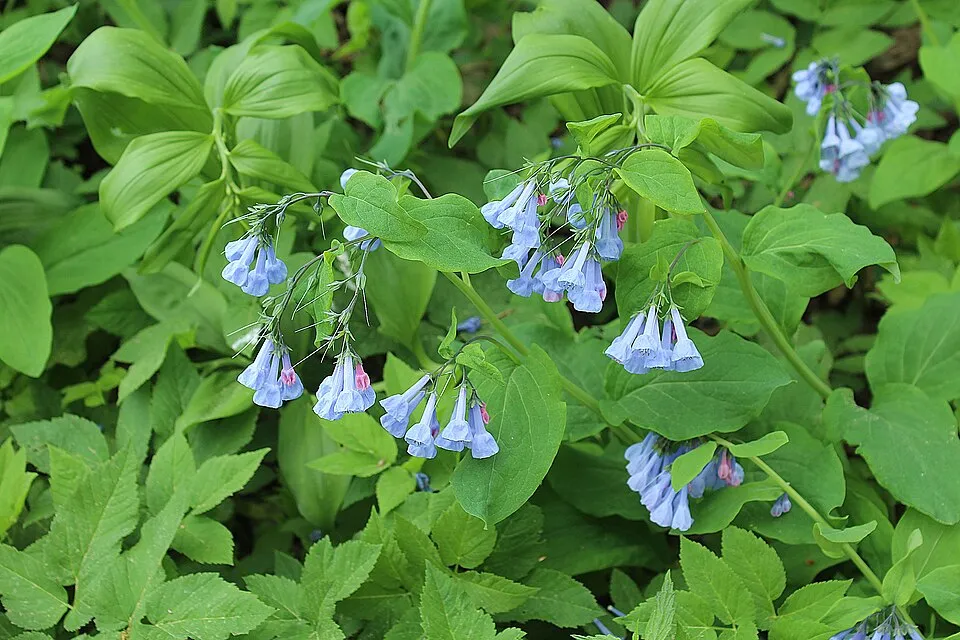
The Virginia Bluebell, or Mertensia virginica, is an enchanting native woodland perennial, celebrated for its ephemeral beauty and distinctive floral display. This herbaceous plant is indigenous to moist woodlands and river flood plains across eastern North America, spanning from New York to Minnesota, and extending south to Kansas and Alabama, as well as into Ontario and Quebec. A member of the Boraginaceae family, it typically forms erect clumps, growing up to 2 feet tall and about a foot wide. In early spring, deep purple emerging foliage quickly transitions to smooth, oval, blue- to gray-green leaves with prominent veins. The leaves, which can be 2-8 inches long, are petiolate at the base and become sessile higher up the stem.
Its succulent-like stems are fragile, mostly green but sometimes tinged with purple. The plant's most captivating feature is its mid-spring bloom (typically mid-April to mid-May), producing loose clusters of nodding, bell-shaped flowers. These blossoms emerge as purplish-pink buds and unfurl into stunning sky-blue flowers, though pink or white variants exist. Each flower features five fused petals, five white stamens, and a slender white pistil, exuding a delicate, sweet fragrance. After a bloom period of about three weeks, the fertilized flowers yield wrinkled nuts containing four seeds.
By early summer, the entire plant gracefully yellows and dies back to the ground, entering a dormant phase until the following spring. This ephemeral nature makes it a crucial early-season nectar source for pollinators like bumblebees and hummingbirds, and an ideal companion for later-season perennials. Hardy in USDA zones 3-9, Mertensia virginica is unfortunately considered threatened in parts of its native range due to habitat destruction and altered natural flood cycles.
Trusted Scientific References
1. Authoritative external sources for Mertensia virginica
1.1 Wikipedia — Mertensia virginica
1.2 Kew POWO (Plants of the World Online)
1.3 PubMed — peer-reviewed research
1.4 NCBI Taxonomy Browser
1.5 GBIF — Global Biodiversity
1.1.Virginia Bluebell — Key Features
- ✓Native Woodland Perennial — Indigenous to moist woodlands and river flood plains of eastern North America.
- ✓Ephemeral Spring Bloom — Emerges in early spring, blooms for 3-4 weeks, then goes dormant by early summer.
- ✓Bell — shaped Blue Flowers — Distinctive nodding flowers that open pink and mature to a vibrant sky-blue.
- ✓Ornamental Value — Highly cherished for its aesthetic appeal in naturalized and shade gardens.
- ✓Pollinator Attractor — Flowers are a valuable early spring nectar source for bumblebees, butterflies, and hummingbirds.
- ✓Deer Resistant — Generally unpalatable to deer, making it a good choice for gardens prone to browsing.
- ✓Habitat Indicator — Its presence often indicates healthy, undisturbed, moist woodland ecosystems.
- ✓Low Maintenance — Once established, requires minimal care, especially when allowed to naturalize and self-seed.
- ✓Self — seeding Colonies — Readily propagates itself under ideal conditions, forming dense, beautiful colonies over time.
- ✓Conservation Concern — Considered threatened in parts of its native range due to habitat loss and environmental changes.
1.2.Virginia Bluebell — At-a-Glance Summary
- ✓Ephemeral spring bloomer native to Eastern North America.
- ✓Known for beautiful bell-shaped flowers transitioning from pink buds to sky-blue.
- ✓Primarily valued for ornamental use in shaded woodland gardens.
- ✓Traditional Native American uses for coughs, fevers, and as a diuretic exist for certain Mertensia species, not specifically M. virginica.
- ✓Lacks scientific substantiation for modern medicinal consumption, primarily ornamental.
- ✓Precautionary concerns for pyrrolizidine alkaloids (PAs) due to Boraginaceae family membership.
2.Virginia Bluebell — Systematic Position
3.Virginia Bluebell — Botanical Stats
4.Virginia Bluebell — Morphological Account
5.Virginia Bluebell — Geographic Distribution
6.Virginia Bluebell — Cultural & Traditional Roles
7.Virginia Bluebell — Bioactive Constituents
- ✓Flavonoids — A diverse group of polyphenolic compounds, such as anthocyanins responsible for the blue flower pigmentation, offering antioxidant and potentially anti-inflammatory effects.
- ✓Phenolic Acids — Including derivatives of caffeic acid and rosmarinic acid, known for their antioxidant, anti-inflammatory, and mild antimicrobial properties, common in many plant species.
- ✓Pyrrolizidine Alkaloids (PAs) — While not specifically quantified for Mertensia virginica, many species within the Boraginaceae family are known to contain PAs, which are hepatotoxic and a significant safety concern for internal use.
- ✓Triterpenes — Compounds often found in plant waxes and resins, possibly contributing to protective mechanisms and having potential anti-inflammatory or adaptogenic properties, though specific presence needs confirmation.
- ✓Saponins — Glycosides that can have foaming properties and are sometimes associated with expectorant or diuretic actions, though their specific role and concentration in M. virginica are not well-documented.
- ✓Mucilage — Polysaccharides that form a gel-like substance when hydrated, potentially offering soothing properties for mucous membranes, relevant to traditional cough remedies.
- ✓Volatile Oils — Aromatic compounds present in small quantities, contributing to the plant's delicate fragrance and possibly possessing mild antiseptic or insect-repellent qualities.
- ✓Tannins — Astringent compounds that can bind to proteins, offering potential anti-inflammatory, antimicrobial, and wound-healing benefits in some plant species.
- ✓Plant Sterols — Structural components of plant cell membranes, these compounds may also have various physiological effects, though specific studies on M. virginica are limited.
8.Virginia Bluebell — What Research Suggests
- ✓Traditional Cough Remedy — Historically, certain Mertensia species were employed by Native American tribes to soothe coughs and respiratory irritations, likely due to potential mucilaginous content.
- ✓Febrifuge Properties — In traditional practices, some Mertensia species were utilized to help reduce fevers, suggesting potential antipyretic actions, though not specific to M. virginica.
- ✓Diuretic Support — Native American traditions included the use of Mertensia species as a diuretic, potentially aiding in fluid balance and urinary health.
- ✓Skin Soothing (Traditional) — While not specific to M. virginica, some plants in the Boraginaceae family are known for emollient properties, which could theoretically offer skin-soothing benefits in traditional topical applications.
- ✓Anti-inflammatory Potential (Speculative) — Like many plants, Virginia Bluebells may possess compounds with general anti-inflammatory properties, although specific research for this species is limited.
- ✓Antioxidant Activity (General) — Mertensia virginica, like most plants, likely contains flavonoids and phenolic acids that contribute to antioxidant defense, protecting cells from oxidative stress.
- ✓Digestive Aid (Ethnobotanical) — Some historical uses of related plants suggest a role in digestive comfort, possibly through mild soothing effects, though not directly attributed to M. virginica.
- ✓Antimicrobial Effects (Hypothetical) — Plant secondary metabolites often exhibit antimicrobial properties, which might offer a broad protective effect, yet specific research on M. virginica is lacking.
- ✓General Wellness Support (Traditional Context) — In historical ethnobotanical contexts, the plant may have been considered a general tonic or resource, offering trace nutrients and phytochemicals for overall vitality.
- ✓Ethnobotanical Significance — Its historical use underscores its cultural importance as a resource for indigenous communities, highlighting the need for further ethnobotanical and phytochemical investigation.
8.1.Virginia Bluebell — Health Applications
9.Virginia Bluebell — Precautions & Warnings
9.1.Virginia Bluebell — Side Effects & Warnings
- ✓Liver Toxicity Risk — Like many members of the Boraginaceae family, there is a theoretical concern for the presence of pyrrolizidine alkaloids (PAs), which can be hepatotoxic if ingested, especially in concentrated or prolonged use.
- ✓Gastrointestinal Upset — Ingestion of plant material, particularly in larger quantities, could potentially lead to mild gastrointestinal discomfort, nausea, or vomiting in sensitive individuals.
- ✓Allergic Reactions — While rare, individuals with sensitivities to plants in the Boraginaceae family may experience allergic reactions, such as skin irritation from contact or respiratory symptoms if airborne pollen is present.
- ✓Photosensitivity — Some plant compounds can induce photosensitivity; however, this is not specifically documented for Virginia Bluebells but remains a general consideration for herbal ingestion.
- ✓Unknown Effects from Lack of Research — Due to the limited scientific study on Mertensia virginica's internal use, the full spectrum of potential side effects, particularly with long-term consumption, remains largely unknown.
9.2.Virginia Bluebell — Toxicity Assessment
- ✓Not for Internal Consumption — Virginia Bluebells are primarily ornamental; internal medicinal use is not scientifically substantiated and is strongly discouraged without professional medical and botanical guidance due to potential risks.
- ✓Pyrrolizidine Alkaloid Concern — Given its family (Boraginaceae), there is a precautionary concern for the presence of potentially hepatotoxic pyrrolizidine alkaloids (PAs), making ingestion unsafe.
- ✓Pregnancy and Lactation — Avoid use during pregnancy and lactation due to the lack of safety data and the potential presence of harmful compounds like PAs, which could affect the fetus or infant.
- ✓Children — Do not administer to children, as their developing systems may be more susceptible to adverse effects, and no safety information exists for pediatric use.
- ✓Drug Interactions — The lack of comprehensive phytochemical research means potential interactions with prescription medications are unknown, posing a risk for individuals on concurrent therapies.
- ✓Consult a Professional — Always consult a qualified healthcare provider or medical herbalist before considering any internal use of Mertensia virginica, even for historical or traditional applications.
10.Virginia Bluebell — How to Use
- ✓Ornamental Garden Display — Primarily cultivated for its aesthetic appeal, Virginia Bluebells are best used in woodland gardens, shaded borders, or naturalized areas where their ephemeral spring beauty can be appreciated.
- ✓Companion Planting — Utilize its dormant summer habit by pairing it with later-season shade perennials like hostas, ferns, Solomon's seal, or astilbe, which will fill the space as the bluebells recede.
- ✓Traditional Decoction (Historical) — Historically, certain Mertensia species were prepared as a decoction by boiling roots or aerial parts in water, intended for internal use as a febrifuge or diuretic by Native American tribes; this is not recommended for M. virginica today.
- ✓Traditional Infusion (Historical) — An infusion, made by steeping leaves or flowers in hot water, was traditionally used by indigenous peoples for soothing coughs, though specific application to M. virginica is not scientifically substantiated and not advised.
- ✓Topical Poultice (Historical) — Some traditional uses of related plants involved crushing fresh leaves to create a poultice, applied externally for minor skin irritations or localized discomfort, without direct evidence for M. virginica and not recommended.
- ✓Seed Collection for Propagation — Collect the wrinkled nuts containing seeds in early summer once ripe for propagation, ensuring the continuation of this native species in appropriate habitats.
- ✓Habitat Restoration — Employ Virginia Bluebells in native plant restoration projects, particularly in moist woodland settings, to support local biodiversity and provide crucial early-season nectar for pollinator populations.
11.Virginia Bluebell — Growth Requirements
- ✓Site Selection — Choose a location with partial to full shade, mimicking its native woodland habitat, and protect from harsh afternoon sun to prevent foliage scorch.
- ✓Soil Requirements — Plant in well-drained, humus-rich soil, ideally amended with compost or leaf mold to ensure consistent moisture retention without becoming waterlogged.
- ✓Planting Depth and Spacing — Space plants 10-18 inches apart to allow for natural spread and colony formation, planting dormant roots or potted plants at the same depth as their original container.
- ✓Watering Regime — Provide consistent moisture, especially during the active growth phase in spring; the plant is sensitive to dry soil and will decline rapidly without adequate hydration.
- ✓Propagation Techniques — Propagate Virginia Bluebells from fresh seeds, which often require a period of cold stratification, or by carefully dividing established clumps in late summer or early fall when dormant.
- ✓Dormancy Care — Mark the plant's location as it goes dormant by early summer; avoid disturbing the long, fragile taproot, and consider interplanting with later-season perennials to fill the resulting bare space.
- ✓Pest and Disease Resistance — This species generally exhibits good resistance to common garden pests and diseases, and it is largely unpalatable to deer, making it a low-maintenance and reliable choice for native gardens.
Reviewed by the Flora Medical Global Botanical Review Panel
Multi-disciplinary editorial group · Botany · Ethnobotany · Herbal-medicine literature
Who reviewed this: This page was checked by the Flora Medical Global Botanical Review Panel — an in-house editorial group of botany graduates, ethnobotany researchers, and horticulture practitioners who collectively maintain our 7,000+ plant encyclopedia. Meet the team.
Our 4-step verification process
1. Taxonomic verification
Scientific names and synonyms cross-checked against Kew POWO, World Flora Online, and The Plant List.
2. Phytochemical & medicinal cross-reference
Active compounds, traditional uses, and reported activities are cross-referenced with PubMed, USDA Dr. Duke's database, and peer-reviewed ethnobotanical literature.
3. Conservation & distribution check
Distribution, ecology, and conservation status confirmed against GBIF occurrence records and the IUCN Red List.
4. Editorial & safety review
Every entry passes an editorial pass for clarity, originality, and safety notices (toxicity, contraindications, dosage caveats) before publication.
Last reviewed:
Important medical disclaimer: This content is for educational and research purposes only. It is not medical advice and is not a substitute for consultation with a licensed healthcare provider. Do not use any herb to self-treat a medical condition without professional guidance.
Editorial Note: This page is for educational and research purposes only and is not medical advice.
Written by: Flora Medical Global Editorial Team
Reviewed by: Flora Medical Global Botanical Review Panel
Last Updated: June 15, 2026





Virginia Bluebell — Comments & Community Reviews
Rate this plant