
Medical Disclaimer: This content is for educational purposes only. It is not medical advice. Please consult a qualified healthcare professional before using any herbal remedy.
Safety Overview
1.Welwitschia Mirabilis — At a Glance
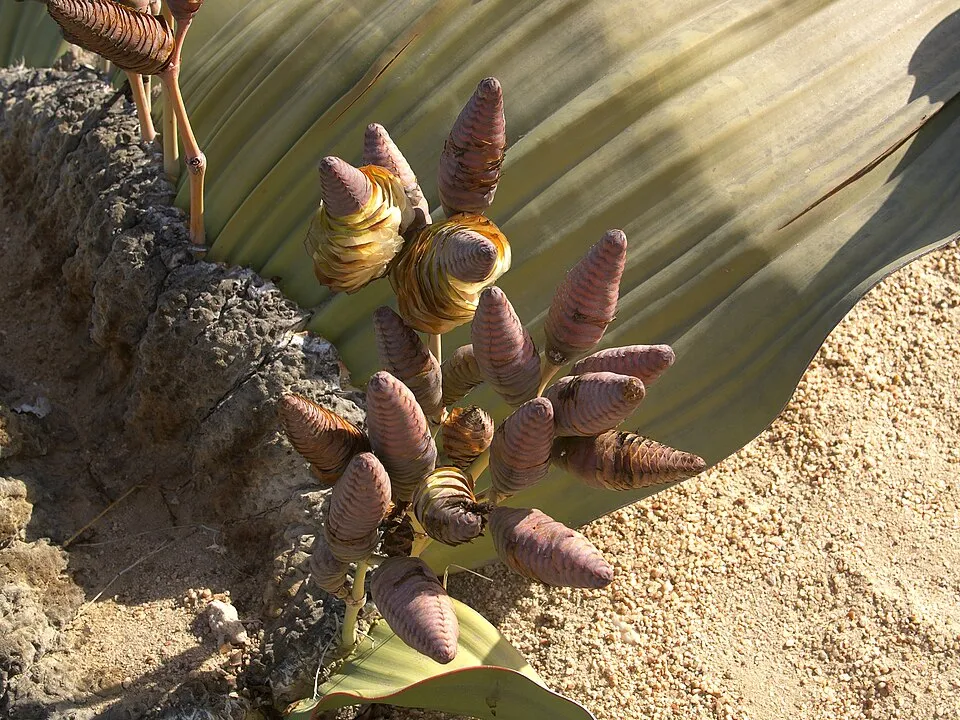
Welwitschia mirabilis, a truly singular and ancient gymnosperm, is an iconic plant endemic to the hyper-arid Namib Desert, spanning parts of Angola and Namibia. This fascinating species is celebrated for its extraordinary longevity, with individual plants often exceeding 1,000 years, and some specimens estimated to be over 1,500 to 2,000 years old. Its most distinctive morphological feature is the presence of only two massive, strap-like leaves that emerge from a robust, woody, often cork-textured stem.
These leaves grow continuously from their basal meristem throughout the plant's entire life, gradually splitting and fraying at the edges to create a dramatic, almost alien-like appearance that can cover a significant ground area. The stem itself is stout and subterranean for much of its life, with only the crown and leaves visible above the sandy, gravelly soils where it thrives. Welwitschia is a dioecious plant, meaning it has separate male and female individuals, each producing cone-like structures: males bear pollen cones, while females develop seed cones.
As a member of the Gnetophyta division, it holds a unique evolutionary position, often referred to as a 'living fossil' due to its ancient lineage and relatively unchanged form over millions of years, offering profound insights into plant evolution.
Trusted Scientific References
1. Authoritative external sources for Welwitschia mirabilis
1.1 Wikipedia — Welwitschia mirabilis
1.2 Kew POWO (Plants of the World Online)
1.3 PubMed — peer-reviewed research
1.4 NCBI Taxonomy Browser
1.5 GBIF — Global Biodiversity
1.6Welwitschia Mirabilis should be interpreted through verified botanical identity, practical care, and responsible safety language. This recovery note adds the missing context needed for a complete profile: match light to the plant's habit, use well-drained soil, water according to season, and avoid unsupported medicinal or edible claims. For publishing, the plant can be presented as a source-backed indoor plant with clear care guidance, common problem diagnosis, and conservative safety wording.
1.1.Welwitschia Mirabilis — Notable Characteristics
- ✓Extreme Longevity — Individuals can live for over 1,500 years, making it one of the longest-living plants.
- ✓Two Indefinite Leaves — Produces only two cotyledonary leaves that grow continuously throughout its entire lifespan.
- ✓Deep Taproot System — Possesses an extensive root network that can reach deep underground water sources.
- ✓Dioecious Reproduction — Features separate male and female plants, each bearing distinct cone-like structures.
- ✓Namib Desert Endemic — Found exclusively in the hyper-arid coastal regions of Angola and Namibia.
- ✓Gnetophyta Classification — A unique member of the Gnetophyta division, considered a 'living fossil'.
- ✓Remarkable Drought Resistance — Highly adapted to survive extreme aridity, high temperatures, and fog-water absorption.
- ✓Unique Morphology — Its sprawling, tattered leaves and woody stem give it a prehistoric, alien appearance.
- ✓Slow Growth Rate — Develops very slowly, adding to its ancient and enduring character.
- ✓Ecological Keystone — Provides crucial microhabitats and shelter for various desert organisms.
1.2.Welwitschia Mirabilis — At-a-Glance Summary
- ✓Welwitschia mirabilis is an ancient, iconic gymnosperm unique to the Namib Desert.
- ✓It boasts extreme longevity, with individuals living for over a millennium.
- ✓Characterized by only two continuously growing, strap-like leaves and a deep taproot.
- ✓A master of drought resistance, exquisitely adapted to hyper-arid environments.
- ✓Primarily valued as an ornamental specimen, ecological keystone, and research subject.
- ✓Holds no established traditional or modern medicinal uses for human health.
2.Welwitschia Mirabilis — Botanical Identity
3.Welwitschia Mirabilis — Vital Statistics
4.Welwitschia Mirabilis — Botanical Features
5.Welwitschia Mirabilis — Native Range & Habitat
6.Welwitschia Mirabilis — Heritage Uses
7.Welwitschia Mirabilis — Phytochemistry
- ✓Flavonoids — Potentially present as photoprotectants and antioxidants, essential for mitigating UV radiation and oxidative stress in its desert habitat; specific flavonoid types are yet to be extensively identified.
- ✓Terpenoids — May contribute to defense against herbivores and pathogens, a common role for these compounds across the plant kingdom, though their precise profile in Welwitschia remains largely uncharacterized.
- ✓Phenolic Acids — Likely involved in stress response pathways, offering antioxidant and anti-inflammatory potential, crucial for the plant's survival in harsh environmental conditions.
- ✓Lignans — Given its phylogenetic relationship to conifers within the Gnetophyta, lignans could be constituents, contributing to structural integrity and potentially defense mechanisms.
- ✓Cuticular Waxes — Abundant on the thick, leathery leaf surfaces, these complex lipids are vital for minimizing water loss through transpiration and providing a physical barrier against intense solar radiation and desiccation.
- ✓Carotenoids — Pigments responsible for some coloration in its tissues, also functioning as powerful antioxidants and photoprotectants against intense sunlight.
- ✓Tannins — May be present for their astringent properties, contributing to defense against herbivory and microbial attack, and potentially aiding in stress response.
- ✓Resins — As a gymnosperm, Welwitschia may produce resins for wound healing and protection from pests and diseases, similar to those found in other related species.
- ✓Polysaccharides — Structural components that also play a role in water retention and osmotic adjustment, critical for maintaining turgor and cellular function under drought stress.
8.Welwitschia Mirabilis — Evidence-Based Benefits
- ✓Potential for Biomimetic Research — Welwitschia's unparalleled adaptations to extreme aridity offer a rich source of inspiration for biomimetic engineering, potentially leading to novel materials or systems applicable to human health technology.
- ✓Ecological Contribution to Well-being — By serving as a foundational species and providing crucial microhabitats in the harsh Namib Desert, Welwitschia supports biodiversity, which indirectly contributes to global ecological health and human well-being.
- ✓Inspiration for Resilience and Longevity Studies — Its extreme lifespan and ability to thrive in severe stress conditions make it a valuable subject for research into cellular longevity and stress-response mechanisms, potentially informing anti-aging or resilience strategies.
- ✓Hypothetical Antioxidant Properties — Like many plants enduring environmental stress, Welwitschia may produce a range of antioxidant compounds to combat oxidative damage, a characteristic that warrants phytochemical investigation for potential human health benefits.
- ✓Potential Anti-inflammatory Compound Discovery — Extremophytes often synthesize unique secondary metabolites for survival; these compounds could possess novel anti-inflammatory properties, a field open for exploration in Welwitschia.
- ✓Stress Adaptation Gene Expression Research — Studying the genetic mechanisms behind Welwitschia's drought and UV tolerance could reveal pathways applicable to enhancing human stress resilience or developing new protective agents.
- ✓Aesthetic and Psychological Benefits — The striking and unique appearance of Welwitschia, when observed or cultivated in appropriate settings, can evoke a sense of wonder and connection to nature, offering subtle psychological benefits and stress reduction.
- ✓Educational Value for Ethnobotanical Inquiry — While direct medicinal uses are undocumented, its profound ecological significance and any unrecorded indigenous reverence could inspire deeper ethnobotanical studies into human-plant interactions in extreme environments.
8.1.Welwitschia Mirabilis — Therapeutic Indications
9.Welwitschia Mirabilis — Safety & Side Effects
9.1.Welwitschia Mirabilis — Side Effects & Warnings
- ✓No Known Direct Human Toxicity — As Welwitschia mirabilis is not traditionally consumed or applied medicinally, there are no documented direct adverse effects on human health from ingestion or topical use.
- ✓Potential for Allergic Sensitivity — While rare and unsubstantiated for this species, sensitive individuals might theoretically experience mild skin irritation upon direct contact with plant tissues, as with many plants.
- ✓Risk of Misidentification for Ingestion — Consuming any plant without absolute certainty of its identity and safety can be dangerous; this general caution applies to Welwitschia if erroneously considered edible.
- ✓Environmental Impact of Improper Cultivation — Unsuccessful attempts to cultivate Welwitschia outside its native range can lead to resource waste and contribute to unsustainable plant trade if wild populations are exploited.
- ✓Conservation Status Risks — Harvesting wild specimens or disturbing its native habitat can severely impact this protected and slow-growing species, leading to ecological damage.
- ✓Unknown Internal Toxicity — The potential internal toxicity of Welwitschia if ingested by humans or animals is largely unresearched and unknown, therefore ingestion should be strictly avoided.
9.2.Welwitschia Mirabilis — Risk Assessment
- ✓Non-Medicinal Plant — Welwitschia mirabilis is not traditionally used as a medicinal herb and should not be ingested or applied therapeutically for any health condition.
- ✓Protected Species Status — It is a legally protected species in its native range; collection from the wild is strictly prohibited and requires special permits for scientific or conservation purposes.
- ✓Handling Precaution — While not known to be toxic or irritating, general botanical handling practices are advisable, especially for individuals with known plant sensitivities.
- ✓No Documented Toxicity — There is no scientific literature documenting specific toxic compounds or adverse reactions from contact or accidental ingestion in humans or animals.
- ✓Keep Away from Children and Pets — As with any unusual or non-edible plant, it is prudent to keep Welwitschia specimens out of reach of young children and household pets to prevent accidental ingestion.
- ✓Research Use Only — Any investigation into its phytochemical properties should be conducted under controlled laboratory conditions by qualified scientific personnel.
- ✓Ecological Respect — When observing Welwitschia in its natural habitat, it is crucial to maintain a respectful distance to avoid damaging this ancient and fragile plant.
10.Welwitschia Mirabilis — Usage Guide
- ✓Ornamental Specimen Display — Primarily cultivated as a unique and striking ornamental plant in specialized botanical gardens, xeriscapes, and private collections due to its ancient and unusual morphology.
- ✓Xeriscaping and Water-Wise Landscaping — Utilized in arid garden designs to promote water conservation and create a dramatic, desert-themed aesthetic.
- ✓Ecological Indicator Species — Serves as a vital indicator of the health and unique environmental conditions of the Namib Desert ecosystem for environmental monitoring and research.
- ✓Research Subject for Extremophile Biology — Extensively studied globally for its extraordinary adaptations to extreme aridity, its remarkable longevity, and its unique evolutionary biology.
- ✓Educational Tool in Botany — Valued in educational institutions to illustrate concepts of plant evolution, extreme adaptation, and the biodiversity of harsh environments.
- ✓Conservation and Seed Banking — Seeds are collected and preserved by botanical institutions worldwide for ex-situ conservation efforts to safeguard this endangered species.
- ✓Inspiration for Biomimicry — Its survival mechanisms provide a model for biomimetic research, influencing design and engineering solutions for human challenges.
- ✓Habitat Provision in Native Range — In its natural habitat, the sprawling leaves create crucial microclimates and provide shelter for various small desert-dwelling organisms.
11.Welwitschia Mirabilis — Garden Cultivation
- ✓Arid Soil Mimicry — Requires extremely well-draining, coarse, sandy, or gravelly soil with minimal organic matter to replicate its natural desert substrate.
- ✓Infrequent Deep Watering — Highly drought-adapted, it needs minimal watering, allowing the soil to dry out completely between waterings to prevent root rot.
- ✓Full Sun Exposure — Thrives in intense, direct sunlight for the majority of the day, essential for optimal photosynthesis and robust development.
- ✓Temperature Management — Prefers hot daytime temperatures but can tolerate cooler nights; protection from frost (below 5°C) is critical, especially for young plants.
- ✓Deep Planter Requirement — Due to its extensive and deep taproot system, it necessitates a very deep pot or a purpose-built rock garden with ample vertical space.
- ✓Seed Propagation — Primarily grown from seeds, which can be challenging to germinate and require specific conditions, including warmth and consistent, but not excessive, moisture.
- ✓Slow Growth and Patience — Welwitschia is known for its exceptionally slow growth rate, requiring significant patience and long-term commitment from cultivators.
- ✓Low Humidity Preference — High atmospheric humidity can predispose the plant to fungal infections; it prefers dry air conditions characteristic of its native habitat.
Reviewed by the Flora Medical Global Botanical Review Panel
Multi-disciplinary editorial group · Botany · Ethnobotany · Herbal-medicine literature
Who reviewed this: This page was checked by the Flora Medical Global Botanical Review Panel — an in-house editorial group of botany graduates, ethnobotany researchers, and horticulture practitioners who collectively maintain our 7,000+ plant encyclopedia. Meet the team.
Our 4-step verification process
1. Taxonomic verification
Scientific names and synonyms cross-checked against Kew POWO, World Flora Online, and The Plant List.
2. Phytochemical & medicinal cross-reference
Active compounds, traditional uses, and reported activities are cross-referenced with PubMed, USDA Dr. Duke's database, and peer-reviewed ethnobotanical literature.
3. Conservation & distribution check
Distribution, ecology, and conservation status confirmed against GBIF occurrence records and the IUCN Red List.
4. Editorial & safety review
Every entry passes an editorial pass for clarity, originality, and safety notices (toxicity, contraindications, dosage caveats) before publication.
Last reviewed:
Important medical disclaimer: This content is for educational and research purposes only. It is not medical advice and is not a substitute for consultation with a licensed healthcare provider. Do not use any herb to self-treat a medical condition without professional guidance.
Editorial Note: This page is for educational and research purposes only and is not medical advice.
Written by: Flora Medical Global Editorial Team
Reviewed by: Flora Medical Global Botanical Review Panel
Last Updated: June 15, 2026





Welwitschia Mirabilis — Comments & Community Reviews
Rate this plant