
Medical Disclaimer: This content is for educational purposes only. It is not medical advice. Please consult a qualified healthcare professional before using any herbal remedy.
Safety Overview
1.White Sage — Essential Profile
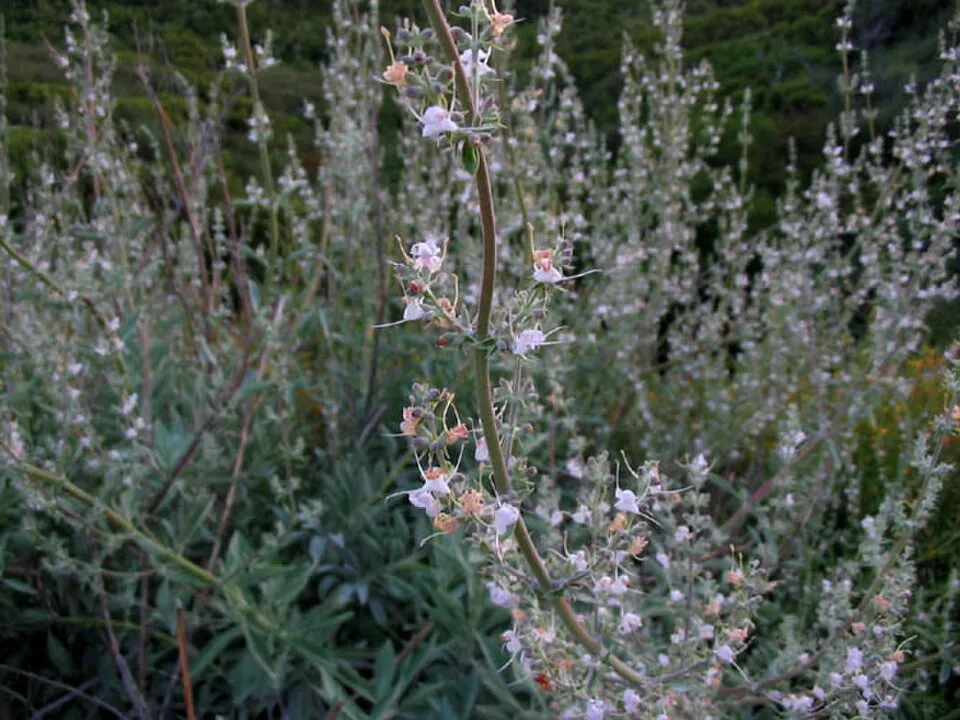
White Sage, scientifically known as Salvia apiana, is a distinctive aromatic perennial subshrub belonging to the Lamiaceae family, commonly recognized as the mint family. It is indigenous to the dry, arid regions of the southwestern United States, particularly California, and extending into northwestern Mexico, notably Baja California. This robust plant typically forms dense, rounded bushes, reaching heights of up to 2 meters.
Its most striking feature is its lanceolate to ovate leaves, which are covered in a dense layer of fine, silvery-white hairs (pubescence), giving the plant its characteristic pale appearance and contributing to its remarkable drought tolerance. These leaves are highly fragrant, releasing a potent, camphoraceous aroma when crushed. Tall, slender flower stalks emerge from the foliage, bearing numerous small, delicate white to pale lavender blossoms arranged in whorls.
These flowers are highly attractive to a variety of pollinators, including bees, which play a crucial role in the ecosystem of its native chaparral, coastal sage scrub, and oak woodland habitats. Salvia apiana thrives on dry slopes and mesas, typically at elevations below 1500 meters, preferring well-drained, often rocky soils and abundant full sun. Its ability to flourish in such challenging conditions underscores its resilience and unique botanical adaptations.
Trusted Scientific References
1. Authoritative external sources for Salvia apiana
1.1 Wikipedia — Salvia apiana
1.2 Kew POWO (Plants of the World Online)
1.3 PubMed — peer-reviewed research
1.4 NCBI Taxonomy Browser
1.5 GBIF — Global Biodiversity
1.6White Sage should be interpreted through verified botanical identity, practical care, and responsible safety language. This recovery note adds the missing context needed for a complete profile: match light to the plant's habit, use well-drained soil, water according to season, and avoid unsupported medicinal or edible claims. For publishing, the plant can be presented as a source-backed medicinal plant with clear care guidance, common problem diagnosis, and conservative safety wording.
1.1.White Sage — Notable Characteristics
- ✓Silvery — white, highly aromatic leaves that release a distinctive camphoraceous scent.
- ✓Drought — tolerant perennial subshrub, well-adapted to arid and semi-arid environments.
- ✓Native to the — Native to the chaparral, coastal sage scrub, and oak woodlands of California and Baja California.
- ✓Central to indigenous — Central to indigenous purification ceremonies, often burned as a 'smudge' for spiritual cleansing.
- ✓Contains powerful antioxidant — Contains powerful antioxidant diterpenoids, notably carnosic acid and carnosol, and volatile monoterpenoids.
- ✓Traditional uses include — Traditional uses include treating respiratory ailments, skin conditions, and as an anti-inflammatory agent.
- ✓Its white to — Its white to pale lavender blossoms attract various pollinators, supporting local ecosystems.
- ✓Demonstrates significant ethnobotanical — Demonstrates significant ethnobotanical importance and continues to be a subject of scientific research.
- ✓Possesses notable antimicrobial, anti — inflammatory, and antioxidant pharmacological activities.
- ✓Recognizable by its — Recognizable by its unique silvery foliage and upright, bushy growth habit.
1.2.White Sage — Quick Summary
- ✓White Sage (Salvia apiana) is a fragrant perennial native to the arid Southwestern U.S. and Mexico.
- ✓Revered by indigenous cultures for its profound ceremonial and medicinal properties, especially for purification.
- ✓Rich in potent chemical compounds like carnosic acid, carnosol, and camphor, contributing to its therapeutic actions.
- ✓Exhibits significant antimicrobial, anti-inflammatory, antioxidant, and neuroprotective benefits.
- ✓Traditionally used for respiratory issues, skin irritations, fevers, and as a calmative.
- ✓Requires careful and responsible usage, particularly regarding essential oil consumption and sustainable harvesting.
2.White Sage — Nomenclature & Classification
3.White Sage — Fact Sheet
4.White Sage — Botanical Features
5.White Sage — Native Range & Habitat
6.White Sage — Heritage Uses
7.White Sage — Phytochemistry
- ✓Monoterpenoids — Key volatile compounds include camphor, eucalyptol (1,8-cineole), alpha-thujone, and borneol, which are largely responsible for the plant's distinctive aroma and contribute to its antimicrobial and anti-inflammatory properties.
- ✓Diterpenoids — Prominent compounds are carnosol and carnosic acid, highly valued for their potent antioxidant, anti-inflammatory, neuroprotective, and emerging anticancer activities.
- ✓Flavonoids — A diverse group of polyphenols present in White Sage, contributing significantly to its overall antioxidant capacity and offering additional anti-inflammatory benefits.
- ✓Phenolic Acids — Including rosmarinic acid, these compounds are strong antioxidants that help protect cells from oxidative stress and have anti-inflammatory effects.
- ✓Triterpenes — Various triterpenoid compounds are found in Salvia apiana, often contributing to its anti-inflammatory and other diverse biological activities.
- ✓C23 Terpenoids — A unique class of terpenoids specific to some Salvia species, which may possess distinct bioactivity and warrant further investigation.
- ✓Essential Oils — The complex mixture of volatile organic compounds, predominantly monoterpenoids, that gives White Sage its characteristic fragrance and acts as the primary vehicle for many of its therapeutic effects.
- ✓Saponins — While less prominent than other classes, saponins may be present, contributing to some traditional uses, though specific roles are less characterized.
8.White Sage — Pharmacological Findings
- ✓Antimicrobial Activity — White Sage extracts and essential oil have demonstrated inhibitory effects against various bacteria and fungi, attributed to compounds like camphor and eucalyptol.
- ✓Anti-inflammatory Effects — Diterpenoids such as carnosol and carnosic acid found in Salvia apiana contribute to its ability to reduce inflammation, both internally and topically.
- ✓Antioxidant Potential — Rich in phenolic acids and diterpenoids, White Sage effectively scavenges free radicals, protecting cells from oxidative damage and supporting overall cellular health.
- ✓Neuroprotective Qualities — Research highlights carnosic acid's potential to protect neuronal cells from damage, suggesting benefits for cognitive health and neurodegenerative conditions.
- ✓Anticancer Potential — Preliminary studies indicate that compounds like carnosol and carnosic acid may exhibit cytotoxic effects against certain cancer cell lines.
- ✓Respiratory Support — Traditionally used as an infusion or smoked, White Sage helps alleviate symptoms of colds, coughs, and sore throats by acting as an expectorant and antimicrobial.
- ✓Fever Reduction — Indigenous communities utilized White Sage to help reduce fever, possibly due to its anti-inflammatory and diaphoretic properties.
- ✓Wound Healing and Skin Irritation Relief — Crushed leaves or poultices applied topically accelerate healing and soothe minor wounds, insect bites, and skin irritations through antiseptic and anti-inflammatory actions.
- ✓Calmative and Anxiolytic Effects — Historically used as a calmative, White Sage may influence the nervous system, potentially interacting with GABA, opioid, and cannabinoid receptors to induce relaxation.
- ✓Diuretic Properties — Traditional applications included using White Sage as a diuretic, aiding in the body's natural elimination processes.
- ✓Ceremonial Purification — The smoke from burning White Sage is central to indigenous purification rituals, believed to cleanse spaces and individuals of negative energy and promote spiritual well-being.
- ✓Cognitive Enhancement — While more research is needed specifically for S. apiana, other Salvia species are known for their cognitive-enhancing properties, suggesting a potential benefit for focus and memory.
8.1.White Sage — Health Applications
9.White Sage — Cautions & Contraindications
9.1.White Sage — Side Effects & Warnings
- ✓Allergic Reactions — Some individuals may experience skin irritation, rashes, or respiratory discomfort from direct contact with the plant or inhaling its smoke.
- ✓Thujone Toxicity — Ingesting large quantities of White Sage essential oil, which contains thujone, can be neurotoxic, causing convulsions or other adverse neurological effects.
- ✓Smoke Inhalation Risks — Prolonged or excessive inhalation of White Sage smoke, especially in poorly ventilated areas, may irritate the respiratory tract or exacerbate asthma.
- ✓Pregnancy Contraindication — Traditional use and a lack of safety data suggest avoiding White Sage during pregnancy due to potential uterine stimulating effects.
- ✓Breastfeeding Caution — Insufficient research exists regarding the safety of White Sage use during breastfeeding, thus it should be avoided.
- ✓Drug Interactions — White Sage may potentially interact with sedatives, anticonvulsants, or other medications affecting the central nervous system due to its constituents.
- ✓Skin Sensitivity — Direct application of concentrated preparations or fresh leaves may cause contact dermatitis in sensitive individuals.
9.2.White Sage — Safety Profile
- ✓Consult Healthcare Professional — Always consult a qualified healthcare provider before using White Sage, especially if pregnant, breastfeeding, or taking medications.
- ✓Pregnancy and Lactation — Avoid use during pregnancy and lactation due to the lack of sufficient safety data and potential abortifacient properties in traditional use.
- ✓Children — Not recommended for use in infants or young children without explicit guidance from a qualified health practitioner.
- ✓Essential Oil Dilution — White Sage essential oil is highly concentrated; never ingest it undiluted, and always dilute properly for topical applications.
- ✓Patch Testing — Perform a patch test on a small area of skin before widespread topical application to check for allergic reactions or sensitivity.
- ✓Sustainable Harvesting — Practice or support sustainable harvesting methods to protect wild populations of White Sage, which are increasingly threatened.
- ✓Dosage Adherence — Strictly adhere to recommended dosages for prepared remedies to minimize the risk of adverse effects, particularly with internal use.
10.White Sage — Usage Guide
- ✓Herbal Infusion/Tea — Steep 1-2 teaspoons of dried White Sage leaves in hot water for 5-10 minutes to make a tea for respiratory ailments or as a calmative.
- ✓Smudging/Incense — Burn dried bundles of White Sage leaves for ceremonial purification, cleansing spaces, and inviting positive energy; ensure good ventilation.
- ✓Topical Poultice — Crush fresh White Sage leaves and apply directly to minor wounds, insect bites, or skin irritations for antiseptic and anti-inflammatory relief.
- ✓Tincture — Prepare an alcohol-based extract of White Sage leaves for internal use, typically 1:5 ratio in 40-60% alcohol, taken in drops.
- ✓Essential Oil Diffusion — Use a few drops of pure White Sage essential oil in a diffuser to purify air or create a calming atmosphere, but use sparingly due to potency.
- ✓Steam Inhalation — Add a few drops of White Sage essential oil or a handful of fresh leaves to a bowl of hot water and inhale the steam for respiratory congestion relief.
- ✓Herbal Bath — Add a strong infusion of White Sage to bathwater for a relaxing and cleansing soak, beneficial for skin and mind.
11.White Sage — Cultivation & Care
- ✓Climate — Thrives in Mediterranean-like climates with dry summers and mild, wet winters; tolerant of arid conditions.
- ✓Soil — Requires well-drained, sandy, or rocky soil with low to moderate fertility; avoid heavy clay soils that retain too much moisture.
- ✓Sun Exposure — Prefers full sun exposure, needing at least 6-8 hours of direct sunlight daily for optimal growth and essential oil production.
- ✓Watering — Highly drought-tolerant once established; water sparingly, allowing the soil to dry out completely between waterings, especially in winter.
- ✓Propagation — Can be propagated from seeds (which benefit from stratification) or semi-hardwood cuttings taken in spring or early summer.
- ✓Pruning — Light pruning after flowering helps maintain a compact shape and encourages new growth; avoid heavy pruning into old wood.
- ✓Pests and Diseases — Generally resistant to most pests and diseases, though overwatering can lead to root rot.
- ✓Spacing — Plant individual shrubs about 1-2 meters apart to allow for mature size and good air circulation.
Reviewed by the Flora Medical Global Botanical Review Panel
Multi-disciplinary editorial group · Botany · Ethnobotany · Herbal-medicine literature
Who reviewed this: This page was checked by the Flora Medical Global Botanical Review Panel — an in-house editorial group of botany graduates, ethnobotany researchers, and horticulture practitioners who collectively maintain our 7,000+ plant encyclopedia. Meet the team.
Our 4-step verification process
1. Taxonomic verification
Scientific names and synonyms cross-checked against Kew POWO, World Flora Online, and The Plant List.
2. Phytochemical & medicinal cross-reference
Active compounds, traditional uses, and reported activities are cross-referenced with PubMed, USDA Dr. Duke's database, and peer-reviewed ethnobotanical literature.
3. Conservation & distribution check
Distribution, ecology, and conservation status confirmed against GBIF occurrence records and the IUCN Red List.
4. Editorial & safety review
Every entry passes an editorial pass for clarity, originality, and safety notices (toxicity, contraindications, dosage caveats) before publication.
Last reviewed:
Important medical disclaimer: This content is for educational and research purposes only. It is not medical advice and is not a substitute for consultation with a licensed healthcare provider. Do not use any herb to self-treat a medical condition without professional guidance.
Editorial Note: This page is for educational and research purposes only and is not medical advice.
Written by: Flora Medical Global Editorial Team
Reviewed by: Flora Medical Global Botanical Review Panel
Last Updated: June 15, 2026





White Sage — Comments & Community Reviews
Rate this plant