
Medical Disclaimer: This content is for educational purposes only. It is not medical advice. Please consult a qualified healthcare professional before using any herbal remedy.
Safety Overview
1.Whiteheadia Bifolia — Overview
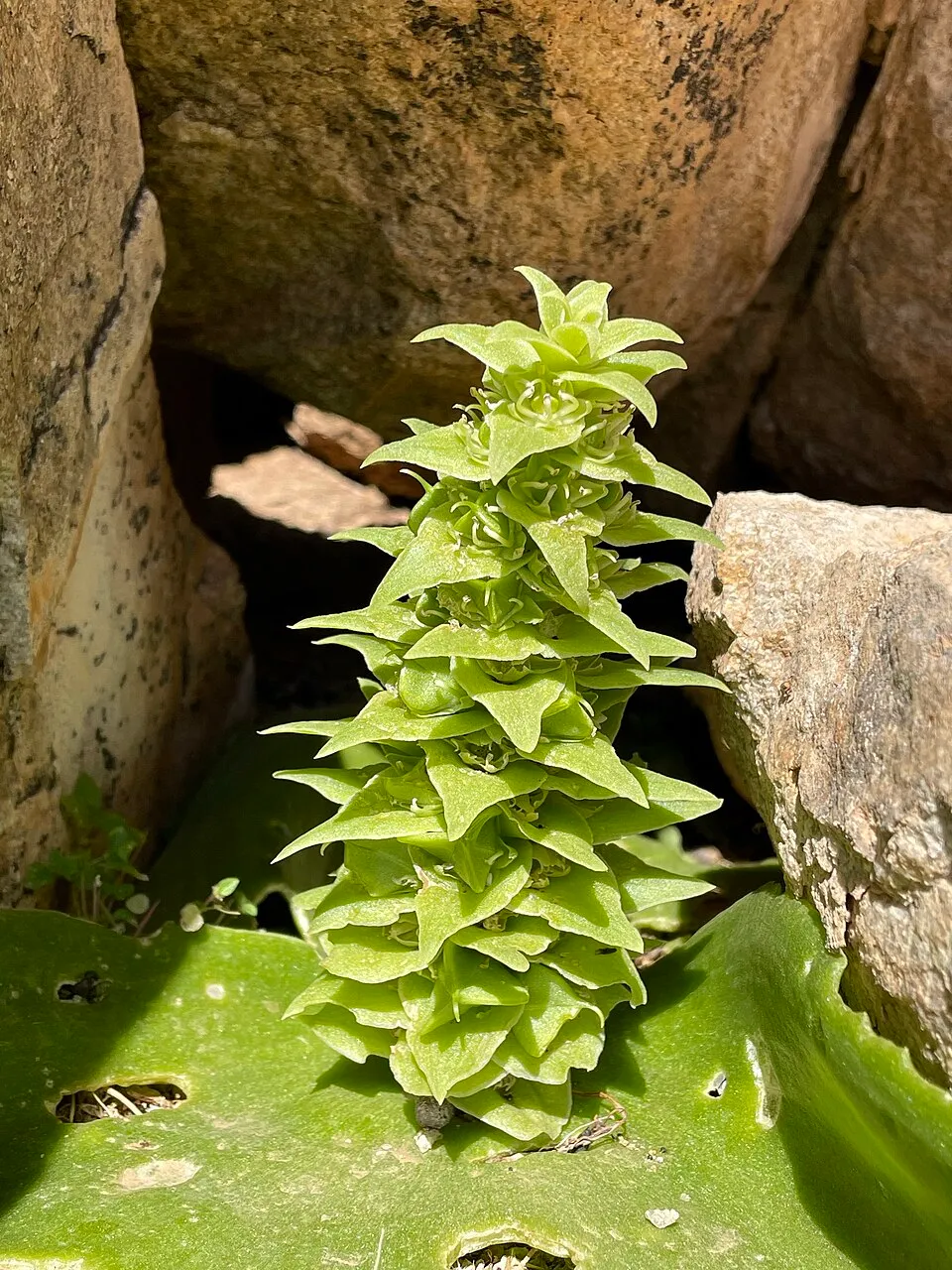
Whiteheadia Bifolia, commonly known as the Pagoda Lily, is a fascinating perennial herbaceous plant native to the arid regions of South Africa and Southern Namibia. Historically classified within the genus Whiteheadia, modern taxonomic revisions often place it within the larger Massonia genus, belonging to the Hyacinthaceae family (formerly part of Liliaceae).
This captivating plant is characterized by its unique morphology, featuring two large, flat, ground-resting leaves that can extend up to 10 cm in length, boasting a smooth, glossy texture and vibrant green coloration. From these prominent leaves emerges a distinct flower stalk, reminiscent of a hyacinth, typically reaching heights between 0.5 to 1 meter.
The inflorescence of Whiteheadia Bifolia is distinctive, consisting primarily of green bracts that support tiny, whitish-green tepals, contributing to its 'floral blandness.' This subdued coloration, coupled with geoflory (flowering close to the ground), robustness, exerted reproductive organs, and a yeasty or musty scent, are classic adaptations for non-flying mammal pollination. Indeed, Whiteheadia Bifolia is famously pollinated by the Namaqua Rock Mouse (Aethomys namaquensis), which visits the flowers, attracted by abundant, viscous nectar, particularly at night.
While other pollinators like bees and butterflies may visit, the primary role of rodents in its reproductive cycle is a significant ecological feature.
Whiteheadia Bifolia thrives in well-drained, fertile soils rich in organic matter, demonstrating remarkable adaptability to various light exposures from full sun to partial shade. Its deep root system confers considerable drought resistance, a vital trait for its native arid habitats, though consistent watering during active growth enhances vitality and flowering.
The plant's robust growth habit and ornamental appeal make it a unique specimen for specialized gardens, highlighting its resilience and intriguing botanical characteristics within its diverse natural distribution.
Trusted Scientific References
1. Authoritative external sources for Whiteheadia Bifolia
1.1 Wikipedia — Whiteheadia Bifolia
1.2 Kew POWO (Plants of the World Online)
1.3 PubMed — peer-reviewed research
1.4 NCBI Taxonomy Browser
1.5 GBIF — Global Biodiversity
1.1.Whiteheadia Bifolia — Standout Qualities
- ✓Unique Rodent Pollination — Primarily pollinated by the Namaqua Rock Mouse, a rare ecological interaction.
- ✓South African Native — Indigenous to arid regions of South Africa and Southern Namibia.
- ✓Hyacinthaceae Family Member — Part of a botanical family known for bulbs and diverse floral structures.
- ✓Ground — Resting Leaves — Features two prominent, flat, glossy leaves that lie close to the ground.
- ✓'Floral Blandness' — Produces small, whitish-green flowers with green bracts, lacking vibrant colors.
- ✓Musty/Yeasty Scent — Emits a distinct odor, particularly at night, to attract nocturnal pollinators.
- ✓Deep Root System — Confers significant drought resistance, adapting to arid native habitats.
- ✓Potential Medicinal Properties — Traditionally noted for anti-inflammatory and digestive support, though requiring caution.
- ✓Ornamental Appeal — Valued in specialized gardens for its unusual form and ecological story.
- ✓Taxonomic Reclassification — Often reclassified from Whiteheadia to the genus Massonia.
1.2.Whiteheadia Bifolia — Snapshot Summary
- ✓Whiteheadia Bifolia (Pagoda Lily) is a unique South African perennial known for its rodent pollination.
- ✓Belongs to the Hyacinthaceae family, with taxonomic reclassification often placing it under Massonia.
- ✓Offers potential traditional anti-inflammatory and digestive support, though research is limited.
- ✓Characterized by dull flowers, ground-resting leaves, and a 'yeasty' scent attracting mice.
- ✓Cultivation requires well-drained soil and moderate watering, with good drought resistance.
- ✓Exercise extreme caution with all parts due to potential toxicity associated with its plant family.
2.Whiteheadia Bifolia — Scientific Profile
3.Whiteheadia Bifolia — Botanical Stats
4.Whiteheadia Bifolia — Plant Morphology
5.Whiteheadia Bifolia — Habitat & Distribution
6.Whiteheadia Bifolia — Ethnobotanical Uses
7.Whiteheadia Bifolia — Active Compounds
- ✓Flavonoids — Compounds like quercetin derivatives and kaempferol glycosides are likely present, contributing to antioxidant and potential anti-inflammatory activities by scavenging free radicals and modulating enzyme pathways.
- ✓Saponins — Steroidal saponins, common in the Hyacinthaceae family, may contribute to the plant's potential digestive aid properties and could exhibit expectorant or mild antimicrobial actions. These compounds can also have foaming properties.
- ✓Phenolic Acids — Derivatives of caffeic acid, ferulic acid, and gallic acid are expected, acting as antioxidants and contributing to the plant's overall protective mechanisms against oxidative stress.
- ✓Polysaccharides — Complex carbohydrates, including mucilaginous gums, may be present, offering demulcent properties that could support digestive and mucosal health by forming a protective layer.
- ✓Volatile Compounds — The 'yeasty' or 'musty' scent attractive to rodent pollinators suggests the presence of specific volatile organic compounds, likely including short-chain fatty acids or sulfur-containing compounds, although specific identification is needed.
- ✓Bufadienolides — A critical class of cardiac glycosides known from several Hyacinthaceae members (e.g., Scillaren A in Drimia). While not confirmed for Whiteheadia bifolia, their potential presence necessitates extreme caution due to their potent pharmacological effects and toxicity.
- ✓Alkaloids — Trace amounts of various nitrogen-containing compounds may be present, which could contribute to diverse biological activities, though specific types and their concentrations in Whiteheadia bifolia are currently unknown.
- ✓Anthraquinones — These compounds, though less common in Hyacinthaceae, can offer laxative or antimicrobial properties. Their presence in Whiteheadia bifolia would require specific phytochemical screening.
8.Whiteheadia Bifolia — Research Insights
- ✓Anti-inflammatory Support — Whiteheadia Bifolia contains compounds that may help modulate inflammatory pathways, potentially alleviating discomfort associated with mild, chronic inflammatory conditions. Preliminary observations suggest its constituent profile could contribute to soothing internal and external irritations.
- ✓Digestive Aid — Traditionally, some plants within the wider Hyacinthaceae family have been employed for their mild demulcent or digestive properties. Whiteheadia Bifolia, while not extensively studied, is thought to potentially support digestive comfort by soothing the gastrointestinal lining.
- ✓Antioxidant Activity — Many plants are rich in phenolic compounds and flavonoids, which are potent antioxidants. Whiteheadia Bifolia may possess antioxidant properties that help combat oxidative stress and protect cellular health, contributing to overall well-being.
- ✓Potential Antimicrobial Effects — Botanical extracts often exhibit mild antimicrobial properties against certain pathogens. Research on Whiteheadia Bifolia is limited, but its secondary metabolites might offer some level of protection against microbial growth.
- ✓Immune System Modulation — Certain plant constituents can subtly influence immune responses. It is hypothesized that compounds in Whiteheadia Bifolia could play a role in supporting a balanced immune system, though specific mechanisms require further investigation.
- ✓Topical Soothing — Due to its potential anti-inflammatory profile, Whiteheadia Bifolia extracts could theoretically be used in topical applications to soothe minor skin irritations or discomfort, similar to other plant-based emollients.
- ✓Cardiovascular Support (Caution Advised) — While some members of the Hyacinthaceae family contain cardiac glycosides, which have historical use in cardiovascular medicine, their potent and often toxic nature means any such application of Whiteheadia Bifolia would require extreme caution, expert supervision, and rigorous scientific validation. This is a potential area for highly controlled research, not general use.
- ✓Respiratory Comfort — In some traditional herbal practices, plants with demulcent properties are used to alleviate mild respiratory discomfort. If Whiteheadia Bifolia possesses such compounds, it might offer a soothing effect on the respiratory tract, though this is speculative without specific research.
8.1.Whiteheadia Bifolia — Reported Uses
9.Whiteheadia Bifolia — Risk Profile
9.1.Whiteheadia Bifolia — Reported Side Effects
- ✓Gastrointestinal Upset — Ingestion, especially of raw plant parts, may lead to nausea, vomiting, abdominal pain, or diarrhea due to potential irritant compounds or saponins.
- ✓Skin Irritation — Direct contact with sap or plant extracts could cause dermatitis, itching, or allergic reactions in sensitive individuals.
- ✓Cardiac Effects — Given the presence of potent cardiac glycosides in some Hyacinthaceae species, ingestion could potentially lead to serious cardiac arrhythmias, heart palpitations, or other cardiovascular complications.
- ✓Allergic Reactions — As with any plant, individuals may experience allergic reactions ranging from mild skin rashes to more severe systemic responses.
- ✓Toxicity Concerns — The Hyacinthaceae family is known to contain poisonous species; therefore, Whiteheadia Bifolia should be treated with extreme caution and not ingested without expert guidance.
- ✓Hepatic/Renal Stress — High doses or prolonged internal use of plant compounds, especially those with unknown toxicity profiles, could potentially stress liver and kidney functions.
9.2.Whiteheadia Bifolia — Risk Assessment
- ✓Avoid Internal Consumption — Due to limited scientific data on its safety and the known toxicity of related species in the Hyacinthaceae family, internal consumption of Whiteheadia Bifolia is strongly discouraged.
- ✓Pregnancy and Lactation — Contraindicated during pregnancy and breastfeeding due to unknown effects on fetal development and infant health.
- ✓Children and Vulnerable Populations — Keep away from children and individuals with compromised health; accidental ingestion can be dangerous.
- ✓Pre-existing Conditions — Individuals with heart conditions, kidney disease, or liver disorders should strictly avoid any exposure or use.
- ✓Drug Interactions — Potential for interaction with cardiovascular medications, diuretics, or other drugs is high given the family's phytochemistry; consult a healthcare provider.
- ✓Topical Use Precautions — Perform a patch test on a small area of skin before extensive topical application to check for allergic reactions or irritation.
- ✓Professional Consultation — Always consult a qualified medical herbalist, toxicologist, or healthcare professional before considering any medicinal use of Whiteheadia Bifolia.
10.Whiteheadia Bifolia — Preparation & Dosage
- ✓Acknowledge Limited Research — It is crucial to note that specific, safe internal usage methods for Whiteheadia Bifolia are not widely established in modern herbalism due to limited research and potential toxicity within its family.
- ✓Traditional External Applications — In some folk practices, crushed leaves or bulbs might have been applied topically as poultices for minor skin irritations or swellings, always with caution for sensitivity.
- ✓Infusions for Research — For scientific study, carefully prepared infusions of aerial parts could be made to investigate antioxidant or anti-inflammatory properties, strictly for laboratory analysis.
- ✓Tincture Preparation (Expert Use Only) — Highly diluted tinctures, prepared by experienced ethnobotanists or researchers, might be used for phytochemical analysis or in highly controlled experimental settings.
- ✓Decoctions for Topical Rinse — A decoction of the plant material could potentially be used as a topical rinse for external cleansing, but patch testing for skin sensitivity is essential.
- ✓Consultation with Professionals — Any consideration of internal use, even for traditional or experimental purposes, MUST be done under the strict guidance of a qualified medical herbalist or healthcare professional, given the family's known toxic members.
- ✓Horticultural Specimen — Its primary safe 'use' is as an ornamental plant in specialized gardens, appreciated for its unique botanical features and pollination ecology.
11.Whiteheadia Bifolia — Growing Guide
- ✓Soil Preference — Thrives in well-drained, fertile soils, ideally enriched with organic matter to mimic its natural environment.
- ✓Light Requirements — Adapts well to a range of exposures, from full sun to partial shade, with optimal growth often achieved in bright, indirect light.
- ✓Watering Regimen — Requires consistent, regular watering during its active growing season, but is drought-resistant due to a deep root system; reduce watering significantly during dormancy.
- ✓Temperature and Climate — Prefers tropical to subtropical conditions, but can tolerate arid environments; protect from extreme cold or frost.
- ✓Fertilization — Benefits from nutrient-rich environments; apply a balanced, slow-release fertilizer during the growing season to enhance vitality.
- ✓Propagation — Primarily propagated from seeds or by careful division of offsets from mature bulbs, ensuring minimal root disturbance.
- ✓Bulb Management — Some species in the family are best grown with bulbs partially exposed, others buried; for Whiteheadia, plant bulbs just below the soil surface in a sandy loam mixture.
- ✓Pest and Disease Control — Generally robust, but monitor for common bulb pests and fungal issues if drainage is poor.
Reviewed by the Flora Medical Global Botanical Review Panel
Multi-disciplinary editorial group · Botany · Ethnobotany · Herbal-medicine literature
Who reviewed this: This page was checked by the Flora Medical Global Botanical Review Panel — an in-house editorial group of botany graduates, ethnobotany researchers, and horticulture practitioners who collectively maintain our 7,000+ plant encyclopedia. Meet the team.
Our 4-step verification process
1. Taxonomic verification
Scientific names and synonyms cross-checked against Kew POWO, World Flora Online, and The Plant List.
2. Phytochemical & medicinal cross-reference
Active compounds, traditional uses, and reported activities are cross-referenced with PubMed, USDA Dr. Duke's database, and peer-reviewed ethnobotanical literature.
3. Conservation & distribution check
Distribution, ecology, and conservation status confirmed against GBIF occurrence records and the IUCN Red List.
4. Editorial & safety review
Every entry passes an editorial pass for clarity, originality, and safety notices (toxicity, contraindications, dosage caveats) before publication.
Last reviewed:
Important medical disclaimer: This content is for educational and research purposes only. It is not medical advice and is not a substitute for consultation with a licensed healthcare provider. Do not use any herb to self-treat a medical condition without professional guidance.
Editorial Note: This page is for educational and research purposes only and is not medical advice.
Written by: Flora Medical Global Editorial Team
Reviewed by: Flora Medical Global Botanical Review Panel
Last Updated: June 15, 2026





Whiteheadia Bifolia — Comments & Community Reviews
Rate this plant