
Medical Disclaimer: This content is for educational purposes only. It is not medical advice. Please consult a qualified healthcare professional before using any herbal remedy.
Safety Overview
1.Yohimbe — Essential Profile
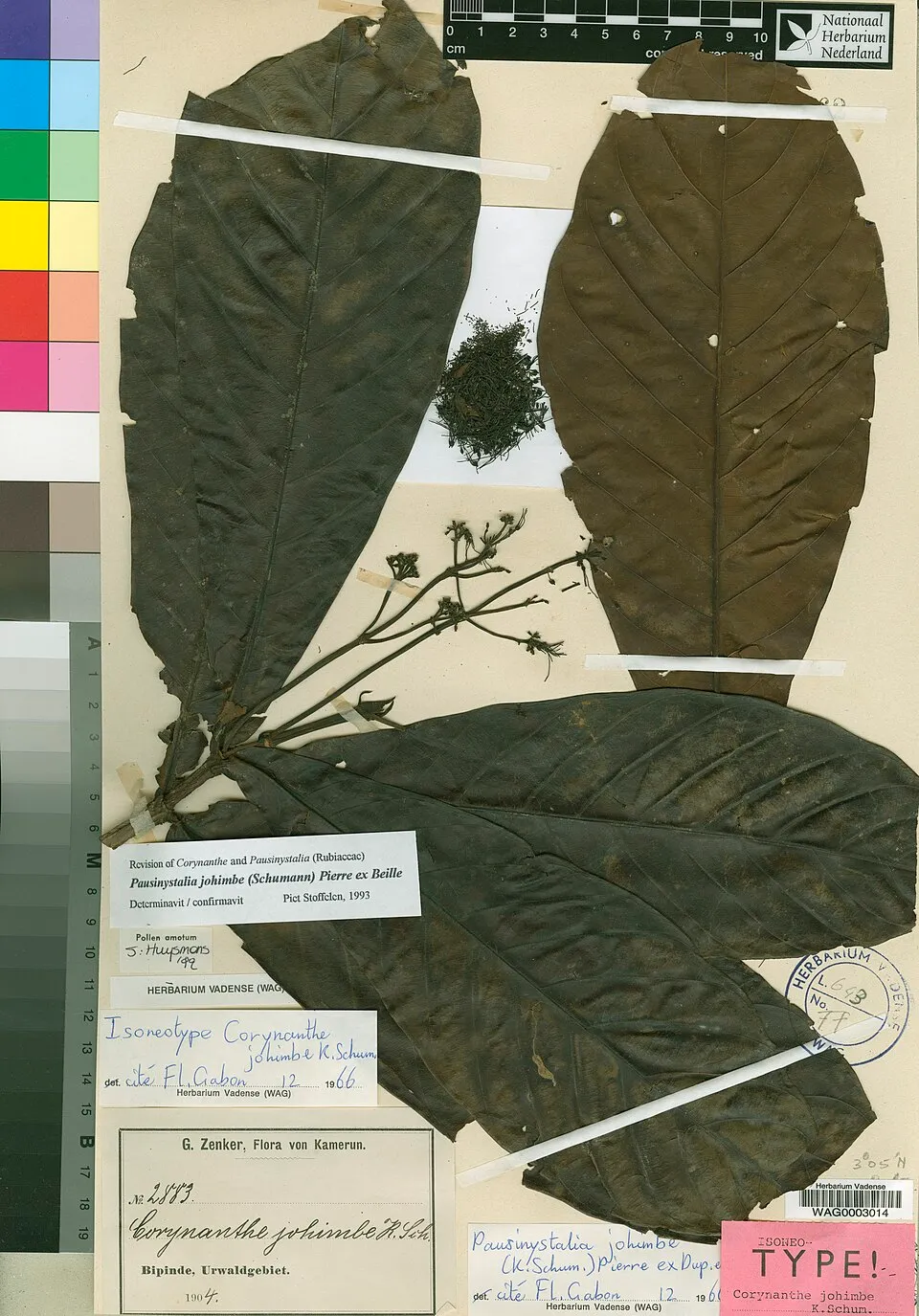
Yohimbe, scientifically known as Pausinystalia yohimbe, is an impressive evergreen tree belonging to the Rubiaceae family, renowned for its medicinal bark. Native to the dense rainforests of West and Central Africa, particularly found in countries like Cameroon, Gabon, Congo, and Nigeria, it thrives in humid, tropical environments. The tree typically grows to a moderate height, often reaching up to 30 meters, characterized by a straight, slender trunk and a dense canopy of dark green, glossy leaves.
Its bark, the primary source of its therapeutic compounds, is rough and fissured, varying in color from grey to reddish-brown, and is traditionally harvested from mature trees. The leaves are opposite, simple, and ovate to elliptical, contributing to its lush appearance in its natural habitat. Small, inconspicuous flowers develop into woody capsules containing winged seeds, facilitating dispersal.
Taxonomically, it is classified within the genus Pausinystalia, which is part of the extensive coffee family, Rubiaceae, known for many economically and medicinally important species. Its distribution is confined to specific ecological niches within the African tropical belt, making it a precious and often vulnerable resource when over-harvested.
Trusted Scientific References
1. Authoritative external sources for Pausinystalia yohimbe
1.1 Wikipedia — Pausinystalia yohimbe
1.2 Kew POWO (Plants of the World Online)
1.3 PubMed — peer-reviewed research
1.4 NCBI Taxonomy Browser
1.5 GBIF — Global Biodiversity
1.6Yohimbe should be interpreted through verified botanical identity, practical care, and responsible safety language. This recovery note adds the missing context needed for a complete profile: match light to the plant's habit, use well-drained soil, water according to season, and avoid unsupported medicinal or edible claims. For publishing, the plant can be presented as a source-backed medicinal plant with clear care guidance, common problem diagnosis, and conservative safety wording.
1.1.Yohimbe — Notable Characteristics
- ✓Botanical Origin — Native to the rainforests of West and Central Africa.
- ✓Active Compound — Contains the potent indole alkaloid yohimbine.
- ✓Traditional Use — Historically revered as an aphrodisiac and stimulant in African traditional medicine.
- ✓Modern Application — Primarily studied for treating erectile dysfunction and sexual side effects from antidepressants.
- ✓Pharmacological Action — Functions as an alpha-2 adrenergic receptor blocker, increasing norepinephrine.
- ✓Cardiovascular Impact — Known to significantly raise heart rate and blood pressure.
- ✓Neurological Effects — Can induce anxiety, nervousness, and in severe cases, psychosis.
- ✓High — Risk Profile — Classified as possibly unsafe without medical supervision due to severe adverse effects.
- ✓Multiple Contraindications — Unsuitable for individuals with heart, kidney, liver disease, or mental health conditions.
- ✓Extensive Drug Interactions — Interacts dangerously with a wide range of pharmaceutical medications.
1.2.Yohimbe — Snapshot Summary
- ✓Potent West African bark historically used as an aphrodisiac.
- ✓Contains yohimbine, a strong alpha-2 adrenergic receptor antagonist.
- ✓Primarily investigated for erectile dysfunction and antidepressant-induced sexual dysfunction.
- ✓Associated with significant cardiovascular (e.g., high blood pressure, heart rate) and neurological (e.g., anxiety, psychosis) side effects.
- ✓Requires strict medical supervision and is contraindicated for many pre-existing health conditions.
- ✓Not suitable for general wellness due to its high-risk safety profile and numerous drug interactions.
2.Yohimbe — Nomenclature & Classification
3.Yohimbe — Fact Sheet
4.Yohimbe — Physical Description
5.Yohimbe — Origin & Spread
6.Yohimbe — Heritage Uses
7.Yohimbe — Chemical Profile
- ✓Indole Alkaloids — The bark of Pausinystalia yohimbe is remarkably rich in indole alkaloids, which are the primary class of bioactive compounds responsible for its pharmacological effects.
- ✓Yohimbine — The most prominent and potent alkaloid, yohimbine (C21H26N2O3), acts as a selective alpha-2 adrenergic receptor antagonist, leading to increased norepinephrine release and vasodilation.
- ✓Corynanthine — An isomer of yohimbine, corynanthine is also present and contributes to the overall alkaloid profile, potentially modulating yohimbine's effects or exhibiting its own alpha-1 adrenergic antagonist activity.
- ✓Rauwolscine (Isouhimbin) — Another diastereomer of yohimbine, rauwolscine shares similar alpha-2 adrenergic blocking properties and is often found alongside yohimbine in extracts.
- ✓Ajmalicine — Also known as raubasine, this indole alkaloid is present in smaller quantities and is known for its alpha-1 adrenergic receptor antagonist and hypotensive properties.
- ✓Other Minor Alkaloids — The bark contains a complex mixture of other related indole alkaloids, such as alloyohimbine and dihydrocorynanthine, which contribute to the plant's overall phytochemical signature.
- ✓Tannins — Astringent polyphenolic compounds are present in the bark, offering antioxidant and potential anti-inflammatory properties, though their contribution to the specific medicinal effects is less prominent than alkaloids.
- ✓Flavonoids — Various flavonoid glycosides and aglycones may also be found, acting as secondary antioxidants and contributing to the plant's protective mechanisms.
8.Yohimbe — Scientific Evidence
- ✓Erectile Dysfunction Support — Yohimbe's primary active compound, yohimbine, acts as an alpha-2 adrenergic receptor antagonist, which can increase blood flow and nerve impulses to the penis, aiding in achieving and maintaining erections.
- ✓Aphrodisiac Properties — Traditionally, the bark has been highly valued in West African cultures as a potent aphrodisiac, believed to enhance libido and sexual desire.
- ✓Antidepressant-induced Sexual Dysfunction — Yohimbine has been studied for its potential to counteract the sexual side effects, such as reduced libido and anorgasmia, caused by certain antidepressant medications like SSRIs.
- ✓Vasodilation — By blocking alpha-2 adrenergic receptors, yohimbine promotes the dilation of blood vessels, which can improve circulation in various parts of the body.
- ✓Mood Enhancement — Some traditional uses and limited modern claims suggest a potential for mood elevation by influencing neurotransmitter activity, though scientific evidence for this is weak and often overshadowed by side effects.
- ✓Athletic Performance Enhancement — Speculative claims suggest yohimbe may aid in fat metabolism and energy expenditure, potentially contributing to athletic performance or weight management, but robust scientific evidence is lacking and safety concerns are high.
- ✓Norepinephrine Release — Its mechanism of action involves increasing the release of norepinephrine, a neurotransmitter that plays a role in alertness, arousal, and blood pressure regulation.
- ✓Sympathomimetic Effects — Yohimbe can stimulate the sympathetic nervous system, leading to effects such as increased heart rate and blood pressure, which are central to its physiological impact.
8.1.Yohimbe — Indications & Uses
9.Yohimbe — Safety Considerations
9.1.Yohimbe — Reported Side Effects
- ✓Cardiovascular Issues — Can cause severe hypertension, tachycardia (rapid heart rate), irregular heartbeat, and potentially lead to heart attack or stroke.
- ✓Neurological Effects — May induce anxiety, nervousness, agitation, tremors, dizziness, insomnia, and in some cases, trigger panic attacks or psychosis.
- ✓Gastrointestinal Distress — Common adverse effects include nausea, vomiting, stomach upset, and diarrhea.
- ✓Renal and Hepatic Complications — Can exacerbate kidney disease by slowing urine flow and potentially impact liver function, especially in individuals with pre-existing conditions.
- ✓Blood Clotting Impairment — May inhibit blood clotting, increasing the risk of bruising and bleeding, particularly when combined with anticoagulant medications.
- ✓Postural Hypotension — Paradoxically, in some individuals or upon cessation, it can lead to a sudden drop in blood pressure when standing up.
- ✓Allergic Reactions — Although rare, allergic reactions manifesting as skin rashes or itching can occur.
9.2.Yohimbe — Safety Profile
- ✓Medical Supervision Required — Yohimbe is considered possibly unsafe and should only be used under strict medical supervision due to its potent effects and significant risks.
- ✓Pregnancy and Breastfeeding Contraindicated — It is likely unsafe during pregnancy as it may affect the uterus and harm the unborn child; also contraindicated during breastfeeding.
- ✓Severe Contraindications — Absolutely avoided by individuals with heart disease, high blood pressure, kidney disease, liver disease, anxiety disorders, panic disorder, PTSD, or schizophrenia.
- ✓Surgical Precautions — Discontinue use at least two weeks before any scheduled surgery due to its potential to increase bleeding risk.
- ✓Extensive Drug Interactions — Poses moderate to severe interaction risks with MAOIs, tricyclic antidepressants, antihypertensive drugs, stimulants, phenothiazines, and anticoagulants.
- ✓Dosage Inaccuracy Risk — Commercial yohimbe supplements frequently contain inaccurate or inconsistent amounts of yohimbine, making safe and effective dosing highly challenging.
- ✓Not for General Wellness — Due to its high-risk profile, yohimbe is not recommended for general wellness or enhancement without a specific, medically diagnosed indication and professional oversight.
10.Yohimbe — Usage Guide
- ✓Bark Decoction — Traditionally, pieces of dried yohimbe bark are boiled in water to create a decoction, which is then consumed orally.
- ✓Powdered Bark — Dried bark can be finely ground into a powder, which may be encapsulated or mixed with a liquid for ingestion.
- ✓Standardized Extracts — Modern medicinal preparations often utilize standardized extracts, typically in capsule or tablet form, ensuring a consistent concentration of yohimbine.
- ✓Tinctures — Alcoholic extracts of the bark are prepared, allowing for a concentrated liquid form that can be dosed in drops.
- ✓Expert Supervision — Due to the potent and potentially dangerous effects, any use of yohimbe or yohimbine-containing products should be strictly under the guidance of a qualified healthcare professional.
- ✓Avoid Self-Dosing — The variability in natural bark's yohimbine content and the strength of commercial supplements make self-dosing extremely risky and strongly discouraged.
- ✓Short-Term Use — If prescribed by a medical professional, yohimbe is generally recommended for short-term use only, with continuous monitoring for adverse effects.
11.Yohimbe — How to Grow
- ✓Climate — Yohimbe thrives in hot, humid tropical climates, requiring consistent warmth and high rainfall typical of its native West African rainforest habitat.
- ✓Soil Requirements — Prefers well-drained, fertile, humus-rich soils with a slightly acidic to neutral pH (5.5-7.0), mimicking its natural forest floor conditions.
- ✓Sunlight Exposure — Requires partial shade when young, maturing to tolerate full sunlight, though it often grows as an understory tree in its natural environment.
- ✓Watering — Needs abundant and consistent moisture, especially during dry seasons, but is sensitive to waterlogging, necessitating good drainage.
- ✓Propagation — Can be propagated from fresh seeds, which have a relatively short viability, or vegetatively through stem cuttings from semi-hardwood shoots.
- ✓Harvesting — The bark is harvested from mature trees, a process that must be carefully managed to ensure sustainability and prevent over-exploitation of wild populations.
- ✓Pest and Disease Management — Generally robust, but young plants can be susceptible to common tropical insect pests and fungal infections in overly damp conditions.
Reviewed by the Flora Medical Global Botanical Review Panel
Multi-disciplinary editorial group · Botany · Ethnobotany · Herbal-medicine literature
Who reviewed this: This page was checked by the Flora Medical Global Botanical Review Panel — an in-house editorial group of botany graduates, ethnobotany researchers, and horticulture practitioners who collectively maintain our 7,000+ plant encyclopedia. Meet the team.
Our 4-step verification process
1. Taxonomic verification
Scientific names and synonyms cross-checked against Kew POWO, World Flora Online, and The Plant List.
2. Phytochemical & medicinal cross-reference
Active compounds, traditional uses, and reported activities are cross-referenced with PubMed, USDA Dr. Duke's database, and peer-reviewed ethnobotanical literature.
3. Conservation & distribution check
Distribution, ecology, and conservation status confirmed against GBIF occurrence records and the IUCN Red List.
4. Editorial & safety review
Every entry passes an editorial pass for clarity, originality, and safety notices (toxicity, contraindications, dosage caveats) before publication.
Last reviewed:
Important medical disclaimer: This content is for educational and research purposes only. It is not medical advice and is not a substitute for consultation with a licensed healthcare provider. Do not use any herb to self-treat a medical condition without professional guidance.
Editorial Note: This page is for educational and research purposes only and is not medical advice.
Written by: Flora Medical Global Editorial Team
Reviewed by: Flora Medical Global Botanical Review Panel
Last Updated: June 15, 2026





Yohimbe — Comments & Community Reviews
Rate this plant