Bloodwort: Benefits, Uses & Safety
 Flora Medical GlobalPublished: 4/10/2026Updated: 6/16/202619 min read
Editorial Disclaimer: This article is for informational and educational purposes only. It is not a substitute for professional medical advice, diagnosis, or treatment. Always consult a qualified healthcare provider or certified herbalist before using any plant for medicinal purposes, especially if you are pregnant, nursing, taking medication, or have a medical condition.
01What is Bloodwort?
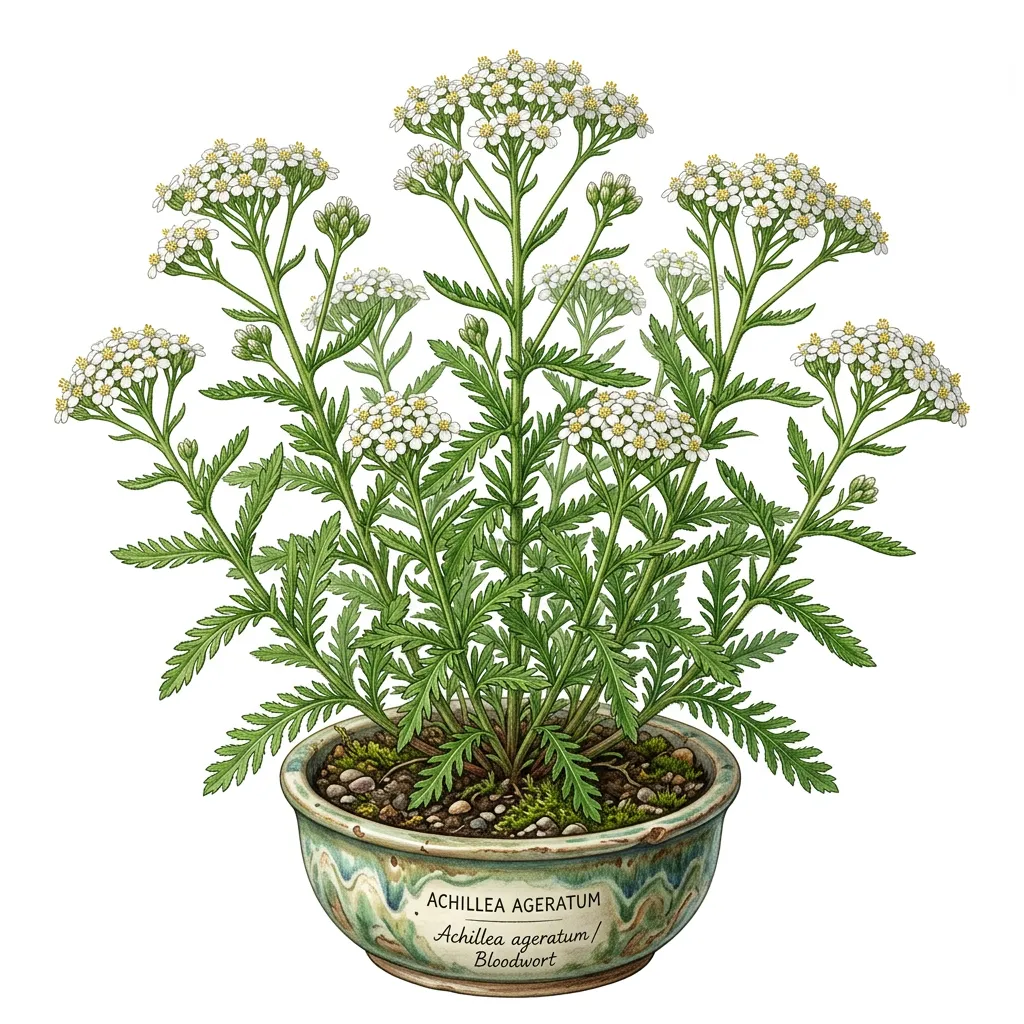
Bloodwort, scientifically designated Achillea ageratum, is a striking perennial herb thriving within the expansive Asteraceae family, often recognized for its resilience and ornamental appeal.
Most thin plant articles flatten everything into a summary. This guide does the opposite by following Bloodwort through identification, care, handling, and the questions that real readers actually ask.
The aim is simple: make the article detailed enough for serious readers while keeping the structure clear enough for fast scanning and confident decision-making.
- Achillea ageratum, or Bloodwort, is a Mediterranean perennial known for its feathery leaves and bright yellow flowers.
- Traditionally used for wound healing, digestive issues, inflammation, and as an antispasmodic.
- Rich in flavonoids, terpenoids, and alkamides, contributing to its medicinal properties.
- Requires well-drained soil and full sun, demonstrating resilience in harsh environments.
- Avoid during pregnancy and if allergic to the Asteraceae family
- Consult a professional for safe use.
02Botanical Identity of Bloodwort
Bloodwort should be anchored to the correct taxonomic identity before any discussion of care, use, or safety begins.
| Common name | Bloodwort |
|---|---|
| Scientific name | Achillea ageratumW |
| Family | Asteraceae |
| Order | Asterales |
| Genus | Achillea |
| Species epithet | ageratum |
| Author citation | L. |
| Synonyms | Achillea viscosa Lam.(https://www.gbif.org/species/3120392)Conforata ageratum., Herbe au charpentie |
| Common names | বলাডওর্ট, স্নিজওর্ট, অচিলিয়া এগেরাটাম, Bloodwort, Sneezewort, स्नीजवर्ट |
| Local names | Leberbalsam-Schafgarbe, Balsam-Schafgarbe, sötröllika, Millefoglio agerato, Achillée visqueuse, Herbe au charpentier, Achillée agérate, süße Schafgarbe, Achillee a feuilles d'ageratum |
| Origin | Mediterranean region (Southern Europe, North Africa, and Western Asia) |
| Life cycle | Perennial |
| Growth habit | Tree |
Using the accepted scientific name Achillea ageratum helps readers avoid confusion caused by old synonyms, loose common names, or inconsistent plant labels.
Family and order placement also matter because they explain recurring structural traits, likely relatives, and the kinds of mistakes readers often make when they rely on appearance alone.
03What Bloodwort Looks Like
A practical reading of the plant starts with visible structure:
- Leaf: The leaves of Bloodwort are feathery and finely divided, ranging from 4 to 10 cm in length. They are dark green, with a glabrous surface and a.
- Stem: The stem is erect, smooth, and can reach heights of 30 to 60 cm. It is usually green but may occasionally exhibit a purple hue at lower nodes.
- Root: Bloodwort has a fibrous root system, which can extend 30 cm deep. The roots are thin and wiry, providing good anchorage.
- Flower: The flowers are small, usually yellow to gold in color, approximately 5-10 mm in diameter, arranged in dense, flat-topped clusters (corymbs).
- Fruit: The fruit is an achene, measuring about 1-2 mm, flat and elongated, often used as a dispersal mechanism by the wind.
- Seed: Seeds are small, oval, and brownish in color, approximately 1 mm in length; they can remain viable for 1-2 years under proper storage conditions.
Microscopic or internal identification notes deepen the picture, especially for processed material: Both glandular and non-glandular trichomes are characteristic; non-glandular hairs are usually uniseriate and multicellular, while glandular hairs. Stomata are predominantly anomocytic, scattered across both leaf surfaces, indicating a general distribution without specific arrangement around. Powdered material reveals fragments of epidermis with stomata, numerous glandular and non-glandular trichomes, parenchymatous cells, spiral and.
In overall habit, the plant is described as Tree with a mature height around Typically 0.5-4 m and spread of Typically 0.5-3 m.
04Bloodwort: Habitat & Distribution
The native or historically recorded center of distribution for Bloodwort is Mediterranean region (Southern Europe, North Africa, and Western Asia). That origin is more than background trivia; it explains how the plant responds to heat, moisture, shade, and seasonal change.
The plant is associated with the following countries or range markers: Morocco, southern Europe.
Environmental notes in the live record add more context: Bloodwort (Achillea ageratum) is best suited to a Mediterranean climate, characterized by hot, dry summers and mild, wet winters. In terms of soil, it thrives in well-drained, sandy or loamy substrates, with a preference for slightly alkaline to neutral pH levels (6.0 to 7.5). The ideal light conditions include full sun exposure, with at least six hours of.
In cultivation terms, the main ecological clues are: Full sun to partial shade; Moderate; Well-drained; Often 6-10; species-dependent; Perennial; Tree.
Physiology data reinforce the habitat story: Highly adapted to drought and poor soil conditions, demonstrating resilience through root system development and physiological adjustments to. Achillea ageratum utilizes C3 photosynthesis, common among plants in temperate and Mediterranean climates. Exhibits moderate to high transpiration rates under ample water availability, but can reduce rates significantly under drought stress due to.
05Bloodwort: Traditional Importance
While Achillea ageratum itself might not be as extensively documented in ancient texts as some of its Achillea cousins, its genus, Achillea, boasts a rich and ancient history deeply intertwined with human culture, particularly in its native Mediterranean region. The common name "Bloodwort" itself hints at its historical medicinal applications, a theme echoed throughout the genus. Across various folk medicine.
Explore Our Platforms
 InfiniCore DataWorks
 Nex-Automata
Ethnobotanical records also show how this plant has been framed across different places: Tumor in Europe (Hartwell, J.L. 1967-71. Plants used against cancer. A survey. Lloydia 30-34.); Wound in Spain (Font Query, P. 1979. Plantas Medicinales el Dioscorides Renovado. Editorial Labor, S.A. Barcelona. 5th Ed.).
Local names help show how different communities notice and classify the plant: Leberbalsam-Schafgarbe, Balsam-Schafgarbe, sötröllika, Millefoglio agerato, Achillée visqueuse, Herbe au charpentier, Achillée agérate, süße Schafgarbe, Achillee a feuilles d'ageratum.
Traditional context matters, but it should always be separated from modern certainty. Historical use can guide questions, yet it does not automatically prove present-day clinical effectiveness.
06Medicinal Properties of Bloodwort
The main benefit themes associated with the plant include:
- Anti-inflammatory Action — Research on related Achillea species suggests the presence of flavonoids and terpenoids that may help reduce inflammation.
- Antispasmodic Properties — Compounds like flavonoids found in Bloodwort are thought to exert relaxant effects on smooth muscles, making it traditionally.
- Wound Healing Support — Historically, Achillea species, including Bloodwort, have been applied topically to minor cuts and abrasions to promote faster healing.
- Hemostatic Effects — Traditional uses highlight its ability to staunch minor bleeding, suggesting constituents that aid in blood clotting, making it valuable.
- Digestive Aid — The plant has been traditionally employed to relieve digestive discomforts such as flatulence, bloating, and dyspepsia, likely due to its.
- Diaphoretic Action — Bloodwort may promote sweating, a mechanism that can be beneficial in supporting the body's natural processes during fevers or colds.
- Diuretic Properties — Some traditional applications suggest Bloodwort acts as a mild diuretic, aiding in increased urine production and potentially assisting.
- Emmenagogic Effects — Traditionally, it has been used to stimulate menstrual flow, making it potentially useful for delayed or scanty menstruation, although.
The evidence matrix gives a more careful picture of those claims: Anti-inflammatory and Antispasmodic Effects. In vitro/Traditional. Traditional Use & Phytochemical Basis. The presence of flavonoids and terpenoids in Achillea species provides a biochemical basis for these traditional claims, often supported by in vitro studies on related species. Wound Healing and Hemostatic Properties. Traditional/Anecdotal. Historical & Ethnobotanical. Long-standing traditional use for staunching bleeding and promoting wound closure, often attributed to astringent and antiseptic qualities of the plant. Digestive Aid for Flatulence and Dyspepsia. Folk Medicine. Traditional Use. Herbal teas from Achillea species are commonly consumed to alleviate gastrointestinal discomforts, suggesting carminative and soothing actions.
The stored evidence confidence for this profile is traditional. That should shape how strongly any benefit statement is interpreted.
For medicinal content, the key discipline is to distinguish traditional use, mechanism-based plausibility, and human clinical support. Those are related ideas, but they are not the same thing.
- Anti-inflammatory Action — Research on related Achillea species suggests the presence of flavonoids and terpenoids that may help reduce inflammation.
- Antispasmodic Properties — Compounds like flavonoids found in Bloodwort are thought to exert relaxant effects on smooth muscles, making it traditionally.
- Wound Healing Support — Historically, Achillea species, including Bloodwort, have been applied topically to minor cuts and abrasions to promote faster healing.
- Hemostatic Effects — Traditional uses highlight its ability to staunch minor bleeding, suggesting constituents that aid in blood clotting, making it valuable.
- Digestive Aid — The plant has been traditionally employed to relieve digestive discomforts such as flatulence, bloating, and dyspepsia, likely due to its.
- Diaphoretic Action — Bloodwort may promote sweating, a mechanism that can be beneficial in supporting the body's natural processes during fevers or colds.
- Diuretic Properties — Some traditional applications suggest Bloodwort acts as a mild diuretic, aiding in increased urine production and potentially assisting.
- Emmenagogic Effects — Traditionally, it has been used to stimulate menstrual flow, making it potentially useful for delayed or scanty menstruation, although.
- General Tonic — In various traditional systems, Achillea species are considered tonics, believed to invigorate the body and enhance overall vitality and.
- Pain Relief — Due to its anti-inflammatory and antispasmodic properties, Bloodwort may offer a degree of relief from various types of pain, including.
07Bloodwort Phytochemistry
- The broader constituent profile includes Flavonoids — Key compounds like cynaroside and cosmosiin are present, known for their significant anti-inflammatory.
- Terpenoids — This broad category includes monoterpenes, sesquiterpenes, diterpenes, and triterpenes, contributing to.
- Proazulenes — Achillicin is a notable proazulene found in the genus, which can convert into chamazulene upon.
- Alkamides — Lipophilic nitrogen-containing compounds such as p-hydroxyphenethylamide are present, which may contribute.
- Phenolic Acids — These compounds offer antioxidant benefits, protecting cells from oxidative stress and contributing.
- Coumarins — Certain species within Achillea contain coumarins, which can have various biological activities including.
- Sterols — Plant sterols are present, which are important for cell membrane structure and can have cholesterol-lowering.
- Lignans — These phytochemicals possess antioxidant and anti-inflammatory properties, contributing to the plant's.
- Fatty Acids — Essential fatty acids and their derivatives are components of the plant's lipid profile, important for.
The detailed phytochemistry file adds these markers: Cynaroside, Flavonoid, Leaves and Flowers, Variable% dry weight; Cosmosiin, Flavonoid, Leaves and Flowers, Variable% dry weight; Achillicin, Proazulene (Sesquiterpene lactone precursor), Aerial Parts, Trace to moderate% essential oil; p-Hydroxyphenethylamide, Alkamides, Roots and Aerial Parts, Lowmg/g; Monoterpenes (e.g., Pinene, Camphene), Terpenoids, Essential Oil from Aerial Parts, Up to 50%% of essential oil; Sesquiterpenes (e.g., Germacrene D), Terpenoids, Essential Oil from Aerial Parts, Up to 30%% of essential oil.
Compound profiles also shift with plant part, age, season, processing, and storage. The chemistry of a fresh leaf, dried root, or concentrated extract should never be treated as automatically identical.
08Bloodwort Preparations & Dosage
- Recorded preparation and use methods include Herbal Tea (Infusion) — Steep 1-2 teaspoons of dried Bloodwort leaves and flowers in hot water for 5-10 minutes to create a digestive or diaphoretic tea.
- Tincture — Prepare a potent liquid extract by macerating fresh or dried plant material in alcohol for several weeks, taking small doses as directed by a herbalist.
- Poultice — Crush fresh leaves and flowers to form a paste, then apply directly to minor wounds, cuts, or skin irritations to leverage its wound-healing and astringent properties.
- Decoction — For tougher plant parts or stronger extraction, simmer the roots or aerial parts in water for 15-20 minutes, then strain and consume.
- Culinary Use — While not widely used, young leaves can sometimes be added in small quantities to salads or cooked dishes for a slightly bitter, aromatic flavor. Essential Oil (for related species) — Though less common for A. ageratum specifically, essential oils from some Achillea species are used topically in diluted form for.
- Herbal Compress — Soak a cloth in a strong infusion or decoction of Bloodwort, then apply warm to sore muscles, joints, or areas of inflammation.
The plant part most closely linked to use is recorded as Leaves, bark, roots, seeds, or berries cited in related taxa.
Edibility and processing notes matter here as well: Varies by species and plant part; verify before use.
Preparation defines the outcome. Tea, decoction, tincture, powder, fresh plant material, cooked food use, and concentrated extract cannot be discussed as if they were interchangeable.
- Identify the exact species and plant part first.
- Match the preparation to the intended use.
- Check safety, interactions, and processing details before routine use or large-scale handling.
09Bloodwort Side Effects & Safety
The first safety note is direct: Varies by species and plant part; verify before use
Specific warnings recorded for this plant include:
- Pregnancy and Lactation — Avoid use during pregnancy and breastfeeding due to potential uterine stimulant effects and lack of sufficient safety data.
- Allergic Sensitivities — Individuals with known allergies to plants in the Asteraceae family should exercise extreme caution or avoid Bloodwort entirely.
- Medical Consultation — Always consult a healthcare professional or qualified herbalist before using Bloodwort, especially if on medication or having.
- Topical Patch Test — Before extensive topical application, perform a patch test on a small skin area to check for allergic reactions or irritation.
- Children — Use in children is generally not recommended without expert medical guidance due to insufficient safety data.
- Surgical Procedures — Discontinue use at least two weeks before any scheduled surgery due to potential interactions with blood clotting.
- Dosage Adherence — Strictly follow recommended dosages and preparation guidelines to minimize the risk of adverse effects.
- Allergic Reactions — Individuals sensitive to the Asteraceae family (daisies, ragweed, chrysanthemums) may experience allergic contact dermatitis or other.
- Photosensitivity — Some users may experience increased sensitivity to sunlight, leading to sunburn or skin rashes, especially with topical application.
- Uterine Stimulation — Due to its traditional emmenagogic properties, it may stimulate uterine contractions and should be avoided during pregnancy.
Quality-control notes add another warning: Risk of adulteration with other Achillea species or morphologically similar plants from the Asteraceae family, necessitating careful botanical identification.
No plant should be described as universally safe. Identity, dose, plant part, preparation style, age, pregnancy status, medication use, allergies, and contamination risk all change the answer.
10Growing Bloodwort Successfully
The cultivation record emphasizes these practical steps:
- Sun Exposure — Plant Bloodwort in full sun for at least 6-8 hours daily to ensure vigorous growth and optimal flowering.
- Soil Requirements — Prefers well-drained soil; sandy or loamy compositions are ideal. It tolerates poor to moderately fertile soils.
- Watering — Once established, Achillea ageratum is drought-tolerant and requires minimal watering. Water deeply during prolonged dry spells.
- Propagation — Can be propagated by seeds, division of established clumps in spring or fall, or by stem cuttings taken in early summer.
- Spacing — Space plants about 30-45 cm apart to allow for proper air circulation and growth, as they can spread over time.
- Pests and Diseases — Generally resistant to most pests and diseases; however, powdery mildew can occur in overly humid conditions or poor air circulation.
The broader growth environment is described like this: Bloodwort (Achillea ageratum) is best suited to a Mediterranean climate, characterized by hot, dry summers and mild, wet winters. In terms of soil, it thrives in well-drained, sandy or loamy substrates, with a preference for slightly alkaline to neutral pH levels (6.0 to 7.5). The ideal light conditions include full sun exposure, with at least six hours of.
Planning becomes easier when these traits are kept in view: Tree; Typically 0.5-4 m; Typically 0.5-3 m.
In practice, healthy cultivation comes from systems thinking rather than one-off tricks. Site choice, drainage, timing, spacing, pruning, feeding, and observation all reinforce one another.
11Caring for Bloodwort: Light, Water & Soil
The most useful care snapshot is this: Light: Full sun to partial shade; Water: Moderate; Soil: Well-drained; USDA zone: Often 6-10; species-dependent.
Outdoors, light, water, and soil must be read together. The same watering schedule can be too much in dense clay and too little in a porous sandy bed.
| Light | Full sun to partial shade |
|---|---|
| Water | Moderate |
| Soil | Well-drained |
| USDA zone | Often 6-10; species-dependent |
Light, water, and soil should never be treated as separate checkboxes. A plant in stronger light often dries faster, soil texture changes how quickly water moves, and temperature plus humidity influence how stress appears in leaves and roots.
For Bloodwort, the safest care approach is to treat Full sun to partial shade, Moderate, and Well-drained as linked decisions rather than isolated tips. If one condition shifts, the other two usually need to be reconsidered as well.
Microclimate matters too. Indoors, room placement and airflow can matter as much as window exposure. Outdoors, reflected heat, slope, mulch, and nearby plants can change how the temperature rhythm described for the species and humidity that matches the plant type are actually experienced at plant level.
12How to Propagate Bloodwort
Documented propagation routes include Propagation of Bloodwort can be done via seeds or divisions. Seed propagation: Start seeds indoors 6-8 weeks before the last frost date. Sow on the surface of. keep moist and warm (70-75°F) until germination occurs in 10-14 days. After seedlings develop 2 true leaves, transplant them into larger pots and harden off.
Propagation works best when the parent stock is healthy, correctly identified, and handled in the right season. That sounds obvious, but it is exactly where many failures begin.
- Propagation of Bloodwort can be done via seeds or divisions. Seed propagation: Start seeds indoors 6-8 weeks before the last frost date. Sow on the surface of.
- Keep moist and warm (70-75°F) until germination occurs in 10-14 days. After seedlings develop 2 true leaves, transplant them into larger pots and harden off.
Propagation works best when the reader matches method to biology. Some plants respond readily to cuttings, some to division, some to seed, and others require more patience or more exact seasonal timing.
13Bloodwort Pests & Diseases
For medicinal species, pest pressure is not only a horticultural issue. It also affects harvest cleanliness, storage stability, and confidence in the final material.
The smartest response sequence is observation first, environmental correction second, and treatment only after the real pattern is clear.
Pest and disease management is strongest when it begins before visible damage becomes severe. Routine observation, clean handling, sensible spacing, air movement, and balanced watering reduce many problems before treatment is even needed.
When symptoms do appear on Bloodwort, the most reliable response is diagnostic rather than reactive. Yellowing, spots, wilt, chewing, and stunting can all have multiple causes, so a rushed treatment can waste time or worsen the problem.
Good troubleshooting also includes environmental correction. Pests and disease often reveal a deeper issue such as root stress, poor airflow, inconsistent watering, weak light, or exhausted soil structure.
14Bloodwort: Harvest, Storage & Processing
The plant part most often associated with harvest or processing is Leaves, bark, roots, seeds, or berries cited in related taxa.
Storage guidance from the quality-control record reads as follows: Dried plant material should be stored in airtight containers, away from light, heat, and moisture, to preserve potency and prevent degradation of active constituents for up to.
For medicinal plants, harvesting cannot be separated from processing. The right plant part, the right timing, and the right drying conditions all shape quality and safety.
Whatever the purpose, the rule is the same: harvest clean material, label it clearly, and store it in a way that preserves identity and condition.
Harvest and storage determine whether a plant's quality is preserved after it leaves the bed, pot, field, or wild source. Clean timing, correct plant part selection, and careful drying or handling all matter more than many readers expect.
15Bloodwort in Garden Design
In a home herb garden or medicinal bed, Bloodwort should be placed where harvesting is easy, labeling remains clear, and neighboring plants do not create confusion at collection time.
Companion planting and design are not only aesthetic decisions. They affect airflow, root competition, moisture sharing, harvest access, visibility, and the general logic of the planting scheme.
With Bloodwort, good placement means thinking about mature size, maintenance rhythm, and how neighboring plants change the feel and function of the space. A plant can be healthy on its own and still be poorly placed within the broader composition.
That is why the best design advice combines biology with usability. The planting should look coherent, but it should also make watering, pruning, harvest, and pest observation easier rather than harder.
16Research on Bloodwort
The evidence matrix points to several recurring themes: Anti-inflammatory and Antispasmodic Effects. In vitro/Traditional. Traditional Use & Phytochemical Basis. The presence of flavonoids and terpenoids in Achillea species provides a biochemical basis for these traditional claims, often supported by in vitro studies on related species. Wound Healing and Hemostatic Properties. Traditional/Anecdotal. Historical & Ethnobotanical. Long-standing traditional use for staunching bleeding and promoting wound closure, often attributed to astringent and antiseptic qualities of the plant. Digestive Aid for Flatulence and Dyspepsia. Folk Medicine. Traditional Use. Herbal teas from Achillea species are commonly consumed to alleviate gastrointestinal discomforts, suggesting carminative and soothing actions.
Ethnobotanical activity records add historical reference trails: Tumor — Europe [Hartwell, J.L. 1967-71. Plants used against cancer. A survey. Lloydia 30-34.]; Wound — Spain [Font Query, P. 1979. Plantas Medicinales el Dioscorides Renovado. Editorial Labor, S.A. Barcelona. 5th Ed.].
The compiled source count behind the live profile is 7. That does not guarantee certainty, but it does suggest the record has been cross-checked beyond a single note.
Analytical testing notes also strengthen the evidence base: HPLC-UV for flavonoid quantification, GC-MS for volatile oil composition, and macroscopic/microscopic examination for botanical identity are key testing methods.
A careful evidence section should say what is known, what is plausible, and what remains uncertain. Readers are better served by clear limits than by exaggerated confidence.
Evidence note: this section blends the live plant record, local ethnobotanical activity data, chemistry records, and the linked Flora Medical Global plant profile for Bloodwort.
17Choosing Quality Bloodwort
Quality markers worth checking include Flavonoids (e.g., cynaroside, cosmosiin) and specific sesquiterpene lactones are often used as chemical markers for identification and standardization.
Adulteration and substitution risk should not be ignored: Risk of adulteration with other Achillea species or morphologically similar plants from the Asteraceae family, necessitating careful botanical identification.
When buying Bloodwort, start with verified botanical identity. The label, scientific name, and the source page should agree before you judge price, size, or claimed benefits.
For living plants, inspect roots, stem firmness, foliage health, and early pest signs. For dried or processed material, look for batch clarity, clean aroma, absence of mold, and any sign that the product has been over-processed to disguise poor quality.
Buying advice should begin with identity. The label, scientific name, visible condition, and seller credibility should agree before price or convenience becomes the deciding factor.
18Common Questions About Bloodwort
What is Bloodwort best known for?
Bloodwort, scientifically designated Achillea ageratum, is a striking perennial herb thriving within the expansive Asteraceae family, often recognized for its resilience and ornamental appeal.
Is Bloodwort beginner-friendly?
That depends on the growing environment and the intended use. Some plants are easy to grow but not simple to use medicinally, while others are the opposite.
How much light does Bloodwort need?
Full sun to partial shade
How often should Bloodwort be watered?
Moderate
Can Bloodwort be propagated at home?
Yes, but the best method depends on whether the species responds best to seed, cuttings, division, offsets, or other propagation routes.
Does Bloodwort have safety concerns?
Varies by species and plant part; verify before use
What is the biggest mistake people make with Bloodwort?
The most common mistake is applying generic advice instead of matching the plant to its real environment, identity, and limits.
Where can I verify more information about Bloodwort?
Start with the Flora Medical Global plant profile: https://www.floramedicalglobal.com/plant/bloodwort
Why do sources sometimes disagree about Bloodwort?
Different references may use different synonyms, plant parts, cultivation conditions, or evidence standards. That is why taxonomy and source quality both matter.
How should I read a long guide about Bloodwort without getting overwhelmed?
Start with identity, habitat, and safety first. Once those are clear, the care, use, and research sections become much easier to interpret correctly.
19Bloodwort: Scientific References
Authoritative sources and related guides:
- Wikipedia — background reference
- PubMed — peer-reviewed studies
- Kew POWO — botanical reference
- NCBI PMC — open-access research
- WHO — global health authority
Related on Flora Medical Global
Reviewed by the Flora Medical Global Botanical Review Panel
Multi-disciplinary editorial group · Botany · Ethnobotany · Herbal-medicine literature
Who reviewed this: This page was checked by the Flora Medical Global Botanical Review Panel — an in-house editorial group of botany graduates, ethnobotany researchers, and horticulture practitioners who collectively maintain our 7,000+ plant encyclopedia. Meet the team.
Our 4-step verification process
1. Taxonomic verification
Scientific names and synonyms cross-checked against Kew POWO, World Flora Online, and The Plant List.
2. Phytochemical & medicinal cross-reference
Active compounds, traditional uses, and reported activities are cross-referenced with PubMed, USDA Dr. Duke's database, and peer-reviewed ethnobotanical literature.
3. Conservation & distribution check
Distribution, ecology, and conservation status confirmed against GBIF occurrence records and the IUCN Red List.
4. Editorial & safety review
Every entry passes an editorial pass for clarity, originality, and safety notices (toxicity, contraindications, dosage caveats) before publication.
Last reviewed:
Important medical disclaimer: This content is for educational and research purposes only. It is not medical advice and is not a substitute for consultation with a licensed healthcare provider. Do not use any herb to self-treat a medical condition without professional guidance.
Explore Our Platforms
Comments (0)
No comments yet. Be the first!